Where do I start with kanji?
Start with characters that repeatedly appear in real Japanese words, and learn to recognize them before demanding perfect handwriting. That is how to start learning kanji without spending your first months memorizing a school sequence designed for native-speaking children.
Kanji, 漢字, kanji, literally “Chinese characters,” are only one part of Japanese writing. If hiragana and katakana are still unfamiliar, begin with Hiragana, Katakana, Kanji: How Japanese Writing Works, which explains what each script does. You need kana to read kanji pronunciations, grammatical endings, and the small words surrounding a character.
Should I learn kanji in the Japanese school order?
Not automatically. Japan’s grade-by-grade allocation serves children who already speak Japanese, understand thousands of words, and spend the school day reading and writing in the language. An adult beginner has a different problem: you are acquiring vocabulary, pronunciation, grammar, and a writing system at the same time.
Japan’s Ministry of Education assigns 1,026 kanji across the six years of elementary school under the current curriculum. The first-grade allocation contains 80 characters, followed by 160 in second grade. Those are official teaching targets for Japanese schools, not a scientifically optimized sequence for an English-speaking adult.
The school order has real strengths. It introduces many simple, productive characters such as 一 “one,” 人 “person,” 日 “day,” and 山 “mountain.” It also supports handwriting and children’s textbooks. But it can prioritize characters useful in elementary lessons before characters an adult repeatedly encounters in transportation, work, news, menus, interfaces, or addresses.
Use the school list as a coverage check, not as your only ordering rule. A frequency-led plan asks a more useful first question: Which character will help you recognize the greatest number of words in the material you actually read?
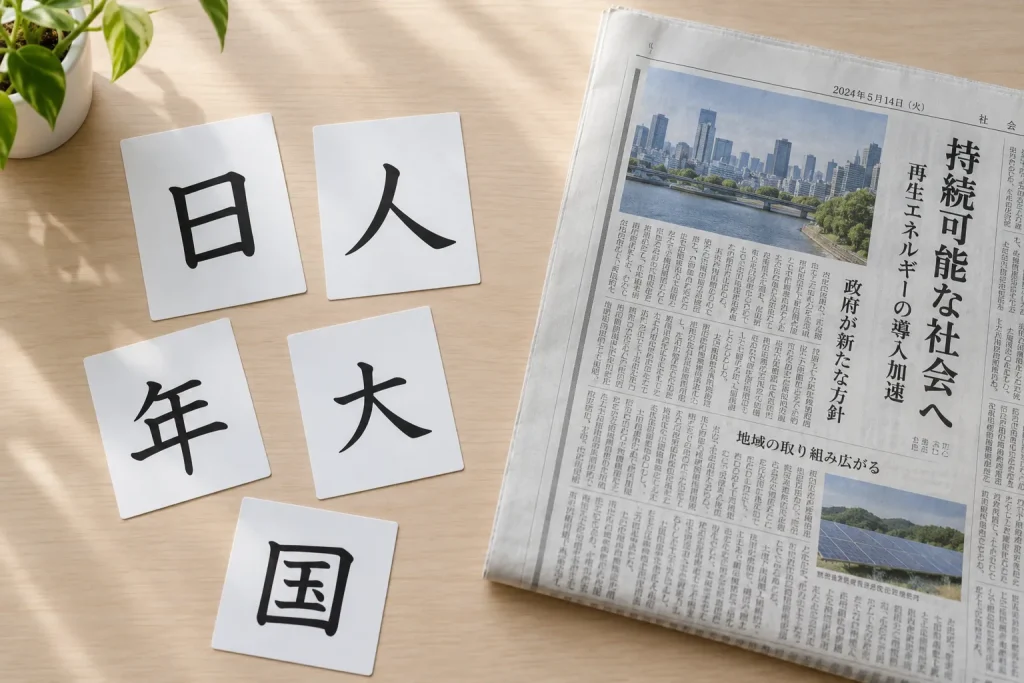
Does “most common” mean the same thing everywhere?
No. A kanji’s frequency changes with the corpus—the body of text being counted. Newspapers overrepresent politics, institutions, dates, and place names. Fiction contains more dialogue and descriptions of people. Websites, train notices, restaurant menus, and phone interfaces produce different rankings again.
The National Institute for Japanese Language and Linguistics created the Balanced Corpus of Contemporary Written Japanese, or BCCWJ, from 104.3 million words sampled across books, magazines, newspapers, business reports, textbooks, legal documents, blogs, and online forums. Its main texts date from 1986 through 2006. That breadth makes it a more defensible starting point than a list drawn only from newspapers, although it cannot perfectly represent what you will read in 2026.
A useful kanji frequency list therefore needs two filters:
- corpus frequency, so common written characters rise early;
- beginner usefulness, so you can attach those characters to words you can understand and use.
Raw frequency alone can put abstract characters ahead of concrete ones you need immediately. It may also count the same character inside many advanced compounds. The sensible first hundred is therefore frequency-led, not mechanically copied from a frequency column.
Which 100 kanji should I learn first?
The set below favors characters common across general modern writing while keeping them teachable through ordinary beginner vocabulary. It is not an official JLPT list, a new government standard, or a claim that the order remains identical in every corpus. Treat it as a practical reading syllabus.
| Group | Characters | Useful territory |
|---|---|---|
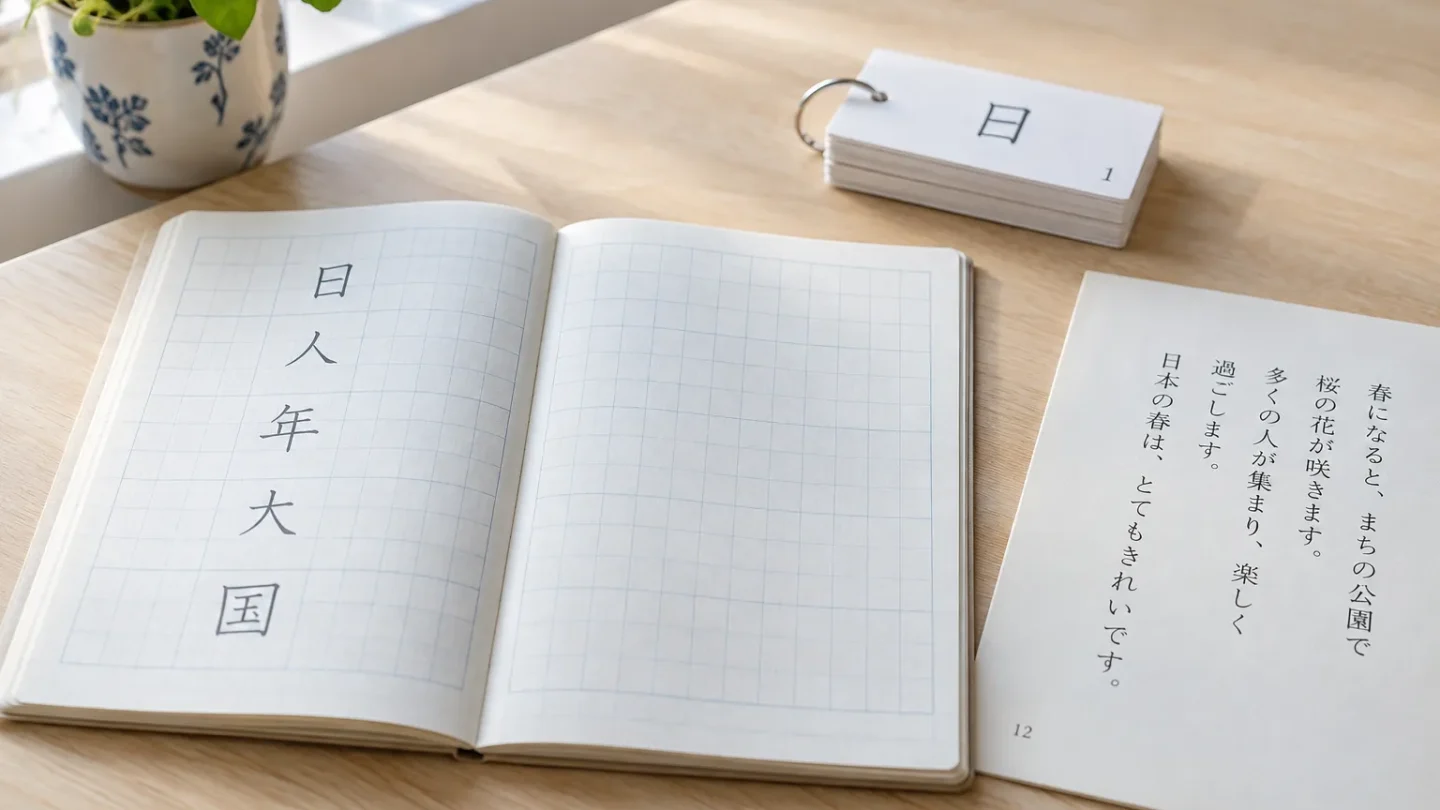
| 1–10 | 日 一 人 年 大 十 二 本 中 国 | dates, quantities, people, Japan |
| 11–20 | 会 出 三 時 行 見 月 分 前 生 | meetings, movement, time, seeing |
| 21–30 | 五 間 上 東 四 今 金 入 学 高 | position, time, school, money |
| 31–40 | 円 子 外 八 六 下 来 気 小 七 | prices, direction, size, arrival |
| 41–50 | 山 話 女 北 午 百 書 先 名 川 | places, people, speech, writing |
| 51–60 | 千 水 半 男 西 電 校 語 土 木 | numbers, directions, language |
| 61–70 | 聞 食 車 何 南 万 毎 白 天 母 | food, transport, questions, family |
| 71–80 | 火 右 読 友 左 休 父 雨 文 字 | directions, reading, basic nouns |
| 81–90 | 早 店 道 駅 社 新 場 地 手 市 | travel, shops, places, institutions |
| 91–100 | 力 立 田 思 家 世 多 正 安 知 | actions, home, thought, qualities |
Do not memorize that table as 100 isolated pictures. Each character needs a small word network. 日, for example, appears in 日本, Nihon, “Japan”; 今日, kyō, “today”; 日曜日, nichiyōbi, “Sunday”; and 毎日, mainichi, “every day.” Those words reveal several readings without requiring you to recite every dictionary reading for 日.
The first set also contains characters whose value comes from combinations. 電 “electricity” and 車 “vehicle” give 電車, densha, “train.” 学 “study” and 校 “school building” give 学校, gakkō, “school.” A character learned through two or three recurring words becomes usable knowledge; a character learned only with an English keyword remains a flashcard answer.
The unit you read is usually a word, not an isolated kanji. The character is the reusable component inside that word.
Do I learn the meaning or the pronunciation first?
Learn a recognizable core meaning and one real word together. A gloss such as “enter” helps you distinguish 入 from 人, but the word 入る, hairu, “to enter,” tells you how the character behaves in Japanese.
Avoid attaching one fixed English word to every character. 上 can express ideas including “up,” “above,” and “to rise,” but its pronunciation changes across 上, ue, “above”; 上げる, ageru, “to raise”; and 上手, jōzu, “skillful.” The English keyword is an index tab, not the content of the file.
For each new character, record:
- the character in a readable typeface;
- one short meaning cue;
- one high-frequency word;
- the word’s kana pronunciation;
- one short sentence containing that word.
This makes common Japanese kanji part of vocabulary from the beginning. It also prevents the familiar failure mode in which you recognize a character on a card but cannot read it inside a sentence.
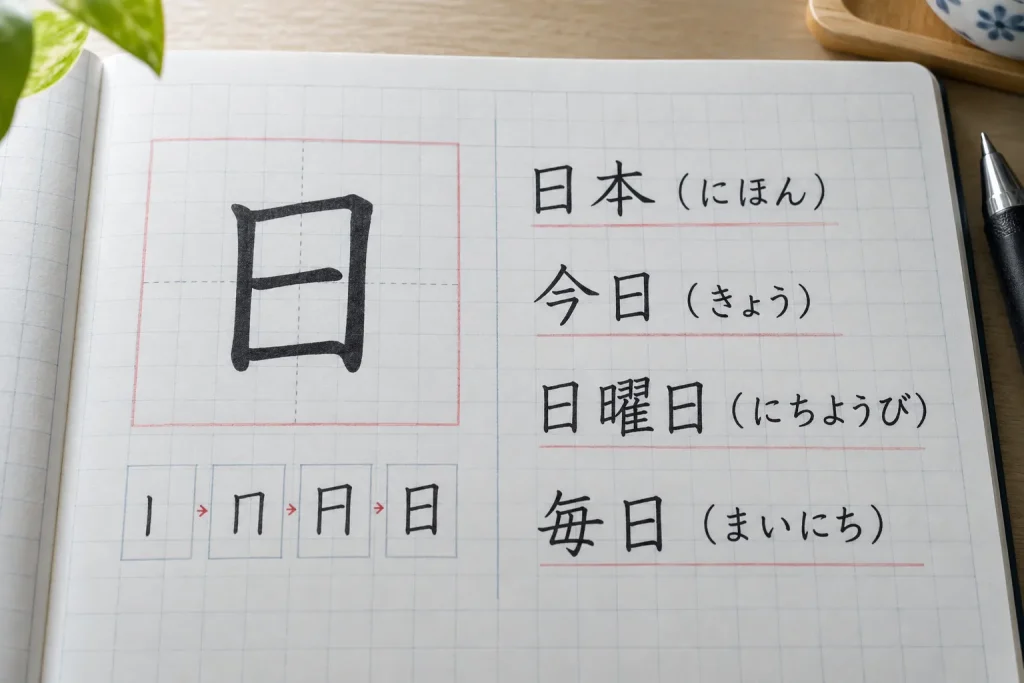
Why does one kanji have several readings?
Japanese borrowed Chinese characters across different periods while retaining native Japanese words. The result is a broad distinction between 音読み, on’yomi, literally “sound reading,” derived historically from Chinese pronunciations, and 訓読み, kun’yomi, literally “explanatory reading,” associated with native Japanese words.
That distinction describes the system, but it does not give you a dependable button to press. Compounds often use on’yomi, while a single character with a kana ending often uses kun’yomi, yet common words produce enough exceptions that guessing remains risky.
Consider 生. It appears in 学生, gakusei, “student”; 先生, sensei, “teacher”; 生まれる, umareru, “to be born”; and 生ビール, nama bīru, “draft beer.” Memorizing a long reading inventory—sei, shō, nama, i, u, ha, and more—does not tell you which pronunciation a particular word requires.
Learn 学生 as gakusei, not as “学 can be gaku, and 生 can be sei, therefore perhaps this word is gakusei.” The analysis becomes useful later, after you already know several words and begin seeing recurring sound patterns. At the beginning, the complete word is the reliable unit.
Do I need to write every kanji by hand?
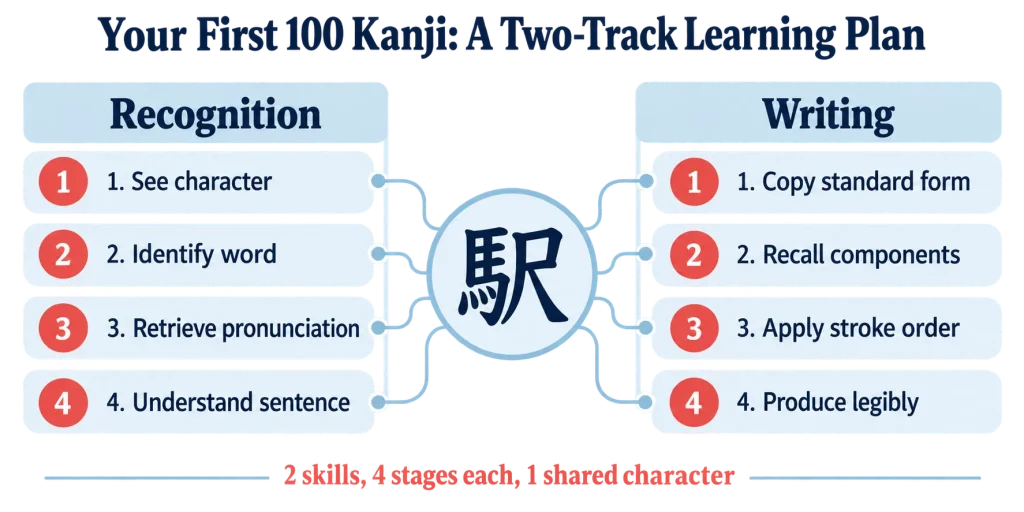
No. Reading kanji and writing kanji are related but separate skills, and forcing them to progress at the same speed wastes effort if your immediate goal is reading.
Recognition asks you to see 駅 and retrieve a useful word or meaning. Handwriting asks you to recall the entire shape, place every component, choose the correct stroke direction, and maintain legible proportions without seeing a model. Production is plainly the harder task.
Separate your targets explicitly:
| Skill | A successful result | Suitable practice |
|---|---|---|
| Recognition | You identify 駅 in a sign or sentence | Reading, matching, spaced recall |
| Word reading | You read 駅 as eki in context | Sentence cards, graded texts |
| Typing | You enter えき and select 駅 | Japanese keyboard practice |
| Copying | You reproduce 駅 from a model | Slow handwriting practice |
| Recall writing | You write 駅 without a model | Retrieval on paper |
| Calligraphic form | You control balance and brush form | Dedicated penmanship instruction |
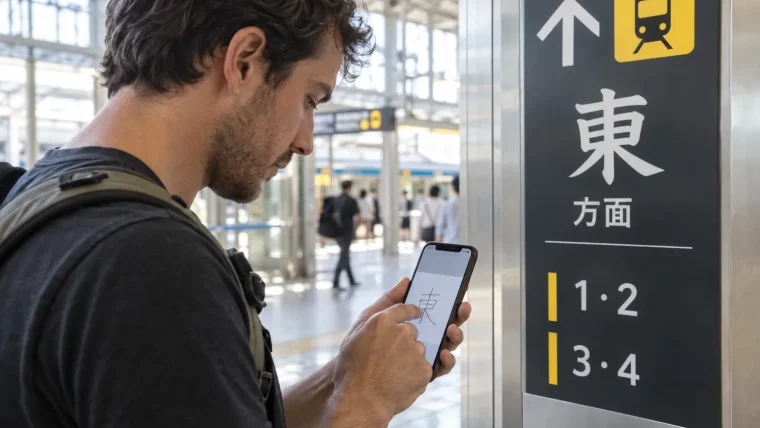
If you need to fill out handwritten forms, take classroom tests, keep a paper journal, or study calligraphy, writing deserves scheduled practice. If you mainly want to read sites, messages, subtitles, menus, and signs, recognition should advance faster. You are not cheating by learning a character you can read but cannot yet produce from memory.
Can I ignore stroke order if I mostly type?
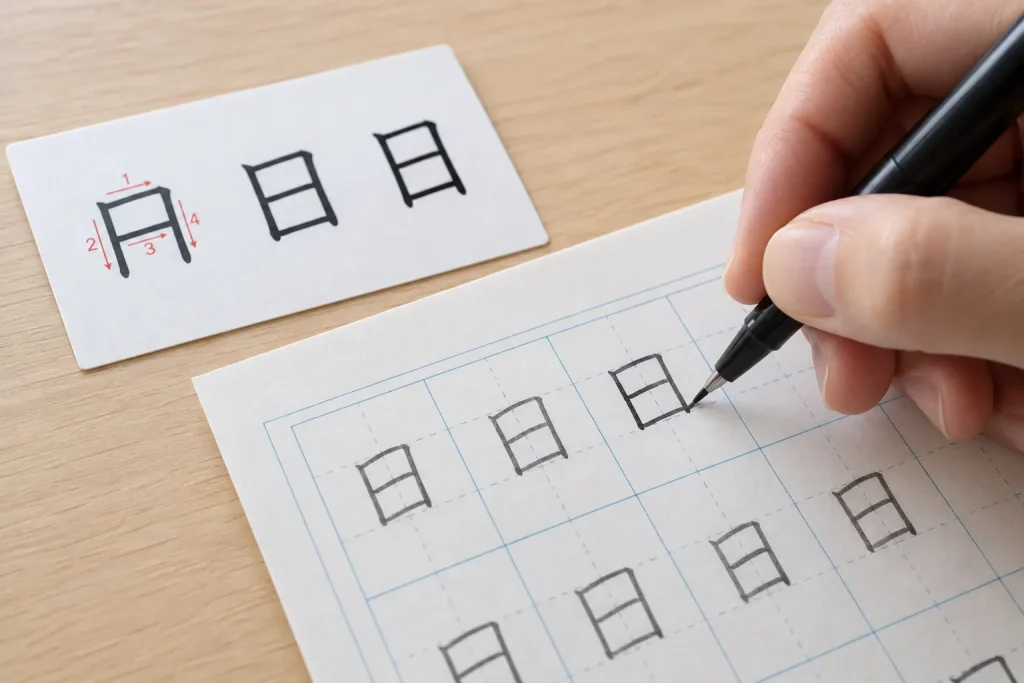
You can postpone high-volume handwriting, but you should not make stroke order random. Standard order helps components keep their recognizable shape and makes handwritten lookup more reliable. It also helps you interpret other people’s compressed handwriting because strokes join and shorten in predictable ways.
You do not need to write every new word repeatedly. Write a character slowly a few times while naming its components, then test whether you can recognize it in different fonts and contexts. If it belongs only to your reading vocabulary, stop there.
What Breaks When You Write Kanji Out of Order explains the cases where incorrect order damages proportion, search accuracy, and legibility. That article handles the mechanics; your decision here is simply whether the character needs recognition practice or production practice.
How many readings should I memorize for each character?
Usually none as a detached list. Memorize readings through the words you are learning, then notice patterns after several examples accumulate.
For 人, start with 人, hito, “person,” 日本人, Nihonjin, “Japanese person,” and 三人, sannin, “three people.” This immediately shows that a character’s pronunciation depends on the word and sometimes on the counter construction. The separate guide to Japanese Numbers and Counters, Made Simple covers those sound changes without turning this page into a counter chart.
A dictionary may display more readings than you need for months or years. Rare name readings, literary readings, and readings limited to one compound do not deserve equal study time. Add a reading when a useful word brings it to you.
What is the question beginners forget to ask?
Which kanji do I need to recognize but not write? This is the question beginners do not know to ask yet, and it changes the workload more than choosing between two flashcard apps.
Create two thresholds. Your recognition threshold includes any character that repeatedly blocks a text you care about. Your handwriting threshold includes characters you genuinely expect to produce without digital conversion. The recognition list should normally grow faster.
This also solves a scheduling problem. Suppose you can read 新聞, shinbun, “newspaper,” but cannot write 聞 from memory. That is not a failed character. It is a successfully acquired reading item and an unfinished—or intentionally unstarted—writing item.
Digital input reinforces the distinction. Japanese typing usually begins with kana or romanized input, after which the software proposes kanji conversions. If you still depend heavily on Latin letters, Romaji Explained: Three Systems and Which One to Use shows why spellings differ. Romaji is a useful input route, but it should not replace learning kana.
How should I study the first hundred in practice?
Work from words you can meet again. A frequency-led list supplies candidates, but your textbook, graded reader, workplace, travel plan, or favorite subject determines which candidates become urgent.
A practical study cycle looks like this:
- Select a small group from the first-hundred table.
- Attach each character to one common word you already understand.
- Read those words in short sentences.
- Test recognition from Japanese to meaning and pronunciation.
- Type the words using a Japanese keyboard.
- Handwrite only the characters that belong to your production target.
- Add another word when it reveals a useful reading or combination.
Mixing scripts is part of the work. Japanese sentences use kanji for many lexical elements, hiragana for particles and inflections, and katakana for numerous loanwords, names, and other categories. Three Scripts Doing Three Different Jobs explains why the mixture carries information rather than representing three interchangeable alphabets.
Names also require caution. Kanji name readings can be far less predictable than ordinary vocabulary, while many foreign names are normally written in katakana. For a real spelling rather than a guessed kanji invention, the name converter contains 898 checked names in katakana.
How do I know when I have really learned one?
You have learned a kanji for reading when you can understand it in familiar words inside a sentence without mentally reconstructing a mnemonic. Seeing only the character on the front of a flashcard is a weaker test because real reading includes neighboring kanji, kana endings, punctuation, and context.
Use three forms of evidence:
- you recognize the character in more than one typeface;
- you can read at least one useful word containing it;
- you still recognize it after it disappears from practice for a while.
For a writing target, add a fourth condition: you can produce a legible version without copying. Do not claim the entire character is “unknown” because handwriting lags behind, and do not claim it is fully mastered because one English keyword comes to mind.
You will eventually outgrow a universal first-hundred list. Once your reading has a clear domain, frequency within that domain becomes more valuable than general rankings. A learner reading recipes needs 食, 水, 肉, 魚, and 焼 early; someone handling train travel needs 駅, 線, 発, 着, and 乗. Personalization should happen after corpus evidence gives you a stable base, not instead of that evidence.
What should I learn after the first hundred?
Move from a fixed list to words collected from controlled reading. Keep counting recognition and handwriting separately, and promote a character into writing practice only when production has a real purpose.
Do not switch blindly to an unofficial “JLPT kanji list.” The official JLPT has not published fixed vocabulary, kanji, and grammar specifications since its 2010 revision. Its organizers say the exam is intended to measure language knowledge together with the ability to use that knowledge for communicative tasks.
Your next question is therefore not simply “What are the next 100?” It is “How much character coverage does my goal require?” How Many Kanji Do You Actually Need? answers that broader question by goal and explains why conversational ability, everyday reading, and advanced literacy require different inventories.