The number people quote is 2,136. That’s the jōyō list — the characters the Japanese government designates for general use, taught across twelve years of school, and assumed in newspapers and official documents.
It’s also the wrong number for almost everyone asking the question. What you need depends entirely on what you want to do, and the honest answers range from about thirty to several thousand. This article gives you the real thresholds and what each one buys.
The thresholds that matter
About 30: surviving a trip
If you’re visiting for two weeks and want to read the things that will actually inconvenience you, this is the whole list: 出口 exit, 入口 entrance, 男 men, 女 women, 駅 station, 円 yen, 東西南北 the four directions, open and closed, push and pull, and the numbers.
Half an hour of study, and it removes most of the friction of being illiterate in a country where the signage assumes you aren’t. Combined with a phrasebook it covers a first visit comfortably.
About 100: menus, signs and prices
The point at which restaurant menus start to open up: 肉 meat, 魚 fish, 鶏 chicken, 豚 pork, 牛 beef, 生 raw, 焼 grilled, 揚 fried, plus the counters and the days of the week. This is also enough to read a train timetable and a price tag with confidence.
About 500: getting around unaided
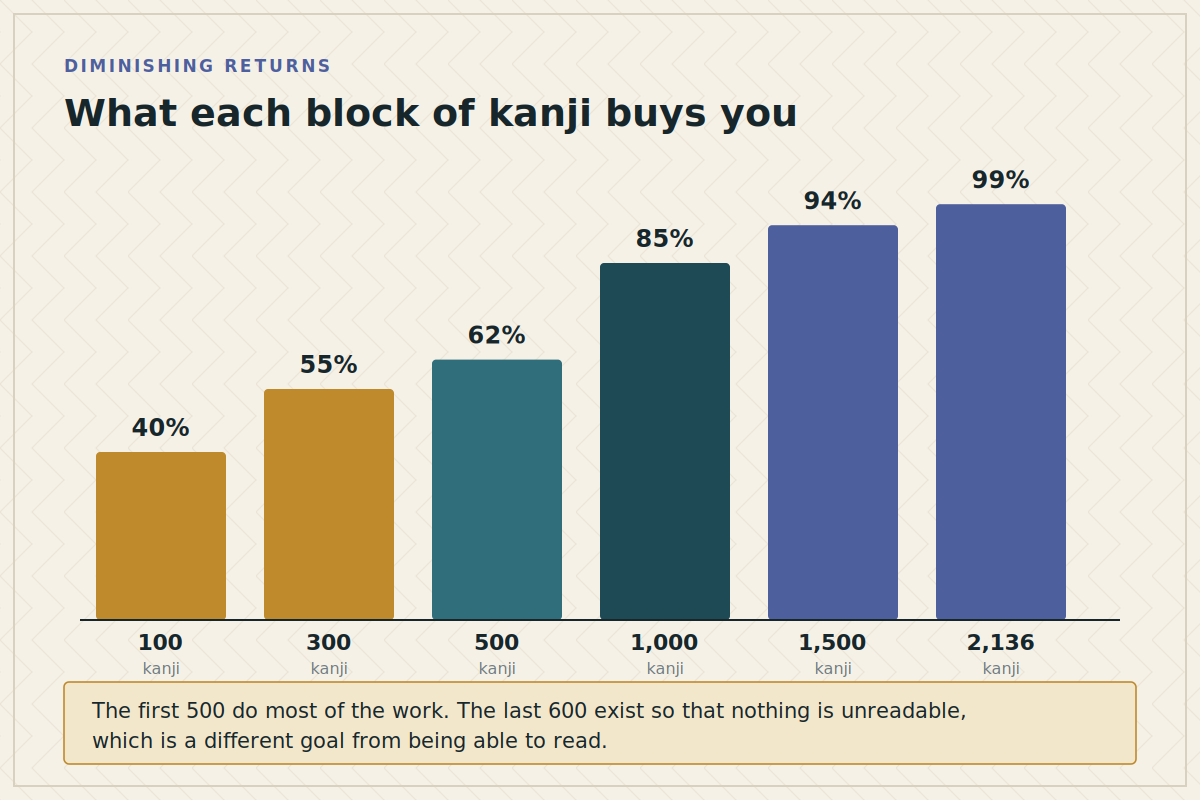
Roughly 60% coverage of running text. Notices, simple instructions, product labels and the gist of a headline. You’ll still be looking things up constantly, but you’ll be reading rather than pattern-matching.
About 1,000: the real threshold
Around 85% coverage, and the point most learners describe as the moment reading becomes possible rather than painful. A newspaper article becomes comprehensible with a dictionary rather than in spite of it, and — crucially — you start being able to guess unfamiliar compounds from the characters they’re made of.
If you’re going to stop somewhere, stop here. The first thousand characters deliver the overwhelming majority of the value.
2,136: the official list
About 99% coverage. This is the standard for functional adult literacy in Japan, and it’s what newspapers assume — anything outside the list gets furigana, small kana printed above the character to show the reading.
The last thousand characters buy about 14 percentage points of coverage. Worth it if you live in Japan or read professionally. Poor value if you’re studying for pleasure.
The official lists, and why there are several
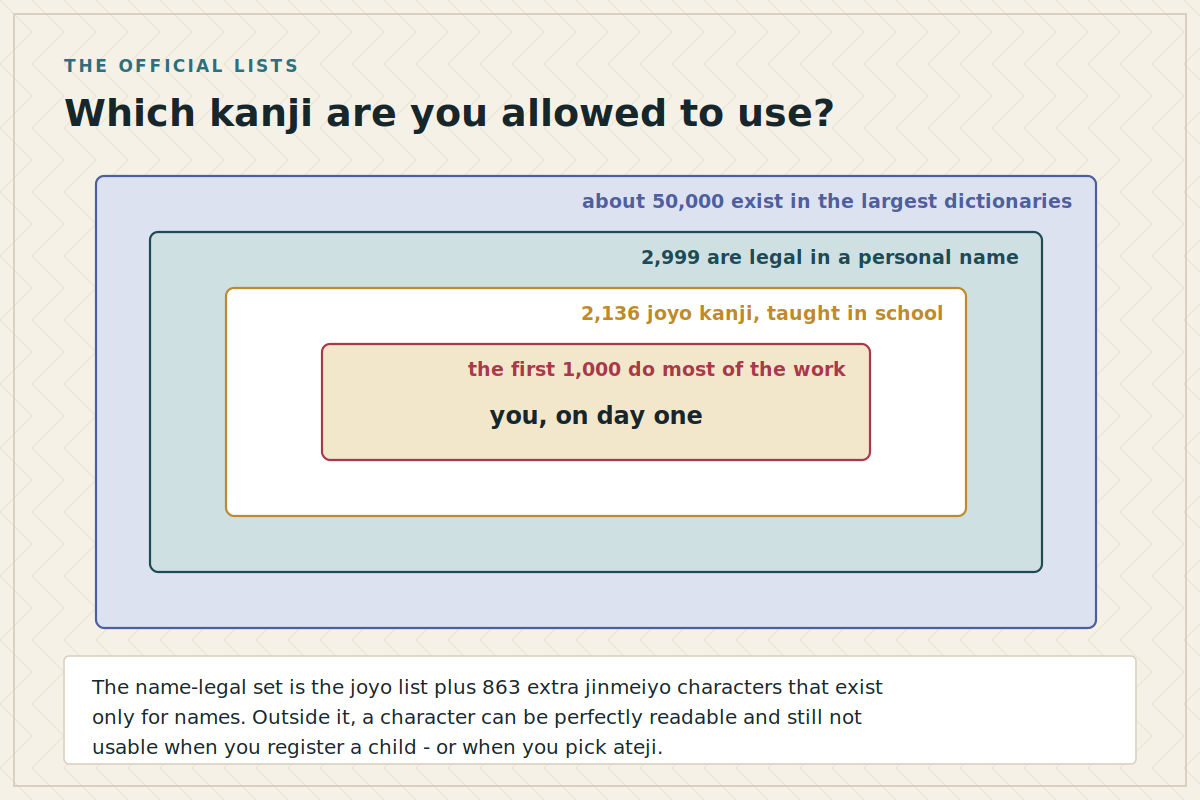
| Set | Size | What it’s for |
|---|---|---|
| Everything in the big dictionaries | about 50,000 | Historical and Chinese characters; nobody knows them all |
| Name-legal set | 2,999 | Characters permitted when registering a personal name |
| Jōyō kanji | 2,136 | Taught in school, assumed in newspapers and public documents |
| Jinmeiyō kanji | 863 | Extra characters allowed in names but not in general use |
| Educational kanji | 1,026 | The subset taught in the six years of elementary school |
The jinmeiyō list is the one people trip over. It exists because parents wanted characters for names that weren’t on the general list — traditional, poetic, or simply pretty — and the registry needed a defined boundary. The practical consequence: a character can be perfectly readable and still not usable in a name.
That constraint matters if you’re picking kanji for a foreign name. A character outside the name-legal set may be elegant and legible and still mark the result as something assembled by an outsider. We go into this, and the other ways it goes wrong, in the guide to ateji for foreign names.
Why 2,000 characters is less work than it sounds
Three things make the number less frightening than the raw count.
Characters are built from parts. Most kanji are compounds of a few hundred recurring components. Once you know that 氵 signals water and 言 signals speech, new characters stop being arbitrary shapes and become combinations. The last five hundred are easier than the first hundred.
Frequency is steeply skewed. A small set of characters appears constantly and the rest appear rarely. That’s what the chart above shows, and it’s why the coverage curve flattens so fast.
Compounds are guessable. Because each character carries meaning, a two-character word you’ve never seen is often decodable: 火 fire plus 山 mountain gives 火山, volcano. This is the compounding effect that makes the second thousand faster than the first.
The first 500 do most of the work. The last 600 exist so that nothing is unreadable, which is a different goal from being able to read.The honest way to read the coverage curve
Do you need any at all?
A fair question, and for a lot of readers the answer is no.
If you want your name written correctly, you need katakana, not kanji — and you don’t need to learn it, you need to get the spelling right, which is what our guide to writing your name in Japanese is for. If you want to order food and take trains, thirty characters plus a phrasebook will carry you. If you want to read manga, furigana over the kanji does much of the work for you.
Kanji become necessary when you want to read something written for adults without help: a novel, a contract, a news site, a restaurant’s handwritten specials board. That’s a real goal and it takes real time — but it’s a goal, not a prerequisite.
How long it actually takes
Estimates vary wildly because they measure different things, so here is the honest shape of it. Japanese children reach the 1,026 educational kanji over six years of school, and the full 2,136 by the end of high school — twelve years, with a native speaker’s vocabulary already in place.
An adult learner working from outside that context usually moves faster on recognition and slower on production. Fifteen minutes a day of spaced repetition puts most people at the first 300 within three months and around 1,000 inside a year, provided the reviews actually happen daily. The variable that decides it is not talent or method but whether the habit survives week six.
Writing by hand is the expensive part, and increasingly optional: most Japanese adults type more than they write, selecting characters from a list rather than recalling the strokes. If your goal is reading, treat handwriting as a separate hobby rather than a requirement, and you cut the workload roughly in half.
A practical order
- Hiragana and katakana first. Two weeks each, and they unlock dictionaries and grammar. The three-script division is explained in how Japanese writing works.
- The survival thirty. Signs, directions, toilets, exits. One sitting.
- Numbers, dates and counters. Small, closed, immediately useful — and Japanese counts differently depending on the shape of the thing, which is covered in the guide to numbers and counters.
- The first 300 by frequency, using whatever spaced-repetition tool you’ll actually open daily.
- Then read something. Characters learned in isolation fade; characters met in a sentence stay. Push to a thousand through reading rather than through lists.
The number that matters isn’t 2,136. It’s whichever number gets you to the thing you wanted to read — and for most people, that number is around a thousand, reachable in a year of unglamorous daily practice.