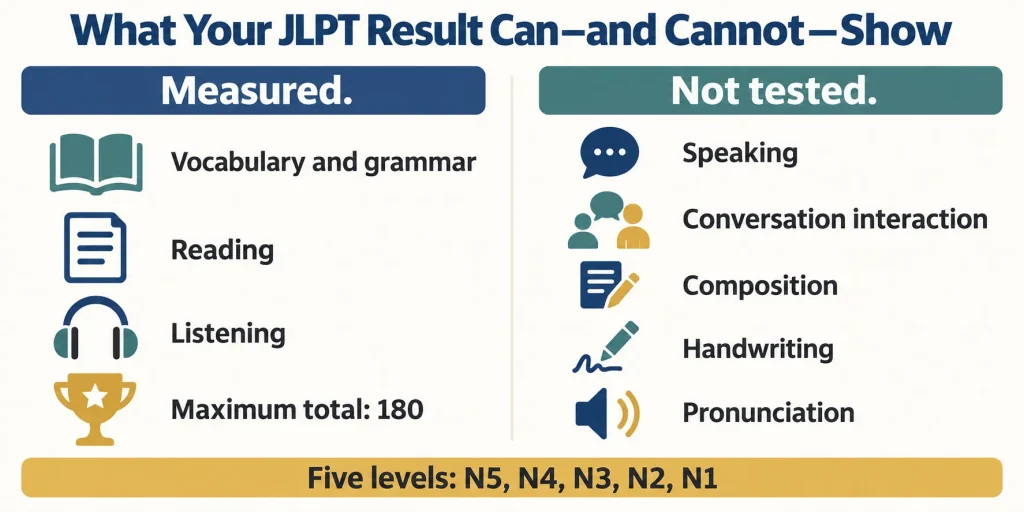
The Japanese-Language Proficiency Test arrives as a paper test, a level from N5 through N1, and eventually a score report that can look like a compact verdict on your Japanese. For anyone researching the JLPT for Americans, that appearance needs to be taken apart. The exam measures language knowledge, reading, and listening, but it has no conversation test and no composition test. A passing certificate therefore shows that you met the standard for the receptive abilities tested at a particular level. It does not prove that you can conduct an interview, write a business email, explain a problem at a city office, or sustain a spontaneous conversation.
Start with the name on the test booklet
The full name is 日本語能力試験, Nihongo Nōryoku Shiken, literally “Japanese-language ability examination.” In English, it is the Japanese-Language Proficiency Test, or JLPT. It is jointly administered worldwide by the Japan Foundation and Japan Educational Exchanges and Services, with local organizations handling applications and test sites outside Japan.
The examination has five levels. N5 is the least difficult and N1 the most difficult. These are exam levels, not Japanese school grades, university years, or direct statements about how a native speaker uses the language. You choose one level when registering and sit only that level on test day.
The whole object can be labeled as follows:
- 日本語能力試験, Nihongo Nōryoku Shiken — the examination as a whole;
- N1–N5, en wan kara en faibu — the five available levels;
- 言語知識, gengo chishiki — “language knowledge,” covering vocabulary and grammar;
- 読解, dokkai — “reading comprehension”;
- 聴解, chōkai — “listening comprehension”;
- 得点区分, tokuten kubun — “scoring section”;
- 合否, gōhi — “pass or fail”;
- 認定書, ninteisho — the certificate issued to a successful candidate.
This article treats the exam as the hub. If the scripts themselves are still competing for your attention, Hiragana, Katakana, Kanji: How Japanese Writing Works explains their separate jobs. The test assumes that you can process Japanese writing; it does not teach the writing system while testing you.

The level number is a target, not a grade
The first prominent component is the level. The official summaries describe N4 and N5 as measuring understanding of basic Japanese mainly learned in class. N1 and N2 address Japanese used across a broader range of everyday situations, while N3 bridges the gap between the lower and upper groups.
Those descriptions combine reading and listening. At N5, the official summary refers to reading typical expressions and sentences written in hiragana, katakana, and basic kanji, along with understanding short, slowly spoken conversations about familiar subjects. At N1, it describes reading logically complex or abstract material and following coherent conversations, news reports, and lectures spoken at natural speed.
The levels do not come with official vocabulary or kanji checklists. The revised test introduced in 2010 stopped publishing a fixed “test content specification” of the kind learners often want. Preparation books may advertise estimated word and character totals, but those figures are not official JLPT requirements.
That matters when you plan your study. Memorizing a publisher’s list can be useful, but the list is not a contract guaranteeing that every test item will come from it. For the distinction between a government general-use character standard and a proficiency test, The Characters the Government Signs Off On explains what the official common-use kanji table actually governs.
| Level | Official direction of difficulty | Broad receptive target |
|---|---|---|
| N5 | Least difficult | Some basic Japanese |
| N4 | Above N5 | Basic Japanese |
| N3 | Bridge level | Everyday Japanese to a certain degree |
| N2 | Below N1 | Everyday Japanese and some broader situations |
| N1 | Most difficult | Japanese used in a broad range of circumstances |
Language knowledge checks recognition in context
The first tested component is 言語知識, gengo chishiki, “language knowledge.” Its vocabulary questions examine kanji readings, orthography, word formation, meaning in context, paraphrases, and usage. Its grammar questions test sentence patterns, sentence construction, and the organization of a longer text.
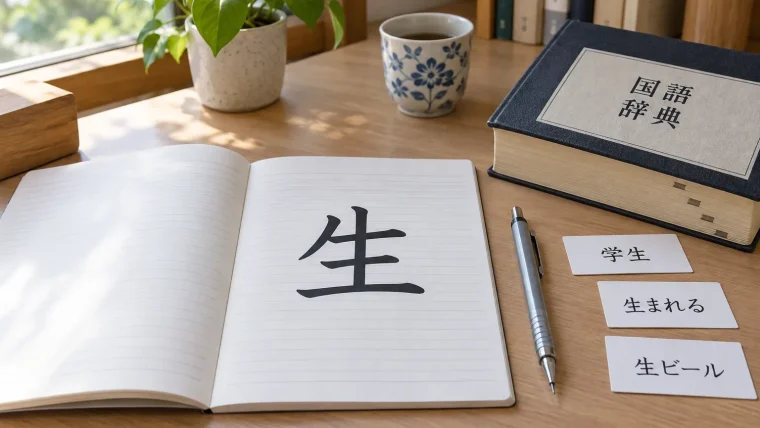
This is not a handwriting test. You select answers on an answer sheet rather than producing kanji from memory in a composition. Recognizing the correct spelling of a word among alternatives is different from writing that word unprompted with a pen.
A typical worked example shows the distinction. Imagine that a sentence contains a missing connector and gives you four options. To answer, you must recognize the grammar, follow the relationship between the clauses, and reject distractors that may be grammatically possible elsewhere. You do not have to create your own sentence using the connector, defend your choice aloud, or spell it without seeing the alternatives.
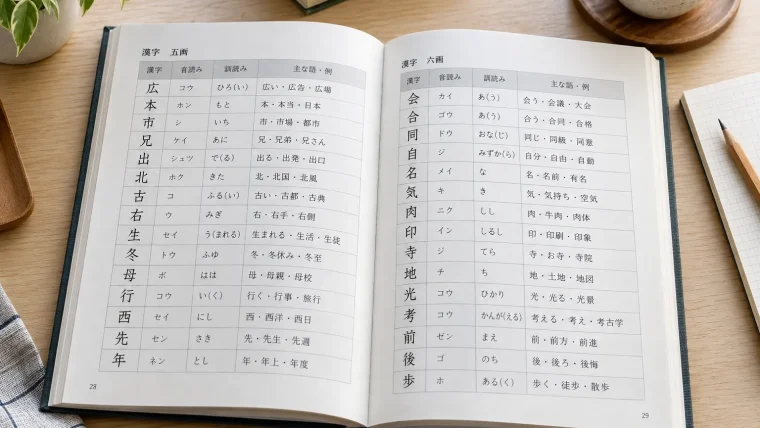
The same limitation applies to kanji. A question can establish that you recognized a reading in context. It cannot establish that you can handwrite the character accurately. When an unknown shape blocks your independent reading, How to Find a Character You Cannot Read covers radical and component lookup instead of repeating that method here.
Reading measures comprehension under time pressure
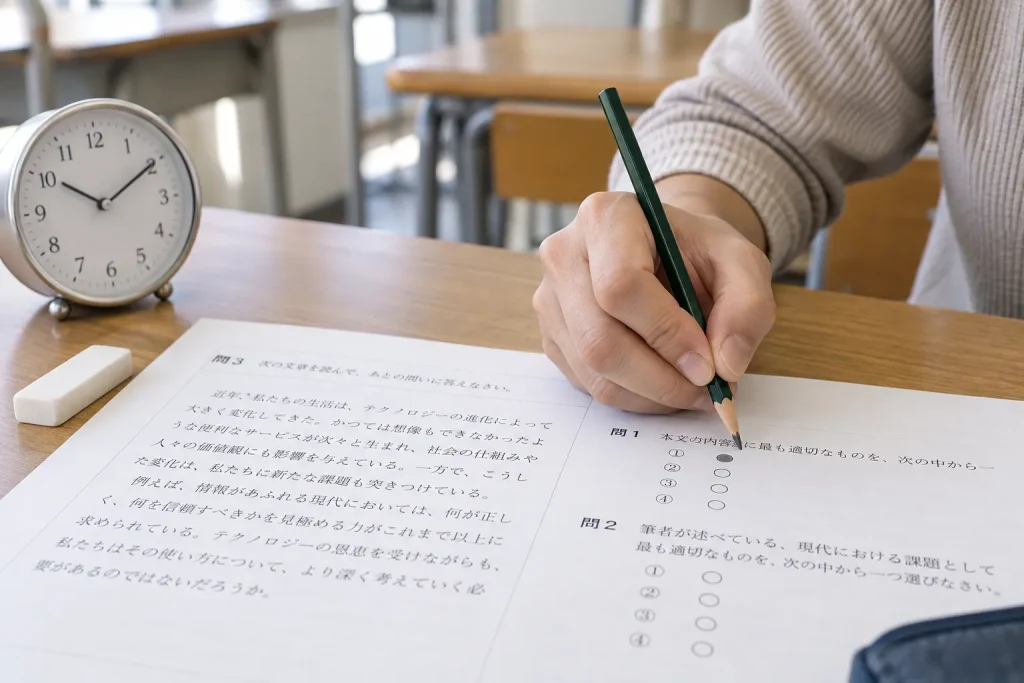
読解, dokkai, literally “reading and understanding,” appears alongside grammar at every level, although the way test sessions are divided changes. Reading tasks include short passages, longer texts, integrated comprehension, thematic comprehension, and information retrieval, with the mix depending on the chosen level.
You may need to identify the writer’s point, follow a contrast, connect information across paragraphs, or extract a practical detail from a notice. The higher levels place greater pressure on your ability to follow abstract arguments and understand the structure of a text rather than translate isolated sentences.
The time limit is part of what the score means. Looking up every character is not possible during the examination. You must decide which information matters, keep track of referents, and avoid spending too long on one difficult passage.
Still, a strong reading score does not show that you can write a comparable passage. This is the first major part that is not what it looks like: a paper covered in Japanese characters can resemble a broad literacy examination, but it measures reading recognition and comprehension without a written production task.
Listening is tested without a conversation partner
聴解, chōkai, “listening comprehension,” is the final tested area. Depending on level, tasks may ask you to identify the appropriate response, understand a key point, follow an outline, or interpret a longer exchange. You listen and select an answer; you do not respond into a microphone.
That difference is decisive. Listening during a real conversation includes the chance to ask for repetition, confirm what you understood, watch facial expressions, and adjust your reply. The JLPT isolates comprehension more tightly. It can show that you processed recorded Japanese under examination conditions, but not that you can take your turn in an unscripted exchange.
No speaking examiner is hiding inside the listening score. The official JLPT FAQ answers the question about conversation and composition tests directly:
“No, neither is currently included.”
This is why JLPT speaking ability must be assessed separately. If a school or employer needs evidence of oral interaction, an interview, recorded response, presentation, or another speaking assessment supplies information the certificate does not contain.
The missing sections change what the certificate means
There is no 会話試験, kaiwa shiken, “conversation examination,” and no 作文試験, sakubun shiken, “composition examination.” You are never scored on pronunciation, fluency, turn-taking, handwriting, message organization, or the ability to retrieve language without answer choices.
That absence is not a minor technical footnote. It defines the boundary of the qualification. Someone may pass N1 while still feeling hesitant in conversation because the exam did not require spoken output. Another learner may speak comfortably in familiar situations yet fail because timed reading, vocabulary recognition, or formal listening is weaker.
A balanced interpretation separates what the test supports from what it cannot establish:
| A passing result supports | A passing result does not establish |
|---|---|
| Receptive competence at the chosen level | Spontaneous conversational fluency |
| Recognition of tested vocabulary and grammar | Ability to create accurate sentences without prompts |
| Reading comprehension under a time limit | Handwriting or extended composition |
| Listening comprehension from recordings | Interactive listening and spoken repair |
| Meeting both total and sectional score rules | Equal ability across every real-life language task |
The uncomfortable correction is simple: a Japanese proficiency certificate is not a speaking certificate. It may be valuable for applications or personal goals, but “passed N1” and “can work entirely in spoken Japanese” are different claims.
Your score report is not a raw percentage
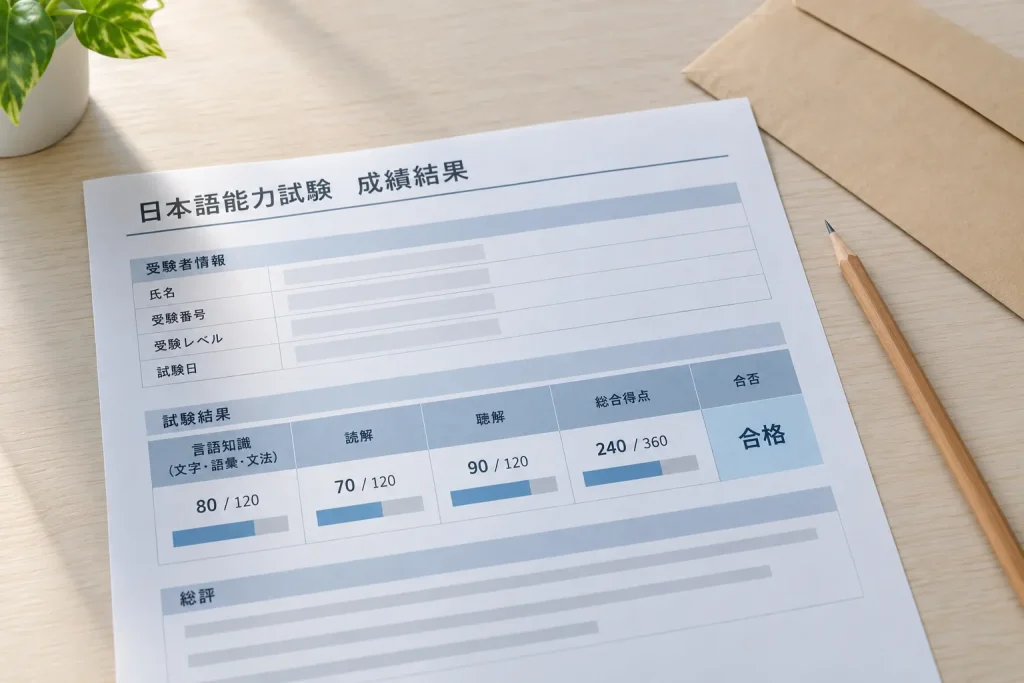
JLPT scores are scaled, not a direct count of correct answers. The organizers use a statistical scaling method so that scores remain comparable across different test forms. Two candidates with the same number of correct responses do not necessarily receive the same scaled score if their patterns of answers indicate different proficiency.
For N1, N2, and N3, the score report has three sections, each running from 0 to 60 points:
- language knowledge, covering vocabulary and grammar;
- reading;
- listening.
For N4 and N5, language knowledge and reading are combined into a 0-to-120-point scoring section, while listening runs from 0 to 60. Every level therefore has a maximum total of 180 points.
The result is not based on the total alone. You must reach the overall passing mark and every sectional minimum. A candidate who exceeds the total requirement but falls below one sectional threshold fails.
| Level | Overall pass mark | Sectional requirements |
|---|---|---|
| N1 | 100/180 | At least 19/60 in each of three sections |
| N2 | 90/180 | At least 19/60 in each of three sections |
| N3 | 95/180 | At least 19/60 in each of three sections |
| N4 | 90/180 | At least 38/120 in language knowledge and reading; 19/60 in listening |
| N5 | 80/180 | At least 38/120 in language knowledge and reading; 19/60 in listening |
The timetable changes shape by level
N1 and N2 use one combined language-knowledge and reading session followed by listening. N3, N4, and N5 separate vocabulary from grammar and reading on test day, then finish with listening. These test-day divisions do not always match the categories printed on the final score report.
This is the second part that is not what it looks like. Three periods in the room do not necessarily produce three separately reported scores. At N4 and N5, vocabulary, grammar, and reading contribute to one combined language-knowledge and reading score, despite being divided into separate timed test periods.
Official test times current for the 2026 examination are:
| Level | Language knowledge and reading | Listening | Tested minutes |
|---|---|---|---|
| N1 | Combined: 110 minutes | 55 minutes | 165 |
| N2 | Combined: 105 minutes | 50 minutes | 155 |
| N3 | Vocabulary: 30; grammar and reading: 70 | 40 minutes | 140 |
| N4 | Vocabulary: 25; grammar and reading: 55 | 35 minutes | 115 |
| N5 | Vocabulary: 20; grammar and reading: 40 | 30 minutes | 90 |
Breaks, check-in, instructions, and dismissal make the total time at the venue longer. AATJ advises that most American sites begin check-in around noon and start testing around 1:00 p.m., with the day generally ending about 3.5 to 4.5 hours after check-in. West Coast and Honolulu schedules differ, so your local test-day document controls.
Registration is the American bottleneck
For the 2026 United States administration, AATJ lists Sunday, December 6, as the test date and charges $135 for every level. The American schedule is not the same as Japan’s twice-yearly pattern. The worldwide JLPT calendar includes July 5 and December 6 in 2026, but overseas cities may offer only one of those sessions.
At the time checked on September 14, 2026, the AATJ page reported that most US sites and levels were already sold out. That is the practical fact that can cost you a year: knowing enough Japanese does not reserve a seat. Capacity belongs to a specific city and level, and “0 seats available” means that combination is sold out.
The published 2026 list contains 21 US test cities:
| Region | 2026 listed cities |
|---|---|
| East of the Mississippi | Ann Arbor, Atlanta, Boston, Charlotte, Chicago, Miami, Middlebury, Newark, New York, Philadelphia, Pittsburgh, Washington |
| West of the Mississippi and Hawaii | Boulder, Fayetteville, Honolulu, Houston, Los Angeles, Monterey Bay, Portland, San Francisco, Seattle |
Register as soon as your chosen location opens rather than waiting for a study milestone. Also read the local age and consent rules. For the 2026 Atlanta administration, AATJ states that examinees born after December 6, 2008, cannot register at that site, while four other listed sites require a consent form for candidates under 18.
If your identification or Japanese-facing paperwork uses a katakana rendering of your name, the site’s name converter with 898 checked names in katakana can help you check a conventional form. It does not replace the registration instructions: enter your legal identity exactly as the testing organization requires.
Test-day rules are stricter than ordinary classroom rules
Your voucher and local test-day PDF tell you where to report, when check-in closes, and what identification to bring. The American organizer planned to release the 2026 voucher instructions and individual site schedules in early November. Those documents should override estimates based on a previous year.
Electronic-device rules deserve special attention. AATJ states that mobile phones and camera-enabled electronic devices must be completely powered off from check-in until all sections are over and the proctor dismisses the room. That includes breaks. A device found powered on can lead to immediate disqualification regardless of whether it rang or was used.
The safest test-day sequence is:
- Download the voucher and site instructions when released.
- Check the required original identification.
- Confirm the site-specific arrival time.
- Bring permitted pencils and an eraser.
- Power off restricted devices before check-in.
- Keep them off through every break.
- Wait for the proctor’s dismissal before turning anything on.
Do not assume rules from a language class, another standardized test, or a previous city apply. Local logistics vary even though the exam’s levels, tested competencies, and scoring framework remain standardized.
A CEFR label still does not include speaking
Beginning with score reports for the December 2025 JLPT, successful candidates receive a Common European Framework of Reference for Languages level as reference information. The mapping uses the JLPT total score and extends from A1 to C1. It appears only for candidates who pass; a failed result does not receive a CEFR reference level.
For N3, passing totals from 95 to 103 correspond to A2, while 104 or higher corresponds to B1. For N2, 90 to 111 corresponds to B1 and 112 or higher to B2. For N1, 100 to 141 corresponds to B2 and 142 or higher to C1. Successful N4 and N5 candidates receive A2 and A1 respectively.
Those labels do not repair the missing productive skills. The official JLPT explanation says the reference mapping covers linguistic knowledge and receptive reading and listening. It does not include CEFR production—speaking and writing—or interaction.
A JLPT CEFR score must therefore be read more narrowly than a full four-skill CEFR assessment. An N1 result carrying C1 reference information is not official evidence that the holder speaks, interacts, and writes at C1.
What changes by region and what stays fixed
Test frequency, registration periods, fees, venue capacity, arrival times, accommodations procedures, and result delivery can change by country or city. In the United States, AATJ manages the local process. In another country, a different host organization may set the operational schedule.
The level framework does not become easier or harder because you sit the exam in a different city. The official content design, scaled scoring model, overall pass marks, and sectional minimums are shared. You should not choose a distant venue because of rumors that its version is easier.
Modern score reports now include the CEFR reference indication, but older valid certificates did not suddenly expire when that feature appeared. The official JLPT guidance states that results and certificates from July 2025 or earlier remain valid. The test itself also has no official expiration period, although an employer, university, or immigration procedure may decide how recent a result must be for its own purpose.
Romanized names can also appear differently across documents without changing the language ability tested. Romaji Explained: Three Systems and Which One to Use covers those systems; the practical rule here is to follow the identity format required by your registration and test site.
Read the certificate through its missing fields
A JLPT result becomes useful when you read all of it together: chosen level, total score, section scores, pass status, and—on newer passing reports—the CEFR reference indication. The level gives context, the total shows overall performance, and the section scores reveal whether one receptive area was substantially weaker. None of those fields measures productive language.
If your goal is employment, study, or life in Japan, prepare beyond the answer sheet. Add spoken interaction, pronunciation, handwritten or typed composition, email conventions, and the vocabulary of the situations you will actually face. Passing the test and becoming operationally comfortable in Japanese can support each other, but neither guarantees the other.
The next time someone shows you a JLPT certificate, look for the section scores before looking at the level in large type. Then notice the fields that are absent. There is no speaking score and no writing score—and that blank space is part of what the qualification means.