You look up a Japanese word and find it spelled shinbun. Another source writes simbun. A third writes sinbun. Nobody is wrong. There are three competing systems for writing Japanese in the Latin alphabet, they disagree about a handful of very common syllables, and which one you’re looking at depends entirely on who wrote it and why.
This is a short guide to telling them apart, knowing which one to use, and handling the long-vowel problem that trips up more people than the systems themselves.
The three systems
Hepburn — the one you’ll actually see
Devised in the 1860s for an English–Japanese dictionary and named after the missionary who compiled it. Its organizing principle is simple: spell it so an English speaker reading it aloud produces roughly the right sound.
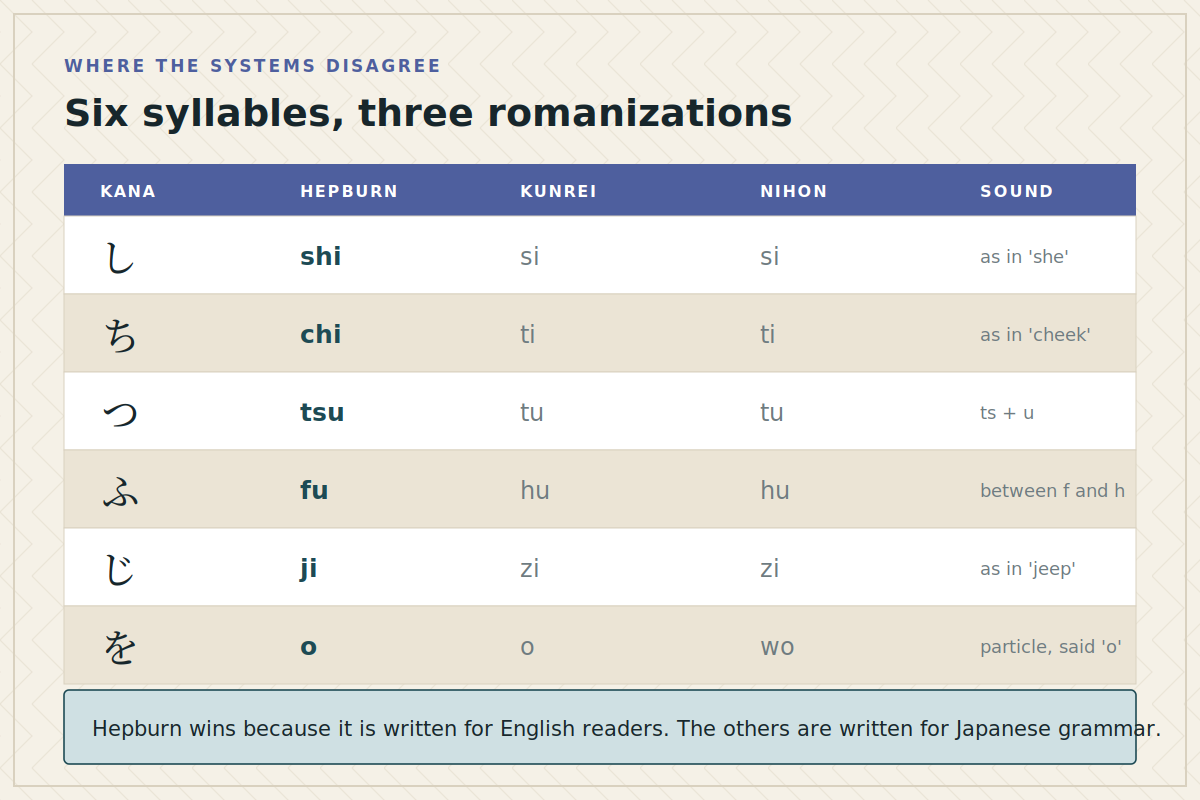
So し is shi, ち is chi, つ is tsu, ふ is fu, じ is ji. These aren’t arbitrary — they reflect what those syllables actually sound like, which is why Hepburn feels natural to read and slightly irregular to a Japanese speaker.
Hepburn is what you’ll find on road signs, station platforms, passports, English-language maps, and virtually every dictionary and textbook aimed at foreigners. If you learn one system, learn this one.
Kunrei-shiki — the official one
Standardized by the Japanese government in the 1930s and still taught in Japanese elementary schools. Its organizing principle is the opposite of Hepburn’s: keep the table regular, even where the sound wanders.
The s row is sa si su se so, full stop, because that’s the row it belongs to — even though し is pronounced closer to “shee.” Likewise the t row is ta ti tu te to, giving ti for ち and tu for つ.
This is genuinely more logical if you’re thinking in Japanese grammar, where verb conjugations move along those rows and Hepburn’s spellings make the pattern look broken. It’s also confusing for anyone reading it as English, which is why you rarely meet it outside Japanese classrooms.
Nihon-shiki — the historical one
The oldest of the three, and the most conservative. It’s nearly identical to Kunrei-shiki, differing on a few syllables that merged in pronunciation centuries ago but stayed distinct in writing: ぢ is di rather than zi, づ is du, を is wo.
You’ll encounter it mostly in linguistics and in older academic work. It’s the system that preserves the most information about how the kana are related, at the cost of telling you least about how to pronounce them.
Which to use
| If you’re… | Use | Because |
|---|---|---|
| Travelling in Japan | Hepburn | It’s what every sign and map uses |
| Writing English about Japan | Hepburn | Readers can pronounce it; style guides expect it |
| In a Japanese classroom in Japan | Kunrei-shiki | It’s what’s taught and tested there |
| Filling in an official Japanese form | Whatever the form specifies | Passport and residence-card rules have their own quirks |
| Typing Japanese on a keyboard | Either — the IME accepts both | shi and si both produce し |
We use modified Hepburn throughout this site, consistently, and say so — mixing systems mid-article is a habit that produces exactly the confusion this page exists to resolve. Our full sourcing and style rules are on the editorial standards page.
The long-vowel problem
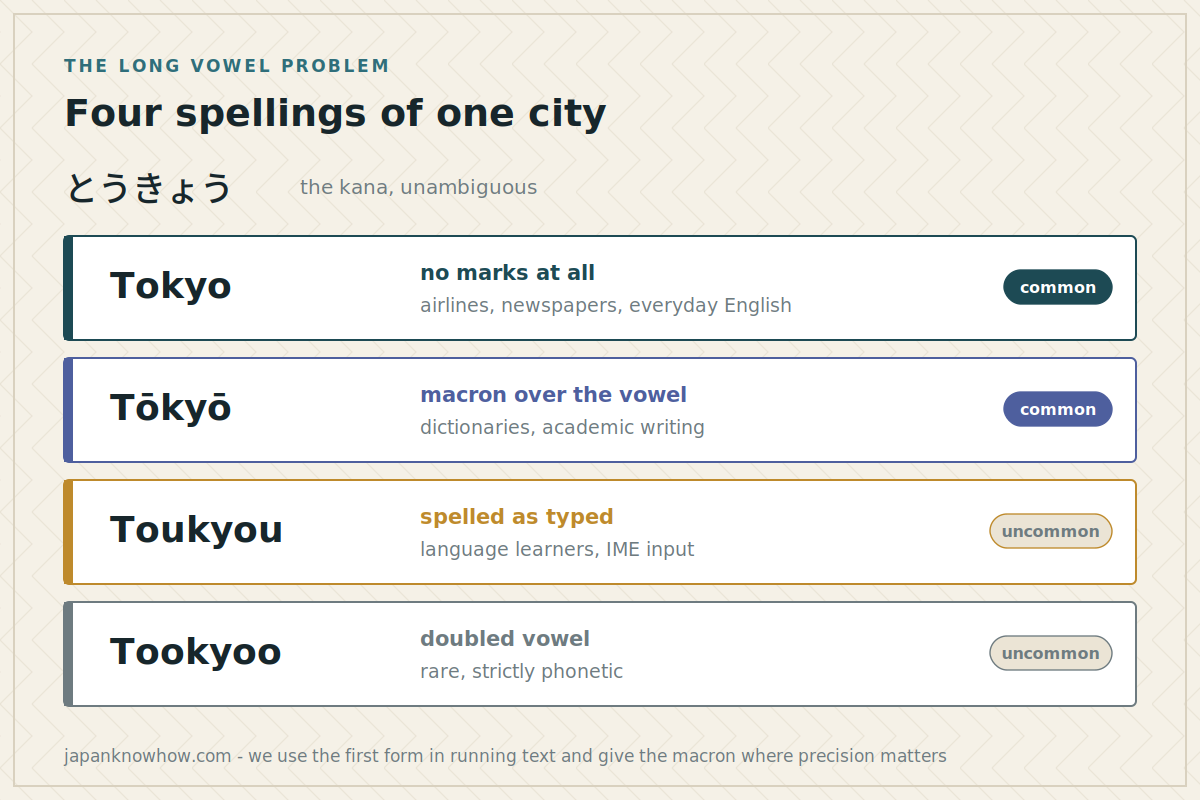
Here’s the messier issue, and the one that causes more real confusion than the three systems combined. Japanese vowel length is meaningful — obasan is aunt, obāsan is grandmother — and the Latin alphabet has no natural way to show it. Four solutions are in circulation:
- Ignore it. Tokyo, Osaka, Kyoto. Standard in newspapers, airlines, and everyday English. It loses information but nobody is confused about which city you mean.
- Macron. Tōkyō, Ōsaka, Kyōto. Standard in dictionaries and academic writing. Precise, and slightly awkward to type.
- Spell the kana. Toukyou — this is literally what you type into a Japanese keyboard, since the kana are とうきょう. Common among learners, rare in print.
- Double the vowel. Tookyoo. Strictly phonetic, and almost nobody uses it.
Our house rule: no marks in running text, where the words are familiar, and macrons where precision matters — in a table of readings, or where two words differ only by vowel length. Familiar place names keep their established English spellings regardless.
Three traps worth knowing
The particles are written as they’re said. The topic particle is written は (the kana ha) but pronounced and romanized wa. The object particle is written を and romanized o in Hepburn, wo in Nihon-shiki. The direction particle へ (the kana he) is romanized e.
The syllabic n needs care. Before b, p, or m it’s pronounced closer to m, which is why you’ll see both shinbun and shimbun for 新聞. Modern Hepburn keeps n; the older “traditional” Hepburn used m, which is why the newspaper Asahi Shimbun spells itself that way. Both are defensible; neither is a typo.
Apostrophes are load-bearing. In kin’en (no smoking) the apostrophe marks that the n ends its own syllable, distinguishing it from kinen (commemoration). Dropping it changes the word.
Hepburn wins because it is written for English readers. The others are written for Japanese grammar.The one-line summary
Romaji is not a stage of learning
One habit worth breaking early: treating romaji as training wheels you’ll ride until the kana feel comfortable. It doesn’t work that way. Romaji lets you pronounce a word without ever learning to read it, and every week spent leaning on it is a week the kana don’t get practised.
Hiragana takes most people one to two weeks. Katakana takes about the same, and pays off faster for a traveller, since menus and shop signs are full of borrowed words — though a borrowed word in Japanese often doesn’t mean what its English source does, as we set out in the piece on Japanese loanwords.
Where romaji genuinely earns its place: typing, since the standard input method converts Latin keystrokes to kana; and in reference material aimed at people who aren’t learning the language and just need to say a word out loud. On this site it appears alongside the kana for exactly that reason, never instead of it. The same principle applies on the name pages, where romanized syllable breakdowns sit next to the katakana — described in our guide to how Japanese writing works.