The most expensive mistake is postponing kanji until you feel “fluent” in hiragana. It can cost months of reading practice because why japanese has 3 writing systems is not answered by saying that the country accumulated scripts through history. Modern Japanese normally runs without spaces between words, and changes among 漢字, kanji, literally “Chinese characters,” ひらがな, hiragana, literally “plain kana,” and カタカナ, katakana, literally “fragmentary kana,” help the reader find structure. Kanji often carries the lexical core, hiragana displays grammar and inflection, and katakana marks a different class or treatment of vocabulary. The division is flexible, but it is functional.
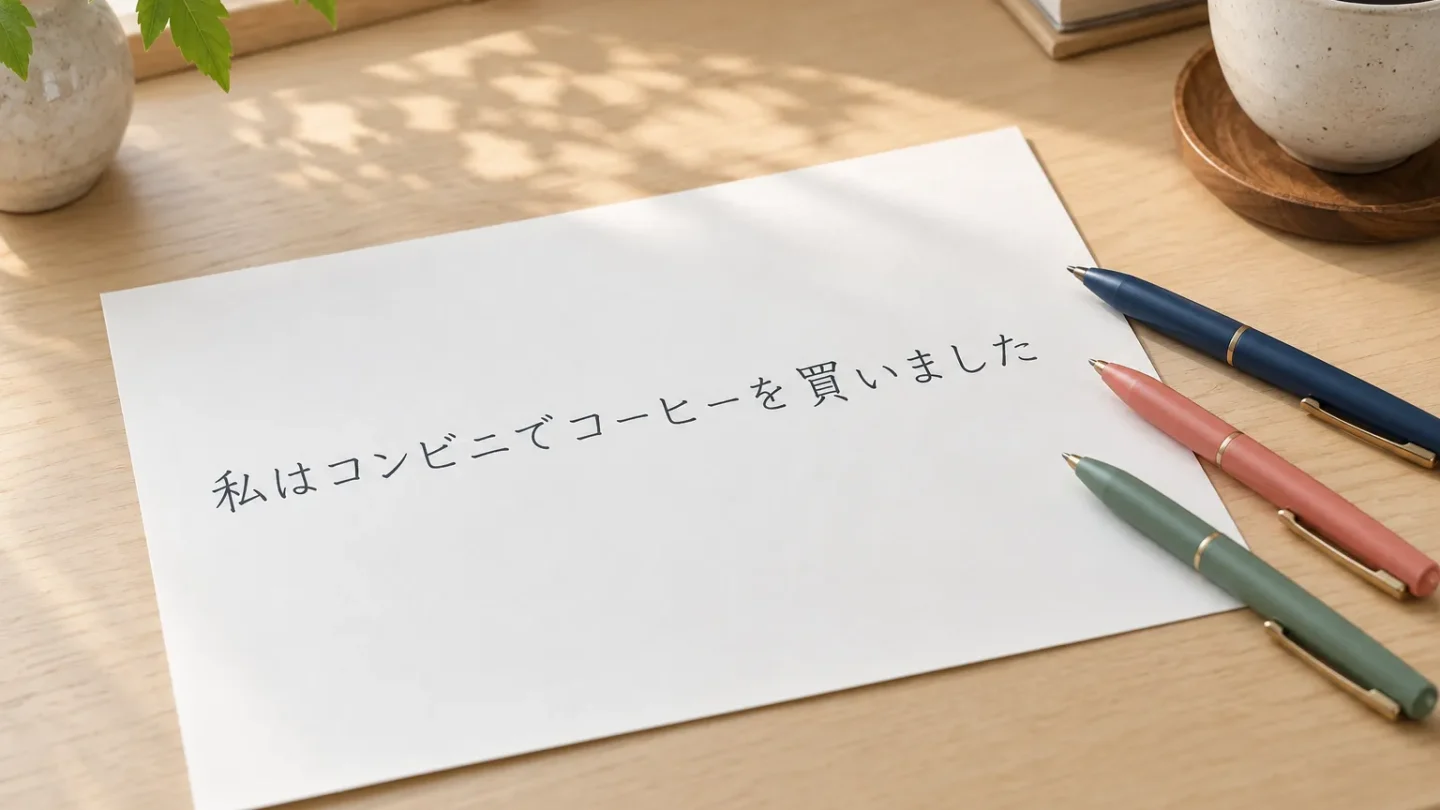
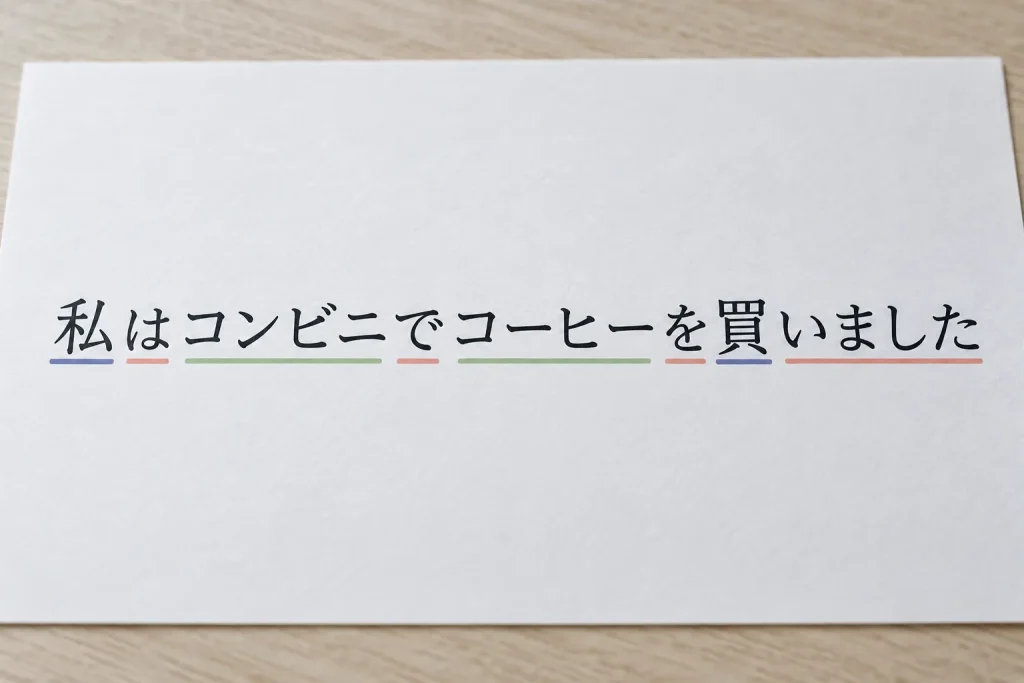
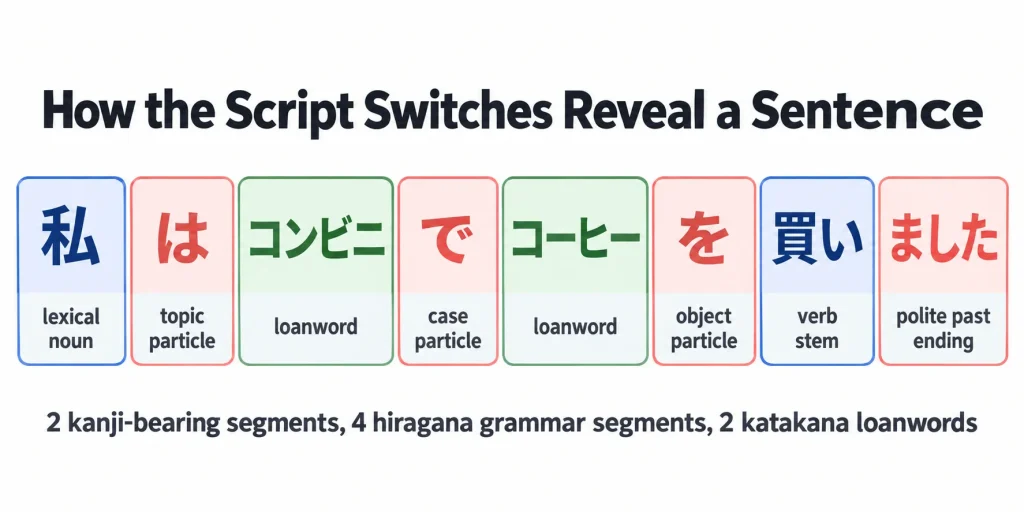
Consider 私はコンビニでコーヒーを買いました, watashi wa konbini de kōhī o kaimashita, “I bought coffee at a convenience store.” No spaces separate its words. Yet the shifts in script help your eye divide 私|は|コンビニ|で|コーヒー|を|買い|ました. The characters 私 and 買 carry lexical information, hiragana marks particles and the inflected verb ending, and katakana packages two loanwords. Script changes do work that blank spaces perform in English, though context and grammar still share the job.
| Part | Script | Job in this sentence | Reading |
|---|---|---|---|
| 私 | Kanji | Identifies the lexical word “I” | watashi |
| は | Hiragana | Marks the topic | wa |
| コンビニ | Katakana | Packages a loanword | konbini |
| で | Hiragana | Marks the location of an action | de |
| コーヒー | Katakana | Packages another loanword | kōhī |
| を | Hiragana | Marks the object | o |
| 買い | Kanji plus hiragana | Shows the verb stem and part of its inflection | kai |
| ました | Hiragana | Completes the polite past form | mashita |
Why Japanese has 3 writing systems is not answered by “learn kana first”
Learners often decide to master all-kana Japanese before touching kanji. The plan seems sensible because hiragana can represent the pronunciation of native Japanese words, particles, and inflected endings. In practice, long kana-only sentences remove many visible boundaries and discard the meaning cues supplied by characters. A string such as わたしはきょうとうきょうへいきます is pronounceable, but the reader must decide where each word begins while also resolving possible homophones. Writing 私は今日東京へ行きます immediately exposes 私, 今日, 東京, and 行 as lexical units surrounded by grammatical hiragana.
Children’s books can use spaces or extensive 振り仮名, furigana, literally “assigned kana,” because their readers have not yet learned enough characters. That adaptation does not make all-hiragana writing the adult default. Kana-only practice is useful for sound recognition but poor preparation for the visual structure of ordinary prose. Hiragana, Katakana, Kanji: How Japanese Writing Works provides the larger map of the scripts; the problem here is what happens when you learn them as isolated alphabets. You should begin reading short mixed-script sentences as soon as you know enough kana to sound them out.
What to do instead: study Japanese scripts together inside complete sentences.
Replacing every unknown kanji with hiragana
A half-informed learner may know that a Japanese word can often be written phonetically and replace every uncertain character with hiragana. This appears safer than risking the wrong kanji. It can be correct in selected words, informal writing, children’s material, or cases where a character feels needlessly obscure. Applied everywhere, however, it removes visual anchors and creates ambiguity between words with the same pronunciation. The reader must reconstruct distinctions that standard orthography would have supplied immediately.
Take かみ, kami. Depending on context and spelling, it can correspond to 紙, “paper,” 髪, “hair,” or 神, “deity,” among other possibilities. A sentence supplies context, but the appropriate kanji reduces the burden before the reader reaches the end. This does not mean that every word has one compulsory character spelling. Japanese orthography permits variation, and writers sometimes choose kana for tone, familiarity, or readability.
Kanji does not merely decorate a pronunciation. It compresses lexical information and makes the surrounding kana easier to divide.
What to do instead: learn common kanji words as vocabulary, not as characters detached from words.
Treating hiragana as pronunciation and nothing else
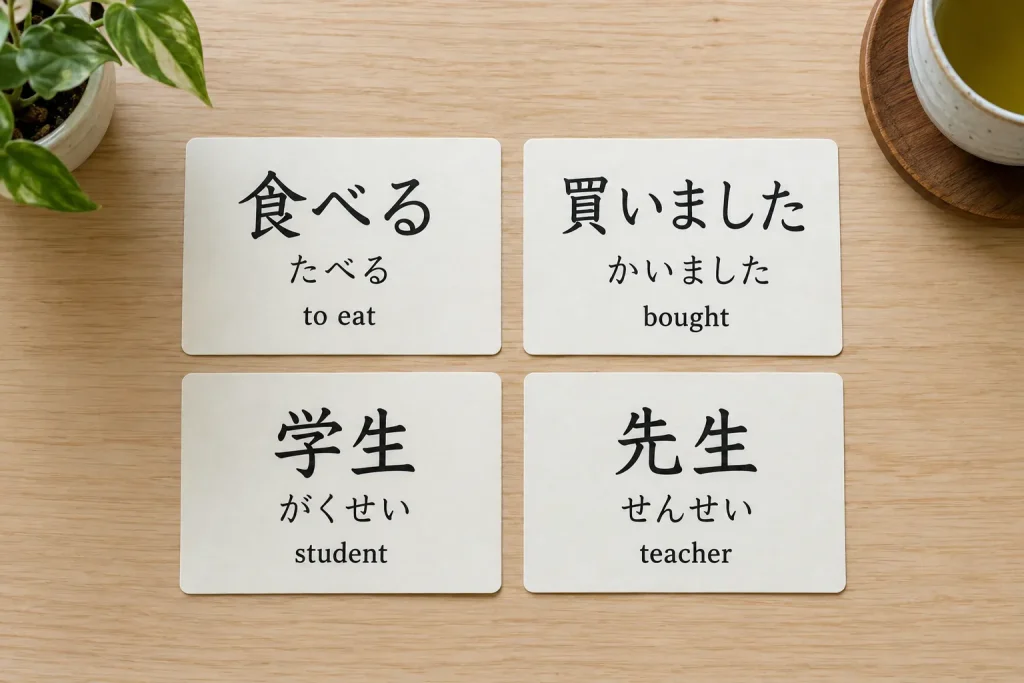
Beginners often call hiragana a phonetic alphabet and stop there. That description seems reasonable because each kana represents a mora, a rhythmic sound unit, rather than an English-style consonant letter. The trouble begins when the learner overlooks particles, inflection, and 送り仮名, okurigana, literally “accompanying kana.” In 食べました, tabemashita, “ate” or “has eaten” in polite speech, 食 identifies the lexical stem while べました shows part of the reading and the grammatical form. The change from kanji to hiragana tells you where stable lexical information gives way to inflection.
Okurigana also helps distinguish readings and related words. The visible endings in 上がる, agaru, “to rise,” and 上げる, ageru, “to raise,” guide both pronunciation and grammar. Replacing those endings with an imagined kanji-only form would conceal information rather than make the word more advanced. The Japanese government’s modern okurigana guidance exists because placement affects consistent public writing. Hiragana is therefore not leftover sound notation filling gaps between important characters.
What to do instead: read hiragana grammar markers as part of the sentence structure.
Assuming katakana means “foreign word”
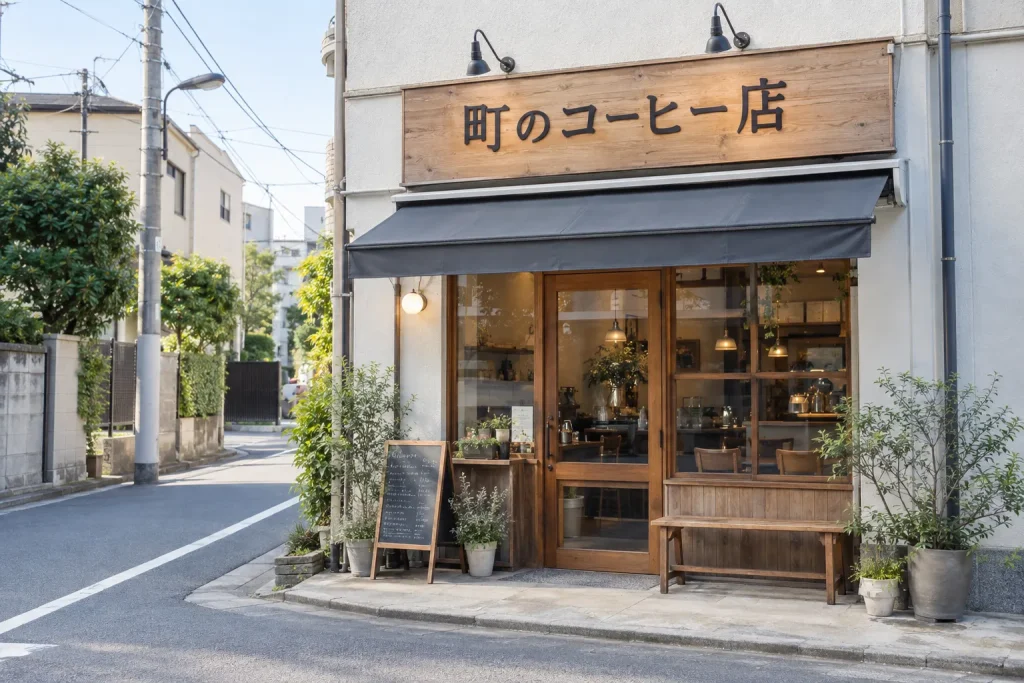
Learners are often taught that katakana is for foreign vocabulary. That shortcut is useful at first, but it becomes expensive when treated as a complete rule. Katakana also marks foreign personal and place names, many scientific names, sound symbolism, emphasis, brand styling, robotic or unusual speech, and selected native words. Meanwhile, words borrowed from Chinese in earlier periods are usually written in kanji rather than modern katakana. Script choice tells you how a writer is presenting an expression, not its complete passport history.
A word in katakana is also not guaranteed to mean what a similar English sound suggests. コンセント, konsento, means an electrical outlet, not “consent,” while マンション, manshon, commonly refers to an apartment building rather than a mansion. Why Japanese Loanwords Are Not the English You Think covers those semantic traps instead of duplicating them here. Recognizing katakana tells you how to start processing the word. It does not finish the translation.
What to do instead: learn katakana vocabulary as Japanese words with Japanese meanings.
Writing foreign names by mechanical substitution
After researching katakana, learners sometimes build names by substituting one kana for every English syllable or letter. This seems more informed than choosing attractive kanji at random, but it still starts from spelling rather than pronunciation. Japanese adapts a name to the sound patterns available in the language, adding vowels where necessary and using small kana, doubled consonants, or long-vowel marks. Regional pronunciation can also change the appropriate result. Two names spelled similarly in English may therefore require different katakana.
The distinction becomes visible in ジェームズ, Jēmuzu, “James,” where the long-vowel mark ー is part of the spelling, and デイビッド, Deibiddo, “David,” where the small ッ marks a doubled following consonant. The name converter with 898 checked katakana names is useful precisely because a simple letter-replacement formula produces errors. It should be used for names rather than duplicated as a generic transliteration table. A spelling generated without checking the source pronunciation can look plausible while naming someone else.
What to do instead: convert names from pronunciation and verify established usage.
Ignoring small kana because the full-size sign looks familiar
Learners who know the basic kana charts may read small characters as though size were decorative. The error seems minor because や and ゃ, or つ and っ, share the same basic shapes. In reality, size changes the sound structure and can change the word. A small ゃ combines with the preceding kana in a form such as きゃ, kya, while a full-size や begins another mora. A small っ, sokuon, literally “促音” or “contracted sound,” signals the closure before a following consonant.
Compare きて, kite, “come,” with きって, kitte, “stamp.” Ignoring っ does not produce a harmless accent; it produces another word. The Tiny Tsu, Ya, Yu and Yo explains the sound patterns and spellings in detail. Within mixed text, these small forms remain part of the same kana system, but they control how the unit is parsed. You cannot compensate for missing them by guessing from the surrounding kanji every time.
What to do instead: treat kana size as spelling, not typography.
Memorizing readings for isolated kanji
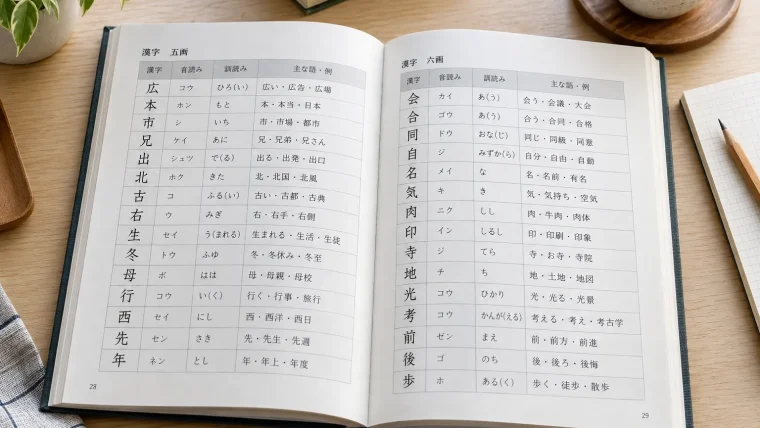
A learner who has done some research may create a list of every 音読み, on’yomi, literally “sound reading,” and 訓読み, kun’yomi, literally “explanatory reading,” attached to each character. The method looks rigorous because dictionaries display those readings in organized groups. It often produces knowledge that cannot be deployed: you recognize 生 and remember several possible sounds, but you cannot choose among them in 生きる, 学生, 先生, or 生ビール. The word and its context select the reading. The character alone frequently does not.
Kanji knowledge becomes useful when stored in combinations such as 学生, gakusei, “student,” and 先生, sensei, “teacher.” Learning vocabulary also shows which script normally surrounds the character and where okurigana begins. What Breaks When You Write Kanji Out of Order addresses the separate handwriting problem: stroke order supports recognizable shapes and lookup habits. Neither stroke order nor reading lists replace word-level learning.
| Inefficient unit | Useful unit | Information gained |
|---|---|---|
| 生 = several memorized readings | 学生, gakusei | Reading, meaning, and compound behavior |
| 食 = “eat” | 食べる, taberu | Kanji stem plus required okurigana |
| 買 = “buy” | 買いました, kaimashita | Lexical stem plus polite past ending |
| 小さい っ = “small tsu” | きって, kitte | Consonant timing and word identity |
| コンセント = “looks like consent” | コンセント = outlet | Actual Japanese meaning |
What to do instead: build kanji vocabulary through whole written words.
Adding spaces as a permanent reading solution
Adding spaces to every Japanese sentence makes early material easier to approach. It therefore seems like the obvious solution to a writing system that normally omits them. The cost appears later, when your eye waits for separators that ordinary books, menus, interfaces, notices, and messages do not supply. Spaced practice can prevent you from learning the boundary cues already present in script changes, particles, inflections, and familiar word shapes. Removing the spaces then feels like learning to read for a second time.
This does not mean that Japanese never uses spacing. Educational material, accessibility-oriented text, signs, and stylistic writing may add it where useful. The mistake is not encountering spaces but depending on them after the scripts themselves have become available. In 私は映画を見ました, the transition 私|は and 映画|を|見|ました already supplies several strong structural cues. Your aim is to perceive those cues without manually inserting an English layout.
What to do instead: phase out learner spaces while marking boundaries during review.
Using romaji after it has stopped helping
ローマ字, rōmaji, literally “Roman letters,” offers a fast entry into pronunciation. Learners keep it because it feels transparent and allows immediate typing or note-taking. Continued dependence hides long vowels, small kana, particles with exceptional conventional readings, and the visual division of labor among the native scripts. It also turns Japanese into an uninterrupted Latin-letter stream that supplies neither standard Japanese boundaries nor reliable English ones. The convenience eventually becomes a ceiling.
Romanization still has legitimate uses in passports, maps, signs, language instruction, and text input. The problem is treating one romanization as Japanese spelling itself. Romaji Explained: Three Systems and Which One to Use compares the established systems and their purposes. Use that guide when the choice of romanization matters. For reading Japanese prose, return to the scripts the prose actually uses.
What to do instead: use romaji as a temporary pronunciation aid, then remove it.
The habit that prevents most of these mistakes
Read complete sentences with three questions in mind: where did the script change, what kind of information begins there, and where does the next grammatical marker appear? This habit prevents you from treating kanji as pictures, hiragana as filler, katakana as translated English, or romaji as permanent support. It also makes the absence of spaces less alarming because you begin seeing boundaries produced by orthography and grammar together. A script switch is not an infallible word divider, but it is a strong recurring cue. Japanese writing works because several signals cooperate.
Return to the worked sentence: 私はコンビニでコーヒーを買いました. Kanji identifies 私 and the lexical core 買; hiragana marks は, で, を, and the inflection いました; katakana groups コンビニ and コーヒー. Not every sentence divides this neatly, and writers can choose alternative spellings for emphasis or tone. The mechanism is nevertheless visible in ordinary prose. Learn the switch, not three disconnected inventories.