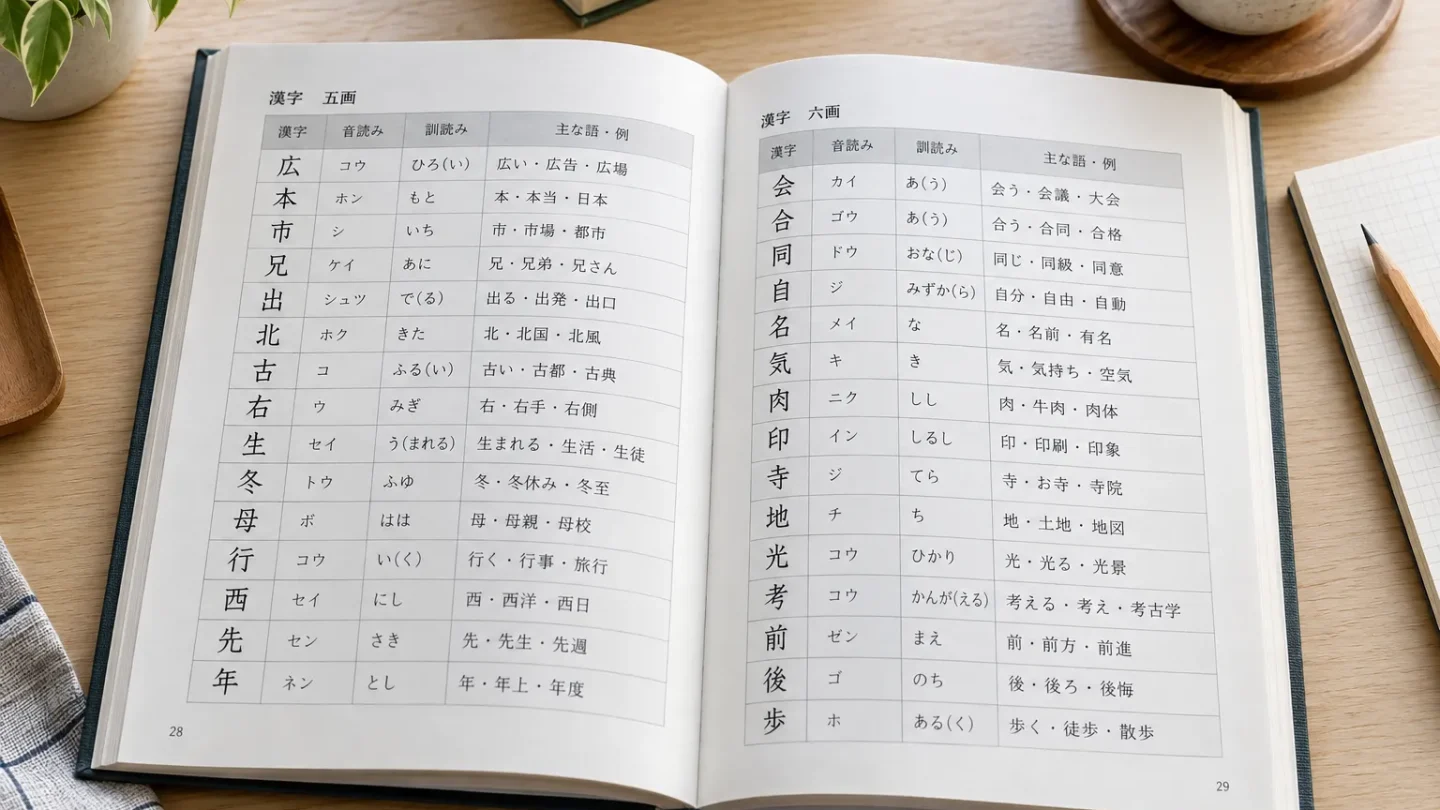
The joyo kanji list looks like a government-approved inventory of Japanese characters: columns of kanji, readings, example words, and notes. The current table contains 2,136 characters following a Cabinet notification issued on November 30, 2010. That revision added 196 characters and removed five from the previous total of 1,945. Yet the table is not a ban on every character outside it, nor is it the list Japanese parents consult on its own when registering a baby’s name. To understand what the document actually controls, you have to take it apart column by column—and keep two other official lists out of the same pile.
The heading defines ordinary public writing
The document is called 常用漢字表, Jōyō Kanji-hyō, literally “table of kanji for regular use.” Its preface describes the table as a guide for writing modern Japanese in ordinary social life. Government bodies use it when preparing official documents, and its choices influence newspapers, publishers, schools, and other public-facing writing.
The crucial word is guide. The Agency for Cultural Affairs explains that the table is not intended to cover specialist fields, scientific terminology, artistic writing, or personal and place names in every circumstance. A character outside the table is not thereby illegal, obsolete, or “not Japanese.” It may simply fall outside the shared baseline chosen for general communication.
This distinction saves you from a common mistake. If you find an unfamiliar character in a novel, historical document, temple name, technical manual, or surname, its absence from the table does not prove that the writer made an error. It tells you that the character is outside the government’s general-use reference framework.
If you are beginning rather than auditing official policy, The First Hundred Kanji and Why Those explains which characters give a learner the most useful starting base. The official table is a reference target, not a sensible order in which to memorize more than two thousand entries.
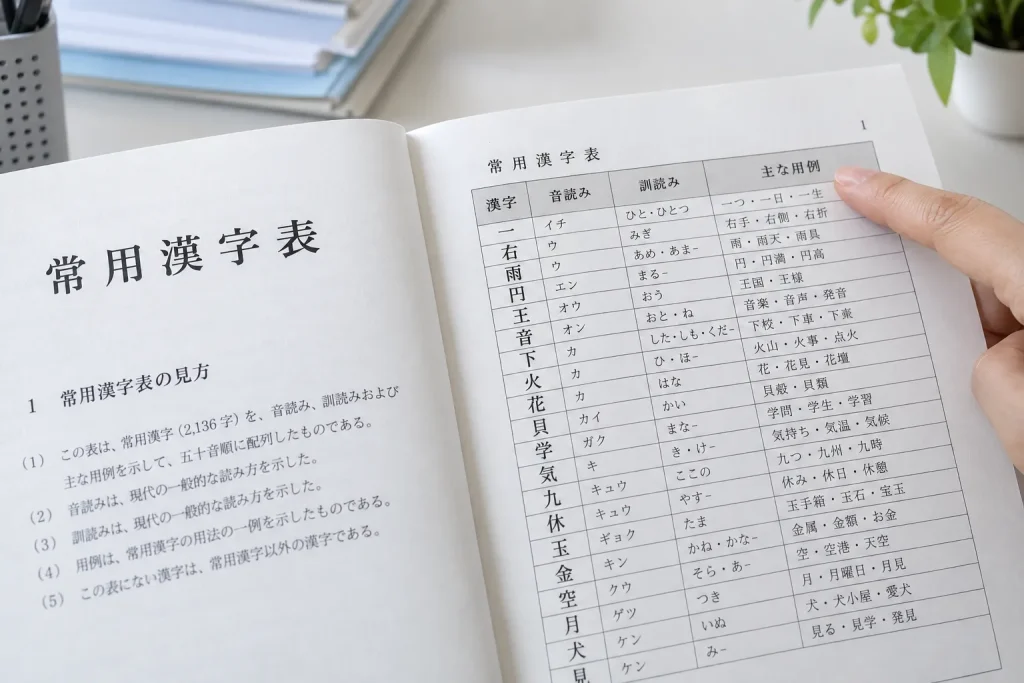
The character column contains 2,136 entries
The first part your eye catches is the character itself. The table’s 2,136 字種, jishu, literally “character types,” form the current common-use kanji inventory. The 2010 revision started from the previous 1,945-character table, removed 勺, 錘, 銑, 脹, and 匁, and added 196 characters, producing the present total.
That arithmetic is straightforward:
| Revision component | Characters | Effect on total |
|---|---|---|
| Previous table | 1,945 | Starting point |
| Characters removed | 5 | −5 |
| Characters retained | 1,940 | 1,945 − 5 |
| Characters added | 196 | +196 |
| Revised table | 2,136 | 1,940 + 196 |
The added group included characters that readers were already encountering in names, prefectures, news reports, digital text, and everyday vocabulary. Examples include 熊 in 熊本, Kumamoto; 阪 in 大阪, Ōsaka; and 鬱 in 憂鬱, yūutsu, “depression” or “gloom.” Their addition did not suddenly create those words. The revision brought the official baseline closer to writing that was already visible in public life.
The uncomfortable part is that “2,136 kanji” does not mean “2,136 items to learn and then you are finished.” A character can carry several approved readings, appear in compounds with meanings you cannot reliably derive from its parts, or have additional readings outside the table. Why the Same Kanji Sounds Different deals with that reading problem directly instead of treating each character as a one-sound symbol.
The reading column is a recommendation, not a complete dictionary
Beside each character is the 音訓, onkun, literally “on and kun readings” column. It records selected 音読み, on’yomi, “sound readings,” and 訓読み, kun’yomi, “meaning readings,” considered appropriate for the table’s general-use purpose. These are not every pronunciation the character has ever had.
The distinction becomes visible when a familiar character appears inside a name. A reading used in a surname or given name may not appear among the regular readings in the table. That does not automatically invalidate the name. Personal names sit partly outside the table’s stated scope, and the rules governing which written characters may be registered are not the same as a dictionary of all possible name readings.
“The table is intended as a guide when writing modern Japanese in ordinary social life.”
That is a short translation of the table’s stated purpose, not a promise that every real word can be generated from its columns. Treating the reading column as exhaustive is the component that is not what it first appears to be. It standardizes a practical core; it does not seal the language at its edges.
The broader relationship among kanji, hiragana, and katakana is covered in Hiragana, Katakana, Kanji: How Japanese Writing Works. The table here governs a selected kanji baseline, not when an entire Japanese sentence should switch among its scripts.
Examples show how a reading behaves inside a word
The next column is 例, rei, literally “example.” It gives words that demonstrate the listed reading and often reveals something the reading alone cannot show. A kun reading may be followed by okurigana, the kana ending that carries inflection or clarifies the word. A compound may also make the intended pronunciation much easier to recognize.
Take 鬱, one of the characters added in the 2010 revision. The reading ウツ appears with examples such as 憂鬱, yūutsu. The entry tells you three connected things: the character belongs to the general-use set, ウツ is an approved reading in this framework, and the example shows a real word in which that reading occurs. Looking at the character alone would tell you none of that.
This is also why a plain visual scan cannot replace the whole table. The same shape can participate in different words and readings, while similar-looking shapes may be unrelated. When you meet a character you cannot type or pronounce, How to Find a Character You Cannot Read explains how components, stroke count, and dictionary lookup work together.
The notes column carries the exceptions
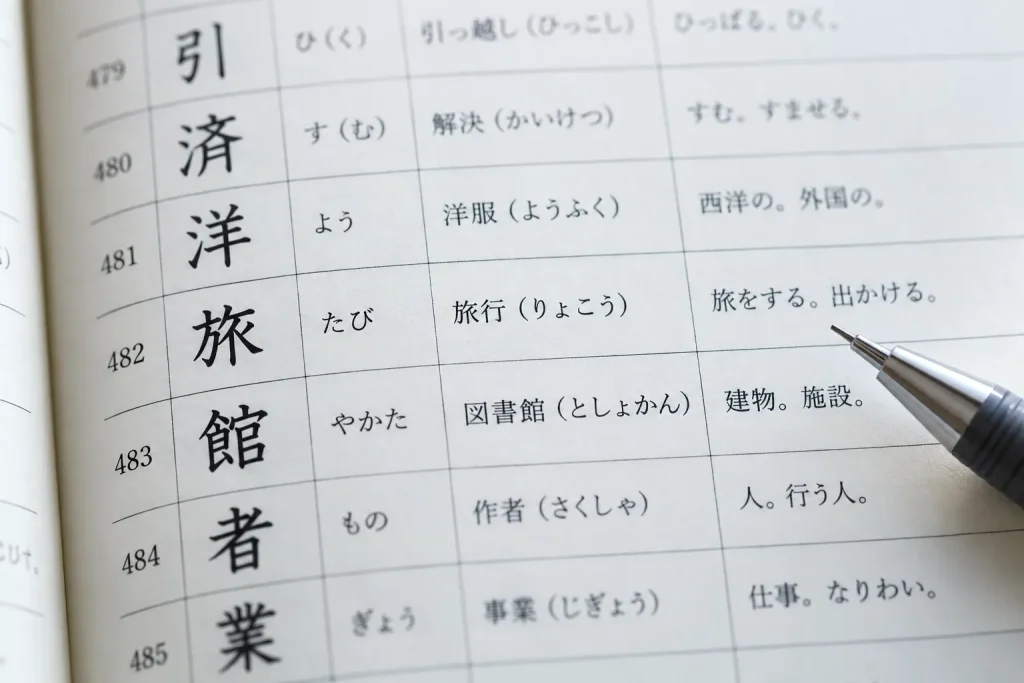
The final major part is 備考, bikō, literally “remarks.” It is easy to treat this as administrative clutter, but it contains information that can change how an entry should be read or written. Notes identify special readings, relationships between forms, prefectural uses, and other cases that do not fit neatly into the main columns.
A reader who copies only the character and its first pronunciation loses this layer. The complete entry is therefore not “kanji equals sound.” It is closer to a compact record containing:
- the character selected for general use;
- the readings included in the official guideline;
- examples showing those readings in words;
- kana endings where required;
- notes about forms or restricted applications.
Together, these parts show how a character participates in the recommended public-writing system. No single column can do that. The character column supplies membership, the reading column supplies approved pronunciations, the examples supply context, and the remarks handle the cases that resist a simple one-row rule.
The 1,026 school characters are a subset
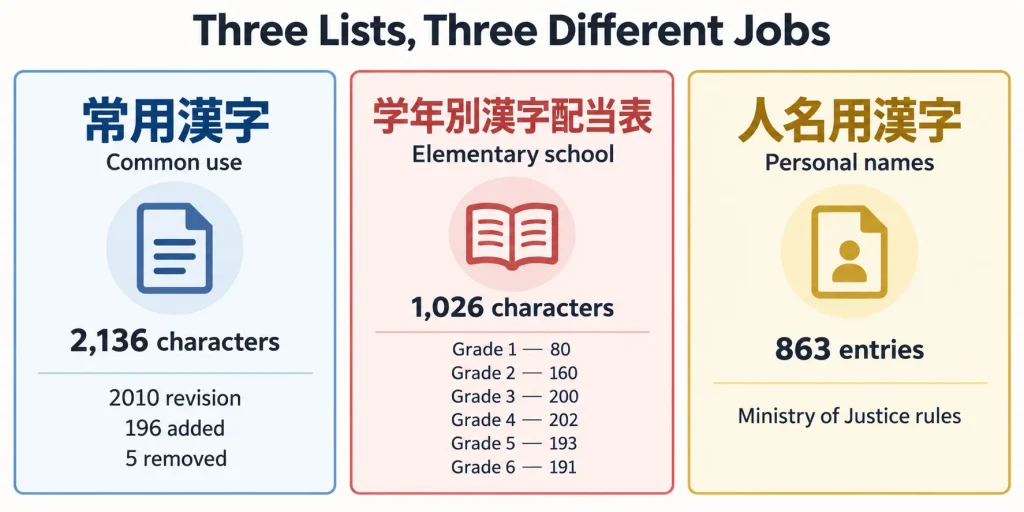
The second list frequently confused with the 2,136-character table is 学年別漢字配当表, Gakunenbetsu Kanji Haitō-hyō, literally “table of kanji allocation by school year.” It is commonly discussed as the school kanji list or 教育漢字, kyōiku kanji, “education kanji.” Under the elementary-school curriculum guidelines implemented from the 2020 school year, it contains 1,026 characters distributed across the six elementary grades.
The grade totals come directly from the Ministry of Education’s allocation table:
| Elementary grade | Assigned characters | Running total |
|---|---|---|
| Grade 1 | 80 | 80 |
| Grade 2 | 160 | 240 |
| Grade 3 | 200 | 440 |
| Grade 4 | 202 | 642 |
| Grade 5 | 193 | 835 |
| Grade 6 | 191 | 1,026 |
These 1,026 characters are not a rival version of the 2,136. They sit inside it. The allocation table answers when elementary pupils are introduced to particular characters, while the larger table defines the broader general-use baseline that education continues to address beyond elementary school.
That difference also explains why “Japanese children learn 1,026 kanji” is incomplete. They are allocated 1,026 during elementary school; that number is not the final general-use inventory. Equally, the table does not mean every child permanently masters every reading, compound, handwritten distinction, and real-world use on the day a character is assigned.
The 863 name characters solve a different legal problem
The third document is 人名用漢字別表, Jinmeiyō Kanji Betsuhyō, literally “separate table of kanji for use in personal names.” Its 863 entries supplement the common-use characters for the purpose of registering a child’s name. The Ministry of Justice states that kanji in both the common-use table and the personal-name table may be used in children’s names.
This is a legal-administrative function, not a school syllabus or a measure of everyday frequency. Under Article 50 of Japan’s Family Register Act, a child’s name must use characters that are common and easy to use, with the permitted range prescribed by Ministry of Justice regulation. The separate table exists because families use name characters and forms that the general-purpose writing table does not need to include.
There is another trap inside the number 863: the list includes variant forms, so it should not be described casually as 863 wholly unrelated extra concepts. The written form matters in family registration. Two shapes that a learner might regard as old and new versions of “the same kanji” can have distinct administrative treatment.
The name rule controls permitted written characters, but it has not traditionally supplied a closed list of permitted pronunciations for them. That gap is one reason a written Japanese name may not tell you its reading with certainty. For foreign names, the site’s name converter with 898 checked names in katakana deals with transliteration into katakana; it does not generate Japanese legal kanji names.
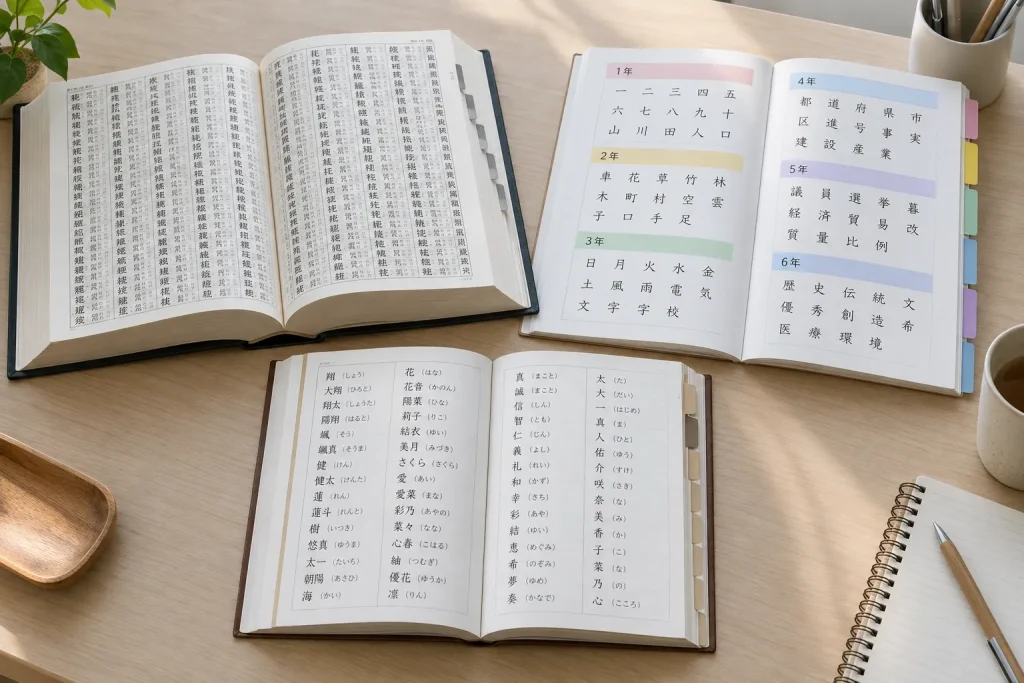
Three lists answer three different questions
Placing the totals side by side makes the boundary clear. The numbers should never be added as though they describe three disjoint vocabularies. The school set is contained within the common-use set, while the personal-name table supplements the characters generally available for names and includes variant forms.
| Japanese list | Number | Authority and current basis | Question it answers |
|---|---|---|---|
| 常用漢字表, Jōyō Kanji-hyō | 2,136 | Cabinet notification, November 30, 2010 | Which kanji and readings form the general-use guideline? |
| 学年別漢字配当表, Gakunenbetsu Kanji Haitō-hyō | 1,026 | MEXT elementary curriculum guidelines, implemented from 2020 | Which kanji are allocated across elementary grades? |
| 人名用漢字別表, Jinmeiyō Kanji Betsuhyō | 863 | Ministry of Justice regulation; current total after the 2017 addition | Which additional kanji and forms may be used in registered personal names? |
The combination tells you which authority is speaking and why. If you are editing an ordinary public document, you begin with the common-use table. If you are checking what a pupil meets in a particular grade, you need the allocation table. If you are registering a child’s name, you must use the Ministry of Justice rules rather than assuming that frequency, tradition, or dictionary inclusion is enough.
The three totals—2,136, 1,026, and 863—are memorable, but purpose is more important than size. A larger list is not automatically more advanced, and a character on the name list is not necessarily something every adult uses in ordinary prose.
Printed and handwritten forms may look different
A modern font can make an official character appear more rigid than its handwritten version. In 2016, the Agency for Cultural Affairs published guidance covering all 2,136 common-use characters and explaining acceptable differences between printed typefaces and handwriting. The report’s purpose was partly to counter the belief that a handwritten character is wrong whenever it fails to reproduce a typeface detail exactly.
This is the modern variant that matters most to everyday learners. Font design, handwritten strokes, and device rendering can change the appearance of a character without changing its identity. At the same time, some differences do represent separate character forms, especially in the personal-name system. You cannot apply the loose rule “close enough means the same character” to a family-register form.
Digital text adds encoding and font-availability problems, but it does not change which national body maintains each list. Nor do regional accents create regional common-use inventories. Pronunciation varies across Japan, and local names preserve unusual readings, yet the national table remains national.
What never changes from region to region
Japan does not issue a separate 2,136-character table for Kansai, Tohoku, Kyushu, or Hokkaido. Schools follow national curriculum standards, although teachers, textbooks, and local vocabulary naturally vary. Municipal family-register offices apply national naming law rather than maintaining independent regional name-kanji lists.
Place names are precisely where you should expect the neat framework to stop predicting everything. Their characters and readings may preserve local history, older forms, or pronunciations that cannot be recovered from the general-use reading column. That is not evidence of a second regional table. It is evidence that place names were never fully governed by the ordinary-writing guide in the first place.
The same caution applies to romanization. When a government form, passport, station sign, or language book renders Japanese in Latin letters, the result belongs to a different standardization problem. Romaji Explained: Three Systems and Which One to Use covers those competing systems without folding them into kanji policy.
Read the row, not just the character
The next time you see an entry from the official table, look past the large kanji at the left. Check the approved reading, the example word, and the remarks column before deciding what the entry tells you. Then ask which list you are actually consulting: general use, elementary education, or names.
That small check prevents the largest misunderstanding. The Japanese government does not “sign off” on every legitimate use of written Japanese through one master inventory. It maintains separate instruments for separate jobs, and the details beside each character explain far more than membership alone.