You learn to count to ten in Japanese in about five minutes. Then you try to order two coffees and discover that “two” is a different word depending on whether you’re counting coffees, tickets, people or cats — and that there are two competing systems for the numbers themselves.
This is the part of Japanese that looks like unnecessary difficulty and turns out to be one of the most useful things to get straight early, because numbers appear in every transaction you’ll have.
Two counting systems, both alive
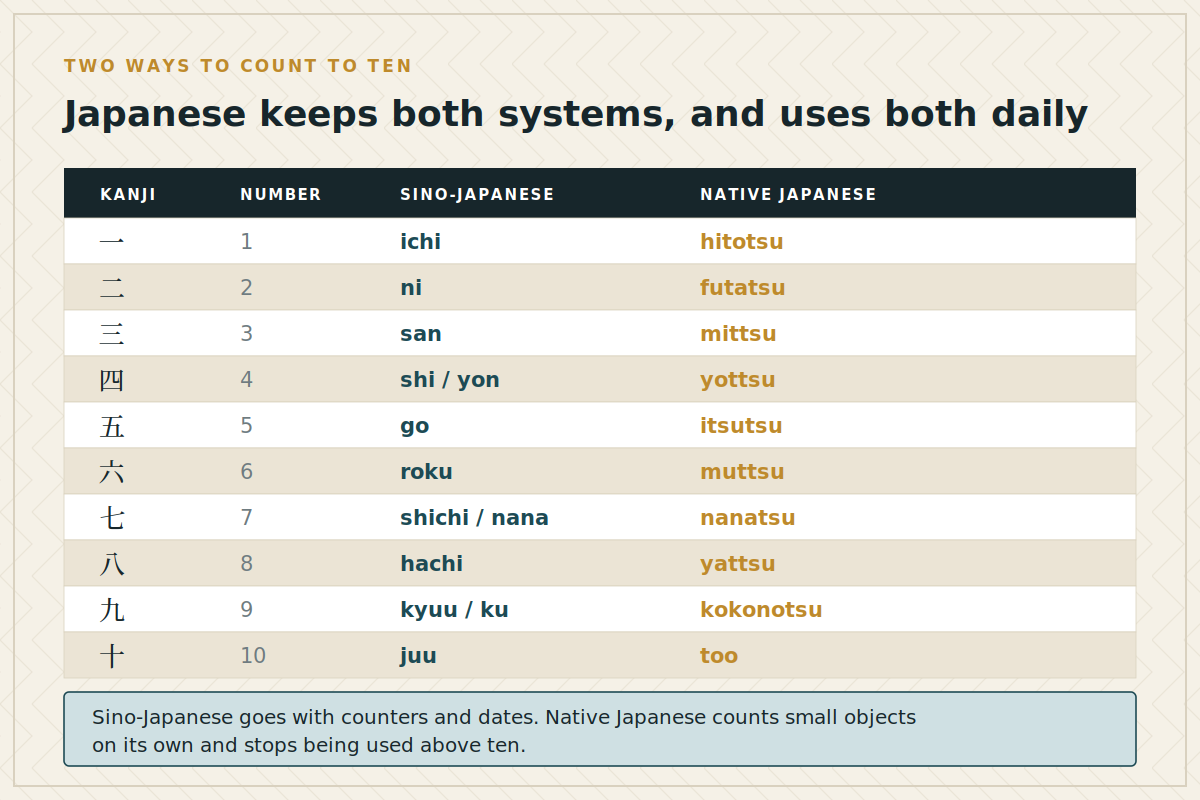
Japanese borrowed Chinese numerals more than a thousand years ago and kept its own alongside them. The result is two sets of readings for the same characters.
Sino-Japanese — ichi, ni, san, shi/yon, go, roku, shichi/nana, hachi, kyū/ku, jū — is the workhorse. Prices, phone numbers, dates, addresses, times, and anything attached to a counter. This is the set to learn first.
Native Japanese — hitotsu, futatsu, mittsu, yottsu, itsutsu, muttsu, nanatsu, yattsu, kokonotsu, tō — is used for counting small objects on its own, without a counter, and effectively stops at ten. It’s what you use when you don’t know the right counter, which makes it quietly the most practical thing on this page.
Above ten the system is beautifully regular: 11 is jū-ichi (ten-one), 20 is ni-jū (two-ten), 47 is yon-jū-nana. There are no irregular teens to memorise.
The numbers with two readings
Four, seven and nine each have two Sino-Japanese readings, and the choice is not free. Shi (four) is a homophone of 死, death, and ku (nine) of 苦, suffering, so both are avoided in many contexts in favour of yon and kyū. When in doubt, use yon and kyū — they’re safe everywhere, while shi and ku are fixed in particular expressions like 四月 (shigatsu, April).
This avoidance is the same instinct that leads some Japanese hospitals to skip room number four and some buildings to skip floor four — a superstition with the same shape as Western thirteen, and one you’ll notice in lifts once you know to look.
Counters: the part that surprises people
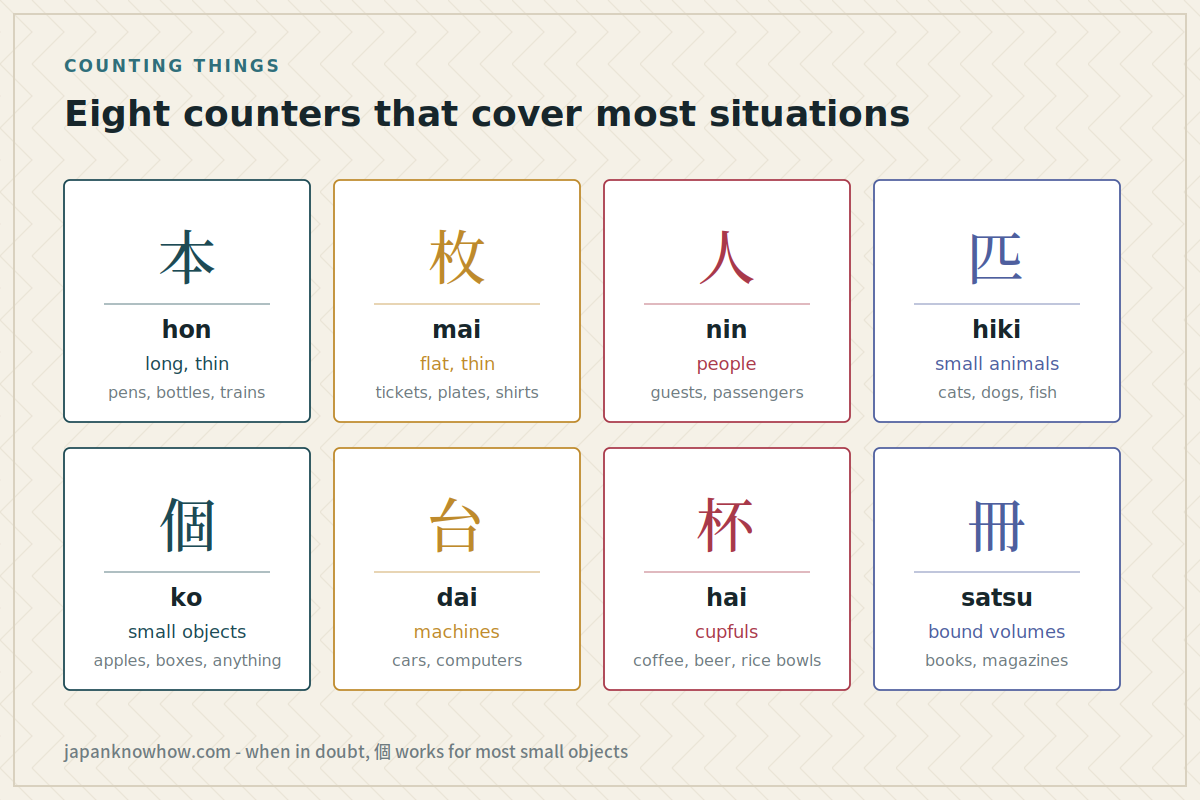
In Japanese you can’t simply say “three.” You say “three long-thin-things” or “three flat-things” or “three people,” using a counter word attached to the number.
English does this occasionally — three sheets of paper, two head of cattle, a pair of trousers — but treats it as optional style. Japanese treats it as grammar, and there are several hundred counters, of which about a dozen cover ordinary life.
| Counter | Reading | Counts | Example |
|---|---|---|---|
| 本 | hon | long, thin things | pens, bottles, umbrellas, trains |
| 枚 | mai | flat, thin things | tickets, plates, shirts, paper |
| 人 | nin | people | guests, passengers, family members |
| 匹 | hiki | small animals | cats, dogs, fish, insects |
| 個 | ko | small objects, general | apples, boxes, almost anything |
| 台 | dai | machines and vehicles | cars, computers, washing machines |
| 杯 | hai | cupfuls and bowlfuls | coffee, beer, rice, ramen |
| 冊 | satsu | bound volumes | books, magazines, notebooks |
The sound changes
Counters shift their sound depending on the number in front, following the same phonetic pressures that reshape borrowed words. 本 is hon, but one is ippon, three is sanbon, six is roppon, eight is happon. 人 is nin, but one person is hitori and two people is futari, both survivals of the native system.
This looks like arbitrary memorisation and mostly isn’t: the changes cluster around one, three, six, eight and ten, and they follow patterns that will feel familiar if you’ve read our piece on how Japanese reshapes sounds it finds awkward. The same forces are at work.
What to do when you don’t know the counter
Three escape routes, in order of usefulness:
- Use the native numbers. Hitotsu, futatsu, mittsu work for most small objects with no counter attached at all. “Two, please” — futatsu kudasai — is understood in any shop.
- Use 個, read ko. The general-purpose counter for small objects. Slightly less elegant than the specific one, entirely acceptable.
- Point and say the number. Not elegant at all. Works every time.
When in doubt, futatsu. Nobody has ever been misunderstood for using the general counter, and plenty of people have frozen up hunting for the right one.The practical rule
Dates and money, which follow their own rules
Two areas where the numbers behave differently enough to be worth a separate look.
Days of the month mix the two systems. The first ten days plus the fourteenth, twentieth and twenty-fourth use native readings — the first is tsuitachi, the twentieth is hatsuka — while the rest use Sino-Japanese plus nichi. The months, by contrast, are perfectly regular: month one, month two, all the way to month twelve.
Years come in two flavours, and this catches Americans out on official paperwork. Alongside the Western year, Japan uses era years — Reiwa 8 for 2026 — and forms frequently want that one. Converting between them, including the transition years where a single calendar year belongs to two eras, is what our Japanese era tool is for.
Money is straightforward: yen has no subunit, so prices are whole numbers, and the counting is the same regular system. The one adjustment is scale. Japanese groups large numbers in units of ten thousand (万, man) rather than thousands, so ¥30,000 is read san-man en, “three ten-thousands.” Once you’re thinking in man, prices stop requiring arithmetic.
Where to start
If you’re learning for a trip, this is the sequence that pays off fastest:
- Sino-Japanese one to ten, plus the ten-based pattern above it.
- Hitotsu through itsutsu — one to five in the native set — which will handle most counter situations you meet in a shop.
- 枚 for tickets and 人 for people, the two counters you will genuinely need.
- Reading prices in man, which turns hotel and shopping figures from a calculation into a glance.
Everything else can wait. The counters are a large system that looks intimidating listed out, and in practice you’ll use six of them for years. If you want the wider context for how these characters and readings fit together, our overview of how Japanese writing works covers why the same character has two readings in the first place, and how many kanji you actually need puts the numeric characters in the right order of priority.