Japanese is often described as having three writing systems, which makes it sound like a language that couldn’t make up its mind. It’s closer to the truth to say Japanese has one writing system with three components, each doing a job the others can’t, all in the same sentence.
Once you see what each one is for, a page of Japanese stops being an undifferentiated wall and starts having structure you can read even before you know the words. That’s the goal of this article: not to teach you the characters, but to teach you the layout.
The sentence above, unpacked
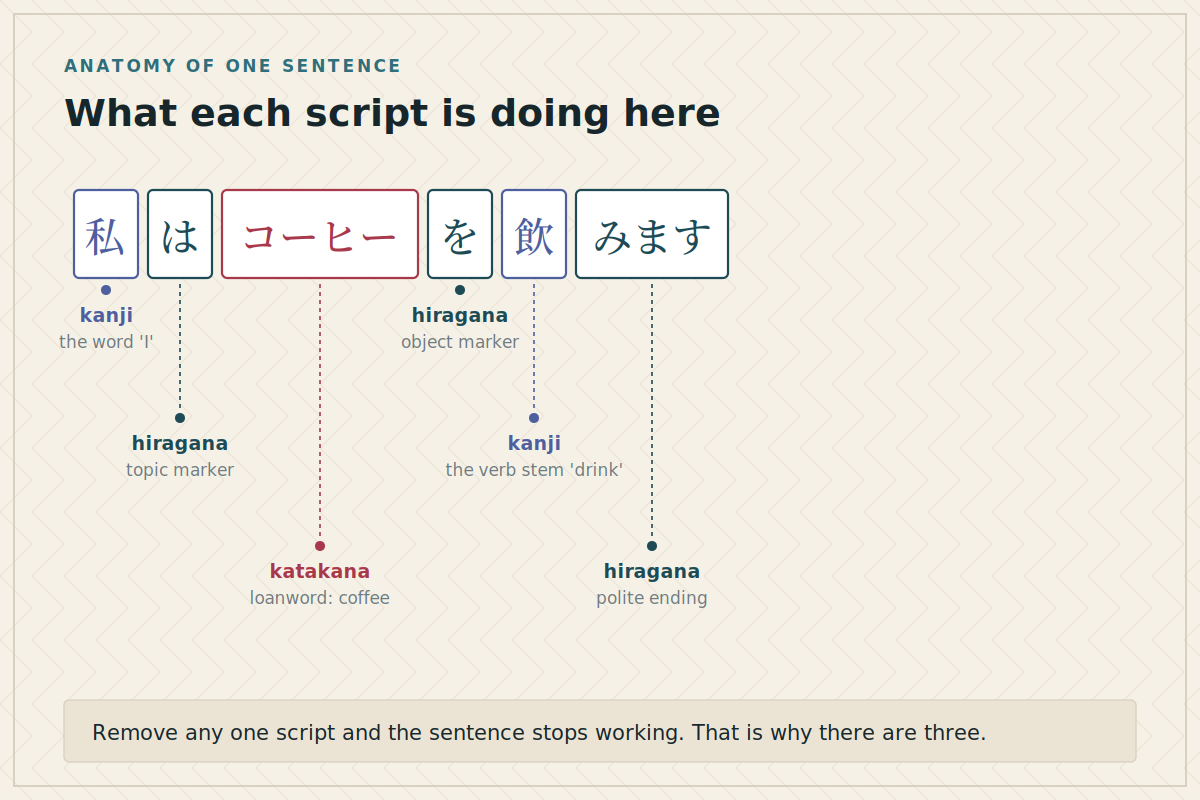
私はコーヒーを飲みます — watashi wa kōhī o nomimasu, “I drink coffee.” Six pieces, and the script of each one tells you what it is before you know what it means:
- 私 — kanji. A whole word carrying meaning: “I.”
- は — hiragana. A grammatical particle marking the topic.
- コーヒー — katakana. A borrowed word, instantly flagged as foreign.
- を — hiragana. Another particle, marking the object.
- 飲 — kanji. The core of the verb, “drink.”
- みます — hiragana. The polite ending attached to that verb.
Notice what the mixture buys. Japanese doesn’t put spaces between words, so a page of pure hiragana would be a continuous stream you’d have to parse by ear. The alternation between kanji blocks and hiragana connective tissue does the job spaces do in English: it shows you where the units are.
What each script is for
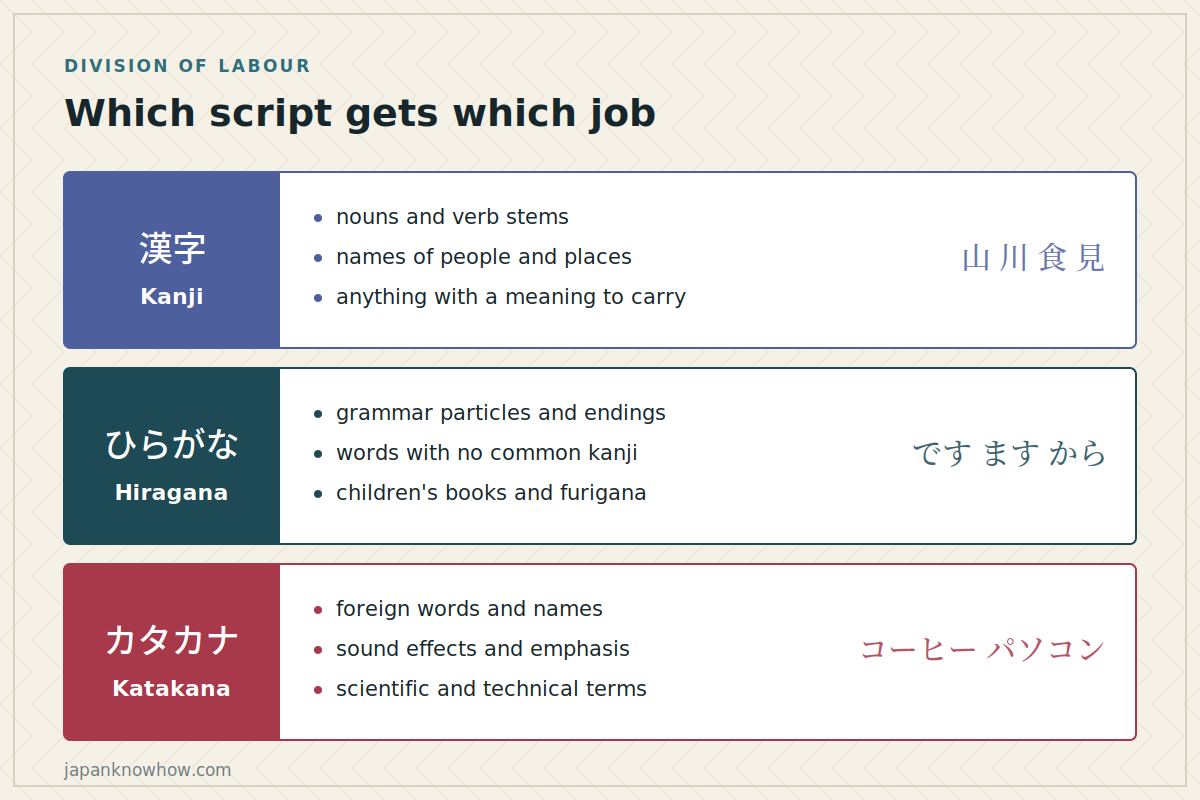
Kanji: the meaning carriers
Characters borrowed from Chinese, roughly 1,500 years ago, each carrying a meaning and usually several possible readings. They do the heavy lifting: nouns, the stems of verbs and adjectives, names of people and places.
The multiple-readings problem is real and it’s the reason kanji take years rather than months. 生 can be read sei, shō, i, u, nama, ki and more, depending on the word it’s sitting in. But there’s a payoff: because each character carries meaning, you can often guess a compound you’ve never seen. How many you actually need is a separate question, and a more cheerful one — we’ve written about how many kanji are really required and what each additional thousand buys you.
Hiragana: the glue
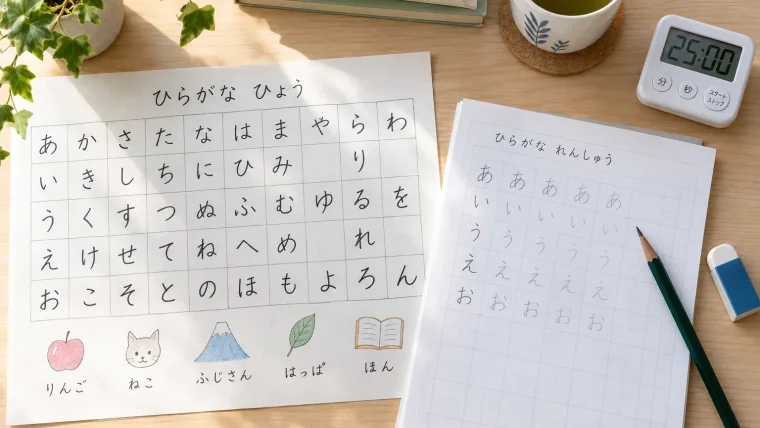
A syllabary — 46 basic characters, each standing for a sound rather than a meaning. Hiragana handles everything grammatical: particles, verb endings, adjective inflections, and any word that has no common kanji or whose kanji is too rare to use.
Its shapes are curved and flowing, which is a historical accident with a useful side effect: you can spot hiragana at a glance without reading it. Children’s books are written entirely in hiragana, and beginners’ textbooks lean on it heavily before introducing characters.
Katakana: the outsider marker
The second syllabary, covering the same sounds as hiragana with different, angular shapes. Its main job is marking words as foreign: loanwords, foreign names, and foreign place names. It also does duty for onomatopoeia, scientific names, and emphasis — roughly where English uses italics.
This is the script your own name goes in. Not as a demotion but as a signal: a Japanese reader seeing katakana knows immediately not to look for meaning in the characters and roughly how to pronounce what follows. The rules for getting from an English name to katakana, and the places those rules break, are covered in our guide to writing your name in Japanese.
A fourth system you’ll meet immediately
Romaji — Japanese written in the Latin alphabet — isn’t part of the native system, but you’ll see it everywhere: on station signs, on passports, in the input method used to type Japanese on a keyboard.
The complication is that there are three competing romanization schemes and they disagree about several common syllables. The syllable し is shi in one system and si in another. Which one you’re looking at matters, and we’ve mapped the differences in the article on romaji systems.
Why not simplify?
The obvious question. If hiragana can write every Japanese sound, why keep 2,000 characters that take a decade to learn?
It has been proposed, seriously, more than once — during the Meiji period and again under the Occupation. It didn’t happen, and the reason is homophones. Japanese has a modest sound inventory and an enormous number of words that sound identical. Kōshō can mean negotiation, mineral spring, artisan, or a dozen other things; the kanji distinguish them instantly and hiragana would not. Written Japanese leans on kanji to do work that spoken Japanese does with context.
| Written | Read as | Means |
|---|---|---|
| 橋 | hashi | bridge |
| 箸 | hashi | chopsticks |
| 端 | hashi | edge |
| 科学 | kagaku | science |
| 化学 | kagaku | chemistry |
In speech, pitch accent and context sort most of these out. On paper, without kanji, you’d be guessing.
Remove any one of the three scripts and the sentence stops working. That is why there are three.The short answer to “why so complicated?”
What this means if you’re learning
A practical order of operations, based on what unlocks the most for the least effort:
- Hiragana first. Forty-six characters, learnable in a week or two. It gets you reading grammar and using a dictionary.
- Katakana second. The same sounds, different shapes, and disproportionately useful as a traveller because menus, coffee shops, and station signage are full of borrowed words. Fair warning: a borrowed word doesn’t always mean what its English source means, which is the subject of our piece on Japanese loanwords.
- Numbers and counters. Small, self-contained, and immediately useful for prices, dates and quantities — though Japanese counts differently depending on what shape the thing is. We’ve laid that out in the guide to numbers and counters.
- Kanji last, and gradually. Start with the ones you actually meet: 出口 exit, 入口 entrance, 円 yen, 駅 station.
If you’re not learning the language and just want to read a sign or write your name correctly, you can skip most of this. The one thing worth keeping is the recognition step: curvy characters are grammar, angular ones are foreign words, dense ones are meaning. That alone will tell you what part of a menu is the dish and what part is the description.
One last thing about mixed text
Modern Japanese also mixes in Arabic numerals, Latin abbreviations and the occasional English word, all in the same line. A price tag might read 1,200円, a station sign JR新宿駅. This isn’t sloppiness — it’s a writing system comfortable with borrowing, which is the same instinct that produced katakana in the first place.
The upshot for a reader is reassuring. You do not need to decode a Japanese page from left to right in one pass. You can read the shapes first, work out where the units are, and only then worry about what they say.