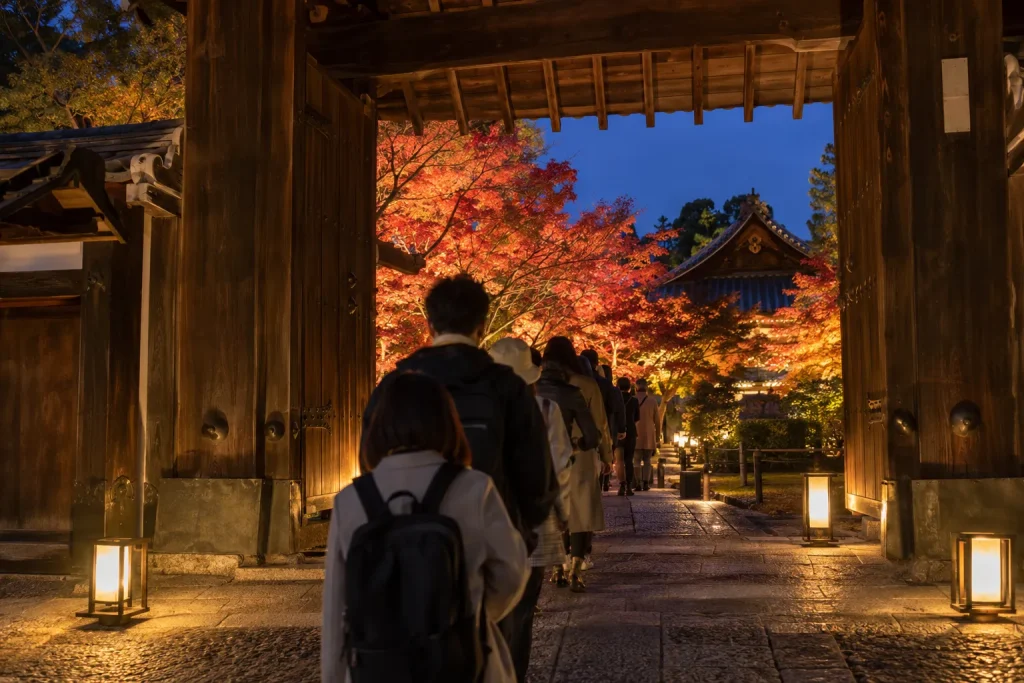
You are standing outside a Kyoto temple at 5:15 p.m., the daytime exit is moving in one direction, and a new line is forming across the street. Join the new line only if you have checked the evening admission: a night illumination may be a separate paid session, not an extension of your daytime visit.
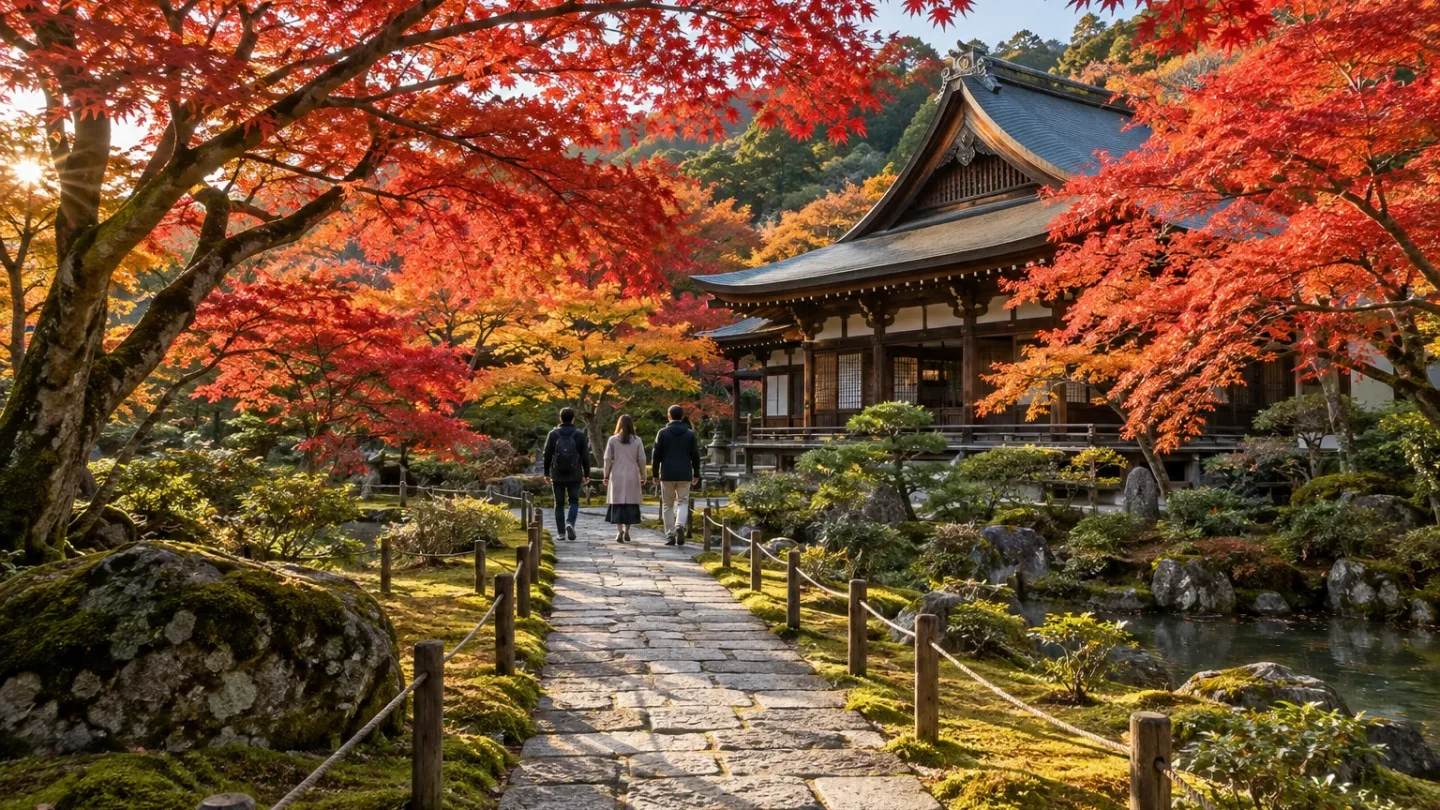
The autumn leaves Japan trip sold in photographs is really a moving calendar. Color begins at high elevations in Hokkaido in September, descends through northern and central Japan during October, and usually reaches lowland Kyoto in the second half of November. In 2026, however, forecasts issued in September put many cities later than normal—and Kyoto’s maples may not peak until December.
How do I follow the autumn leaves Japan calendar?
Use the sequence below in order. Do not begin with a famous temple and then try to force the season around it. Begin with your dates, locate the color front, and choose places that fit the stage the leaves have actually reached.
- Fix the dates you cannot change. Write down every full day when you can view leaves, including arrival and departure constraints. What you see next depends on latitude, elevation, tree species, and recent temperatures—not merely whether your trip falls in “fall.”
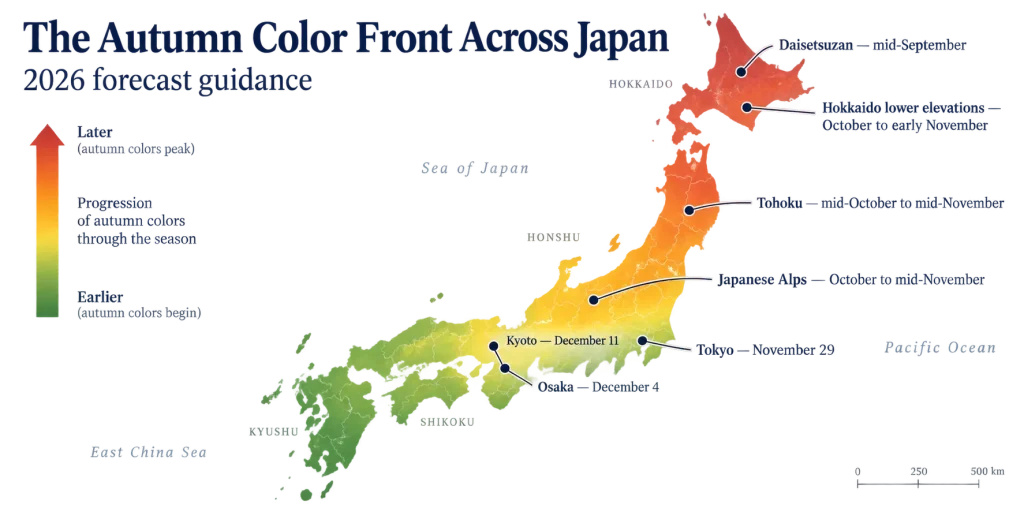
- Find the front, not a national peak date. Look for 紅葉, kōyō, literally “red leaves” or “autumn coloring,” on a current forecast. The front begins in northern mountains and advances generally southward and downhill. A September traveler looks toward Daisetsuzan in Hokkaido; a late-November traveler may be looking at Kyoto or Tokyo.
- Check an individual viewing site. City-level dates are orientation points, not promises for every garden. A high mountain, shaded gorge, urban park, and temple courtyard in the same prefecture can peak at different times. Open the location’s status page and look for labels such as “starting to color,” “best viewing,” or “past peak.”
- Separate red maples from yellow ginkgo. 紅葉, momiji, literally “autumn leaves” and commonly used for maples, does not follow precisely the same schedule as 銀杏, ichō, “ginkgo.” A forecast may publish separate red-leaf and yellow-leaf dates. Confirm which tree produces the scene you expect.
- Choose a flexible day route. Put one primary site and one nearby alternative into your plan. What happens next is simple: if the first location is still green or already bare, you move to the second rather than losing half a day crossing a city.
- Check admission and opening hours again. Temples may extend their hours for autumn, require another ticket at night, or clear daytime visitors before illumination admission begins. Official schedules outrank travel blogs and last year’s social posts.
- Arrive before the crowd pattern peaks. For ordinary daytime viewing, early opening is usually more useful than arriving at midday. For an illumination, arriving at lighting time may put you into the first major queue; later entry can be calmer, but only if you leave enough time before final admission.
- Check the same-day evidence. Look at the venue’s official update, live camera, or a recent dated photograph. A seasonal forecast narrows the window; it cannot confirm that yesterday’s wind did not strip a particular slope.
For Japan’s wider seasonal rhythm—including holidays that can change transport demand—What Happens in Japan, Month by Month is the planning hub. This article stays with the moving leaf front and the practical viewing sequence.
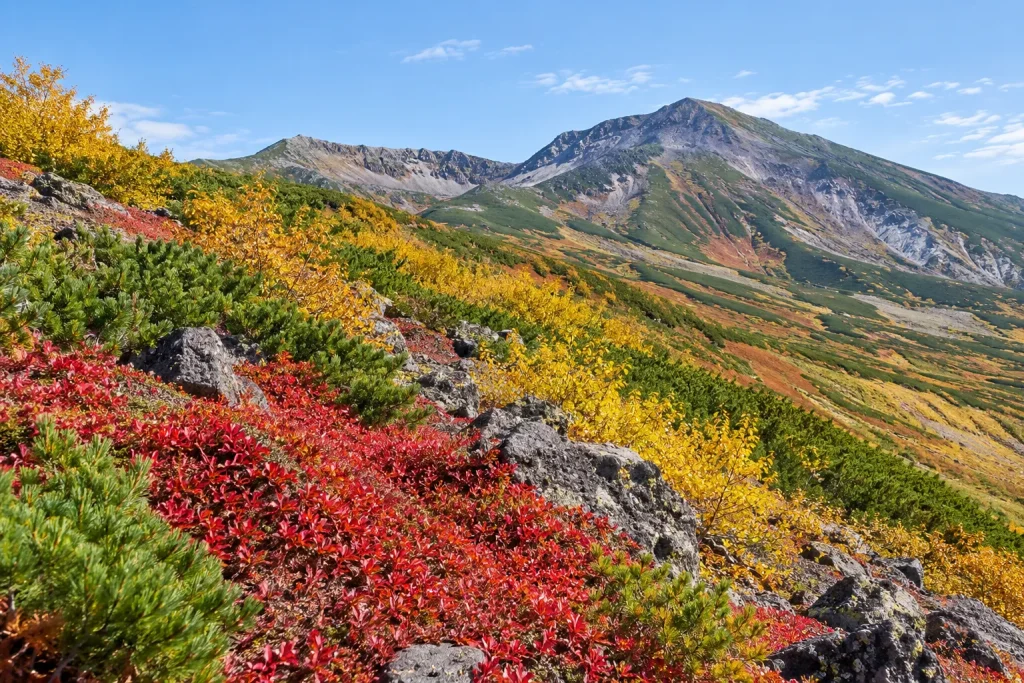
When does the color front reach each region?
The table is a planning range, not a guarantee. Mountains turn before nearby cities, and the spread within a region can cover several weeks. The 2026 forecast is especially important because warm conditions are expected to delay color at many lower-elevation sites.
| Region or representative area | Typical planning window | 2026 signal checked in September | What to target |
|---|---|---|---|
| Daisetsuzan, Hokkaido | Mid-September to early October | High-elevation color expected from mid-September | Alpine slopes and ropeway viewpoints |
| Hokkaido cities and lower elevations | October to early November | Some locations forecast later than normal | Parks, university avenues, lake shores |
| Tohoku | Mid-October to mid-November | Generally normal to later than normal | Gorges, lakes, mountain roads |
| Japanese Alps and higher central Honshu | October to mid-November | Timing varies sharply by elevation | Cable cars, valleys, castle towns |
| Tokyo | Mid-November to early December | Maple peak forecast around November 29 | Urban gardens and maple valleys |
| Kyoto | Late November into early December | Maple peak forecast around December 11 | Temple gardens and wooded hills |
| Osaka | Late November into early December | Maple peak forecast around December 4 | Parks, castle grounds, nearby valleys |
| Southern and western lowlands | Late November into December | Many lowland sites expected late | Gardens, parks, temple precincts |
This corrects an easy oversimplification in the working angle. “Hokkaido in September to Kyoto in late November” describes the broad long-term journey, but the 2026 Japan fall foliage forecast is later. Japan Weather Association reporting and Japan Weather Corporation’s first 2026 forecast place Kyoto’s representative maple peak around December 11, not in late November.
The date does not mean Kyoto will be green everywhere until December 10 and perfect everywhere on December 11. Trees change gradually, and individual sites differ. A traveler in late November should still find color, but the mix may include green, orange, and partial red rather than uniform peak foliage.
Why does the forecast move every year?
Autumn color is a plant response, not a fixed festival date. As days shorten and temperatures fall, trees reduce chlorophyll production, revealing or producing the pigments associated with yellow, orange, and red leaves. The pace differs by species and local conditions.
Warm temperatures can delay the process. Elevation usually brings cooler conditions, so mountain color tends to precede nearby lowland color. Slope direction, sunlight, moisture, drought stress, wind, and sudden cold can change both timing and quality.
A forecast therefore changes as newer temperature observations and forecasts replace earlier assumptions. In early September, the useful question is “Which week is most likely?” Closer to your visit, the useful question becomes “What stage is this individual site reporting today?”
The uncomfortable part is that booking airfare around a single predicted peak date months ahead does not buy certainty. You reduce the risk by giving yourself several elevations or nearby regions, not by treating one forecast icon as an appointment.
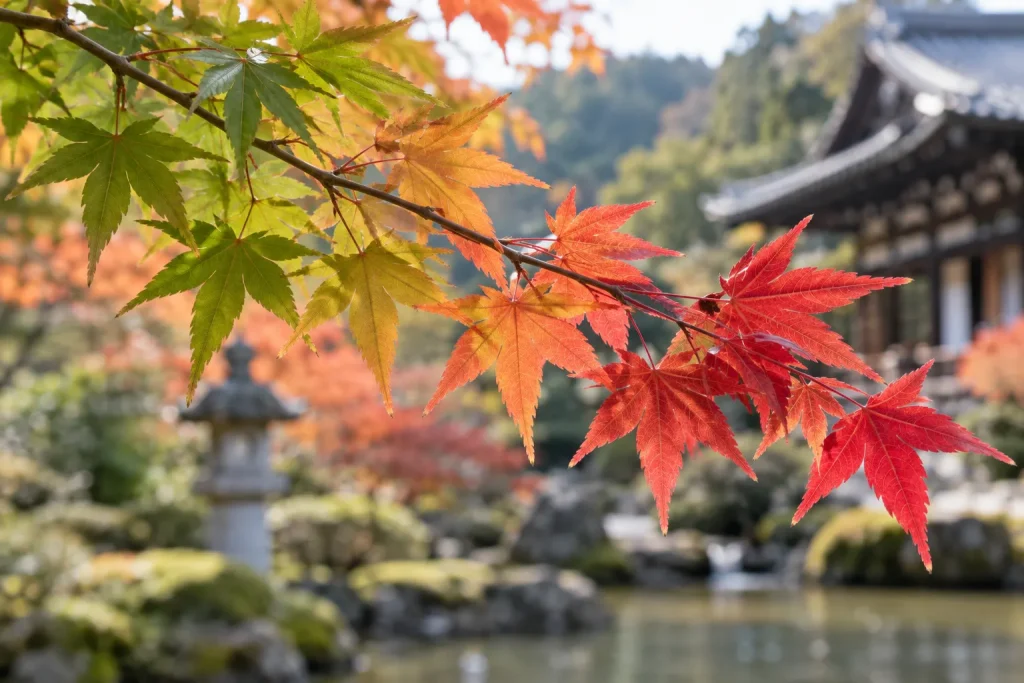
How do I read a kōyō forecast correctly?
First identify whether the map refers to red maples or yellow ginkgo. Then check whether its date means “color begins” or 見頃, migoro, literally “best viewing time.” Those are not interchangeable.
Forecast services also use status scales. The English wording varies, but the sequence typically resembles:
- green or not yet changing;
- beginning to color;
- coloring in progress;
- best viewing;
- beginning to fall;
- past peak.
A “best viewing” marker is not a promise of one perfect day. It usually represents a usable viewing period. If your trip falls near an edge of the predicted window, recent photographs matter more than the national map.
Do not compare dates from different forecast publishers without checking their definition. One service may predict the representative date of peak color, while another displays a multi-day viewing window. Both can be internally reasonable and still show different dates.
Do Kyoto temple illuminations use the same ticket?
Sometimes, but not reliably. Each temple sets its own rules, dates, admission price, last-entry time, and whether daytime visitors must leave. Treat Kyoto autumn illuminations as ticketed events separate from free public parks.
The confirmed 2026 examples below show why you must check venue by venue. Dollar equivalents use the Bank of Japan’s September 11, 2026 reference rate of roughly ¥153–¥154 per US dollar and are rounded only to help with budgeting.
| Kyoto venue | 2026 evening dates and hours | Adult evening admission | Day-to-night rule |
|---|---|---|---|
| Kōdaiji | October 23–December 13; lights from 5 p.m.; last admission 9:30 p.m.; closes 10 p.m. | ¥800, about $5.20 | Same daytime and evening admission; no readmission after exiting |
| Tōji | October 31–December 13; 6–9:30 p.m.; last admission 9 p.m. | ¥1,000, about $6.50 | Separate night program; no group discount or combined ticket |
| Eikandō | November 20–December 6; 5:30–8:30 p.m. admission; closes 9 p.m. | ¥1,000, about $6.50 | Day and night are cleared separately; you cannot remain inside |
| Kiyomizu-dera | November 21–30; open until 9:30 p.m.; last admission 9 p.m. | Confirm on official admission notice | Dates are confirmed, but check the current admission page before visiting |
Eikandō makes the distinction unusually clear. Its daytime Autumn Temple Treasures Exhibition runs from November 11 through December 6 and costs ¥1,500, about $9.75, for a general adult ticket. The illumination begins on November 20, costs another ¥1,000, and operates as a separate session. Paying for daytime entry does not let you stay continuously for the lights.
Kōdaiji works differently in 2026. It opens during the day, switches on its lights at 5 p.m., and does not use a daytime-nighttime clearing system. However, once you exit, the same ticket does not admit you again.
This is where travelers stall: they assume “extended hours” means ordinary daytime access simply continues everywhere. It does not. Before committing to two famous venues in one evening, calculate their separate queues, admission deadlines, and travel time.
Where does the sequence usually go wrong?
The first failure is booking Kyoto in early November because an advertisement says “autumn.” Kyoto may have scattered early color then, especially at cooler sites, but lowland peak color normally comes later. In 2026, forecasts indicate an even later season.
The second is reading a Hokkaido headline as though it describes Sapporo city. Japan’s earliest widely reported foliage appears high in the Daisetsuzan range. The mountains can be coloring while lower urban trees remain green.
The third is confusing an event period with a peak forecast. Kōdaiji’s 2026 illumination begins on October 23, weeks before Kyoto’s currently predicted representative peak. The long event window is operational; it does not certify peak leaves on every night.
The fourth is assuming that a rail pass solves the problem by making daily long-distance chasing economical. A pass may or may not pay off, and a rushed transfer can consume the daylight you intended to use. Choose a base with several elevations nearby before buying transport around an imagined cross-country pursuit.
How does the plan change between Hokkaido, Tokyo, and Kyoto?
In Hokkaido, elevation is the main lever early in the season. September color generally means mountains rather than every city park. Hiking conditions, ropeway operations, wind, and cold matter more than temple opening hours, so check outdoor safety information as carefully as the leaf status.
In Tokyo, the season is easier to combine with an existing city trip. Gardens and avenues are connected by urban transit, and you can substitute one location without changing hotels. Ginkgo and maple schedules may differ, giving you more than one type of color to target.
Kyoto requires the most disciplined crowd planning. Famous temple gardens have fixed gates, admission fees, narrow approaches, and evening events. The city’s official congestion tools and live cameras are more useful than a generic “hidden gem” list because crowd conditions vary by district and hour.
Your behavior does not need to become ceremonial. Japanese Etiquette for Visitors: What Actually Matters covers the few habits that materially affect other people. For autumn viewing, the relevant basics are following staff directions, not blocking paths or gates, respecting photography restrictions, and staying out of private property.
What changes at night?
At night, you stop evaluating only the leaves. You are buying a designed scene: illuminated canopies, reflections, lit architecture, and access beyond ordinary closing time. That can be worth the extra ticket, but it is not a substitute for daylight viewing.
Artificial light concentrates attention on selected trees and structures. You may see richer apparent reds in photographs, but you lose the broader landscape and the subtle color transitions visible during the day. If leaves are your priority, see at least one major garden in daylight.
Night also compresses visitors into illuminated routes. Tripods may be restricted, the best-known viewpoint may have a slow-moving line, and closing time is firm. Keep your camera ready before reaching the viewpoint, take the photograph without occupying the position indefinitely, and move with the queue.
If a notice uses a Japanese era year, 2026 is Reiwa 8. The site’s era converter covers every year from 1868 through 2050 and all five modern eras, but you only need it when the official schedule does not also print a Western year.
What does nobody mind if I get wrong?
Nobody minds if you cannot distinguish every maple species. Nobody minds if you call the whole activity “seeing fall colors” instead of using momijigari, 紅葉狩り, momijigari, literally “autumn-leaf hunting.” Nobody expects you to photograph every famous view.
You do not need special clothing in autumn colors, a professional camera, or a rehearsed pose. You can take ordinary phone photographs as long as photography is permitted and you are not obstructing the route. You can also put the phone away.
A small bow to temple staff is fine, but nobody is grading its angle. Follow the posted rules, speak quietly where the setting asks for it, and keep moving when other visitors are waiting. Formal bowing belongs to a broader subject already covered in Bowing in Japan: The Three Angles Explained.
The seasonal event calendar is also less rigid than it looks. Autumn foliage viewing is not one nationwide festival with one opening day. For actual matsuri and their seasonal pattern, Japanese Festivals by Season: A Year-Round Guide handles the distinction.
Mini-FAQ
Is momiji the same as kōyō?
Not exactly. 紅葉, kōyō, broadly refers to leaves changing color, while 紅葉 can also be read momiji and commonly refers to maples or maple leaves. In travel material, the terms often overlap, so inspect the plants and dates rather than relying on the English translation alone.
Is late November still the best time for Kyoto in 2026?
Late November should offer autumn color, but the first nationwide 2026 forecast points to a later-than-normal season. Japan Weather Corporation’s September forecast placed Kyoto’s representative maple peak around December 11. Check the updated forecast and individual venue photographs immediately before travel.
Are temple illuminations free?
The major Kyoto examples discussed here charge admission. Confirmed 2026 adult prices include ¥800 at Kōdaiji and ¥1,000 at Tōji and Eikandō. Public streets and some parks may be free, but a temple illumination should never be assumed to be included in daytime admission.
Can I visit two illuminations in one evening?
Yes, if their locations and final-entry times make the route realistic. Two distant headline sites can turn the evening into transport and queues, so pair venues in the same district when possible. Check whether the first temple clears visitors before its evening session.
What is the shortest workable plan?
- Fix dates.
- Find the front.
- Check the site.
- Confirm the ticket.
- Look again today.