You will meet 筆順, hitsujun, in lessons; 画, kaku, beside dictionary entries; and 手書き入力, tegaki nyūryoku, on a handwriting pad. Those words describe different parts of japanese stroke order, and confusing them creates a false rule: that a phone cannot recognize any character written out of sequence.
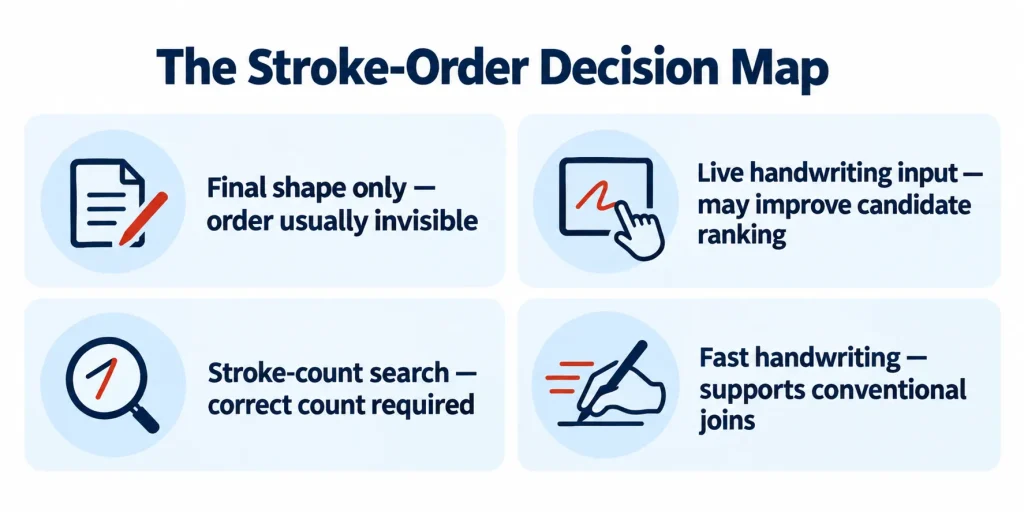
Correct order gives a recognizer better trajectory data, keeps stroke-count filters useful, and supports conventional fast writing. If only a clear final glyph remains, however, a reader usually cannot reconstruct the order you used.
Stroke order is not a beauty filter. It is a repeatable route through a character.
Where Japanese stroke order actually changes the result
The first distinction is between shape and movement. A printed page preserves the shape; a live pad may also receive the sequence and direction of your movements. The SKIP tool offers both “Use stroke order” and “Ignore stroke order,” so order can help without being mandatory for every engine.
“Use stroke order” and “Ignore stroke order.” — options presented by the SKIP handwritten kanji recognition tool
If you need the script map, Hiragana, Katakana, Kanji: How Japanese Writing Works explains what each script does. The First 92 Characters, in Order covers the kana foundation.
| Task | What correct order contributes | What happens out of order |
|---|---|---|
| Looking at a finished character | Nothing directly visible if the shape is sound | A reader may never know |
| Drawing into a recognition box | A conventional motion path that can narrow candidates | Ranking may worsen, although tolerant tools may still succeed |
| Filtering a dictionary by stroke count | A stable way to divide and count the marks | The wrong count can send you to the wrong candidate set |
| Writing quickly | Familiar joins, proportions, and pen travel | The character may become harder to read as strokes connect or shorten |
The words a lesson uses before your pen moves
筆順, hitsujun: “brush sequence”
You meet 筆順 beside an animation or correction. It means the conventional sequence, not a judgment about elegance. The mistake is treating kanji stroke order as ornamental etiquette; its value is a consistent motion pattern.
書き順, kakijun: “writing sequence”
書き順 is the everyday alternative heard in class or seen in searches. It points to the same issue as 筆順, not a competing system. Do not waste time hunting for a distinction every time the label changes.
書き方, kakikata: “way of writing”
書き方 concerns how to write something, from a character to an address. It is broader than sequence and can include form or placement. The mistake is reading it as “calligraphy” when the task is simply forming a mark.
If kana still consume all your attention, use A Two-Day Schedule for 46 Characters for a compact hiragana plan. Why the Second Alphabet Trips Everyone addresses the specific confusions that appear when katakana follows.
What a dictionary is counting
画, kaku: “stroke”
You meet 画 after a number in a dictionary entry or search filter. It is one prescribed pen movement, including a movement that turns a corner without lifting.
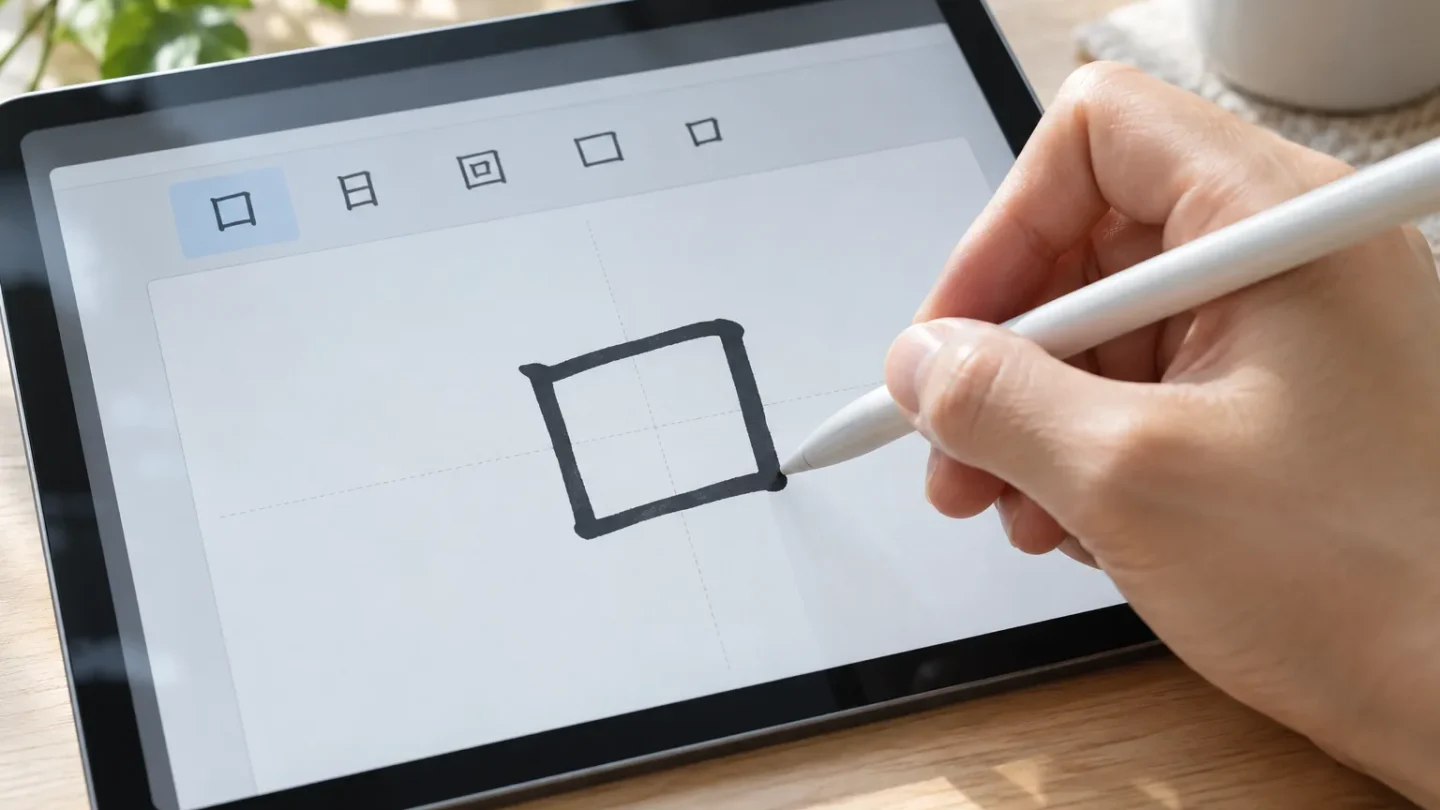
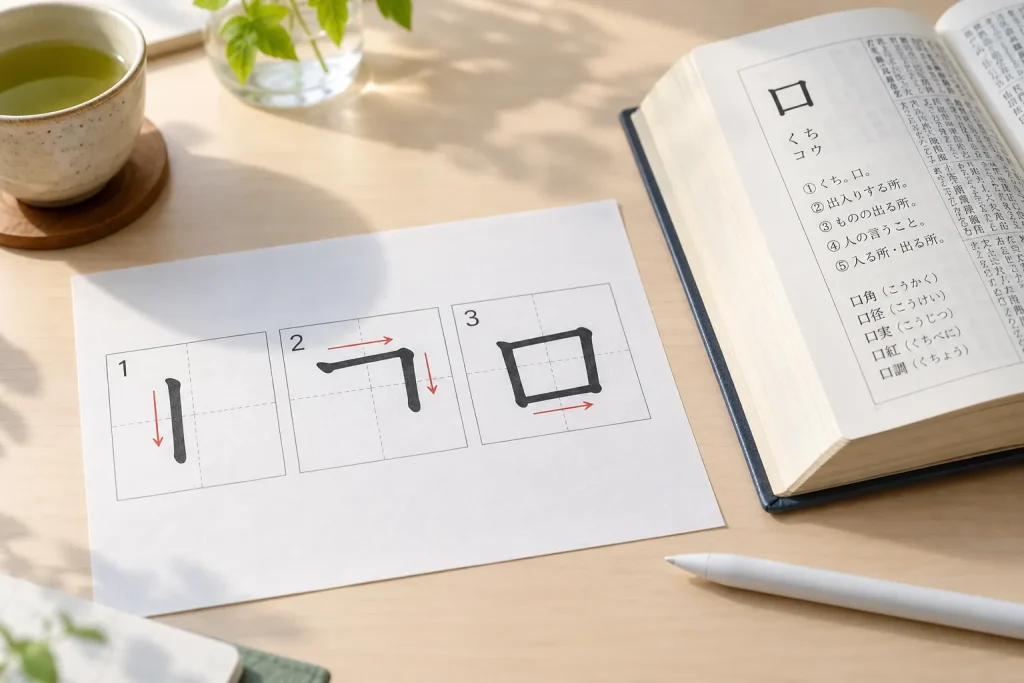
The character 口, kuchi, “mouth,” uses three strokes: left; top and right as one turning stroke; then bottom. Four separate sides can produce the same outline but the wrong kanji stroke count.
総画数, sōkakusū: “total stroke count”
総画数 is the whole character’s stroke count, used when you cannot supply a reading. The mistake is counting visible segments: a corner is not automatically a new 画, so an invented sequence can spoil the filter.
部首, bushu: “section heading”
部首 is the component under which a dictionary classifies a character. The mistake is assuming every recognizable component is the radical. A kanji can contain several reusable shapes but have one indexing 部首 in a given system.
| Term | Reading | Literal meaning | Where you meet it |
|---|---|---|---|
| 筆順 | hitsujun | brush sequence | Stroke animations and corrections |
| 書き順 | kakijun | writing sequence | Everyday lessons and searches |
| 書き方 | kakikata | way of writing | General instructions |
| 画 | kaku | stroke | Stroke-count labels |
| 総画数 | sōkakusū | total stroke count | Dictionary filters |
| 部首 | bushu | section heading | Radical indexes |
| 手書き入力 | tegaki nyūryoku | handwritten input | Phone and dictionary pads |
| 認識 | ninshiki | recognition | Candidate results and settings |
| 止め | tome | stop | Stroke-ending instruction |
| はね | hane | hook or upward flick | Stroke-ending instruction |
| 払い | harai | sweep | Tapered stroke endings |
| ペン | pen | pen | Paper or screen input |
| タブレット | taburetto | tablet device | Digital handwriting practice |
What your phone sees—and what it can forgive
手書き入力, tegaki nyūryoku: “handwritten input”
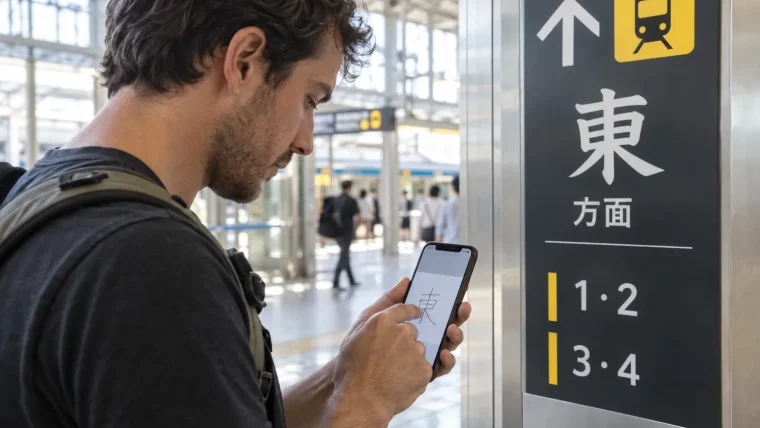
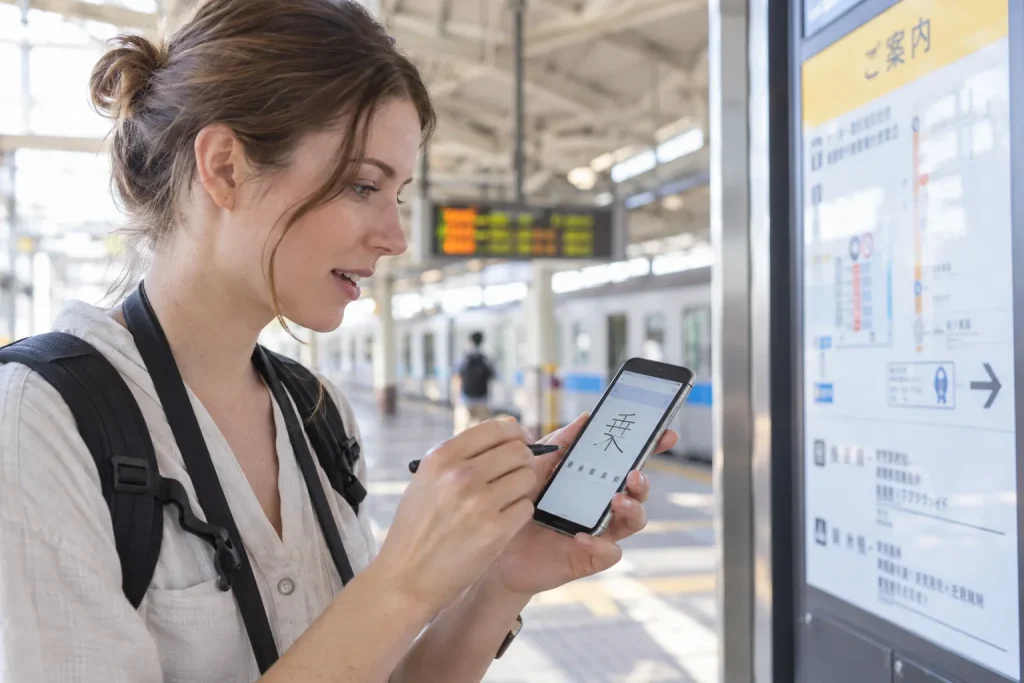
手書き入力 is the blank drawing area in a keyboard, dictionary, or app. Google says Gboard can accept a finger or stylus, though handwriting is not available for every language. The mistake is assuming all Japanese handwriting recognition works alike: order is useful input, not a universal access code.
認識, ninshiki: “recognition”
認識 appears when software turns your drawing into candidates. Recognition means “the system guessed a character,” not “your handwriting technique was approved.”
Research systems have been built to recognize kanji without stroke-number or stroke-order dependence. A successful phone result can therefore hide a bad habit, while failure does not prove a person could not read the glyph.
Try this sequence when a lookup fails:
- Draw once at a natural size.
- Redraw with conventional order and direction.
- If it fails, search by 部首 and 総画数.
- Confirm the character inside a word.
The three endings that survive fast handwriting
止め, tome: “stop”
止め is a firm ending rather than a taper or upward kick. The mistake is reducing it to decoration; you need control of the endpoint, not a theatrical pause.
はね, hane: “hook” or “upward flick”
はね is a small rising hook before the pen leaves the surface, not an added stroke. Drawing it separately can alter both motion and count.
払い, harai: “sweep”
払い is a stroke that releases and narrows. Although 払う, harau, often means “to pay,” a worksheet’s 払い concerns the pen leaving the page, not a bill.
Order matters most when writing stops being a sequence of careful snapshots and becomes continuous movement.
Two loanwords that do less work in Japanese
ペン, pen: “pen”
ペン appears in ペン入力, pen nyūryoku, “pen input,” even for an inkless stylus. The loanword names the tool by function. Do not assume the instruction demands ink; Google allows finger or stylus where handwriting is supported.
タブレット, taburetto: “tablet device”
タブレット in hardware instructions means a touchscreen computer, not a pill. Loanwords are Japanese vocabulary, not English pasted unchanged. Romaji Explained: Three Systems and Which One to Use handles Latin-letter representation.
For personal names, use the name converter with 898 checked names in katakana rather than inventing a spelling from English. That tool solves name conversion; it does not teach the stroke order of the resulting katakana.
A worked test: the box that looks right but counts wrong
Write 口 slowly as four independent sides. Then write it conventionally in three movements: left vertical; top across and right side down without lifting; bottom across to close.
Both versions can leave a recognizable square. Only the second supplies the conventional three-stroke trajectory and count. The final shape may pass, while a handwriting dictionary lookup based on movement or count receives worse evidence from the first.
Use this priority order:
- Learn where the stroke starts and in which direction it moves.
- Preserve the correct number of pen movements, especially through corners.
- Practice at a speed where the structure remains stable.
- Treat calligraphic polish as optional unless calligraphy is your actual goal.
What to memorize and what merely needs recognition
Memorize 筆順, hitsujun, because lessons label the sequence with it. Memorize 画, kaku, because stroke-count lookup depends on it. Memorize 手書き入力, tegaki nyūryoku, because it gets you to the input method where the issue becomes practical.
The rest can remain recognition vocabulary at first. If you can identify 部首, 総画数, 止め, はね, and 払い when an app or teacher uses them, you have enough to diagnose most failures without turning handwriting into a ceremony.
The decision is simple: learn conventional order for reliable practice, faster legible writing, and better search evidence. Do not claim that every phone requires it, and do not pretend that a correct-looking printed result exposes the route your hand took.