Every Japanese Form That Asks for Your Name: Your Name on Japanese Forms
A Japanese form is usually not asking you to choose between an English name and a Japanese name. It is asking for two representations of the same identity: the spelling tied to your passport or residence card and a phonetic reading that Japanese systems can process. That distinction explains most problems with a name on Japanese forms, including why a correct-looking katakana spelling may still be rejected. Roman letters identify you against an official document, while katakana often tells staff or software how to read, sort, or transmit that name. When those versions stop pointing to the same person, the inconvenience can spread from one application to the next.
Japan does not operate one universal name-entry standard across government offices, banks, hotels, airlines, and commercial services. Each organization designs its fields around a different legal duty or computer system, so the same person may be entered differently without legally changing their name. A label such as 氏名, shimei, “full name,” may request the official spelling, while フリガナ, furigana, “phonetic guide,” requests its reading. A field marked ローマ字, rōmaji, “Roman letters,” normally expects Latin characters. The decisive question is therefore not “How do I write my name in Japanese?” but “Which identity record is this form trying to match?”
If you still need to establish a natural Japanese rendering, How to Write Your Name in Japanese: The Complete Guide explains the sound-to-katakana process. Names that resist predictable conversion are covered separately in Katakana Name Rules, and the Names That Break Them. The Japanese name converter is useful for checking a proposed reading against its database of 898 reviewed names, but it cannot determine what a bank or government office has already registered for you. On paperwork, the spelling held by the relevant institution matters more than a newly generated alternative. A linguistically defensible answer is not automatically an administratively matching answer.
The two-name mechanism behind Japanese forms
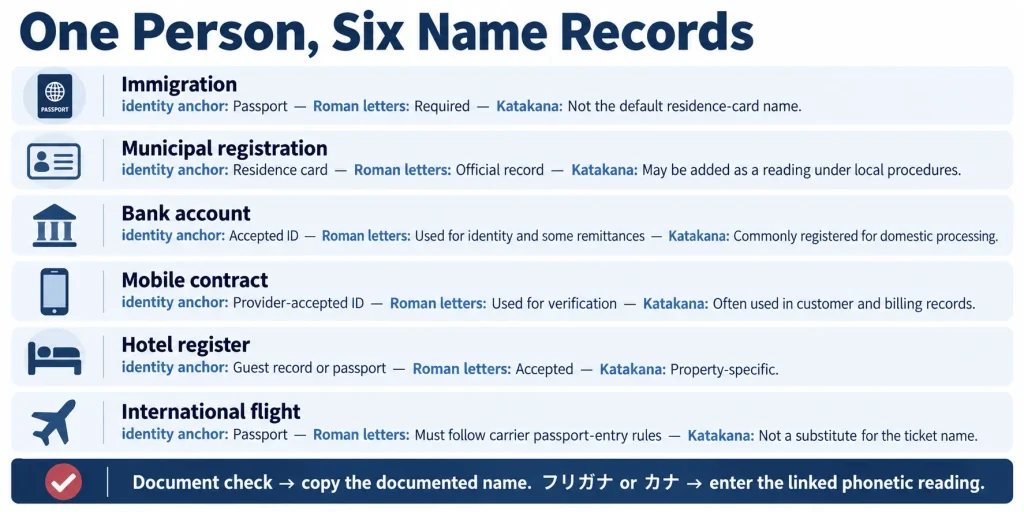
The central mechanism is a linked pair: an official documentary name and a machine-readable or pronounceable rendering. For a foreign resident, the documentary version commonly originates with the passport and then appears in Roman letters on the residence card. A bank or phone company may reproduce that legal version while also creating a kana record for domestic processing. The kana entry does not normally replace the legal identity; it sits beside it as a reading. This is why changing only the katakana in one account does not change the name printed on an immigration document.
The labels themselves offer clues, but they are not perfectly standardized. 氏名, shimei, can mean the full legal name, yet an adjacent フリガナ field shows that the first box is not asking for pronunciation. 姓, sei, means family name, and 名, mei, means given name, although a foreign passport may contain several given names or compound surnames. カナ and フリガナ usually call for katakana, while ふりがな written in hiragana may signal that hiragana is expected. If the instructions conflict with the name on the identity document being checked, the issuing organization—not a general language guide—is the authoritative place to ask.
| Field label | What it usually requests | Typical script | Common mistake |
|---|---|---|---|
| 氏名 (shimei) | Full legal name | Script shown on the identity document | Entering only a preferred or shortened name |
| 姓 / 名 (sei / mei) | Family name / given name | Roman letters, kanji, or kana as specified | Treating a middle name as a surname |
| ローマ字 (rōmaji) | Romanized name | Latin alphabet | Using katakana because the form is Japanese |
| フリガナ / カナ | Phonetic reading | Usually katakana | Creating a new spelling that differs from existing records |
| ふりがな | Phonetic reading | Often hiragana | Automatically entering katakana without reading the instruction |
| 通称 (tsūshō) | Registered or accepted alias | Depends on the record | Assuming any everyday nickname qualifies |
Immigration forms begin with the passport spelling
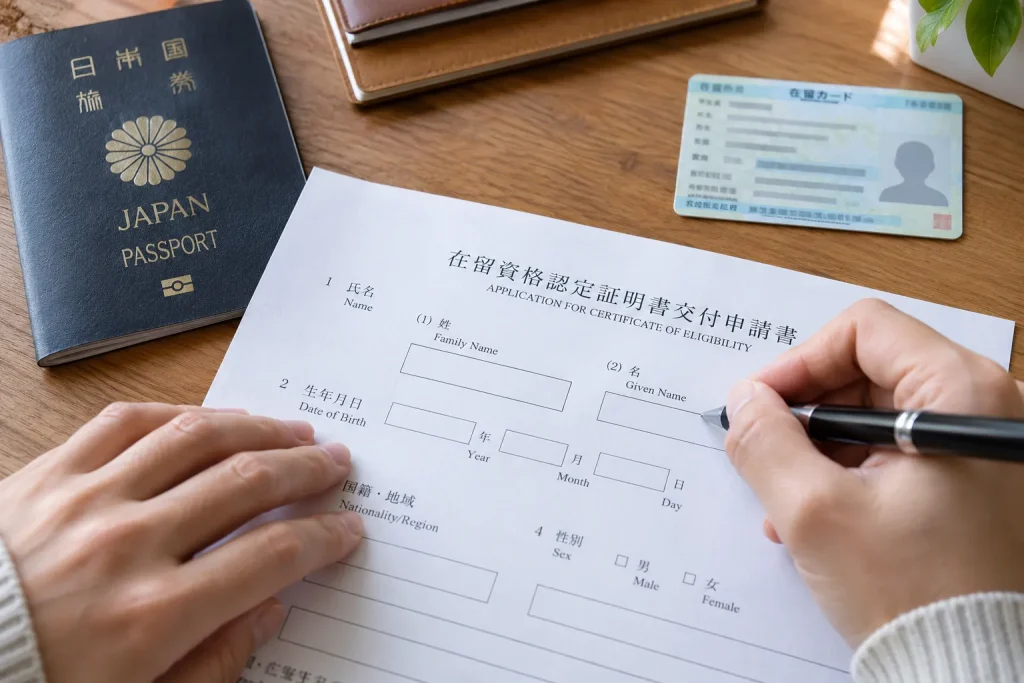
Immigration paperwork is the least suitable place for improvisation. The Immigration Services Agency generally records a foreign national’s name from the Roman-alphabet spelling in the passport, and residence cards normally display that Roman-letter name. Its application forms separate family name and given names, so every passport component must be assigned carefully. Katakana is not the default legal-name layer on the residence card. Foreign nationals who officially use kanji may apply for eligible kanji notation under a separate published procedure, but that does not create a general option to substitute katakana for the passport name.
A worked example makes the hierarchy clearer. Suppose the passport shows family name “ROTHWELL” and given names “MEGAN LOUISE.” An immigration form’s family-name field follows ROTHWELL, while the given-name field follows MEGAN LOUISE unless the form’s own directions specify another arrangement. メーガン・ルイーズ・ロスウェル may be a useful Japanese reading, but it does not replace those passport components. For an actual application, use the current Immigration Services Agency form and ask the agency or an authorized professional when the document structure does not map cleanly onto the available boxes.
“Please enter your name exactly as it appears on your passport.” — ANA international reservation guidance
Municipal records can add a reading without replacing the legal name
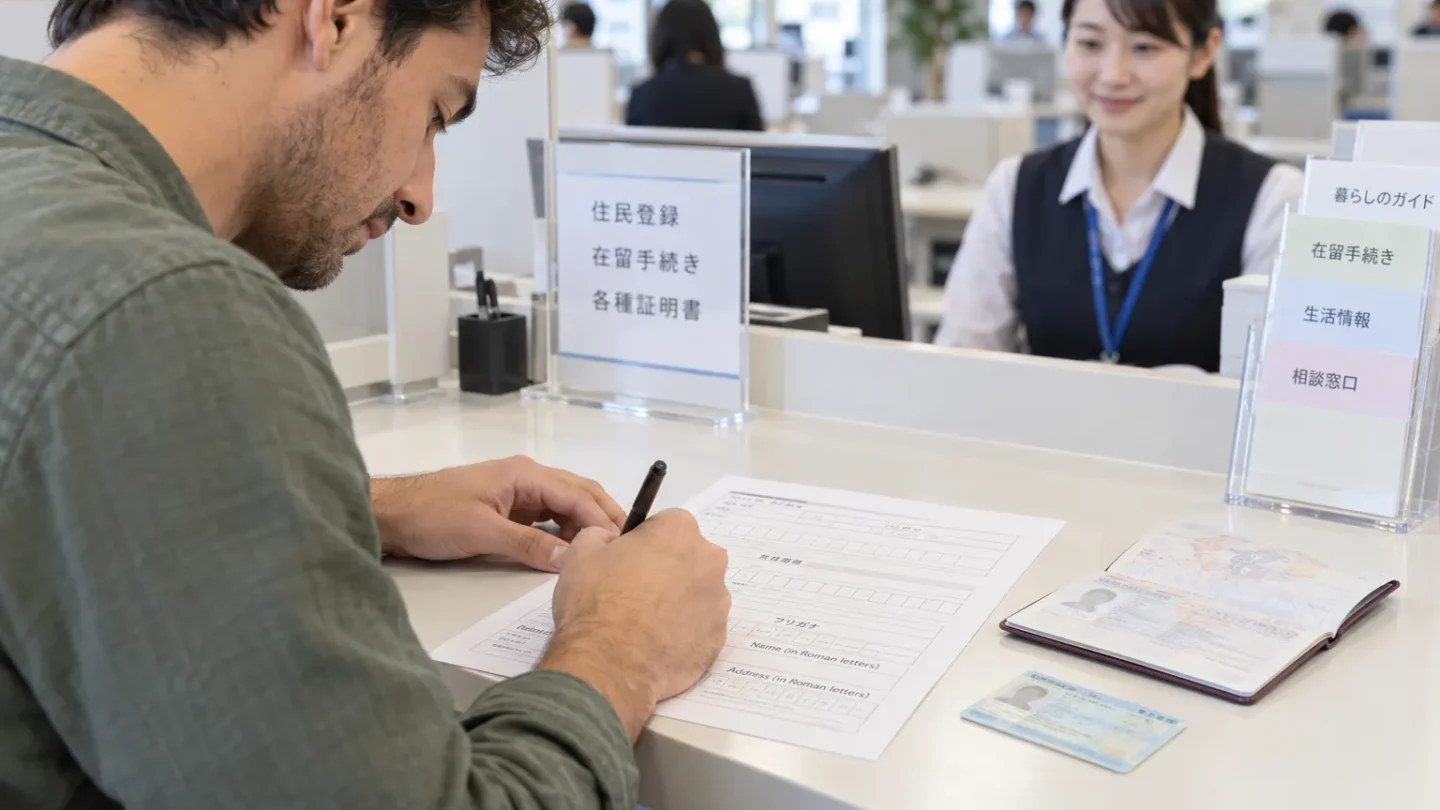
Resident registration at a municipal office carries the residence-card identity into the local administrative system. Municipal guidance, including information published by Hikone City, states that the name shown on the residence card is the foreign resident’s official name for registration. Some municipalities can also record a katakana reading in the remarks portion of a residence certificate, but the availability and evidentiary requirements should be confirmed locally. The reading is an additional record, not permission to erase middle names or reorganize a compound surname. City-hall practices and form layouts may differ even when they operate under the same national framework.
This distinction also affects My Number-related paperwork. A card or certificate is intended to reflect registered resident information, not whichever version fits most neatly into an online box. A municipal katakana record may help with later services that cannot process long Roman-letter names, but it does not guarantee acceptance by a private institution. The uncomfortable fact is that a locally recorded reading and a bank’s kana account name can still differ. Before relying on a kana version as proof, check what is actually printed on the resident certificate and ask the receiving organization whether it recognizes that field.
Bank applications create a second name record
A Japanese bank may need both the legal spelling used for customer verification and a katakana account-holder reading used by domestic banking systems. Japan Post Bank’s materials for foreign customers direct applicants to present identification such as a residence card and to provide their name in katakana. Its debit-card instructions separately ask for a full name in katakana and provide error messages for unsupported characters or excessive field length. International remittance instructions, meanwhile, state that the beneficiary name should match the name registered to the account in English characters. The same institution can therefore maintain more than one operational representation of the same customer.
That is where opening a Japanese bank account becomes a name-management problem rather than a translation exercise. A teller may need the legal name exactly as documented, while the transfer interface may expose only the registered kana account name. Long names, middle names, punctuation, and spaces may be normalized differently by particular products. Bank policies also vary, and account approval depends on more than spelling, so no universal field recipe can promise acceptance. If the proposed kana differs from a name already attached to your account, ask the bank which version is registered before arranging a salary payment or transfer.
The following sequence keeps evidence and inference separate:
- Copy the documentary name from the identity document named in the bank’s instructions.
- Enter katakana only where the field explicitly requests カナ or フリガナ.
- Treat spacing, middle names, and character limits as product-specific rules.
- Confirm the registered account-holder form directly with the bank before another institution sends money.
- Do not assume that a successful application proves every later banking service will accept the same character pattern.

Mobile contracts inherit identity checks and software limits
Mobile-phone applications commonly compare the applicant’s entered identity with an accepted identification document. The legal-name field therefore serves a different purpose from the kana reading used for billing, customer search, or spoken confirmation. A middle name present on the residence card may need to appear even when the applicant never uses it socially. At the same time, the provider’s interface may divide the name into family and given-name boxes or impose script restrictions that do not resemble the document. Those interface rules belong to that carrier and application channel, not to Japanese law in general.
This is one reason a katakana name field should not be treated as a casual pronunciation note. Once accepted, that kana version may appear in customer-service records, direct-debit requests, and account-linking attempts. If the carrier record says ロスウェル メーガン while the bank record says メーガンロスウェル, automated matching may fail even though a person can see that both refer to the same customer. Removing spaces or middle names without an explicit instruction can create a second mismatch rather than solve the first. When an online form cannot represent the identification document, use the carrier’s published support channel or an in-person application route instead of inventing a shorter identity.
Hotel registers follow the guest’s residence situation
Hotels and other licensed accommodations maintain guest registers, but the passport rule is frequently described too broadly. Under Japan’s Hotel Business Act framework and Ministry of Health, Labour and Welfare guidance, lodging operators record guest information including the name and address. Foreign guests who do not have an address in Japan are additionally asked for nationality and passport number, and official guidance calls for passport presentation and a copy. That specific passport-copy procedure is tied to the absence of an address in Japan, not simply to the guest looking or sounding foreign. A foreign resident who has an address in Japan falls into a different factual category, although a property may still need to confirm the information used in its register.
A booking page may accept Latin letters because it is designed for international reservations, while the physical or digital guest card follows the accommodation’s Japanese registration workflow. Katakana is not a universal statutory requirement for a foreign visitor’s hotel name. The legal purpose is to create the required guest record, and the passport provides the identifying spelling for a visitor without a Japanese address. If a property requests documents beyond what you understand the rule to require, ask which guest-register field or verification policy the request serves. Do not send additional identity images through an unverified link merely because a message uses the name of a real hotel.
Airline tickets use the travel-document version
For international aviation, the controlling representation is the passenger name associated with the travel document, not the katakana used in a Japanese customer profile. ANA tells passengers to enter the name as it appears on the passport and publishes special handling for middle names, compound names, punctuation, diacritics, suffixes, and long entries. Its examples also show that reservation systems may remove spaces or punctuation while still deriving the entry from the passport. This is normalization under the airline’s documented rules, not permission to choose a more convenient spelling. Other airlines can use different limits or correction processes.
The practical consequence is severe: a familiar katakana version does not repair a ticket booked under the wrong Roman-letter identity. A frequent-flyer profile may also hold an English name that needs to correspond with the booking before the membership number can be applied correctly. Airline corrections and rebooking conditions are carrier-specific and can change, so they must be checked before purchase. If your passport contains multiple surnames, parenthetical names, diacritics, or no clear family-name division, consult the operating airline’s instructions. The article on Five English Sounds Japanese Does Not Have explains pronunciation differences, but those sound rules do not control ticket identity.

Why small spelling differences travel further than expected
The first consequence is that “correct katakana” can have two meanings. A spelling may be linguistically natural but administratively wrong because an earlier institution registered another established form. The difference between メーガン and ミーガン is not necessarily a simple typo; both have appeared as renderings of Megan. Katakana Name Rules, and the Names That Break Them examines why established usage defeats mechanical conversion. On an application, however, consistency with the relevant record usually matters more than winning a pronunciation argument.
The second consequence is that spaces and order can become data. Japanese databases often separate surname and given name, while passports may place several elements under one heading. A middle dot in メーガン・ロスウェル helps a reader, but a restricted kana field may reject that punctuation. A transfer system may concatenate the name, while a customer-service screen displays spaces inserted elsewhere. These variations should be documented rather than “fixed” independently in every account.
The third consequence is that the shortest spelling is not always the safest spelling. Omitting a middle name may make a form fit, but it can also break the link to the identity document. Conversely, some service instructions explicitly tell users how to compress names or remove punctuation. The authority for that compression is the service’s published rule, not a general belief that Japanese systems dislike middle names. When the interface and the document cannot be reconciled, the organization operating the form must decide how its record should be created.
The fourth consequence is that a mismatch may surface much later. An account can function normally until a direct debit, international remittance, identity recheck, or linked service compares stored strings. The original spelling choice then becomes harder to diagnose because each institution displays a different layer of the name. Keeping a private record of the Roman-letter and kana forms accepted by each provider can clarify what happened. It does not change the legal identity, but it prevents memory from becoming the only record of an administrative decision.
| Context | Identity anchor | Katakana status | Main mismatch risk |
|---|---|---|---|
| Immigration and residence card | Passport | Not the default card name | Replacing passport spelling with phonetic kana |
| Municipal resident record | Residence-card record | May be recorded as an additional reading locally | Assuming local kana binds private companies |
| Bank account | Accepted identity document and bank record | Commonly required as an account reading | Transfers using a different registered sequence |
| Mobile contract | Provider-accepted identification | Often used in customer records | Carrier and bank kana failing to match |
| Hotel register | Guest information; passport for covered visitors | Property-specific, not universally required by statute | Applying the visitor passport rule to every foreign resident |
| International airline ticket | Passport or other travel document | Not a substitute for ticket name | Booking a phonetic or shortened identity |
Where the pattern stops being reliable
Not every name box belongs to an identity-verification system. A restaurant reservation, event signup, package delivery form, or informal visitor log may ask only for a readable contact name. Such services can accept katakana even when no government document contains it, and some international interfaces accept only Latin letters. A field may also be technically optional despite appearing visually prominent. Read the form’s own instructions before carrying government-document conventions into a low-stakes reservation.
People from countries that officially use Chinese characters may have an additional kanji layer. The Immigration Services Agency publishes a procedure for eligible kanji notation on a residence card, with characters handled under Japanese standards. That is a documented exception to the Roman-only appearance of many foreign residents’ cards, but it is not evidence that any foreign applicant may invent kanji. Ateji: How Foreign Names Get Written in Kanji covers decorative sound-based kanji; that creative practice is separate from official kanji supported by identity documents. Decorative ateji should never be inserted into legal or financial paperwork as though it were a registered name.
Registered aliases create another exception, but ordinary nicknames do not become official merely through repeated use. A municipality may require evidence that an alias is established in daily life before recording it. Even after municipal recognition, a bank, carrier, or other private organization may apply its own identification policy. An alias can therefore be valid in one record and unavailable in another. Confirm both the municipal status and the receiving organization’s policy rather than assuming that one registration propagates automatically.
Regional offices and individual companies also use different layouts, character limits, and support procedures. A paper form may allow staff to annotate a name that an online form rejects. A domestic booking may use kana where an international booking uses passport Romanization. A change in software can alter accepted characters without changing the underlying legal rule. Rules and interfaces were checked on September 8, 2026, and banking, immigration, lodging, and carrier procedures should be rechecked at the official source before submission.
A field-by-field check before you submit
Use this checklist as a reading method, not as a promise that an application will be accepted:
- Identify the document the organization says it will verify.
- Copy the Roman-letter legal name from that document where requested.
- Look for separate 姓 and 名 boxes before deciding where middle or compound names belong.
- Use katakana only for カナ, フリガナ, or another explicitly phonetic field.
- Preserve the kana spelling already registered with that institution unless it authorizes a change.
- Follow published instructions for spaces, hyphens, diacritics, suffixes, and character limits.
- Contact the issuing office, bank, hotel, carrier, or service provider if the boxes cannot represent the document.
The rule to carry away is simple: copy identity from the document being checked, and treat katakana as its linked reading—not as a replacement name.
FAQ about names on Japanese paperwork
Do I put my name in katakana on every Japanese form?
No. Katakana is appropriate when the field specifically requests カナ, フリガナ, or a phonetic reading. Immigration and international airline fields commonly rely on the Roman-letter version tied to a passport or residence card. A Japanese-language interface does not automatically mean that every entry must use Japanese script. Follow the label and the organization’s instructions together. If the form verifies an identity document, the document remains the starting point.
Should my katakana include my middle name?
There is no universal answer for every institution. If the legal-name field includes the middle name, omitting it without instructions can cause a mismatch. A separate kana field may impose a different structure or character limit, but only the organization can confirm how it stores the full name. Do not remove a name component merely because another person’s application worked without it. Ask the office or provider when the available boxes do not accommodate the documented name.
Can I use the Japanese name converter for official paperwork?
The converter can help produce or check a plausible phonetic rendering. Its reviewed database is especially useful when a name has an established katakana spelling that simple sound rules miss. It cannot see the kana already registered by a municipality, bank, employer, or carrier. For that reason, an existing institutional record takes priority in a matching process. Use the tool as a language reference, not as proof of legal identity.
Why does my bank name look different from my residence-card name?
The residence card normally presents the official Roman-letter identity derived from the passport. A bank may keep that legal spelling while also registering a katakana account-holder reading for domestic systems. Spaces, punctuation, order, and middle names may be normalized for a particular banking product. The two displays can therefore differ without representing two different people. Ask the bank for the exact registered account-holder form required for the transaction you intend to receive.
Must every foreign guest give a hotel a passport copy?
The national lodging guidance distinguishes foreign guests who do not have an address in Japan. That category is asked to provide nationality and passport number and to present a passport for copying at check-in. The rule is not framed as a blanket passport-copy requirement for every non-Japanese resident. A property still maintains a guest register and may need information appropriate to the guest’s situation. If the request seems broader, ask the accommodation what requirement or policy it is applying.