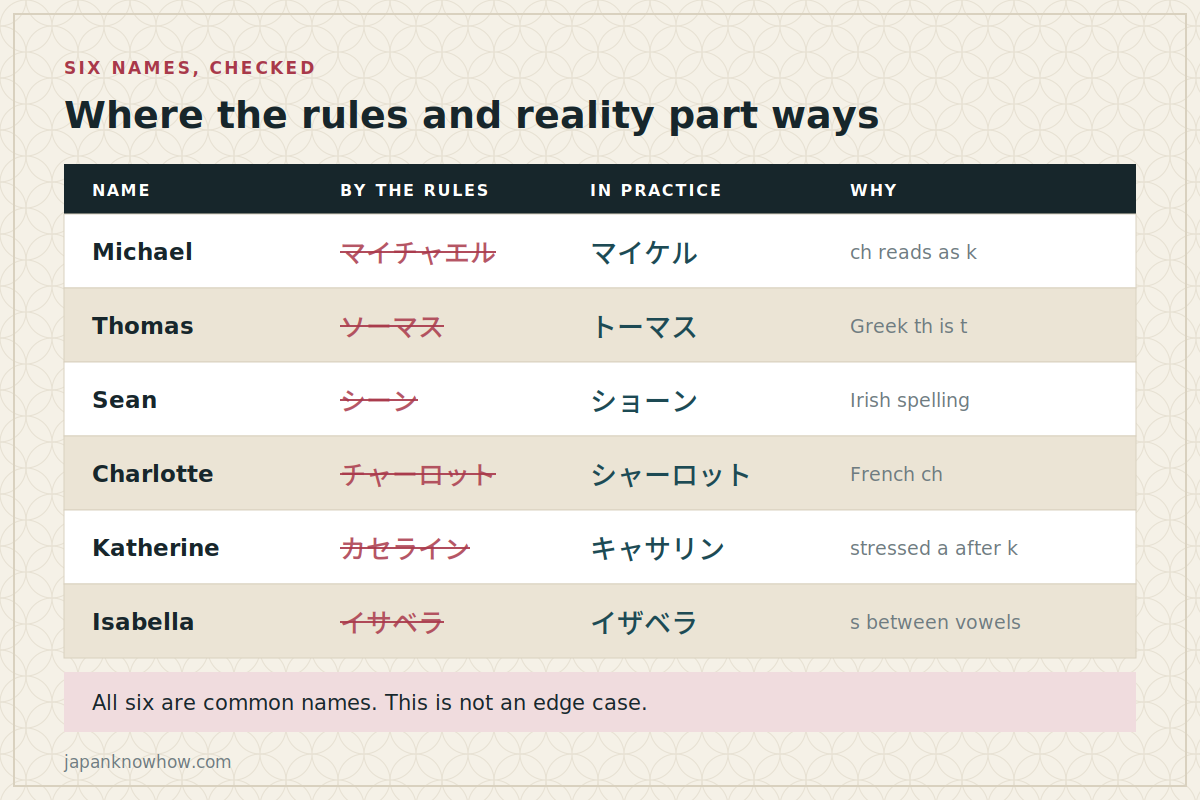
We built a rule engine to convert English names into katakana, tested it against 61 names with well-documented Japanese spellings, and it got 77% exactly right. That number sounds respectable until you look at which 23% it missed.
It missed Michael. Thomas. Sean. Charlotte. Katherine. Isabella. Not obscure names — the names people actually type into a converter. This article is the autopsy: what the rules predict, what Japan writes instead, and the eight distinct reasons the two come apart.
Why a rule engine has a ceiling
The rules themselves are sound. Break the name into sounds, map the sounds onto Japanese syllables, fix the vowel lengths — the process described in our guide to writing your name in Japanese works, and it works for the majority of names.
The problem is the very first step. Converting spelling to sound is straightforward in Spanish, Italian, or Polish, where letters map onto sounds with near-total consistency. English does not work that way. The same letters routinely represent different sounds with nothing in the word to signal which, and a machine reading letters has no way to know that Sean rhymes with lawn.
Layered on top of that is a second problem, and it’s the bigger one: even when the pronunciation is unambiguous, the Japanese spelling may have been fixed decades ago by a film, a novel, or a brand, and may not match what the rules produce. Once a spelling is in circulation, it wins.
The eight failure categories
1. ch reads three different ways
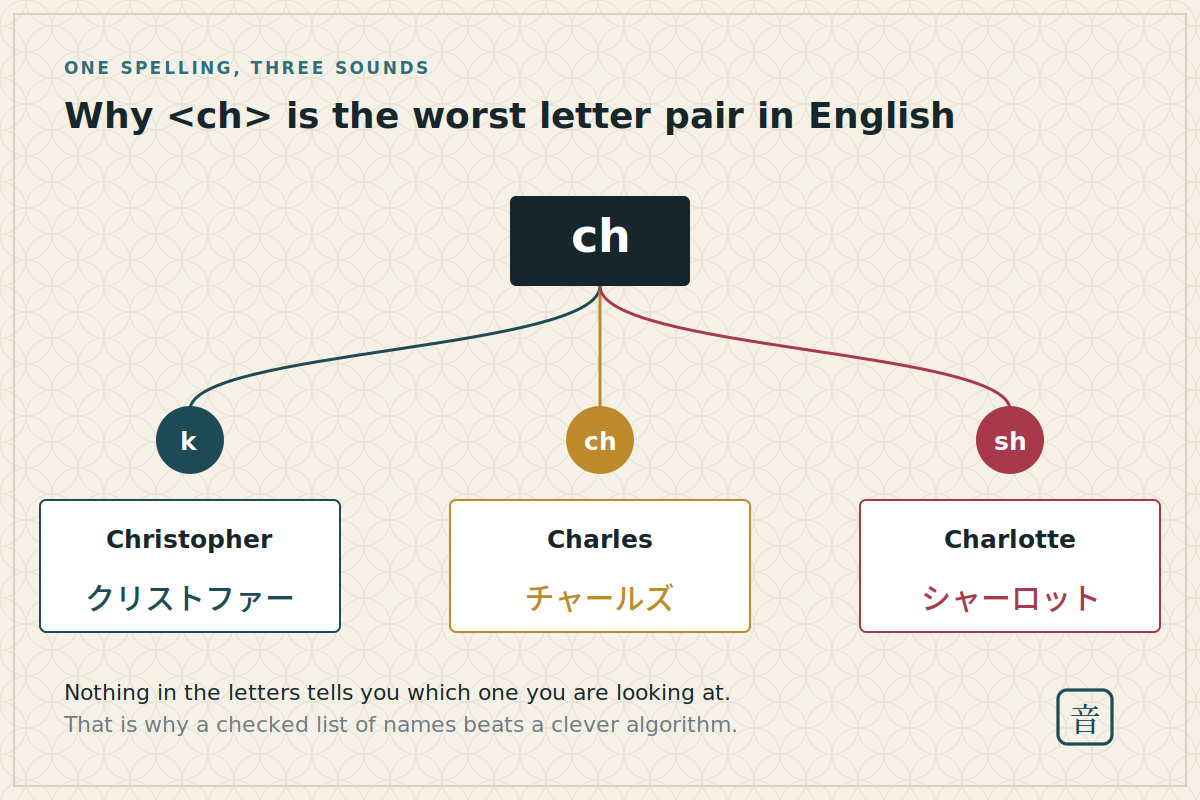
Christopher takes a K sound: クリストファー. Charles takes the ch of chair: チャールズ. Charlotte, which arrived through French, takes an SH: シャーロット. And Michael takes a K but with a vowel the letters don’t predict: マイケル. Four names, four different treatments of the same two letters.
2. Greek th is a T
In most words, th is the sound in think, which Japanese renders with the S row — hence Ruth as ルース and Elizabeth as エリザベス. But in names of Greek origin the th is simply a T. Thomas is トーマス, not ソーマス; Thompson is トンプソン. Theodore, confusingly, goes the other way: セオドア. The list of exceptions is shorter than the rule that would generate them.
3. Irish and Gaelic spelling
Sean is ショーン. Siobhan is シボーン. Aoife, Sinéad, Niamh — these follow a different orthographic system that happens to be written in the same alphabet. No English-based rule set will ever handle them, because they aren’t English spellings.
4. s between vowels
Sometimes it’s voiced, sometimes it isn’t, and the spelling is identical. Isabella is イザベラ and Susan is スーザン, both with a Z sound. Lisa is リサ and Madison is マディソン, both with an S. A rule for this scores about 50%, which is another way of saying it isn’t a rule.
5. Vowels that vanish in speech
Evelyn is written with three syllables and spoken with two — the middle one collapses. Japanese follows the speech: エブリン, not エベリン. Meanwhile camera keeps all three and becomes カメラ. Whether an unstressed vowel survives is a property of the individual word.
6. The a after K and G
Katherine is キャサリン and Cameron is キャメロン, both with the small ャ. But Karen is カレン and Carl is カール, without it. The difference is the vowel quality in English, which the letter a doesn’t distinguish.
7. Vowel length before r
Sarah is サラ, short. Nora is ノーラ, long. Identical spelling pattern, different English vowels, and nothing on the page to tell them apart. Our engine chooses the short reading because it’s more common in names, and takes the loss on Nora.
8. Stressed i before a vowel
Violet is バイオレット — the i is stressed and becomes a diphthong. Julia is ジュリア — the i is unstressed and stays short. Stress isn’t written in English, so a machine reading letters can’t see the difference.
What this means in practice
Add these up and the pattern is clear: the failures cluster on high-frequency names, because high-frequency names are exactly the ones that have been in circulation long enough to acquire a fixed Japanese spelling that predates any rule.
| Approach | Accuracy on common names | Works for names never seen before |
|---|---|---|
| Rules only | About 77% | Yes |
| Checked list only | Effectively 100% | No |
| List first, rules as fallback | Effectively 100% on the list | Yes, flagged as calculated |
The third row is what a working tool has to do, and it’s why we spent the time to hand-check around 900 common American given names rather than polishing the algorithm further. Our converter tells you which of the two produced your answer, so you know how much weight to put on it.
When the honest answer is “it depends,” we’d rather write “it depends” and explain what it depends on than pick one and sound confident.Our editorial standards
Two spellings can both be right
One more wrinkle worth knowing about, because it looks like an error and isn’t. Some names genuinely have two live spellings, and Japanese publications differ:
- Grace — グレース in older usage, グレイス in newer. Both current.
- Olivia — オリビア or オリヴィア, depending on whether the publication uses the ヴ character for the V sound. Broadcast style guides prefer the B row; print often keeps ヴ.
- Megan — ミーガン or メーガン, and which one you see often depends on which famous Megan the reader has in mind.
- Sarah — サラ normally, but セーラ in some literary translations.
Where a second form is genuinely in use, we show it next to the main one rather than pretending there’s a single answer. The V question in particular is a house-style decision rather than a fact, and the reasoning behind ours is set out in our piece on the English sounds Japanese doesn’t have.
How the list gets built
A checked list sounds like it should be the easy part, and it wasn’t. We started from the names actually common in the United States — not just recent baby names, but the whole living population, which is a different list. Then we added the current top names for parents searching on behalf of a child, and a vintage layer from the 1940s to the 1970s for readers looking up their own name.
Two groups turned out to need far more hand-correction than the test predicted. The first is Spanish-origin names, which are a large share of American given names and follow Spanish reading rules rather than English ones: José is ホセ, Juan is フアン, Javier is ハビエル. Run those through an English rule set and you get nonsense. The second is short forms — Andy, Becky, Ricky, Eddie — where the ending behaves differently after a T or a D than after anything else. Andy is アンディ with no long vowel; Danny is ダニー with one.
Neither group appears in a list of “typical English names,” which is exactly why a 61-name test underestimated the work by a factor of about one and a half.
The practical takeaway is short. If your name is common, look it up rather than calculating it. If it isn’t, calculate it and then have a native speaker glance at the result — especially if it’s going anywhere permanent. And if a converter gives you an answer without telling you which of those two situations you’re in, close the tab.