Ordering, Paying and the Rules Nobody States
A Japanese restaurant usually tells you how the meal will work before you see the food: the machine, tablet, bill slip, or host at the entrance reveals when you order and when you pay. That is the mechanism behind how restaurants work in Japan, and it matters more than memorizing a long catalog of manners. The venue is not expecting every customer to follow one national dining script. Instead, each restaurant has built a transaction path that moves the order from you to the kitchen and the payment from you to the correct terminal. Read that path correctly, and most of the supposedly “unstated” rules become visible.
The useful question is not simply, “Is this a ramen shop, sushi restaurant, or izakaya?” Look for where the restaurant wants the commitment to happen. A meal-ticket machine asks you to choose and pay before the kitchen begins, while a table-order system opens a running bill that you settle later. A counter café may collect payment before making anything, and a traditional restaurant may keep the commercial part of the meal discreet until the end. These are operating systems, not tests of whether you understand Japanese culture.
How restaurants work in Japan: follow the transaction
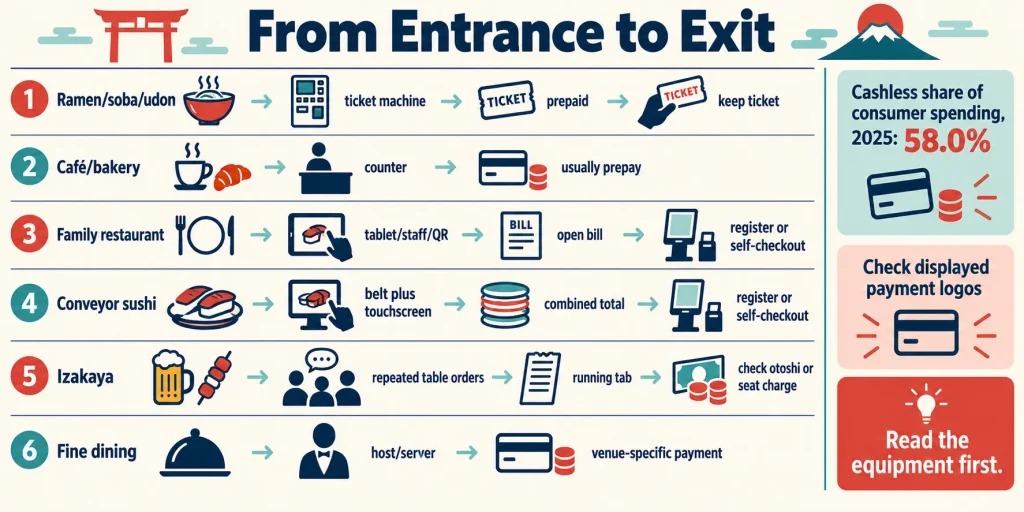
Restaurant type is a practical clue because businesses with similar service rhythms often adopt similar systems. Fast noodle shops need quick turnover, so prepayment removes a conversation and a payment step from the dining room. Family restaurants need to handle large menus and repeated additions, so tablets and table bills make more sense. Izakaya expect drinks and dishes to arrive in rounds, which requires an open tab. Formal restaurants manage the meal through staff because timing, courses, and hospitality are part of what the guest has purchased.
The visible equipment is often a better guide than the cuisine. A ramen shop with a restaurant ticket machine behaves differently from a ramen shop that takes orders at the counter, even though both serve the same kind of food. A conveyor-belt sushi chain with a touchscreen and self-checkout has little operational resemblance to a small sushi counter. A café can be counter-service at one branch and seated service at another. When the equipment and the restaurant category disagree, trust the equipment.
| Venue or format | Usual ordering point | Usual payment point | What visitors often misread |
|---|---|---|---|
| Ramen, soba, udon, beef-bowl shop | Ticket machine or counter | Before eating | The printed ticket is the order, not merely a receipt |
| Family restaurant | Tablet, QR menu, call button, or server | Register or self-checkout after eating | Staff may not bring a card terminal to the table |
| Conveyor-belt sushi | Belt and touchscreen | Register or self-checkout | The system must total plates and screen orders before payment |
| Izakaya | Staff, tablet, or QR menu over several rounds | Register or, in some venues, at the table | An automatically served appetizer may be charged |
| Café or bakery | Counter in many shops; table in others | Before or after eating | The presence of seats does not prove table service |
| Sushi counter, kaiseki, or fine dining | Host or server | Venue-specific | Formal service does not guarantee tableside payment |
The meal ticket closes the order early
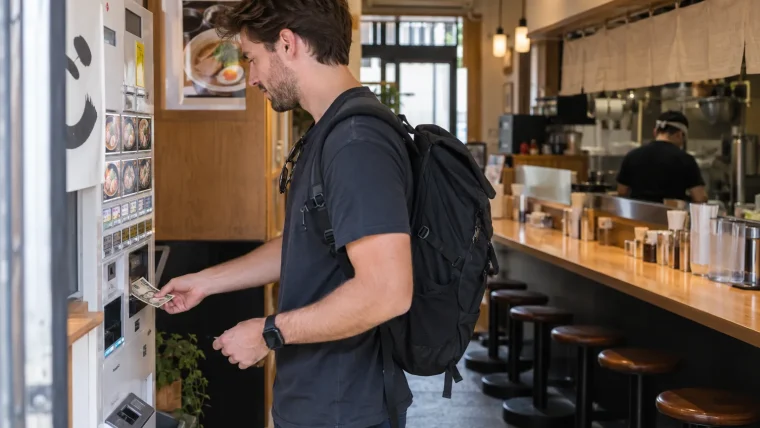
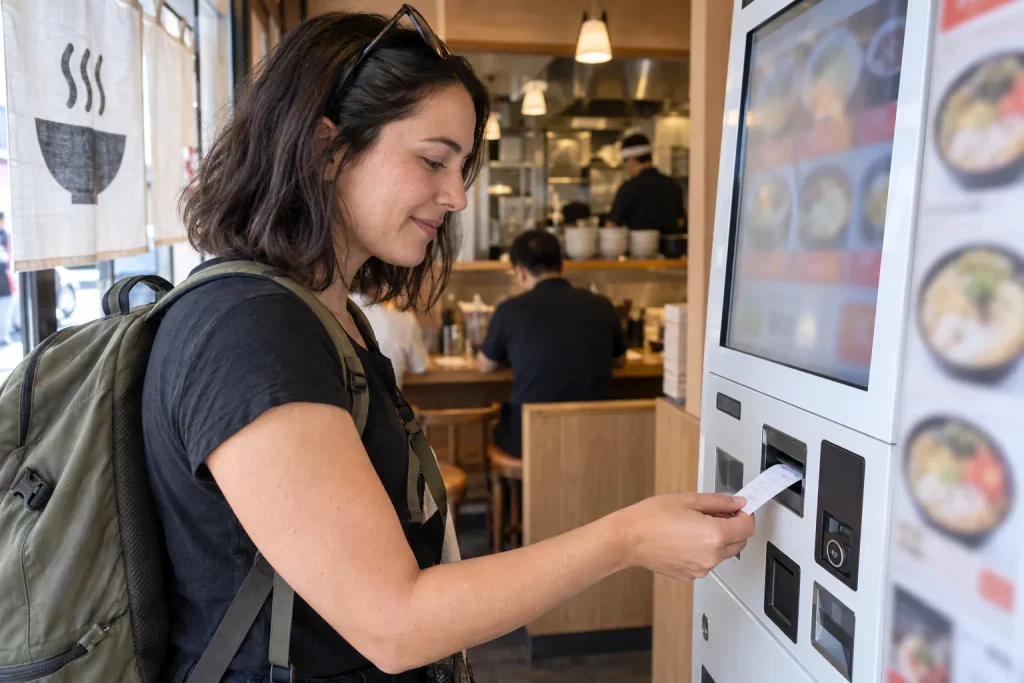
食券 shokken, literally “meal ticket,” combines ordering and payment before you sit down. Sapporo’s official visitor guidance says that when a restaurant has a machine near the entrance, customers purchase the ticket before taking a seat; it identifies ramen shops and highway service-area restaurants as common settings. Select the dish, complete the payment using a method shown on that particular machine, and take every printed ticket. Depending on the shop, you hand the ticket to staff, place it on the counter, or keep it while an electronic order travels directly to the kitchen. Watch the customer ahead of you if the handoff is not obvious.
The outsider’s mistake is treating the paper as an ordinary receipt. It may carry the dish, size, topping, queue number, or proof that the kitchen should release the meal. If the machine produces several pieces of paper, keep all of them until staff indicate which can be discarded. Some machines offer an English screen, but language support and accepted payment methods vary by model and branch. The Japanese Food for Beginners guide explains how cooking characters and menu formats help when the translation button does not solve the menu itself.
A seat can open a running bill
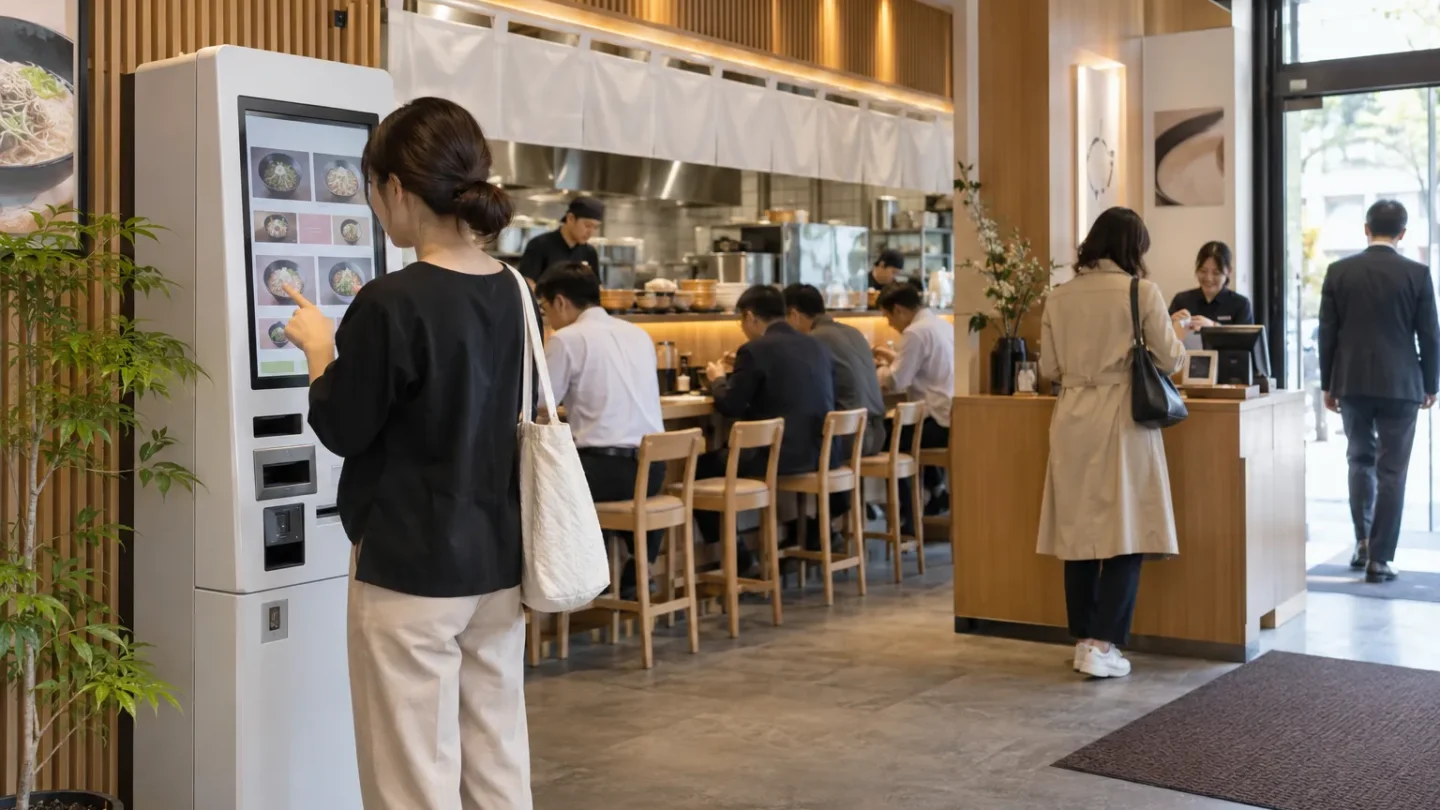
At a family restaurant, casual dining chain, or modern sushi venue, sitting down commonly begins a different process. 注文 chūmon, literally “order,” may be entered on a tablet, scanned from a QR menu, spoken to a server, or placed through a call button. You can usually add dishes while the table remains open, and the system attaches each addition to that seat or table. This is operationally closer to a running tab than to an American server carrying a handwritten check. The important signal is whether a slip, table number, barcode, or checkout button appears after you order.
Conveyor-belt sushi makes the logic especially visible because food can reach you through more than one channel. You may take circulating plates and order other items on a screen, so the restaurant must reconcile both streams before you leave. Kura Sushi’s official Japan site advertises cashless payment availability, but that does not mean every independent sushi shop accepts the same methods. For the food distinction and counter behavior, Sushi vs Sashimi: The Difference Is the Rice covers what belongs on rice, what does not, and which sushi-counter rules carry real weight. This article stays with the ordering and payment machinery.
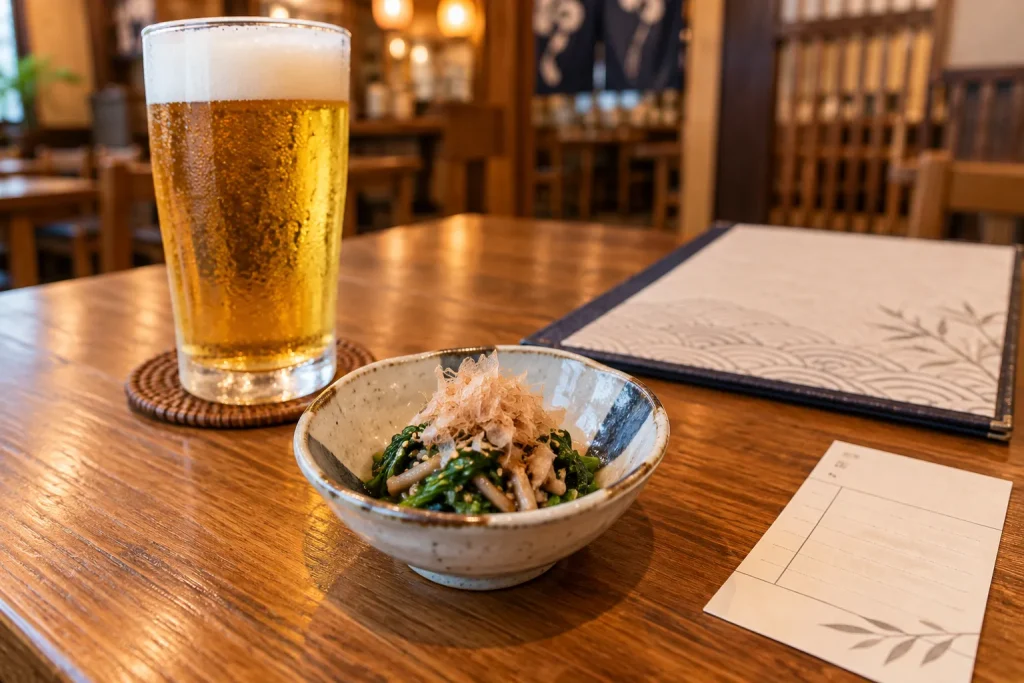
Otoshi is a charge delivered as food
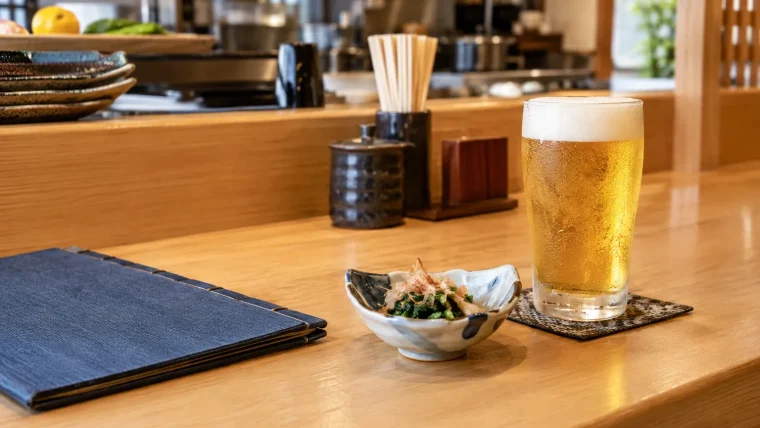
At many izakaya, お通し otōshi, literally “something passed through,” is a small dish brought after you sit down and later included on the bill. It functions as an appetizer and is associated with the seat or service charge, even though you did not choose it from the menu. That makes it uncomfortable for visitors accustomed to approving every paid item in advance. It is not a tip, and leaving extra cash does not replace it. The amount and whether it can be declined are venue-specific, so check the menu, reservation terms, or entrance notice instead of relying on a universal price range.
The strongest evidence that this is a house policy rather than an izakaya law comes from the industry itself. Torikizoku states on its official website that it does not collect otoshi, seating, or late-night charges. In other words, even a large yakitori izakaya chain can reject the practice entirely. In parts of western Japan you may hear 突き出し tsukidashi, literally “pushed-out dish,” used for a similar arrangement, but naming and billing still depend on the venue. Otoshi in Japan should therefore be read as a possible line item, not an automatic feature of every place serving alcohol.
“We do not charge customers for otoshi, seating, or late-night fees.” — translation of Torikizoku’s official policy
The bill slip is meant to travel
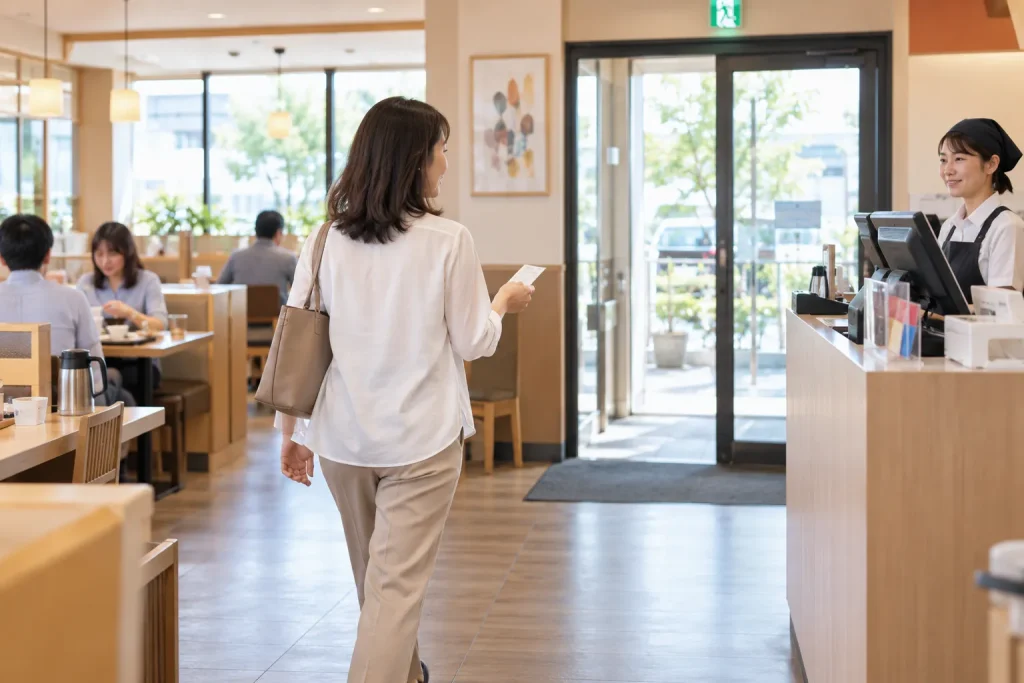
会計 kaikei, literally “account” or “settlement,” often happens at レジ reji, the Japanese shortening of “cash register.” In many casual table-service restaurants, staff leave a slip, folder, barcode, or table card for you to carry to the register near the exit. Waiting for a server to collect a credit card can therefore produce a long, unnecessary pause. Look at what other departing diners carry and whether a staffed or self-service terminal is positioned by the door. If there is no slip, ask staff before walking away from the table.
The common error is assuming that “pay at the register” describes every restaurant. Fine dining, hotel restaurants, reservation-only meals, and some izakaya may settle the bill at the table, while counter-service venues may have collected it already. A QR system can also let you close the bill on your phone without visiting either location. If you need language support, the site’s Japanese phrasebook contains 337 checked phrases, including restaurant ordering and allergy situations. Use the phrasebook rather than building improvised sentences around a sensitive request.
Payment logos matter more than national averages
The safest approach to paying at Japanese restaurants is to inspect the door, machine, menu, or register for accepted-payment logos. Japan is no longer accurately described as an overwhelmingly cash-only economy: the Ministry of Economy, Trade and Industry reported that cashless payments represented 58.0 percent of consumer spending under its domestic indicator for 2025. That national figure does not promise that a specific restaurant accepts your card. Independent shops can choose different payment terminals, and even branches of the same broader category may not offer identical options. Carrying yen remains practical because the restaurant in front of you matters more than the national average.
Cash, credit cards, transport IC cards, and mobile or QR payments are separate rails. A ticket machine that accepts a transport card may still reject a foreign credit card, while a staffed register may accept that card without difficulty. Do not assume that a familiar contactless symbol means every wallet or card network will work. If a business displays 現金のみ genkin nomi, literally “cash only,” take it at face value. The uncomfortable part is that a technically cashless trip can still fail at the exact small restaurant you came to visit.
| Signal you see | What it usually indicates | What you should do |
|---|---|---|
| 券売機, a button machine, or a large ordering screen | Order and payment may happen before seating | Complete the machine flow and keep every ticket |
| A tablet or QR code at the table | Orders are attached to an open table account | Add items there and look for checkout instructions |
| A small slip, barcode, or table card | The register needs an identifier for your bill | Carry it to the register unless staff direct otherwise |
| お通し, 席料, or チャージ on a menu | An appetizer, seating fee, or charge may be added | Confirm the policy before ordering if it matters |
| 現金のみ | The venue accepts cash only | Pay in yen rather than testing unsupported cards |
| A card or wallet logo | That named method is advertised | Do not infer support for unlisted networks |
The system changes the meal in ways you can feel
Prepayment does more than save time at the end. It fixes the first order before the customer reaches the seat, which is why toppings, sizes, and sets may each appear as separate machine choices. A table account does the opposite: it keeps the meal expandable, allowing another drink or dish to be added without reopening payment. An izakaya’s running tab supports food arriving in waves rather than as a starter-main-dessert sequence. These operating choices explain behavior that can otherwise look abrupt, inattentive, or unusually automated.
Several practical consequences follow:
- Do not claim a seat and then search for the machine unless the shop’s signs tell you to sit first.
- Keep tickets, slips, barcodes, and table cards until payment or food collection is complete.
- Check charges before ordering when a seat fee, service fee, or otoshi would affect your decision.
- Ask about separate payments before the bill is closed; the terminal or house policy may favor one transaction.
- Never add an American-style percentage automatically, because Japan’s official tourism guidance says tipping is unnecessary.
- Confirm dietary restrictions before paying at a machine, since a prepaid order can be harder to change.
No tipping does not mean that every amount beyond the listed dish prices is improper. A disclosed service charge, seating charge, reservation condition, or otoshi belongs to the venue’s pricing system rather than to employee gratuity. That distinction protects you from two opposite mistakes: leaving money that staff may treat as forgotten, or challenging a charge that the restaurant presented as a condition of service. For serious dietary restrictions, payment protocol is secondary to ingredient certainty. The guide to vegetarian food and allergies in Japan explains why hidden stock and restaurant-labeling limits require more planning than the order screen suggests.
Where the map stops working
Restaurant categories overlap, and technology changes faster than etiquette guides do. A noodle shop may use a QR menu instead of a ticket machine, while a family restaurant may install self-checkout without changing its table-order system. A department-store restaurant can share a centralized payment arrangement, and a food hall may require payment at each vendor. Hotel restaurants are more likely to resemble international full-service dining, but the property’s own procedure still controls. Use the category as a prediction, then verify it against the equipment and instructions you can see.
Regional food identity does not guarantee a regional payment protocol either. A Hakata ramen shop and a Sapporo ramen shop may use the same kind of meal-ticket machine despite serving very different bowls. The regional ramen guide handles differences in soup, seasoning, noodles, and toppings without pretending they dictate checkout. Likewise, convenience-store meals use retail checkout rather than restaurant service, so the Japanese convenience-store food guide is the better map for that setting. Counterexamples do not break the mechanism; they show why you must identify the venue’s chosen transaction path rather than recite a national rule.
FAQ
Do I pay before or after eating at a Japanese restaurant?
You pay before eating when the venue uses a meal-ticket machine or prepay counter. You usually pay afterward when the restaurant opens a table account through staff, a tablet, or a QR menu. The final payment may happen at a register, self-checkout, on your phone, or at the table. The location of the menu terminal and the presence of a bill slip are stronger clues than the food being served. If the flow remains unclear, show the slip to staff and ask where to settle it.
Is the appetizer at an izakaya free?
Not necessarily. An otoshi can be automatically served and added to the bill as part of the venue’s seating or service arrangement. Its price, availability, and refusal policy are not standardized across Japan. Some izakaya explicitly charge no otoshi or seating fee, as Torikizoku’s published policy demonstrates. Check the menu or ask before ordering if you do not want an unplanned charge.
Should I tip restaurant staff in Japan?
No tip is normally required in Japanese restaurants. JNTO’s official etiquette guidance says tipping is unnecessary, and extra cash left behind may not be interpreted as a gratuity. This does not erase properly disclosed service, seating, or appetizer charges. Pay the amount the restaurant’s system calculates unless you have a specific question about a line item. Gratitude is better communicated directly than through an unexplained banknote.
Carry away one rule: identify where the restaurant wants you to commit to the order, and the correct way to pay will usually follow.