The first time an American hears their own name said back to them in Japanese, the reaction is almost always the same small double-take. It’s recognizable. It’s also, unmistakably, not quite the name.
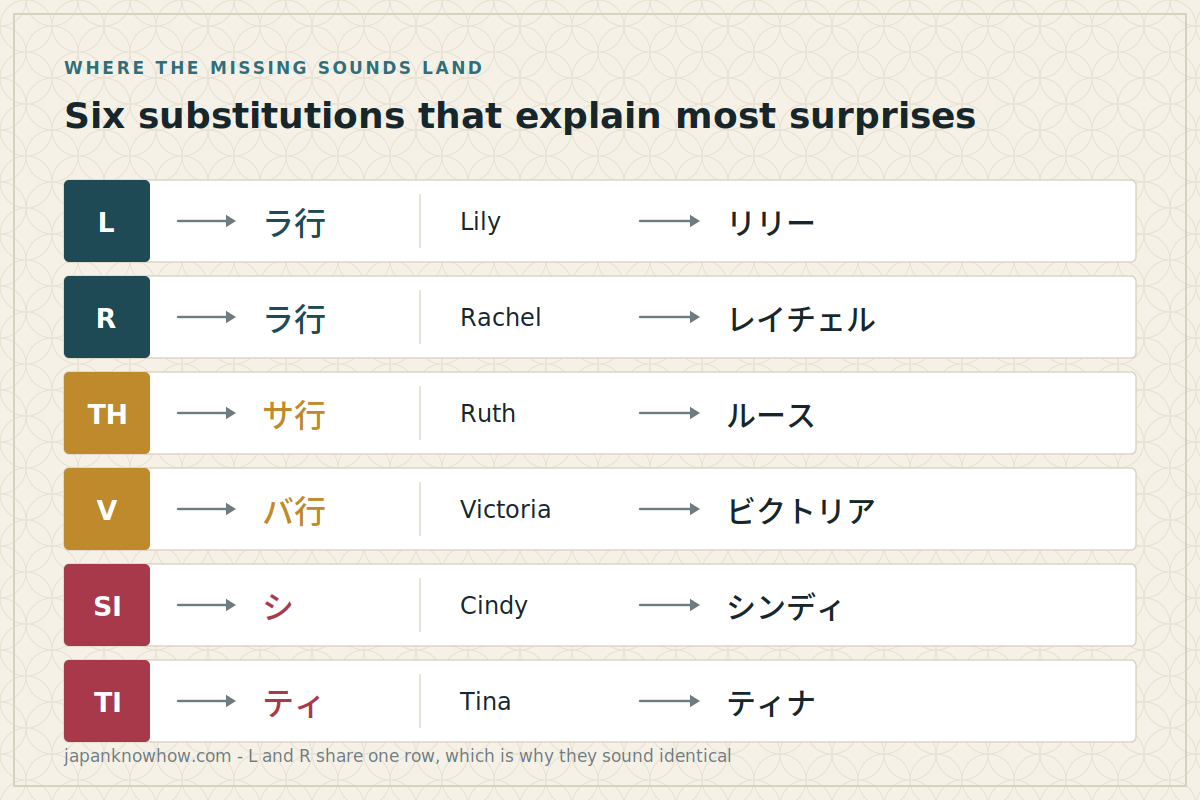
That gap isn’t sloppiness and it isn’t an accent in the usual sense. It’s structural: Japanese has a smaller set of distinct sounds than English, and when a name arrives, every English sound has to land on the nearest available Japanese one. Nothing is lost at random. Each substitution is predictable, and once you know the five big ones you can hear your own name coming before it arrives.
1. L and R are the same sound
This is the famous one, and it’s usually described backwards. Japanese doesn’t confuse L and R; Japanese has one liquid consonant where English has two, and it sits between them — a light tap of the tongue closer to a Spanish single R than to either English sound.
So both English sounds map onto the same row: ラ・リ・ル・レ・ロ. Lily is リリー. Rachel is レイチェル. Lauren and Warren start to look uncomfortably similar. There’s no workaround, because there’s nothing to work around — the distinction simply doesn’t exist in the receiving language, the way the distinction between the two Japanese pitch patterns doesn’t exist in English.
2. TH becomes S or Z
English has two th sounds, both rare across the world’s languages, and Japanese has neither. The voiceless one, as in think, lands on the S row: Ruth is ルース, Elizabeth is エリザベス, Ethan is イーサン. The voiced one, as in this, lands on the Z row: Heather is ヘザー.
The catch is that English spelling doesn’t distinguish them, which is one of the reasons automated conversion struggles — the full list of those reasons is in our piece on the names that break the rules.
3. V becomes B, usually
Japanese has no V. Broadcast style, including NHK’s, puts it on the B row: Victoria is ビクトリア, Oliver is オリバー, Kevin is ケビン.
There is an alternative. The character ヴ was invented specifically to write a V sound, and print publications use it: ヴィクトリア, オリヴァー. Both are correct; the difference is house style rather than accuracy. Most Japanese speakers pronounce both versions identically, as a B.
We use the B row as the primary spelling on this site and show the ヴ form alongside it where it’s in common use, which is the same choice most broadcasters make. Why we picked that way round is covered on our tools page.
4. Some consonant-vowel pairs don’t exist
This one is less famous and causes more confusion. Japanese doesn’t just lack certain consonants — it lacks certain combinations. Historically there was no si, no ti, no tu, no hu. Where you’d expect them the sound shifted: si became shi, ti became chi, hu became fu.
So Cindy is シンディ, with a shi at the front. Modern Japanese has borrowed combinations back in for foreign words — ティ for ti, ファ for fa, ウィ for wi — which is why Tina is ティナ rather than the older チナ. These borrowed forms are written with a small vowel beside a base character, and they’re the most recent layer in the writing system.
| Sound | Older form | Modern form | Example |
|---|---|---|---|
| ti | チ (chi) | ティ | Tina → ティナ |
| di | ヂ (ji) | ディ | Cindy → シンディ |
| fa / fi / fe / fo | ハ行 | ファ・フィ・フェ・フォ | Sophia → ソフィア |
| wi / we | ウイ・ウエ | ウィ・ウェ | William → ウィリアム |
| si | still シ — never borrowed back | Cindy → シンディ | |
5. Consonants can’t stand alone
The biggest structural difference, and the one that changes the shape of a name rather than just its texture.
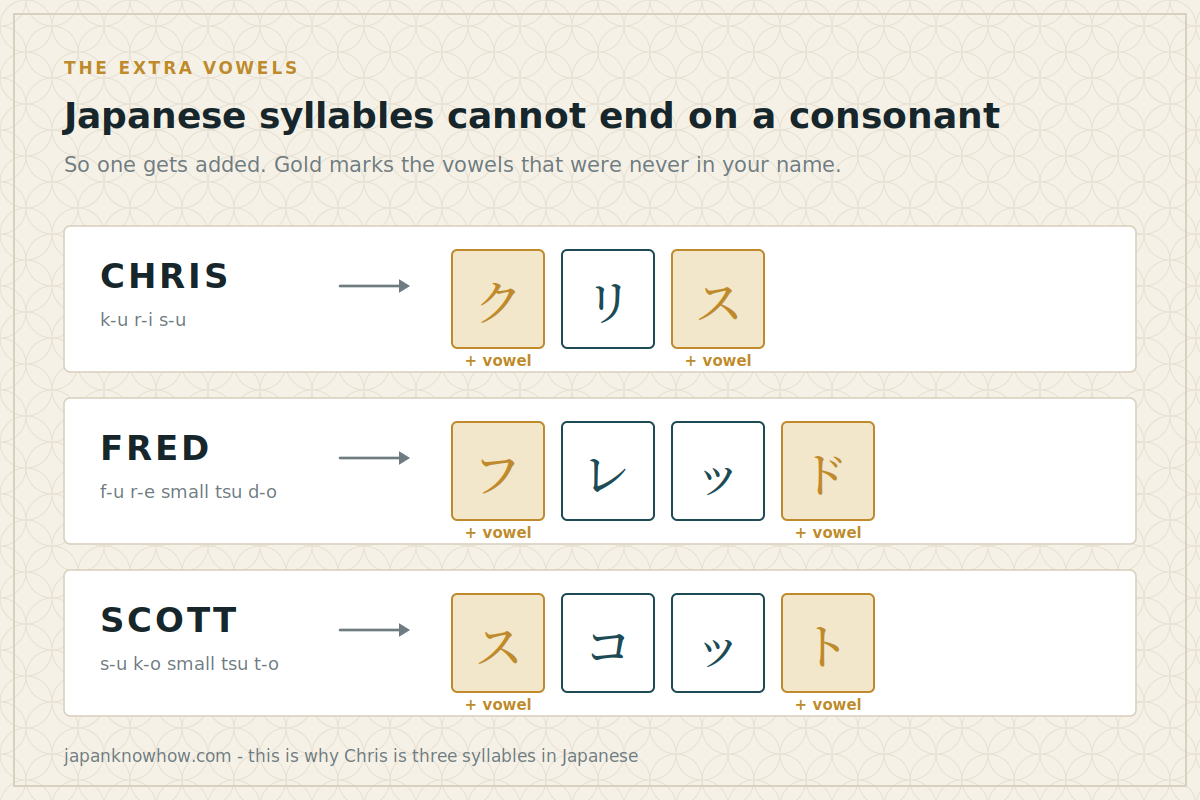
A Japanese syllable is a consonant plus a vowel, or a vowel alone. There are exactly two exceptions: the standalone n (ン) and the stopped beat written ッ. Everything else needs a vowel.
That means English consonant clusters get broken open with inserted vowels. Chris is one syllable in English; the kr can’t stand together and the final s can’t stand alone, so it becomes ku-ri-su: クリス. Three syllables. Fred becomes フレッド, four beats. Scott becomes スコット.
Which vowel gets inserted isn’t random. The default is u, the shortest and least conspicuous Japanese vowel — hence ku, su, fu. After T and D it’s o instead, because tu and du have their own complications: hence Fred ending in ド and Scott in ト rather than ツ.
Two marks that carry the rhythm
Once the sounds are placed, two small characters decide whether the result sounds like your name or like a near miss.
The long-vowel bar ー holds a vowel for a second beat. Japanese treats vowel length as meaningful — different length, different word — so this isn’t decoration. Emily is エミリー with a held final vowel, and every English -er, -ar and -or ending takes one: Jennifer is ジェニファー, Taylor is テイラー.
The small tsu ッ marks a held stop, a beat of silence before the following consonant. Scott is スコット, not スコト. Matt is マット. Rick is リック. The rough rule: a short stressed vowel followed by a final k, t, p, d or g takes one.
Get the sounds right and the length marks wrong and you produce something a Japanese reader can decode but would never write.Our guide to writing your name in Japanese
Why this is worth knowing
Three practical reasons, beyond the satisfaction of understanding it.
- You can predict your own name. Run the five substitutions in your head and you’ll usually land within one character of the standard spelling.
- You can hear it coming. Recognising your name in a train announcement or a roll call is much easier when you know what shape to listen for.
- You’ll stop hearing errors. A Japanese speaker saying your name the Japanese way isn’t mispronouncing it. They’re saying the version of it that exists in their language, correctly.
And one caution. All of the above describes what the sound system does. It doesn’t tell you which spelling caught on — Michael is マイケル for historical reasons no substitution rule predicts, and the same is true of a long list of common names. If you’re putting your name anywhere permanent, start with our guide to writing your name in Japanese and check whether yours is one of them, then read the notes on vertical layout if it’s going on something hand-written.