Sooner or later everyone who looks up their name in Japanese asks the same follow-up: yes, but what about the cool characters? The ones with meaning. The ones that would look good carved into something.
Those are kanji, and there is a real tradition of writing foreign names with them. It’s called ateji — literally “assigned characters” — and it’s how Japan wrote foreign words for centuries before katakana took the job. America was 亜米利加. Coffee was 珈琲, and still is on some menus. The tradition is genuine and it is not closed to you.
It is also, of all the things on this site, the one with the highest ratio of confident bad advice to reliable information. So this article is structured around what goes wrong.
Ateji is a sound game first
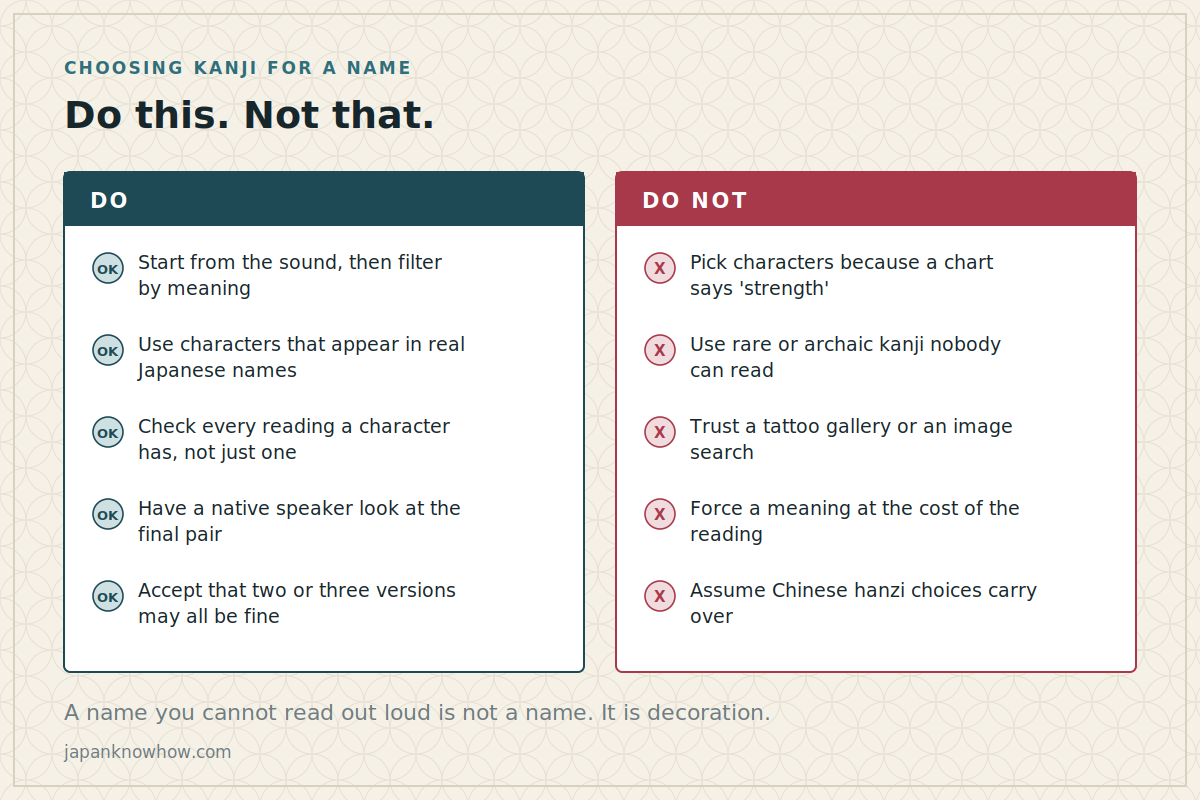
The mechanism is simple to state. Each kanji has one or more readings; you pick characters whose readings, chained together, produce the sounds of the name. Meaning comes second — it’s a filter applied to the shortlist, not the starting point.
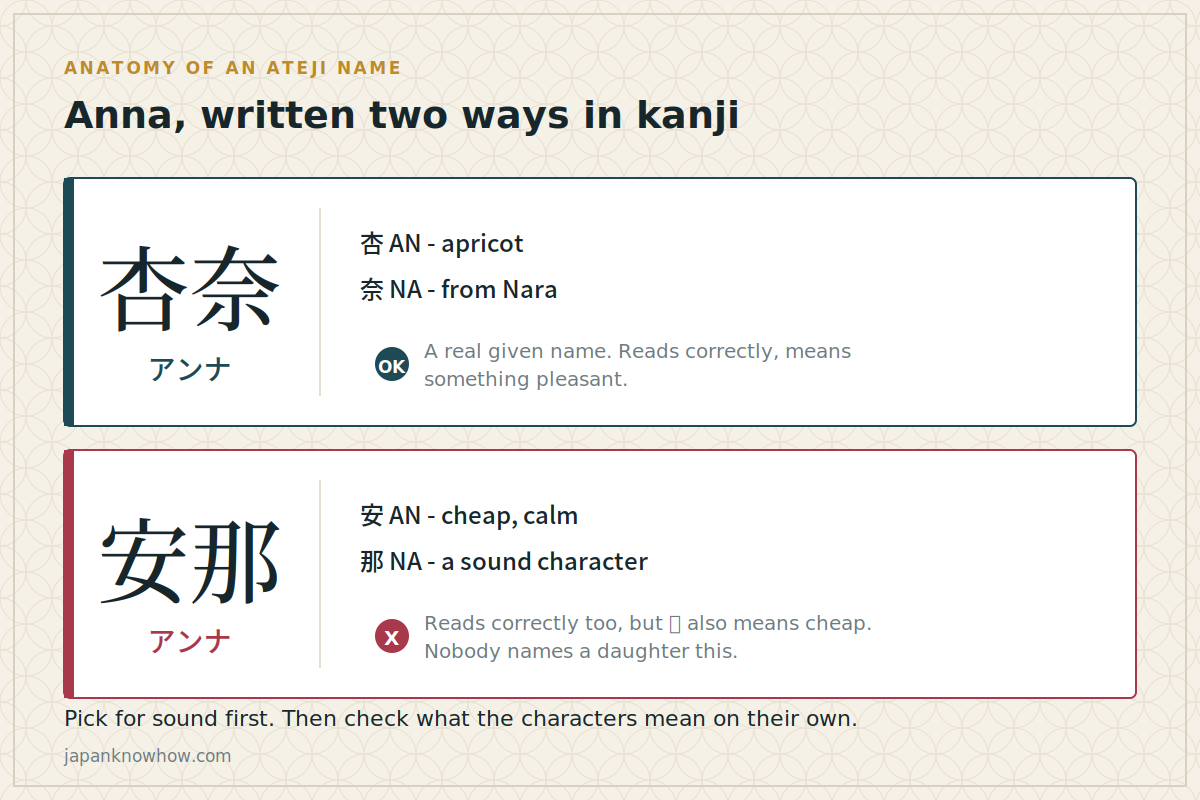
Take Anna. The sounds are an and na. Plenty of kanji read an: 安, 杏, 庵, 案. Plenty read na: 奈, 那, 菜, 名. Any combination gives you a correct reading. But 杏奈 — apricot plus the character from the place name Nara — is a real Japanese given name that thousands of women have. 安那 reads identically and pairs “cheap” with a character used mostly for its sound. Same phonetics, completely different impression.
This is the trap. English-language ateji advice almost always runs backwards: pick the meanings you want, then find characters for them. That produces combinations that are grammatically legal, semantically flattering, and immediately identifiable as something a foreigner assembled from a chart.
What actually goes wrong
Characters that are legal but not used in names
Japan maintains an official list of characters permitted in given names — the jinmeiyō kanji, several hundred characters on top of the standard set. Outside that list, a character may be perfectly readable and still land like naming a child with a piece of technical vocabulary. Readable is not the same as nameable.
Readings that only exist in one compound
Many kanji have a reading that appears in exactly one word and nowhere else. Build a name on one of those and you get something no reader can pronounce on sight — they’ll see the characters, fail to produce a sound, and ask. Every time.
Meanings that shift in combination
Kanji don’t sit in isolation; they colour each other. A character that means “power” alone can read as “forced” beside the wrong neighbour. This is the failure mode that never shows up in a dictionary lookup, because dictionaries define characters one at a time.
Chinese choices that don’t transfer
Chinese and Japanese share characters but not their readings, their frequency, or their connotations. A transliteration built for Mandarin will read as gibberish in Japanese, and vice versa. Plenty of “name in kanji” pages online silently mix the two.
When ateji is the right choice
Given all that, when should you use it at all? A short and honest list:
- Calligraphy and art. A brushed piece is decorative by nature, and the tradition is real.
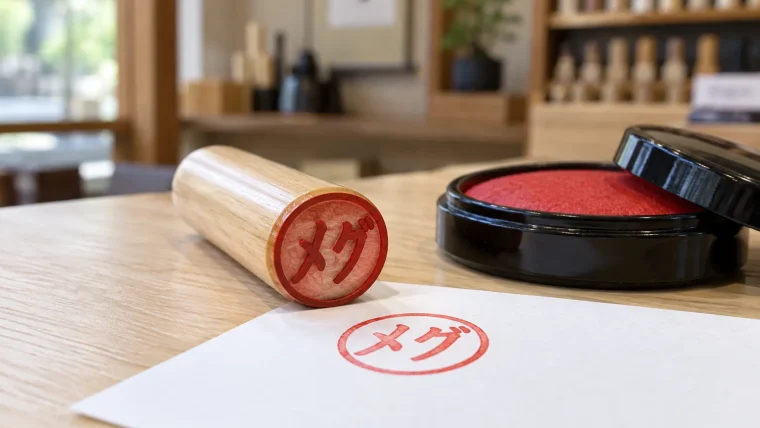
- A personal seal. A hanko with your name in kanji is a normal thing for a long-term resident to own.
- A gift or a keepsake, where the point is the gesture rather than the paperwork.
- Curiosity. Which is a perfectly good reason on its own.
And when it’s the wrong choice:
- Anything official. Visas, bank accounts, residence cards, contracts — these want katakana, in the form the institution specifies.
- Business cards. Katakana, with the middle dot between given name and surname. A kanji version reads as costume.
- Introducing yourself. People need to say your name, and katakana tells them how.
- Tattoos, unless a native speaker has seen the exact design. More on that below.
The tattoo problem, stated plainly
Kanji tattoos are the most common way this goes wrong, and the reason is structural rather than linguistic.
A tattoo is chosen from an image, applied by someone who usually can’t read it, based on a meaning supplied by a third party who also usually can’t read it. Nothing in that chain checks whether the characters read naturally, whether they’re the right way up, whether the font is a real Japanese typeface or a machine-generated approximation, or whether the combination means something different from the sum of its parts.
We’ll explain what a character means and how it reads. We won’t tell you it’s safe to put on your body permanently.Our tools page
If you want Japanese on your skin, the sequence that works is: settle the wording, have a native speaker who reads Japanese fluently look at the exact design at the exact size, and only then book the appointment. That check takes a day and costs nothing. Removal takes a year.
A workable process
If you’ve read this far and still want ateji, here’s the order of operations that produces something defensible:
| Step | What you’re doing | What you’re checking |
|---|---|---|
| 1 | Get your name in katakana first | That you know what sounds you’re working with |
| 2 | List kanji for each syllable | That the reading is a common one, not a one-off |
| 3 | Filter to characters used in real names | The jinmeiyō list, and whether real people have the name |
| 4 | Read each candidate pair as a whole | What the combination suggests, not what each part means |
| 5 | Ask a native speaker | The impression it makes, which is the part no list captures |
Step one is not optional. Ateji is built on top of the sound, so you need the sound settled before anything else — our guide to writing your name in Japanese covers that, including the cases where the established spelling differs from what the rules predict. If your name is one of those, the katakana you start from matters: build ateji on the wrong sounds and every step after it inherits the error. The list of names that break the rules is worth a glance before you begin.
The short version
Ateji is real, it’s old, and it’s fun. It is also decorative rather than functional in 2026, and it rewards patience and a native reader far more than it rewards a clever chart of meanings. Start from the sound. Filter by meaning. Get a second pair of eyes before anything becomes permanent — and if the answer comes back “that’s a bit strange,” believe it.