This case follows 佐藤 Satō, a surname written with the characters commonly read as “assistant” and “wisteria,” from the top of a national ranking into Okinawa, where it disappears from the leading positions. It is representative because the most common Japanese surnames are common nationally without being evenly distributed. A major private survey placed Satō first with 1.53 percent of its sample, but Okinawa’s leading names included 比嘉 Higa, 金城 Kinjō and 大城 Ōshiro. That is not a minor regional reshuffling of the same list. It shows why a Japanese surname must be read as a combination of spelling, pronunciation, distribution and local history.
The numbers require an immediate qualification. Japan’s government does not publish a complete public surname census from which you can obtain an official total of every spelling and reading. Reference works and specialist databases contain well over 100,000 distinct written surnames, with some databases claiming substantially higher totals depending on whether rare variants and alternate characters are counted separately. That supports the conservative phrase “more than 100,000,” but not one uncontested exact figure. How a Japanese Name Is Built and Read covers name order and the problem of multiple readings; this article follows the statistics and their limits.
Stage one: establish what the national ranking actually measured
The most useful large survey for this case was published by Meiji Yasuda Life Insurance in August 2018. It analyzed approximately 6.55 million policyholders in the company’s insurance and annuity records as of May 2018. That is a very large sample, but it is still a customer database rather than a census of every resident. The ranking should therefore be described as a survey result, not as a legally definitive register. Its value comes from the size and national distribution of the sample.
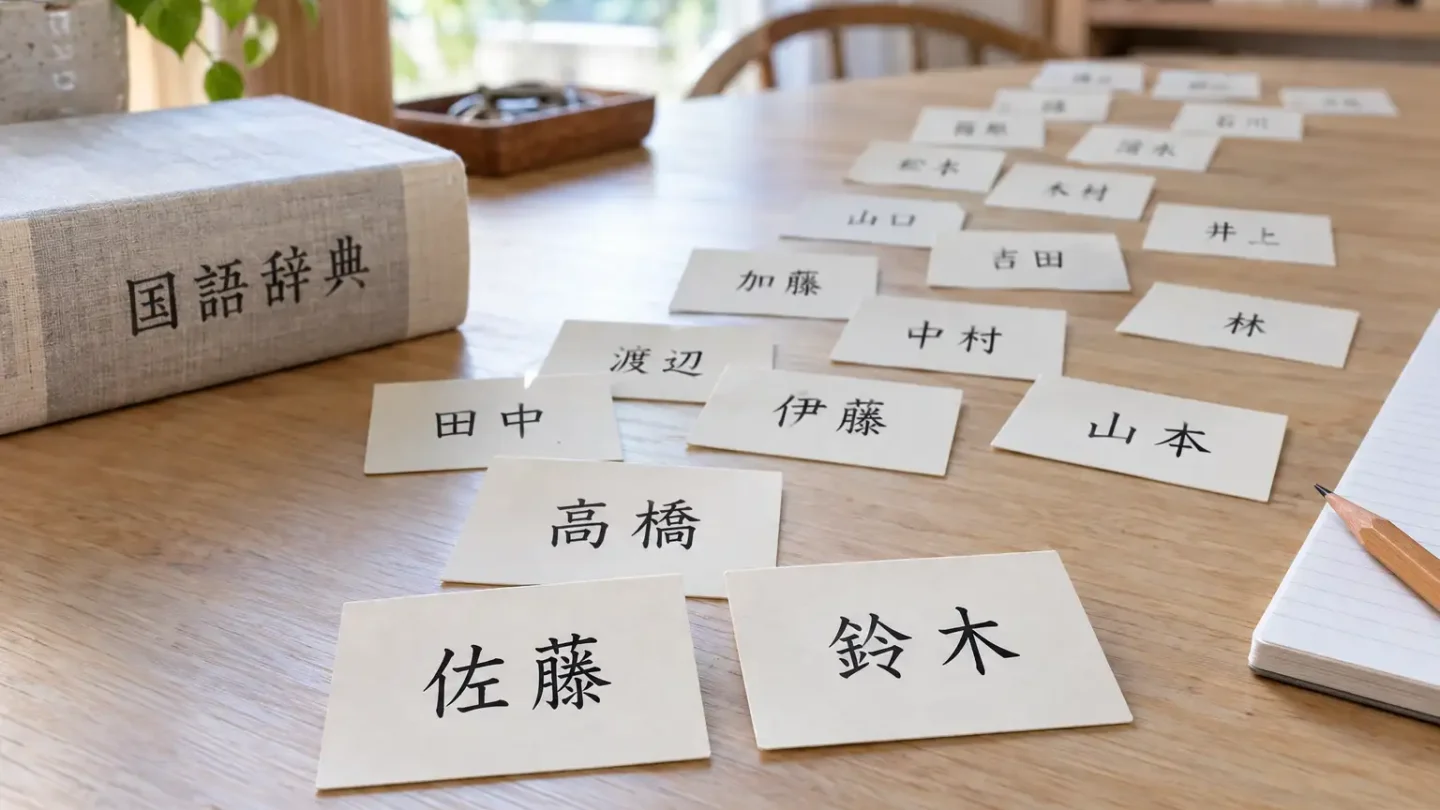
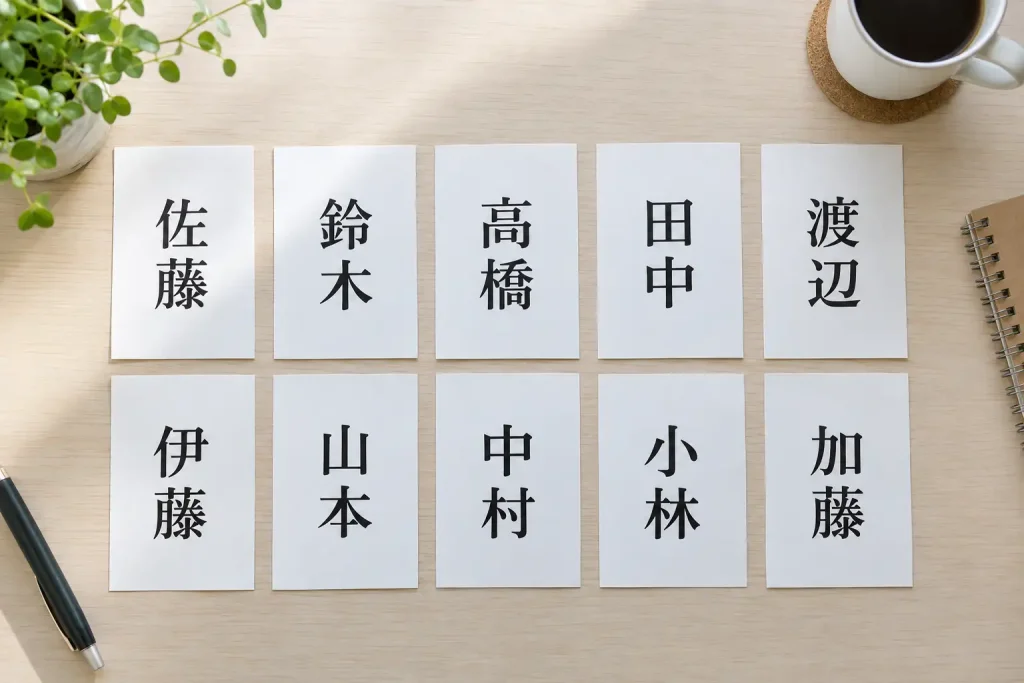
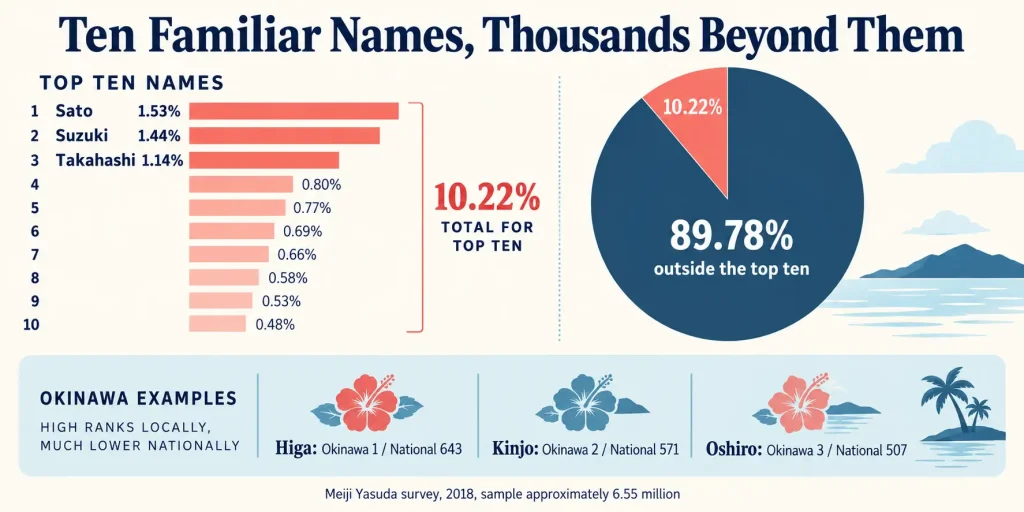
The report placed Satō first, followed by 鈴木 Suzuki and 高橋 Takahashi. The top three had held the same order in the company’s previous surveys. The first ten surnames together represented 10.22 percent of the sample, while the first hundred represented 33.38 percent. In other words, the top ten covered roughly one surveyed person in ten rather than a majority of the country. That is the first sign of Japan’s unusually long surname tail.
“The most common nationwide is Sato, followed by Suzuki and Takahashi.” — translation of Meiji Yasuda’s 2018 survey headline
| Rank | Surname | Common reading | Share of survey sample |
|---|---|---|---|
| 1 | 佐藤 | Satō | 1.53% |
| 2 | 鈴木 | Suzuki | 1.44% |
| 3 | 高橋 | Takahashi | 1.14% |
| 4 | 田中 | Tanaka | 1.06% |
| 5 | 渡辺 | Watanabe | 0.94% |
| 6 | 伊藤 | Itō | 0.90% |
| 7 | 山本 | Yamamoto | 0.84% |
| 8 | 中村 | Nakamura | 0.83% |
| 9 | 小林 | Kobayashi | 0.82% |
| 10 | 加藤 | Katō | 0.72% |
| Combined | Top ten | — | 10.22% |
The decision at this stage is to retain percentages rather than turn them into precise national headcounts. Multiplying a survey share by Japan’s total population would produce an estimate that looks more exact than the evidence allows. The cost of ignoring the sample is false precision: a convenient number presented as though it came from the family register system. The running state is therefore “national ranking established, population count not claimed.” Japanese surname rankings are estimates unless their methodology says otherwise.
Stage two: see how quickly the familiar names give way
A reader arriving from the United States may expect a few dominant surnames to account for a much larger portion of the population. The Meiji Yasuda data does not support that expectation. Satō and Suzuki together represented 2.97 percent of the survey sample, and the first three names together reached 4.11 percent. Even after the list expands to ten names, nearly nine out of ten people in the sample remain outside it. The headline names are only the entrance to the distribution.
This is why lists of twenty or fifty common Japanese last names can create the wrong mental picture. They are useful for recognition but poor at showing the scale of what follows. After the highly visible national names comes a long sequence of surnames that may be concentrated in a prefecture, tied to a local place name or represented by only a small number of households. Alternate kanji forms and multiple readings make the inventory larger still. A Romanized list hides those distinctions because two different written names can converge on the same Latin spelling.
The case state now changes from “Satō is number one” to “Satō is number one in a shallow national peak.” No purchase or government fee is involved, so there is no monetary running total. The practical cost is mistaken identification: assuming that two people with the same Romanized surname necessarily write or read it the same way. Preserve the kanji whenever the distinction matters. A ranking without the characters is an index, not a complete name record.
Stage three: separate the written name from its apparent meaning
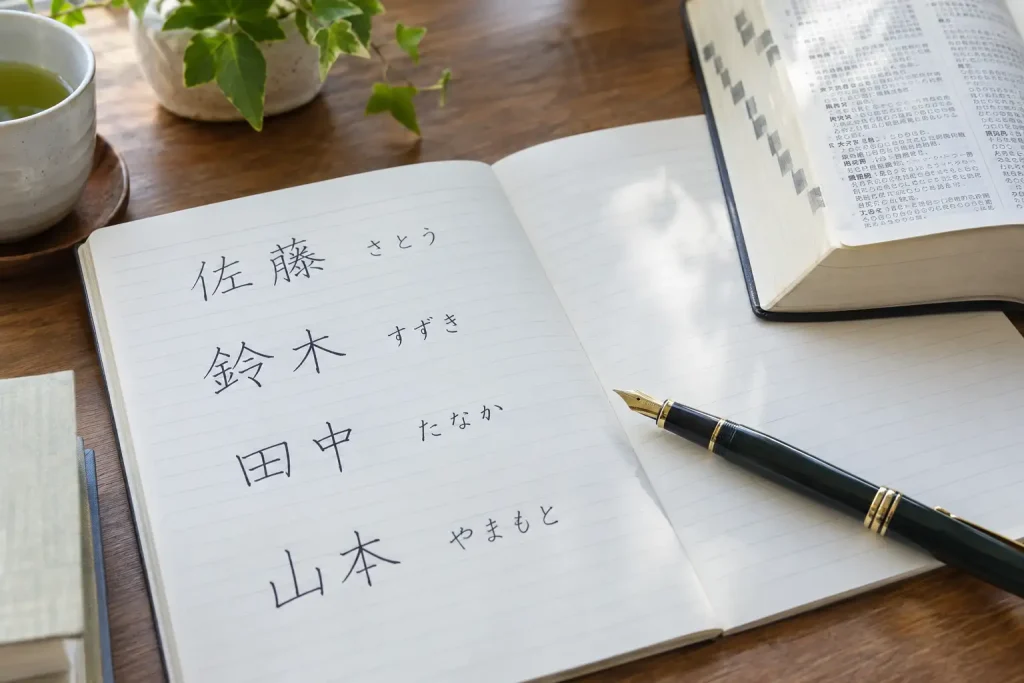
Japanese surnames often look transparent because their kanji are familiar words. 田中 Tanaka can be read literally as “inside the rice field,” 山本 Yamamoto as “base of the mountain,” and 中村 Nakamura as “middle village.” Those glosses explain the characters, but they do not prove the documented origin of every family using the name. The same written surname can arise in more than one place or lineage. A literal translation is therefore not a family history.
The same restraint applies to names containing 藤 fuji or tō, “wisteria.” Satō, Itō and Katō all contain that character, and historical explanations often connect such names to branches, offices or associations involving the Fujiwara name. That does not mean every present-day holder has one simple traceable descent from the same medieval family. Modern distribution is the result of migration, marriage, recordkeeping and independent adoption as well as inheritance. Japanese surname meanings should be presented as character meanings unless a specific genealogy has been demonstrated.
This is also where a foreign-name tool stops being relevant. Japanese family names are normally written in kanji and may have inherited readings that cannot be generated from English spelling. By contrast, a foreign personal name is ordinarily transliterated into katakana. How to Write Your Name in Japanese handles that separate task, while the Japanese name converter supplies checked katakana forms for 898 common names. It does not assign a Japanese family lineage or manufacture kanji ancestry.
Stage four: move the same test to Okinawa
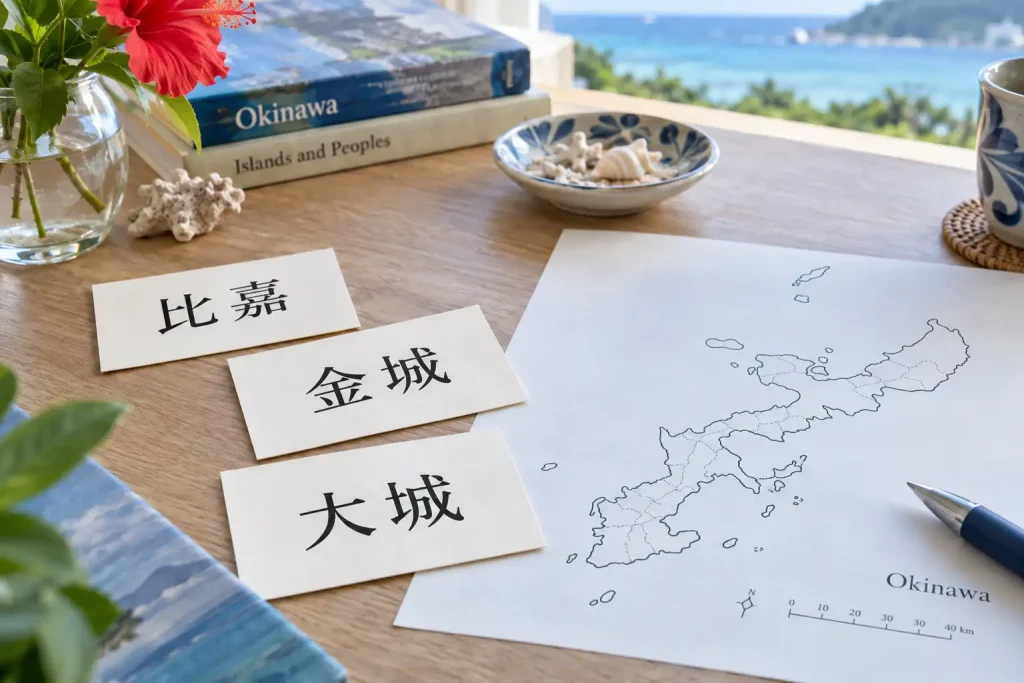
The general national list fails most visibly in Okinawa. In the 2018 Meiji Yasuda survey, Higa ranked first within Okinawa even though it stood at number 643 nationally. Kinjō placed second in the prefecture while ranking number 571 nationwide, and Ōshiro placed third while ranking number 507 nationally. None appears in the national top ten. The local order is therefore not a slightly modified Tokyo-oriented list.
| Okinawa rank | Surname | Common Okinawan reading | National rank in the 2018 survey |
|---|---|---|---|
| 1 | 比嘉 | Higa | 643 |
| 2 | 金城 | Kinjō | 571 |
| 3 | 大城 | Ōshiro | 507 |
These Okinawan surnames belong to a regional history shaped by the Ryukyu Kingdom and its later incorporation into modern Japan. The Ryukyu Kingdom was abolished and Okinawa Prefecture established in 1879, but political incorporation did not erase local place names, language patterns or family naming traditions. Names using 城, “castle,” are especially visible, yet their Okinawan readings do not always follow the reading a mainland visitor might predict. 金城, for example, can appear with readings including Kinjō and Kaneshiro. The characters alone do not settle the pronunciation.
The decision at this stage is to replace the national ranking with prefectural evidence when the question is local. The cost of keeping the national list is not merely statistical. You may misread a name, underestimate how ordinary it is in Okinawa or describe a major regional surname as an exotic exception. Higa is not nationally frequent, but that does not make it rare in its strongest region. Okinawan family names need their own layer in any serious account of Japanese surname distribution.
Stage five: identify where the easy advice breaks
The easy advice says to learn the national top ten and use the kanji meanings to remember them. That works for recognizing Satō or Suzuki on a Tokyo office directory. It fails when the same reader arrives in Okinawa and repeatedly encounters names far below the national leaders. It also fails whenever a familiar spelling has more than one reading. Frequency and pronunciation are regional variables, not properties fixed by the character alone.
A better method has four checks:
- Confirm the written surname in kanji.
- Ask for or verify the reading rather than deriving it automatically.
- Check whether the ranking is national or prefectural.
- Read the methodology and date of the source.
- Treat literal kanji meanings separately from family history.
The fifth check is where casual surname articles most often go wrong. A character-by-character gloss becomes an origin story, the origin story becomes a universal genealogy, and the result is repeated without documentation. The honest form is narrower: “This surname is written with these characters and is commonly read this way.” A specific family’s origin requires a specific record. The case state is now “name recognized, reading verified, regional context added.”
Stage six: adapt the method to place and purpose
City matters; budget and season largely do not. If you are identifying names in Sendai, Nagoya, Kagoshima or Naha, use a regional distribution source rather than assuming the national table describes the local street. If you are preparing a hotel booking, school form or business record, prioritize the exact legal spelling and reading supplied by the person. If you are studying casually, the national top ten provides a manageable starting set. The purpose determines how much verification you need.
Your Japanese level also changes the workflow. A beginner can learn to recognize the ten leading kanji forms without memorizing speculative etymologies. An intermediate reader should note variant characters such as 渡辺, 渡邊 and 渡邉, which may represent the same broad surname family while remaining distinct legal spellings. An advanced researcher should consult historical records and local studies rather than a web ranking alone. No level benefits from guessing a person’s reading.
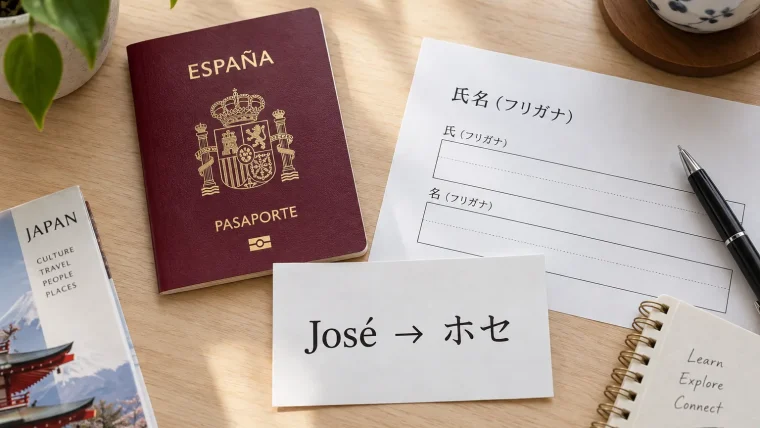
Foreign surnames require a different procedure altogether. They enter Japanese through sound and are normally written in katakana, so national Japanese surname frequency is irrelevant. Why Jose Becomes Hose and Not Joe-Say explains why Spanish spelling must be read through Spanish pronunciation before conversion. Katakana Name Rules, and the Names That Break Them covers established spellings that defeat mechanical rules. Do not use a kanji surname list to transliterate an American family name.
The long tail is the result, not background noise
The phrase “more than 100,000 surnames” should remain an informed lower-bound description rather than a false official count. Different reference works count variant characters, historical forms, alternative readings and extremely rare names differently. That disagreement does not weaken the central point. It explains why a stable national top ten can coexist with extraordinary regional and orthographic variety. The uncertainty is in the exact size of the tail, not in its existence.
The 2018 survey supplies a clean numerical anchor: the first ten surnames accounted for 10.22 percent of its 6.55 million-record sample. Okinawa then shows what the national table leaves out, with Higa, Kinjō and Ōshiro leading locally despite much lower national positions. Satō remains the national leader in that survey, but it is not the template from which every prefecture is built. How a Japanese Name Is Built and Read provides the structural explanation when you need to move from rankings back to complete names. The transferable rule is to keep the kanji, confirm the reading and always ask what population the ranking actually measured.