Type your name into any converter and you’ll get an answer in about a second. What you won’t get is any sense of whether that answer is the one a Japanese person would actually write. Those are two different questions, and the gap between them is where almost every mistake lives.
This guide covers the whole process: which script your name belongs in, how English sounds get remapped onto Japanese ones, the four adjustments that decide whether a spelling looks natural or foreign, and — the part most guides skip — when the “correct” answer is simply the one that caught on decades ago.
Your name goes in katakana, and that’s not an insult
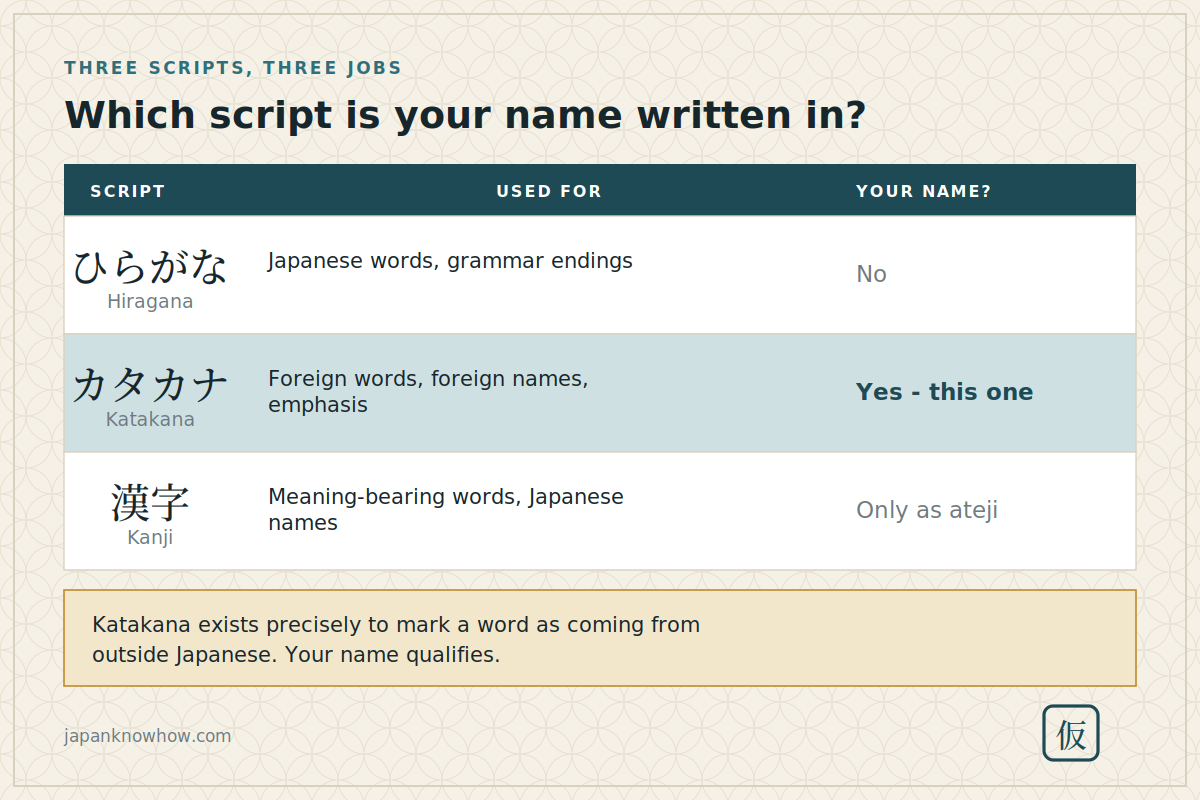
Japanese runs three writing systems in parallel, in the same sentence, doing different jobs. Hiragana carries Japanese words and grammar. Kanji carries meaning. Katakana marks a word as having come from outside Japanese — loanwords, foreign place names, foreign personal names, and the occasional word set in italics for emphasis.
English speakers sometimes read that as a demotion, as though katakana were the plastic-cutlery script. It isn’t. It’s a signal, and a useful one: a Japanese reader seeing マイケル knows instantly that this is a foreign name, roughly how to pronounce it, and that they shouldn’t try to parse meaning out of the characters. Written in kanji, the same name would raise all three questions at once.
There is a separate tradition of writing foreign names in kanji chosen for their sound, called ateji, and it’s genuinely interesting — but it’s decorative rather than standard. If you want your name on a business card, a form, or a name tag, katakana is the answer. If you want it on a scroll, read our piece on choosing kanji for a foreign name first, because the failure modes there are expensive.
The four steps
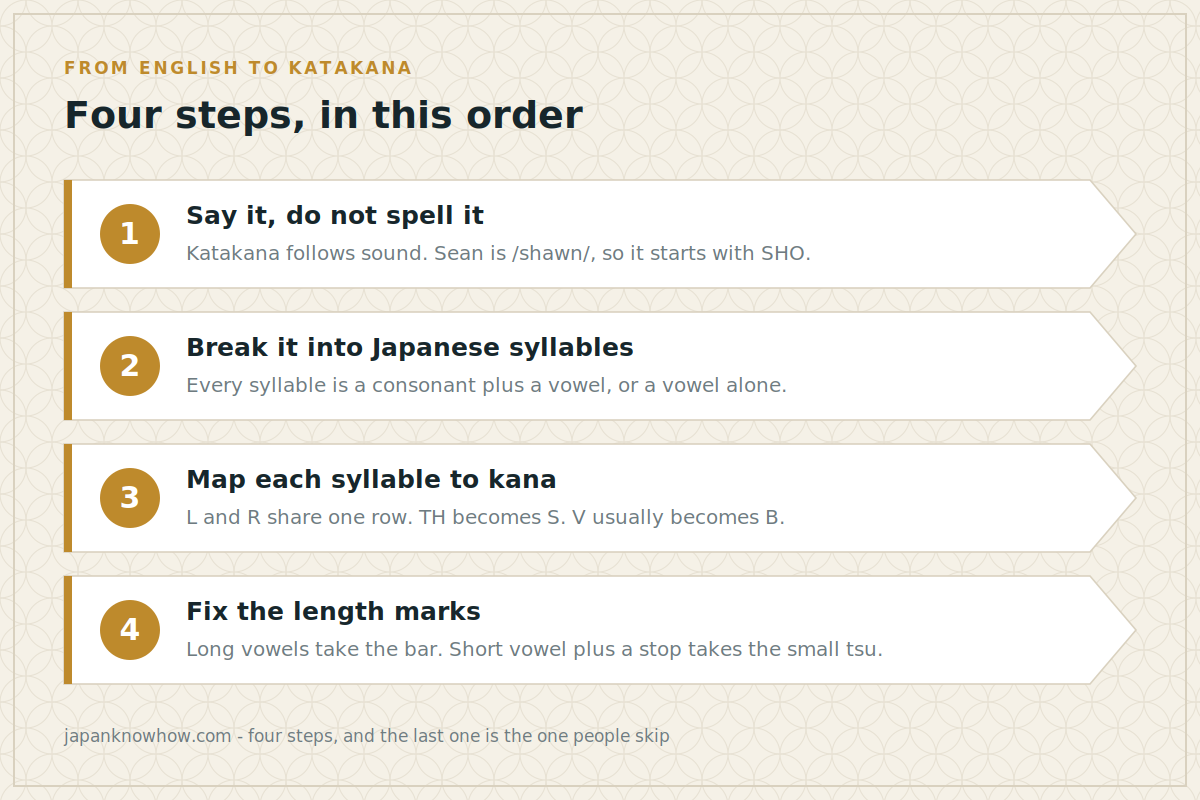
1. Say it, don’t spell it
Katakana follows pronunciation, not orthography. This is the single most important thing on this page, and it’s the reason spelling-based converters go wrong.
Sean is not S-E-A-N. It’s shawn, so it begins with the sho sound and comes out ショーン. Thomas is tommus, not thomas, so its first sound is a hard T and it comes out トーマス. Chloe is klo-ee, so the C and H fuse into a K: クロエ. Say the name out loud before you do anything else, and if it has a silent letter, drop it now.
2. Break it into Japanese syllables
Japanese syllables are almost all consonant-plus-vowel, or a vowel on its own. There are exactly two exceptions: the standalone n (ン) and the small pause written ッ.
That structure means English consonant clusters have to be broken open. Chris has one syllable in English and three in Japanese, because kr can’t stand together and s can’t end a syllable. It becomes ku-ri-su: クリス. This is why your name is often longer in Japanese than you expect, and it’s covered in detail in the article on English sounds Japanese doesn’t have.
3. Map each syllable to a kana
Now the substitutions. Japanese has fewer distinct consonants than English, so several English sounds collapse onto one Japanese row:
| English sound | Japanese row | Example |
|---|---|---|
| L and R (both) | ラ行 ra-ri-ru-re-ro | Lily → リリー, Rachel → レイチェル |
| TH (as in Ruth) | サ行 sa-shi-su-se-so | Ruth → ルース |
| V | バ行 ba-bi-bu-be-bo | Victoria → ビクトリア |
| F before most vowels | ファ・フィ・フェ・フォ | Sophia → ソフィア |
| SI | シ (shi) | Cindy → シンディ |
The L/R merge is the famous one, and it goes both ways: Japanese has a single liquid consonant that sits between the two English sounds, so Lee and Rhea can end up looking closer than you’d like.
4. Fix the length marks
Two small marks do a disproportionate amount of work, and getting them wrong is what makes a spelling look amateur.
The long-vowel bar ー holds a vowel for an extra beat. It’s what turns ri into ree: Emily is エミリー, not エミリ. Any English -er, -ar, or -or ending takes one, which is why Jennifer is ジェニファー and Taylor is テイラー.
The small tsu ッ marks a stopped beat before a consonant — a tiny catch in the throat. Scott is スコット, not スコト; Matt is マット. As a rough guide, a short stressed vowel followed by a final k, t, p, d, or g takes one.
A converter that gets the sounds right and the length marks wrong produces something a Japanese reader can decode but would never write. That’s the difference between transliteration and spelling.Our tools page, on measured accuracy
Where the rules stop working
Here’s the uncomfortable part. If you apply the four steps above to Michael, you get something like マイチャエル — because ch, by the ordinary rules, is the cha sound. Every Japanese source writes マイケル. The rules aren’t wrong; they simply lose to precedent.
This happens because English spelling doesn’t reliably encode pronunciation, and because names arrive in Japanese through specific channels — a famous actor, a translated novel, a brand — and whatever spelling that first arrival used tends to stick. For common names, established usage beats any algorithm, and no amount of rule-writing closes the gap.
We measured this. Running a rule engine against 61 names with well-documented Japanese spellings, it got 77% exactly right. The misses weren’t obscure names — they were Michael, Thomas, Sean, Charlotte, Katherine, Isabella. In other words, precisely the names people look up. The full breakdown, including the eight categories of failure, is in our article on the names that break the rules.
That’s why the converter on this site checks a hand-verified list of around 900 common American given names first, and only falls back to calculation when a name isn’t on it. It also tells you which of the two answered — see how our tools work for what that flag means and where you should not rely on it.
Writing it out
Once you have the katakana, two practical questions come up.
Order. Japanese puts the family name first. In katakana, foreign names usually keep Western order — given name, then surname — with a middle dot separating them: マイケル・スミス. That interpunct is a real character (・) and Japanese readers expect it; a space looks wrong.
Direction. Horizontal, left to right, is the default for anything modern. But name cards, wish strips, and calligraphy still run vertically, top to bottom, and the long-vowel bar rotates to stand upright when they do. If your name is going on anything hand-brushed, read the guide to vertical writing before you copy anything from a screen.
A short checklist
- Say the name aloud and write down what you hear, not what you spell.
- Check whether it’s a common name with an established Japanese spelling. If it is, use that.
- Break consonant clusters open; every consonant needs a vowel after it.
- Add the long-vowel bar to -er, -ar, -or and any held vowel.
- Add the small ッ before a final hard consonant after a short vowel.
- Use the middle dot between given name and surname.
- If it’s going somewhere permanent, have a native speaker look at it.
That last one isn’t a disclaimer for its own sake. A spelling can be technically defensible and still read as odd, dated, or unintentionally comic, and no tool — ours included — can hear that. What a tool can do is get you to a good starting point in a second, which is most of the way there for most purposes.