The Money Behind a Single Episode: How Anime Is Made
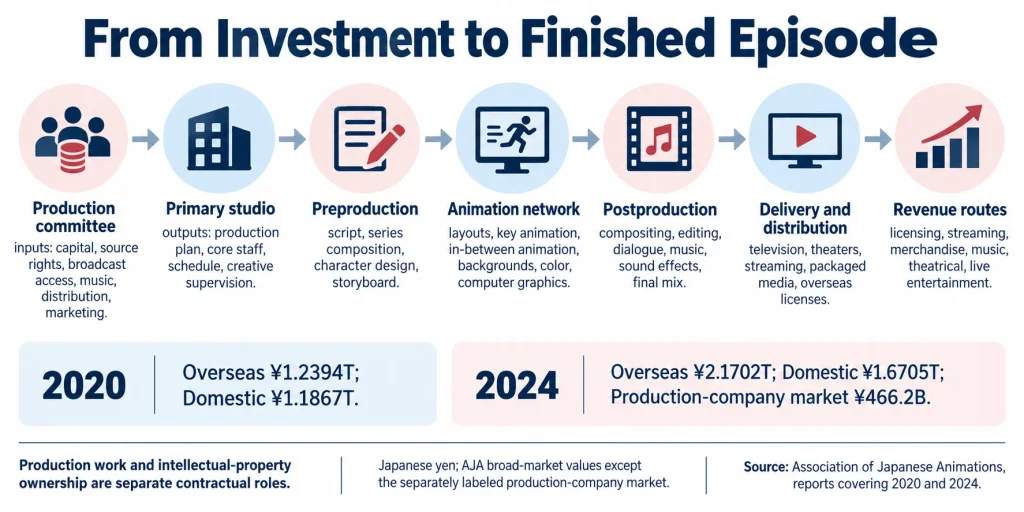
The company drawing an anime episode is often not the company paying for the entire show or controlling its long-term rights. That division between financing, production, and ownership is the mechanism behind how anime is made. A 製作委員会, seisaku iinkai, “production committee,” assembles the money and commercial interests, while an animation studio manages the creative and technical work under contract. Individual scenes may then travel through several specialist companies and freelance desks before they return for editing. The finished episode looks like one work because production management makes a fragmented supply chain behave like one studio.
This arrangement is easy to misread from the credits. The studio name is prominent, so overseas viewers commonly assume that the studio commissioned the series, financed every department, and owns the resulting intellectual property. Sometimes it does hold an investment share, and sometimes it leads the project, but neither is guaranteed. A studio hired only as the animation contractor is paid to deliver the agreed work rather than automatically receiving the licensing, publishing, music, merchandise, or streaming income that follows. The organization with the most visible artistic responsibility can therefore have limited control over the most valuable rights.
The second misconception is that there is one universally meaningful “budget per episode.” Public production accounts rarely provide a clean, comparable figure, and quoted estimates often mix different costs: the studio’s production fee, the committee’s total investment, advertising, music, broadcaster charges, localization, or later corrections. A visually ambitious episode can also consume resources shifted from elsewhere in the series. Without a contract or audited project account, attaching a precise yen-and-dollar price to an ordinary episode creates certainty that the evidence does not support. The production chain is more revealing than an unsupported headline number.
The funding mechanism behind how anime is made
A production committee is not usually a creative department sitting inside an animation studio. It is a project partnership formed by companies that bring money, rights, distribution routes, or products connected with the title. Depending on the project, participants may include a publisher, broadcaster, film distributor, music label, advertising company, streaming service, toy company, game business, or the animation studio itself. Each participant’s position is governed by the project agreement rather than by one industry-wide ownership formula. The committee finances and commercializes the project because no single participant necessarily wants to carry every risk alone.
The original publisher may want more manga or novel sales. A music company may value theme songs, soundtrack releases, and performers. A broadcaster needs programming, while a distributor and streaming platform need screen rights for specific territories and periods. A merchandise company is interested in characters that can continue earning after the broadcast ends. Those objectives can align around the same show even though the partners measure success differently.
This structure spreads the financial exposure, but it also divides authority. A committee member that invests more or contributes a crucial underlying right may receive a stronger contractual position. The studio can be included as an investor, hired only to animate, or placed somewhere between those poles. The outsider’s mistake is to treat “the committee” as a mysterious company with one permanent staff. It is better understood as the contractual and decision-making structure assembled for that title.
| Participant | What it commonly contributes | What outsiders often assume incorrectly |
|---|---|---|
| Publisher or original-rights holder | Access to the manga, novel, game, or other source property | The publisher personally supervises every animation decision |
| Broadcaster or platform | Exhibition route, scheduling, promotion, or investment | Paying to show the series always means owning the whole property |
| Music company | Theme songs, recordings, performers, and music exploitation | Music is added only after the animation has been finished |
| Distributor or advertising company | Sales, theatrical or video distribution, marketing, coordination | Distribution begins only when the episodes are complete |
| Animation studio | Direction, production management, animation, compositing, and delivery | Producing the images automatically confers all copyright and licensing rights |

The committee pays, but not every payment reaches the studio
The committee or its lead company commissions the screen production and agrees on the terms under which the studio will deliver it. That payment is not identical to the entire economic value of the anime. Marketing campaigns, music releases, licensing work, broadcast arrangements, merchandise development, and overseas sales can sit in other budgets or revenue streams. Even within animation production, the primary contractor may use part of its fee to commission specialist companies and freelancers. The money reaching an individual animator is therefore several contractual steps away from the consumer’s subscription or merchandise purchase.
This separation explains why a successful franchise does not automatically make every production contractor wealthy. A studio with no meaningful ownership stake may receive its contracted fee even if the title later becomes a global hit, subject to the actual agreement. Conversely, an investing studio accepts more commercial risk in exchange for the possibility of rights-related returns. Committee participation is therefore not automatically exploitative or automatically beneficial. The decisive questions are how much the studio invested, which rights it received, when revenue is distributed, and whether it can afford to wait.
“The anime industry market and the anime production industry market are different.” — Association of Japanese Animations reporting framework
AJA deliberately distinguishes the broad animation market from the narrower market measured from animation production companies. That distinction is the uncomfortable part behind many impressive revenue headlines. Consumer spending on merchandise or overseas services can expand without an equivalent amount becoming production revenue for the studios doing the screen work. In AJA’s latest English summary available when this article was checked, the broad market for the reporting year was far larger than the production-company market. Treating those totals as though they were one pool of money disguises where the value accumulates.
The studio turns the contract into a production plan
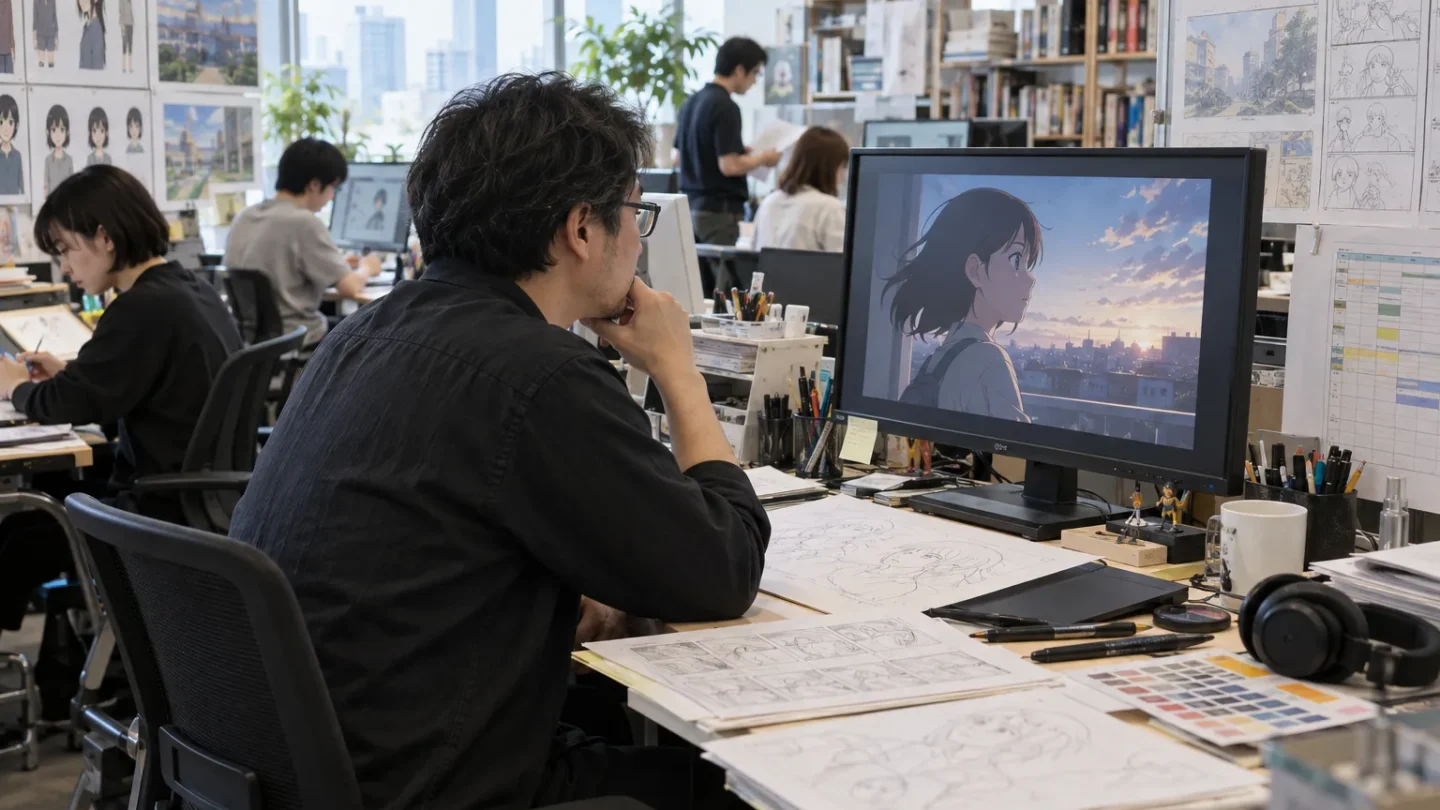
Once commissioned, the primary studio has to transform a proposal, source work, or original concept into deliverable footage. Planning establishes the format, core staff, schedule, design direction, and production assumptions. Series composition organizes the larger story, while episode scripts determine what must happen within individual installments. Storyboards then convert dialogue and action into shots, camera decisions, timing, and staging. The studio’s production department coordinates this work even when much of the drawing happens elsewhere.
The director protects the overall dramatic and visual direction, but does not personally approve every pencil line in isolation. Character designers establish usable model sheets from the original designs, and animation directors correct drawings to maintain consistency. Episode directors interpret the storyboard and manage the episode’s execution. Production assistants track material, assignments, deadlines, and revisions across desks and companies. When this coordination fails, talent alone cannot keep the pipeline moving.
In Japanese production terminology, 作画, sakuga, literally “drawing pictures,” refers to the drawing side of animation rather than to a special genre of unusually beautiful scenes. Key animators establish important poses and movement, while in-between work connects those drawings. Background art, color design, digital paint, computer graphics, photography or compositing, editing, sound, and recording form separate but interdependent processes. Some stages can proceed in parallel, but each still depends on approved material arriving in usable form. A late storyboard does not merely delay storyboarding; it compresses the time available to nearly everyone downstream.
Subcontractors are part of the normal pipeline
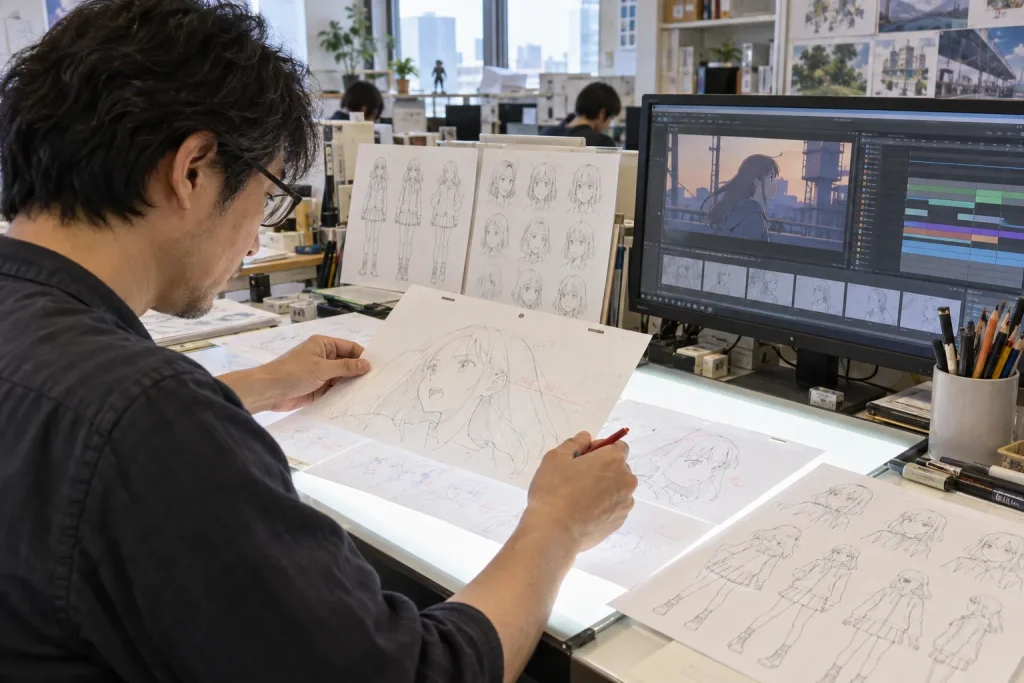
The word “studio” suggests one building where the entire episode moves from script to broadcast master. Contemporary production is often distributed across companies, freelance artists, and sometimes overseas partners. A primary contractor may assign a complete episode to another studio, commission only in-between animation, or send backgrounds, coloring, computer graphics, compositing, and other tasks to specialists. The resulting credits can contain many corporate names because the work genuinely crossed many organizational boundaries. Outsourcing is not by itself evidence that a production has collapsed.
The problem appears when the schedule leaves no room for coordination, checking, or corrections. Material may arrive late, forcing downstream teams to start from incomplete information or work in shorter windows. A subcontractor asked to rescue an episode near delivery faces different conditions from one booked during a stable production plan. More companies can increase capacity, but they also create more handoffs, file checks, communication points, and approval loops. A distributed pipeline becomes fragile when time is treated as an endlessly compressible resource.
AJA’s television-animation production manual maps a chain involving planning, scripts, storyboards, layouts, key animation, in-between animation, finishing, backgrounds, photography, editing, audio, and delivery. It also emphasizes the coordination role of production staff. That official workflow should not be read as proof that every title follows an identical order or keeps every process in-house. It demonstrates why one episode can involve many specialists before viewers see a continuous program. The outsider’s mistake is to interpret every subcontractor credit as either meaningless assistance or proof of failure, when the reality depends on scope and schedule.
Voices, music, and sound follow their own clock
Picture production is only one half of an episode. Voice recording must coordinate actors, scripts, direction, studio availability, and a visual reference that may not yet be fully animated. When final footage is unavailable, performers can record against storyboards, layouts, or provisional video. Sound effects, dialogue editing, music placement, mixing, and final synchronization then have to meet the same delivery deadline as the images. A late picture change can therefore create work in departments that never draw a frame.
Music is also connected to the committee structure. A participating label may supply performers and manage theme-song exploitation, while the score itself follows production and rights agreements specific to the title. Opening and ending sequences can function simultaneously as creative statements, promotional assets, and music products. That does not mean artistic decisions are fake or reducible to advertising. It means the artwork and its commercial routes are designed inside the same project.
Dialogue carries information that the production chain must later transmit across languages. Japanese Honorifics in Anime: -san, -kun, -chan and the Rest explains why a suffix can mark a relationship change that English cannot reproduce neatly. Anime Speech Styles, and What Subtitles Cannot Carry covers pronouns, register, role language, and dialect instead of repeating that linguistic problem here. These choices begin with Japanese writing and performance, but their consequences continue into subtitling, dubbing, and international distribution.
Distribution money arrives through separate doors
A finished episode does not produce one undivided stream of revenue. Domestic broadcasting, theatrical exhibition, packaged video, streaming, merchandise, music, live entertainment, and overseas licensing are measured as different segments in AJA’s reporting. The contractual route from each segment to committee members or contractors depends on the title. A platform payment may be an advance, a minimum guarantee, a license fee, a production investment, or part of a larger rights package. Calling all of it “streaming revenue” can conceal materially different arrangements.
Overseas demand has changed the scale of this system. AJA reported that the overseas anime market first exceeded the domestic market in 2020: ¥1.2394 trillion overseas against ¥1.1867 trillion domestically. Using the Federal Reserve’s 2020 average exchange rate, those totals were approximately $11.6 billion and $11.1 billion. The crossover did not create a permanent straight line, because the domestic market moved back ahead in 2021 and 2022. Overseas value then exceeded domestic value again in 2023 and widened its lead in 2024, according to AJA’s later reports.
For 2024, AJA estimated the broad anime market at ¥3.8407 trillion, approximately $25.4 billion using the Federal Reserve’s average 2024 exchange rate. The overseas component was ¥2.1702 trillion, about $14.3 billion, while the implied domestic portion was ¥1.6705 trillion, about $11.0 billion. AJA separately estimated the animation production-company market at ¥466.2 billion, about $3.1 billion. Those figures are related, but they do not measure the same layer of the business.
| AJA market measure | 2020 | 2024 | What the measure includes |
|---|---|---|---|
| Overseas anime market | ¥1.2394 trillion, about $11.6 billion | ¥2.1702 trillion, about $14.3 billion | Overseas consumer and business activity captured by AJA’s broad-market method |
| Domestic anime market | ¥1.1867 trillion, about $11.1 billion | ¥1.6705 trillion, about $11.0 billion | Japanese activity across the broad market’s segments |
| Total broad anime market | ¥2.4261 trillion, about $22.7 billion | ¥3.8407 trillion, about $25.4 billion | The wider market surrounding anime-related consumption |
| Production-company market | Not used here for comparison | ¥466.2 billion, about $3.1 billion | Revenue measured from animation production companies |
The overseas crossover matters because committee planning no longer treats international demand as merely a late bonus. Streaming availability, territorial rights, global marketing, localization timing, and overseas merchandise can influence decisions before broadcast. Yet a larger overseas market does not prove that the animating studio owns the foreign rights. It proves that international activity has become central to the value of the industry. Who receives that value still depends on contracts and investment positions.

Four consequences hidden inside the production chain
The first consequence is that visual quality and ownership are separate facts. A studio may define the look of a title, solve its hardest production problems, and still hold little or no long-term intellectual-property participation. Viewers reward the visible maker with loyalty, while the financial structure may reward rights holders and investors elsewhere. That gap is not an exception invented for a few notorious productions. It is a possibility built into commissioned production.
The second consequence is that a schedule failure can begin before animation starts. If financing closes late, scripts remain unsettled, designs arrive slowly, or approvals become congested, the drawing departments inherit lost time. Hiring additional freelancers can increase raw capacity, but it cannot always restore orderly dependencies. The visible symptom appears in animation because that is what reaches the screen. The origin may sit earlier in planning, decision-making, or material delivery.
The third consequence is that a global hit can widen the difference between franchise success and studio security. Overseas licensing and merchandise can make the title more valuable while the primary studio continues to earn mainly through contracted production work. A studio with committee equity may participate differently, but participation cannot be inferred from its logo appearing in the opening. You have to inspect the production credits, committee listing, corporate disclosures, and rights notices. Even then, private contracts normally prevent a complete public reconstruction.
The fourth consequence is that localization is part of the commercial chain, not a separate cultural afterthought. Subtitles, dubbing, title treatment, character-name readings, and platform metadata determine how the work travels. What Gets Lost in the Dub explains the timing and performance constraints of rewriting dialogue for existing mouth movements. Character Names in Japanese: Meaning, Kanji and Readings deals with names whose sound and written meaning cannot both be carried cleanly into English. The site’s Japanese name converter checks 898 common names in katakana, but it is a language tool rather than a substitute for a production’s official English name sheet.
Where the committee model does not fit
Not every anime uses a conventional multi-company committee. A large company can finance a project more directly, a studio can develop original intellectual property and retain a stronger rights position, or a platform can commission a title under a different financing arrangement. Theatrical features, short works, advertising animation, independent productions, and artist-led web projects can operate under different structures. Some committees are compact and operationally decisive, while others contain many participants with carefully divided interests. “Production committee” names a family of contractual arrangements rather than one mandatory template.
The statement that a studio “usually owns nothing” also needs qualification. A studio may appear on the committee, own part of an original property, control particular adaptation rights, or participate through an affiliated company. Some animation companies deliberately pursue intellectual-property creation and licensing because contract production alone offers limited upside. Others prioritize production services or lack the capital to invest in several risky titles. Ownership is therefore a title-by-title question, even though limited studio ownership remains a defining risk of the traditional model.
AJA’s broad-market figures have limits as well. They estimate economic activity across defined anime-related categories; they are not a ledger showing how a specific series distributed its income. They cannot tell you how much an animator earned from a streaming subscription or what one committee paid one subcontractor. They also should not be compared directly with an isolated episode estimate. Broad market value, production-company revenue, project financing, and individual compensation are four different levels of measurement.
The phrase anime episode budget is useful only when its scope is stated. Does it include preproduction, music, voice recording, postproduction, marketing, committee administration, or expenses carried across the full series? Does it describe the contracted studio fee or the investors’ complete cost? Was the figure confirmed by a party to the production, or copied from an unsourced estimate? If those questions have no answers, the number is decoration rather than reporting.
Reading an anime credit sequence as a money map
Credits cannot reveal private contracts, but they can show the production’s organizational shape. Start with the 製作, seisaku, “production” or “financing/rights-side production,” line and distinguish it from 制作, also read seisaku, “physical or creative production.” The identical pronunciation hides an important difference in the written characters. Then identify the committee name, principal animation studio, episode-production assistance, and specialist companies. Repeated appearances across episodes can reveal which work remained stable and which work moved among suppliers.
Use the following order when researching a title:
- Identify the companies listed under 製作 and the named production committee.
- Separate those entities from the studio credited for アニメーション制作, animēshon seisaku, “animation production.”
- Check whether the studio itself appears among the committee participants.
- Compare episode credits for production assistance, key animation, backgrounds, computer graphics, finishing, and compositing.
- Consult corporate reports for declared licensing or intellectual-property strategies.
- Treat any ownership conclusion as incomplete unless a contract, rights notice, or participant disclosure confirms it.
This method will not produce a precise profit split. It will, however, prevent the common error of assigning every commercial decision to the studio whose artists made the episode. Credits are evidence of participation, not a complete capitalization table. They show who performed named roles, while contracts determine who paid, bore risk, and receives particular returns. The rule of thumb is simple: follow 製作 to find the money and rights, and 制作 to find the company organizing the animation.
FAQ about anime production
Does an anime studio own the series it animates?
Not automatically. A studio can work as a contractor, invest in the production committee, hold specific rights, or combine those roles. Its ownership position depends on the project agreement and the underlying intellectual property. Prominent credit for animation production proves that the studio organized or executed the screen work, but it does not prove complete ownership. Rights notices and committee listings provide better evidence, although they may not reveal the percentage held by each participant.
Who actually pays for an anime episode?
Funding commonly comes through the production committee or a lead company acting within the project structure. Committee members contribute money, rights, distribution access, promotion, or commercial capabilities under their agreement. The primary studio receives a production arrangement and may then pay other studios, specialist companies, and freelancers for assigned work. Individual payment routes vary by title and contract. There is no single public tariff that applies to every television episode.
How much does one anime episode cost?
There is no reliable universal figure. Public estimates often fail to define whether they include only the animation studio’s fee or the project’s wider spending. Production complexity, schedule, staff, format, outsourcing, corrections, and accounting boundaries vary substantially. A figure without a primary source and a definition of included costs should not be presented as fact. This article therefore does not publish an unsupported average.
Why do anime episodes get delayed?
A delay can originate in planning, writing, storyboarding, design approvals, drawing, digital finishing, computer graphics, compositing, editing, sound, or final delivery. Because the stages depend on one another, time lost upstream compresses several downstream schedules. Outsourcing can add capacity, but it also adds handoffs and approval points. Public announcements rarely disclose the entire internal cause. A delay should therefore not automatically be blamed on individual animators or one subcontracting studio.
Did the overseas anime market permanently overtake Japan in 2020?
It overtook the domestic market for the first time in 2020 according to AJA’s broad-market figures. Japan’s domestic market moved slightly ahead again in 2021 and remained ahead in 2022. The overseas market regained the lead in 2023 and expanded that lead in 2024. This sequence matters because “overtook in 2020” describes the first crossover, not an uninterrupted lead from that year onward. The figures measure the broad anime market rather than only studio production revenue.