
On February 2, 2007, Japan’s Council for Cultural Affairs published its modern guidance on respectful language, describing politeness as a set of choices shaped by relationships and situations rather than a fixed list of honorific words. It did not invent indirect refusals, which long predate the document, but it gave official form to a principle behind how to say no in Japanese politely: the listener’s position matters as much as the speaker’s message. That is why ちょっと, chotto, literally “a little,” can end a conversation without completing the sentence. 難しいですね, muzukashii desu ne, literally “it is difficult, isn’t it,” can also mean that a proposal will not happen. The other half of the skill is recognizing when those phrases are aimed at you.
Before politeness became a government guideline
Japanese speakers did not wait for an official report to soften refusals. Invitations, requests, negotiations, and family discussions already relied on implication, pauses, apologies, reasons, and unfinished sentences. A refusal could protect the other person from the embarrassment of hearing a blunt rejection. It could also protect the speaker from appearing confrontational or claiming more authority than the relationship allowed. Meaning emerged from the entire exchange rather than from a single word equivalent to “no.”
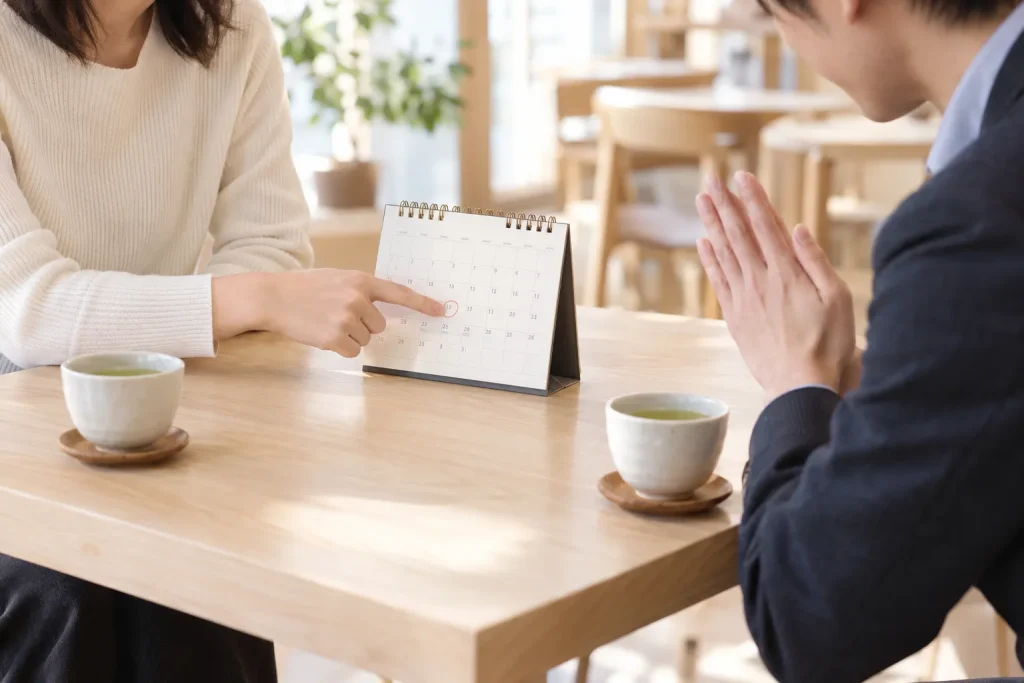
The basic mechanism remains visible in a short invitation. Someone asks, 土曜日、一緒に食事しませんか, doyōbi, issho ni shokuji shimasen ka, literally “Saturday, will we not have a meal together?” The answer begins 土曜日はちょっと…, doyōbi wa chotto…, literally “As for Saturday, a little…” and then stops. Grammatically, the speaker has not stated what is “a little” difficult, inconvenient, or impossible. Pragmatically, the omitted ending is normally recoverable from the pause and the absence of an alternative.
An unfinished Japanese refusal is not necessarily incomplete communication. The listener is expected to finish the meaning without forcing the speaker to say the damaging part aloud.
This works because Japanese politeness is broader than verb endings. Politeness Is a System, Not a List of Words explains the full combination of register, timing, apology, distance, and what remains unsaid. A perfectly conjugated sentence can still sound pushy if it corners the listener. A short phrase can sound considerate when it leaves both people a graceful exit. Refusing well therefore requires attention to the next conversational move, not only to vocabulary.
What the 2007 guidance changed—and what it did not
The Council for Cultural Affairs issued 敬語の指針, keigo no shishin, literally “guidelines for respectful language,” on February 2, 2007. The document organized modern respectful language and emphasized choosing forms according to relationships, roles, and communicative situations. It did not establish a statutory formula for refusals, prohibit いいえ, or declare that every vague answer means no. Its importance here is narrower: it rejects the idea that politeness can be reduced to substituting one “polite word” for another. The social effect of an expression depends on how it treats the person hearing it.
No comparable national rule created ちょっと as a refusal marker on a particular date. The word continues to mean “a little” in literal statements such as ちょっと待ってください, chotto matte kudasai, “please wait a little.” It becomes a refusal when the context supplies an unwanted invitation or request and the speaker leaves the difficulty unstated. This distinction prevents the common mistake of translating every ちょっと as “no.” Tone, pause, grammar, and the next sentence determine the function.
| Situation | Earlier practice | What the 2007 guidance clarified | Current practical meaning |
|---|---|---|---|
| Informal invitation | Refusal could be implied through hesitation or a reason | Politeness depends on relationship and context | ちょっと… can close the invitation |
| Workplace request | Speakers softened disagreement according to status | Respectful language is not a mechanical word swap | A reason plus a clear limit is often safest |
| Business proposal | Vague language could avoid direct confrontation | Appropriate expression depends on role and purpose | “We will consider it” needs a concrete next step to count as progress |
| Customer interaction | Formulaic polite speech was already common | Honorific form alone does not guarantee appropriate communication | Clear information should not disappear behind politeness |
How to say no in Japanese politely without creating false hope
ちょっと… is effective when the other person can identify exactly what you are declining. If someone invites you to dinner on a particular evening, その日はちょっと…, sono hi wa chotto…, literally “that day is a little…,” normally communicates that you cannot accept. The trailing pause is part of the message. You do not need to invent an illness, emergency, or elaborate excuse. If you would genuinely like another date, offer one immediately.
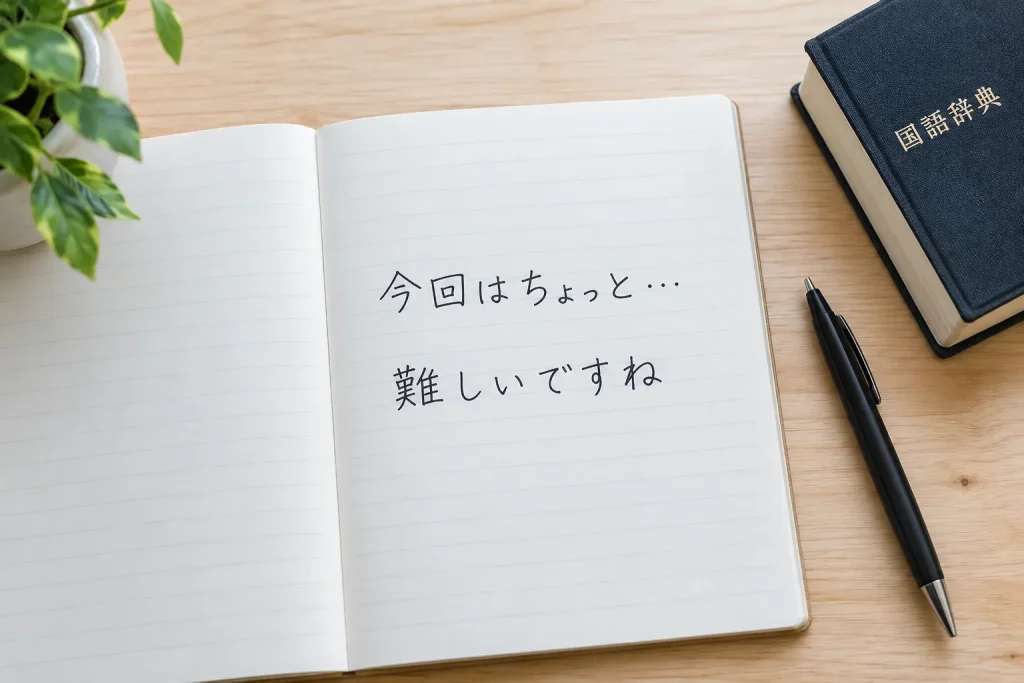
A slightly fuller refusal is すみません、ちょっと難しいです, sumimasen, chotto muzukashii desu, literally “I’m sorry, it is a little difficult.” 難しい, muzukashii, literally “difficult,” often evaluates feasibility rather than intellectual complexity. In response to a request, it can mean that the request cannot reasonably be fulfilled. Adding ね, ne, literally a particle seeking shared recognition, softens the assessment: 難しいですね, muzukashii desu ne. It invites the listener to recognize the obstacle without demanding a blunt declaration.
Useful patterns include:
- 今回はちょっと…, konkai wa chotto… — “As for this time, it is a little…”
- 申し訳ありませんが、難しいです, mōshiwake arimasen ga, muzukashii desu — “I am sorry, but it is difficult.”
- 今回は見送らせてください, konkai wa miokurasete kudasai — “Please allow me to pass this time.”
- 参加できません, sanka dekimasen — “I cannot participate.”
- その日は都合がつきません, sono hi wa tsugō ga tsukimasen — “That day does not work for me.”
- また別の機会にお願いします, mata betsu no kikai ni onegai shimasu — “Please ask me again on another occasion.”
The last formula should be used only when you welcome another invitation. Otherwise, it creates a promise you did not intend to make. A polite refusal does not have to be vague about the outcome. It softens the delivery while leaving the decision understandable. Polite Japanese refusal phrases work best when kindness and clarity point in the same direction.
How to hear the refusal aimed at you
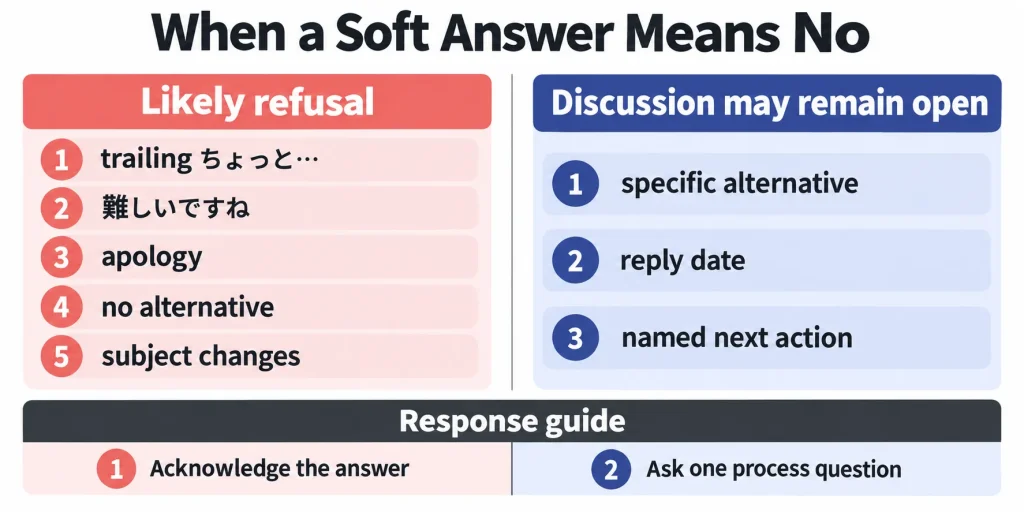
The clearest clue is not the word ちょっと by itself but what fails to follow it. If the speaker gives no alternative time, asks no follow-up question, and moves the conversation away from your proposal, the practical answer is probably no. 難しいですね can perform the same function, particularly when it refers to the feasibility of a request. Pressing with “Why?” or proposing minor changes repeatedly may force the speaker into a direct confrontation they were trying to avoid. Accepting the first refusal is usually the more respectful response.
Consider this exchange:
“Could we deliver it by Friday?”
“金曜日まではちょっと難しいですね, kin’yōbi made wa chotto muzukashii desu ne — As for by Friday, that is a little difficult.”
If the speaker then says 月曜日ならできます, getsuyōbi nara dekimasu, “Monday would be possible,” Friday was refused but the underlying request remains negotiable. If the speaker offers no workable date and closes the topic, the whole proposal may be blocked. The phrase itself does not decide between those meanings. The presence or absence of a counterproposal does.
| Response you hear | Literal reading | Likely function | What to check next |
|---|---|---|---|
| ちょっと… | “A little…” | Soft refusal or hesitation | Is an alternative offered? |
| 難しいですね | “It is difficult, isn’t it?” | Feasibility refusal | Does the speaker name a workable condition? |
| 検討します | “We will consider it” | Genuine review or diplomatic closure | Is there a date, owner, or next action? |
| 考えておきます | “I will think about it” | Delay, low commitment, or refusal | Does the speaker return to the subject? |
| 今回は見送ります | “We will pass this time” | Clear refusal | Is “this time” meaningful or formulaic? |
| また今度 | “Another time” | Real postponement or gentle no | Is another time proposed? |
“We will think about it” is not a contract
検討します, kentō shimasu, literally “we will examine it,” and 考えておきます, kangaete okimasu, literally “I will think about it in preparation,” cannot honestly be translated as “no” in every situation. A company may genuinely need internal approval, technical review, or a budget decision. The uncomfortable part is that neither phrase constitutes acceptance. If it arrives without a deadline, responsible person, requested document, or next meeting, treating it as progress can waste time.
The claim that “we will think about it” almost always means no is too categorical for publication as a universal language rule. It is safer to say that the phrase often functions as a low-commitment response and may serve as a diplomatic refusal. In a sales conversation, ask a neutral process question rather than demanding a yes-or-no answer. You can say いつ頃お返事をいただけますか, itsu goro ohenji o itadakemasu ka, literally “Around when may I receive your reply?” A concrete answer suggests an active review; continued vagueness suggests that you should stop planning around approval.
Politeness does not turn uncertainty into consent.
Why いいえ is not forbidden
いいえ, iie, literally “no,” is a normal Japanese word, not a breach of etiquette. You will hear it when correcting a fact, rejecting an incorrect assumption, answering certain questions, or modestly responding to thanks and praise. The mistake is believing that Japanese speakers are culturally unable to say it. Directness varies with the relationship, stakes, urgency, and need for precision. Safety instructions, contractual decisions, and factual corrections may require language much clearer than ちょっと….
The useful distinction is between rejecting information and rejecting a person’s proposal. “Is this your bag?” can receive いいえ because the answer corrects a fact. “Will you join my event?” may receive その日はちょっと… because the answer affects the inviter socially. Japanese Politeness Levels, and Which One to Use covers register choices across casual, polite, respectful, and humble language. The central question here is whether the listener can understand your decision without feeling needlessly cornered.

Apology can open the refusal without replacing it
すみません, sumimasen, literally “it does not end” or “this remains unsettled,” commonly opens small apologies, requests, interruptions, and refusals. The Word You Will Use Fifty Times a Day explains those broader functions. Before a refusal, it signals awareness that the answer may inconvenience or disappoint the listener. It does not state the decision by itself. Follow it with the limit you need to communicate.
ありがとうございます, arigatō gozaimasu, conventionally “thank you,” can acknowledge an invitation before you decline it. Arigatou Literally Means This Rarely Happens examines the expression’s literal structure and social weight. A natural refusal might begin お誘いありがとうございます, osasoi arigatō gozaimasu, “thank you for the invitation,” before stating that the date is difficult. Gratitude should not be stretched into several sentences that hide the actual answer. The listener still needs to know whether you are coming.
What indirect language cannot safely do
Indirect refusal is unsuitable when ambiguity creates financial, legal, medical, or physical risk. If you are allergic to an ingredient, cannot authorize a payment, or will not meet a deadline, say the operative fact clearly. You can soften the beginning and ending without weakening the middle. できません, dekimasen, “cannot do,” and お受けできません, ouke dekimasen, “cannot accept,” remain polite when the situation requires certainty. A gentle tone is not a substitute for an intelligible decision.
Travelers should also avoid interpreting every はい, hai, “yes,” as agreement. In conversation it can acknowledge that the speaker heard or understood you without accepting the proposal. The site’s Essential Japanese Phrases for Travelers covers the compact phrases needed across common situations. The phrasebook with 337 phrases in 25 situations gives each expression its own page, including ordering and emergency language. Use those resources for the situation itself rather than treating indirect refusal as a universal conversation template.
No scheduled reform will make every answer explicit
No Japanese law or announced language reform is scheduled to abolish ちょっと…, redefine 難しいですね, or require direct yes-and-no answers. Communication styles continue to change across generations, workplaces, industries, and digital channels. International teams may favor written decisions, explicit deadlines, and documented next steps because the cost of ambiguity is high. Friends may remain comfortable with half-finished refusals because shared context makes the meaning obvious. Neither approach represents every Japanese speaker.
What has not changed is the need to read the whole response. A pause, apologetic opening, negative assessment, lack of counterproposal, and topic change can combine into a refusal without いいえ appearing once. Conversely, a specific review date or alternative condition can show that “we will consider it” is genuine. Understanding indirect Japanese means testing the next step rather than translating one phrase mechanically. Context is not decorative information added after the sentence; it is part of the sentence’s practical meaning.
Short FAQ
Does ちょっと always mean no?
No. It can literally mean “a little,” as in asking someone to wait briefly or describing a small amount. It works as a refusal when it follows an invitation or request, trails off, and is not followed by a workable alternative. Listen for the pause and the next conversational move. Never translate the word without its surrounding exchange.
Is 難しいです rude?
難しいです is not inherently rude. In requests and negotiations, it can be a restrained way to say that something is not feasible. Adding ちょっと or ね can soften its delivery, while an apology can acknowledge the inconvenience. If precision matters, state what cannot be done and offer an alternative if one exists. Avoid using “difficult” when you really mean “maybe” and expect the listener to keep waiting.
How should I respond to a soft refusal?
Accept it without demanding a more embarrassing repetition. You can say 分かりました, wakarimashita, “understood,” or 承知しました, shōchi shimashita, “I understand and acknowledge it,” in a more formal setting. If negotiation is appropriate, ask once whether another date or condition would work. If no alternative appears, close the subject. Respecting a soft no is part of giving one successfully.