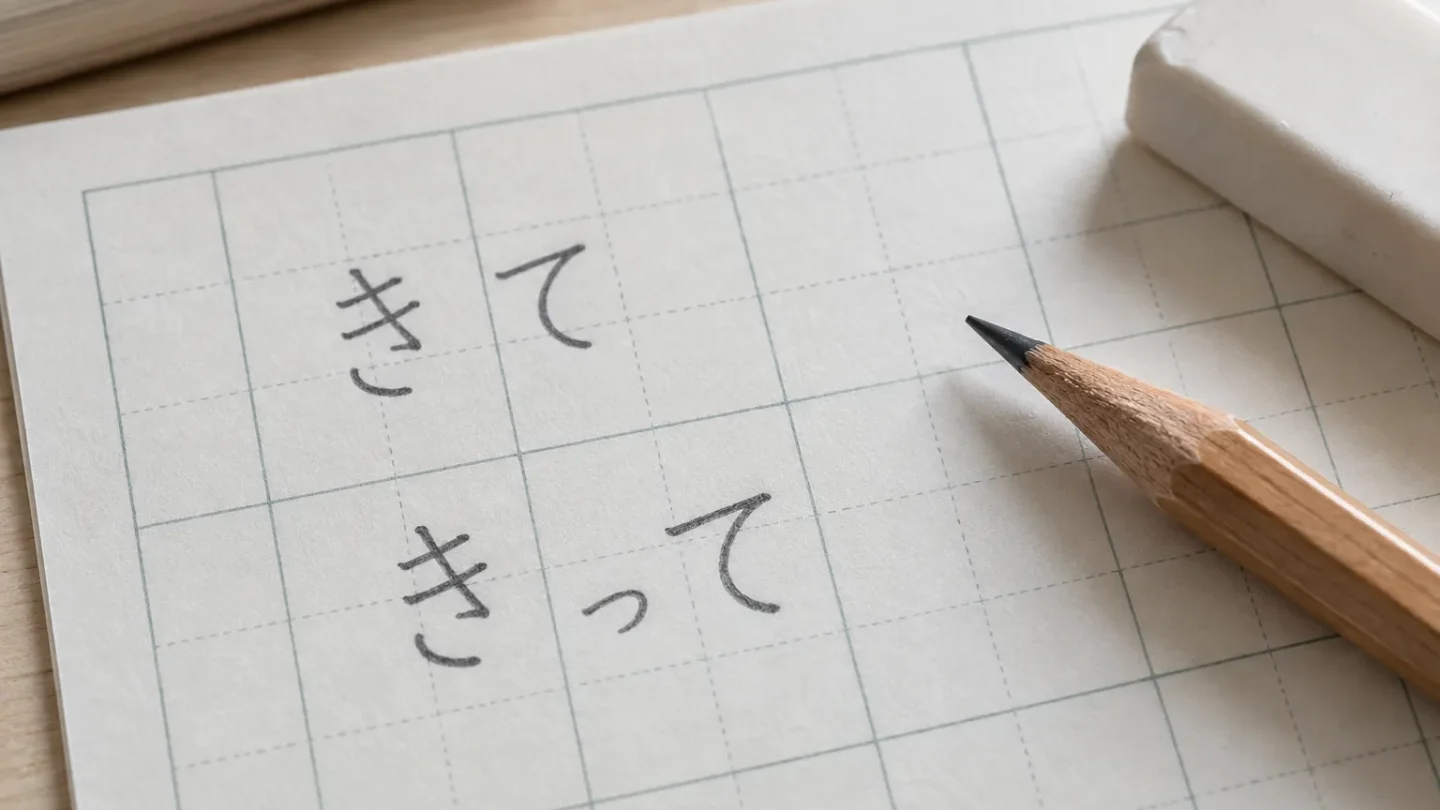
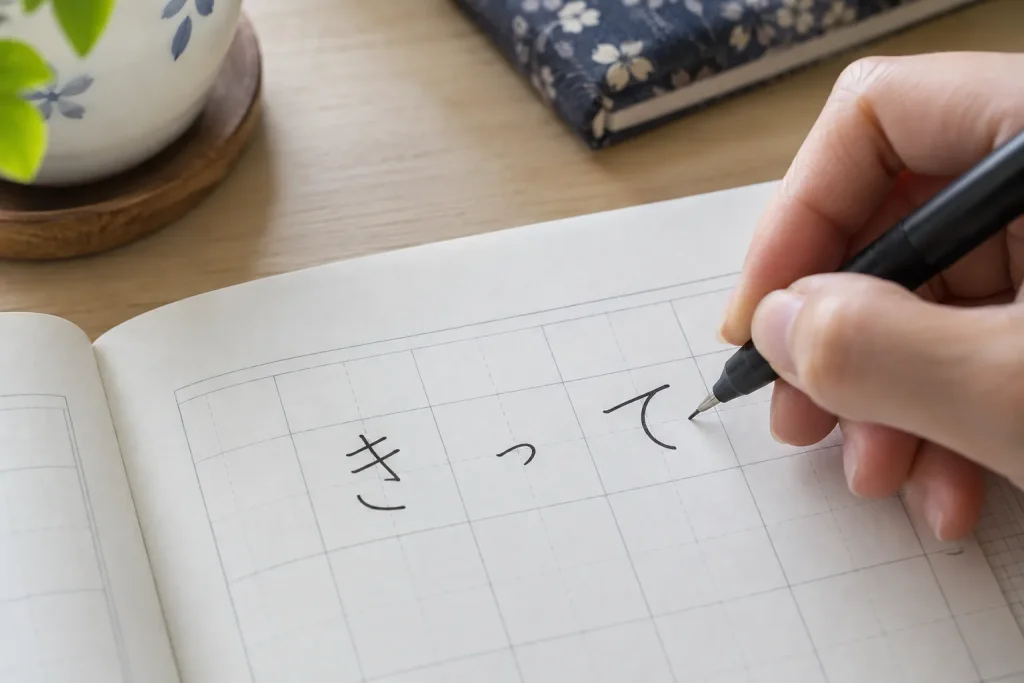
The costliest small-kana mistake is writing a person’s name, address, or other identifying detail as a different sequence of sounds. In small tsu Japanese spelling, size carries information: きて, kite, “come,” and きって, kitte, “postage stamp,” are not two handwriting styles for the same word.
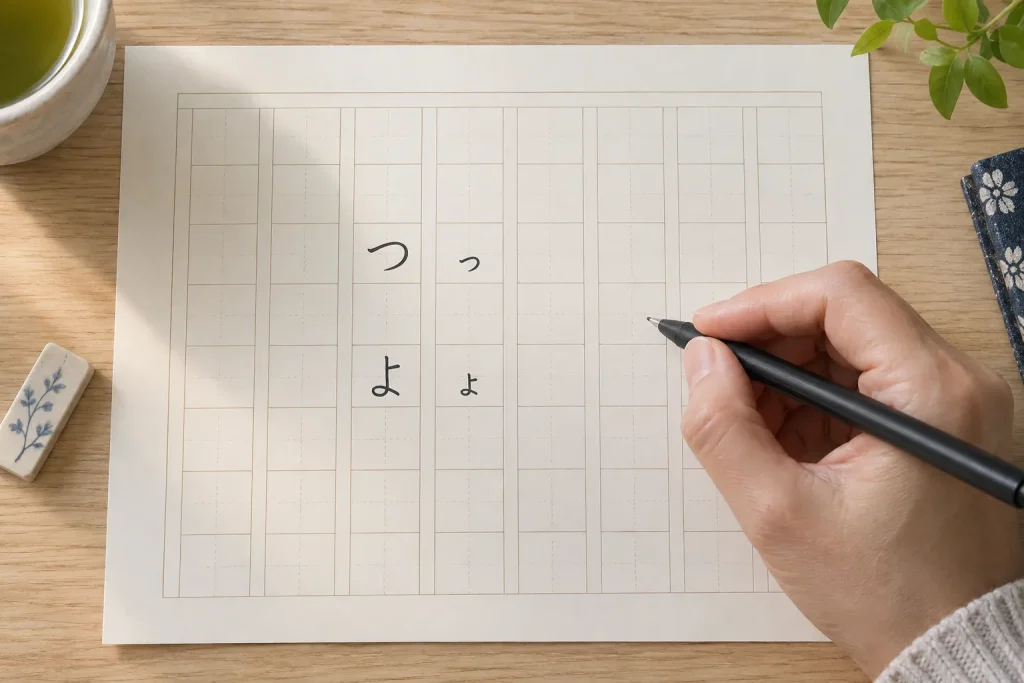
The same principle separates ちよ, chiyo, from ちょ, cho. The first has an independently pronounced よ, yo; the second uses a small ょ to combine with ち, chi. A reader does not mentally repair the size and continue. The reader sees different kana and therefore a different pronunciation.
That is the uncomfortable part: beautiful strokes cannot rescue an incorrectly sized character.
Mistake 1: Changing the Spelling of a Name on a Form
Beginners often make every kana approximately the same size when completing a form. That seems reasonable because English handwriting allows considerable variation in the height of lowercase letters. Japanese small kana, however, are not merely shorter graphic variants.
Consider ちよ and ちょ:
| Written form | Reading | Timing | What the last character does |
|---|---|---|---|
| ちよ | chiyo | ち + よ | よ begins its own sound |
| ちょ | cho | ちょ | ょ combines with ち |
The difference becomes especially important in names. 千代/ちよ, Chiyo, a personal name literally associated with “a thousand generations,” contains a full-size よ. Writing ちょ would produce cho, not an acceptable shorthand for the same reading.
If you are writing a foreign name in katakana, do not improvise its small characters from romaji. The site’s name converter with 898 checked names in katakana is the appropriate place to check an established rendering rather than reproducing the database here.
What to do instead — Japanese handwriting: Copy a name character by character and compare every small kana with the full-size kana beside it.
Mistake 2: Reading っ as a Quiet Version of つ
The character っ is called 促音/そくおん, sokuon, “contracted sound.” A learner sees that it resembles つ and tries to pronounce a reduced tsu. That guess is visually logical and phonetically wrong in ordinary medial use.
The small っ marks a closure or pause before the following consonant. In romanization, that effect is commonly represented by doubling the following consonant:
| Kana | Romaji | Meaning or function |
|---|---|---|
| きて | kite | 来て, “come,” the te-form of 来る |
| きって | kitte | 切手, “postage stamp” |
| かこ | kako | 過去, “past” |
| かっこ | kakko | 括弧, “parentheses” |
The worked example is simple. Read きて as ki-te. For きって, hold the closure before the t: ki-(pause)-te. The small character changes both the timing and the lexical result.
For the larger map of the scripts, Hiragana, Katakana, Kanji: How Japanese Writing Works explains which writing system does which job. This article stays with the narrower problem of character size.
What to do instead — sokuon Japanese: Give っ its own beat of timing, but do not pronounce it as tsu.
Mistake 3: Putting the Small Tsu After the Consonant It Changes
A half-informed learner remembers that っ “doubles a consonant” and places it after that consonant’s kana. English spelling encourages the mistake: doubled letters stand together, and readers process them from left to right.
Japanese marks the closure before the consonant-bearing kana. In きって, っ comes before て because the interruption occurs before the t of te. Moving it changes or destroys the spelling rather than producing an alternative notation.
You can verify the pattern by reading forward:
- Read the kana before っ.
- Pause for the closure represented by っ.
- Release the consonant that begins the next kana.
- Continue with its vowel.
If you still need to make the basic characters automatic, The First 92 Characters, in Order gives the full learning sequence. Its role is the inventory; the present problem is what happens when a regular character is replaced by its small counterpart.
What to do instead — hiragana small tsu: Look one kana to the right of っ; that following consonant is the one affected.
Mistake 4: Treating Small ゃ, ゅ, and ょ as Optional Typography
The small forms ゃ, ゅ, and ょ create 拗音/ようおん, yōon, “contracted sounds,” when they follow an appropriate i-row kana. They do not merely make a printed word look compact.
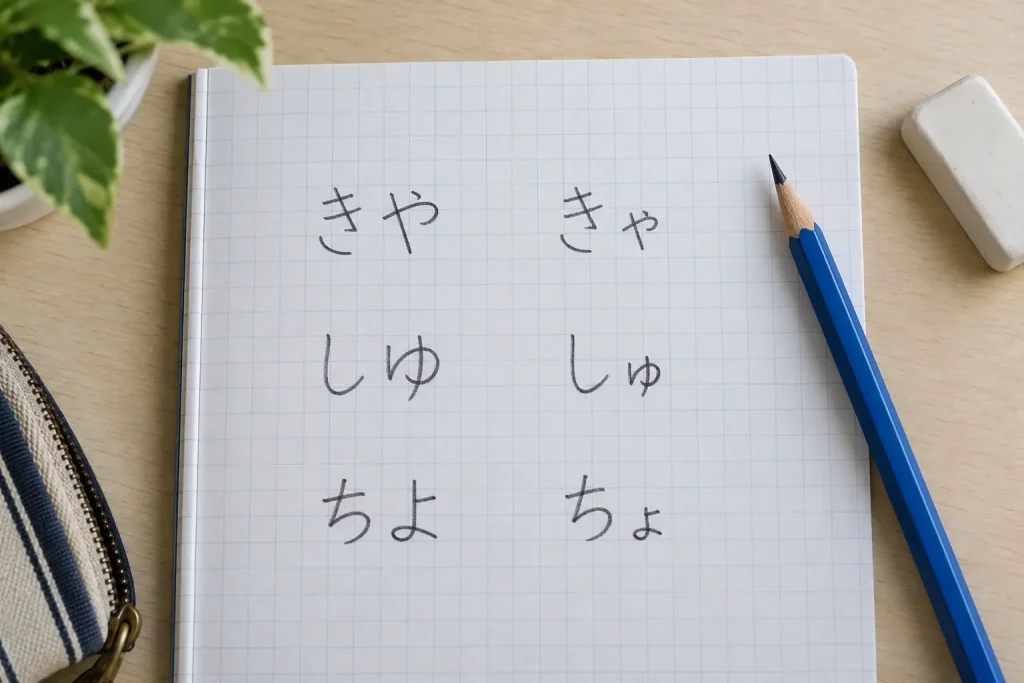
Compare ちよ with ちょ. In ちよ, you pronounce ち and よ separately: chi-yo. In ちょ, the small ょ changes the combination to cho. The written form becomes shorter because the sound structure is different, not because the writer needed to save space.
A useful comparison table makes the rule visible:
| Full-size sequence | Reading | Small-kana combination | Reading |
|---|---|---|---|
| きや | kiya | きゃ | kya |
| しゆ | shiyu | しゅ | shu |
| ちよ | chiyo | ちょ | cho |
| りよ | riyo | りょ | ryo |
This distinction is about a sequence versus a combination. The brief calls ちよ and ちょ a minimal pair, but that wording needs care: ちよ can be a complete name reading, while ちょ is primarily a kana combination and not necessarily an independent vocabulary item. It is nevertheless an exact demonstration of how size changes pronunciation.
What to do instead — yoon Japanese: Read a full-size や, ゆ, or よ separately; merge a small ゃ, ゅ, or ょ with the kana before it.
Mistake 5: Shrinking や, ゆ, or よ After Any Kana
Once learners understand that small ゃ, ゅ, and ょ merge sounds, they sometimes attach them wherever the desired English-like sound seems plausible. This is another researched-but-incomplete mistake: the general mechanism is remembered, but the permitted base kana are not.
In standard combinations, the small y-row kana follow kana from the i column, including き, し, ち, に, ひ, み, and り and their voiced forms where applicable. That produces combinations such as きゃ, kya; しゅ, shu; and ちょ, cho.
Do not infer from this that any two kana may be compressed. Small kana belong to spelling patterns, not a general instruction to write sounds more tightly.
A practical test is to expand the combination. If きゃ becomes きや, you should hear ki-ya, not a longer version of kya. If that change does not make sense to you, return to the sound before copying the spelling.
What to do instead — small ya yu yo: Learn each combination as a base kana plus a specific small kana, not as a freely movable suffix.
Mistake 6: Trusting Romaji to Preserve Every Difference
Romaji is useful for revealing the result: chiyo versus cho, or kite versus kitte. It becomes unreliable when learners assume that any Latin-letter spelling can be converted backward without knowing the source word or romanization convention.
For example, doubled consonants help you notice the presence of っ in kitte. Yet romaji does not teach you how large to draw the character, and typing systems are not identical to editorial romanization. Input methods may also accept more than one keystroke sequence for the same kana.
Romaji Explained: Three Systems and Which One to Use covers the competing transcription systems. Read that distinction there; the rule needed here is narrower: once you have the correct kana, copy the kana rather than repeatedly converting through Latin letters.
What to do instead — Japanese romaji: Use romaji to check pronunciation, then verify the final word in kana before writing it.
Mistake 7: Drawing the Small Character So Large That the Reader Must Guess
The official rule identifies っ and the yōon kana as small-written characters, but it does not prescribe a universal percentage for handwriting. Fonts, notebooks, forms, and individual hands vary. The distinction must therefore be visible rather than mathematically measured.
A common failure is to write っ only slightly smaller than つ. The writer remembers the rule but preserves the full character’s visual weight. In an isolated vocabulary exercise, a teacher may infer the intention. In a name or unfamiliar word, a reader has less context and may interpret the character literally.
On squared paper, use the surrounding kana as your local scale. Keep the small character clearly within a reduced area of the square and maintain ordinary spacing. Do not enlarge it simply because the strokes feel cramped.
If katakana forms are causing more trouble than their hiragana equivalents, Why the Second Alphabet Trips Everyone addresses the visual-confusion problem rather than repeating it here.
What to do instead — small kana: Make the size contrast unmistakable, even when the small character appears between two visually dense kana.
Mistake 8: Practicing Isolated Symbols Instead of Contrasts
Writing っ across an entire row trains its shape. It does not train the decision that matters: whether a word requires つ or っ. The same problem applies to よ and ょ.
Contrast practice is more effective because every line forces you to notice the meaningful variable:
- つ beside っ
- よ beside ょ
- きて beside きって
- ちよ beside ちょ
- きや beside きゃ
- しゆ beside しゅ
Say each item while writing it. The goal is not decorative penmanship; it is a stable connection among size, timing, and spelling.
For a concentrated review of the base hiragana before adding contrasts, A Two-Day Schedule for 46 Characters provides the practice order. Small kana should follow that foundation, not replace it.
What to do instead — kana practice: Write contrasting pairs and read them aloud rather than filling a page with one isolated symbol.
The Habit That Prevents Most Small-Kana Errors
Proofread for size separately from proofreading for shape. On the first pass, confirm that each character is recognizable. On the second, circle every っ, ゃ, ゅ, and ょ and ask what it does to the sound beside it.
Use this short check:
- Is っ visibly smaller than つ?
- Does っ occur before the consonant it affects?
- Is や, ゆ, or よ meant to begin a separate sound?
- If not, is its small form clearly joined conceptually to the preceding kana?
- Does the word still match the pronunciation you intended?
The single habit to keep is simple: compare every small kana with its full-size counterpart before you submit the writing.
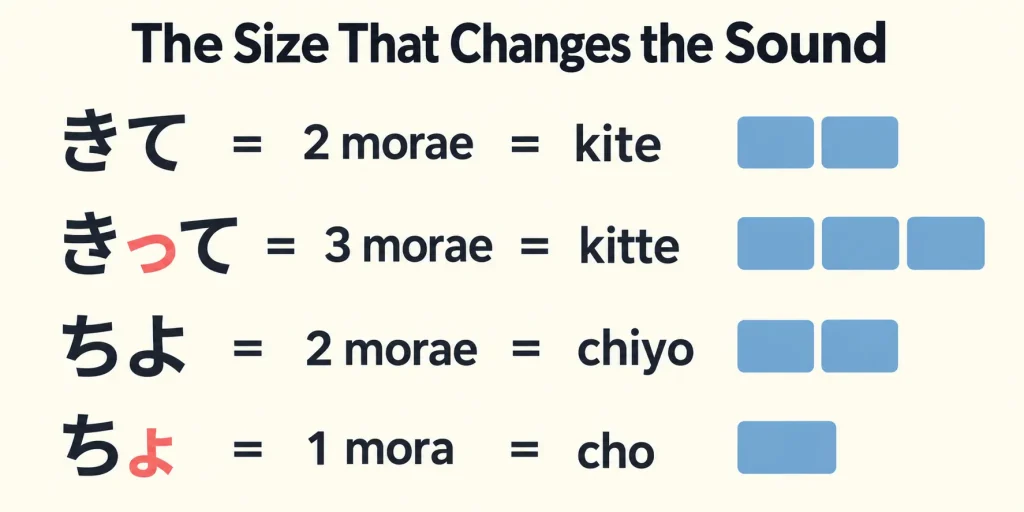
Data shown:
| Written contrast | Sound units | Romanized result | Function |
|---|---|---|---|
| きて | 2 morae | kite | ordinary sequence |
| きって | 3 morae | kitte | っ adds a closure beat |
| ちよ | 2 morae | chiyo | full よ begins a separate mora |
| ちょ | 1 mora | cho | small ょ combines with ち |
| きや | 2 morae | kiya | full や remains separate |
| きゃ | 1 mora | kya | small ゃ forms yōon |
Frequently Asked Questions
Is small っ pronounced tsu?
Not in its ordinary word-medial function. It indicates a closure before the following consonant. Thus きって is read kitte, not kitsute.
Does っ simply double the next English letter?
Doubling is a useful romanization convention, not the complete phonetic explanation. The character represents timing and consonant closure in Japanese pronunciation.
Are ちよ and ちょ two spellings of the same sound?
No. ちよ is chiyo, with よ pronounced separately. ちょ is cho, with small ょ combining with ち.
Must handwritten small kana have an exact size?
No universal percentage is specified by the official orthographic rule. The contrast must be clear within the handwriting style, form, or grid you are using.
Do the same rules apply in katakana?
Yes. The corresponding forms are ッ, ャ, ュ, and ョ. Katakana also uses additional small vowels in established foreign-word combinations, but those spellings should be learned as combinations rather than improvised.
What is the quickest way to check a word?
Compare it with a reliable kana spelling, then read it by mora rather than counting visible characters alone. A small っ occupies timing, while a yōon pair such as ちょ combines two written characters into one mora.