On June 1, 2020, the Japan Rail Pass moved to a machine-readable ticket and introduced official online purchasing and seat reservations, tying the pass more directly to registered passport information. A name mismatch on Japan tickets can therefore be more than an untidy spelling difference, but the consequences depend on whether you booked a flight, a national rail pass, an ordinary train, or a hotel. Japan Rail Pass eligibility is checked when the pass is collected, and its user must carry the registered passport while traveling. Passport inspection is possible during use, although it does not occur at every automatic gate. No reliable rule promises that a counter employee can repair a mismatch without a fee or rebooking.
Before the pass became a machine-readable ticket
Before June 1, 2020, Japan Rail Pass users received a larger laminated pass and generally showed it to staff at a manned gate. Seat reservations were arranged through a staffed ticket office rather than linked to the current official online account in the same way. The pass was already personal and non-transferable, so the move to a standard magnetic ticket did not create identity checks from nothing. What changed was the operating system around the pass: automatic gates, online purchasing, and machine-issued reservations became part of the normal process. Passport identity remained the foundation beneath those conveniences.
An overseas Exchange Order also had to be converted into the actual pass after arrival. The traveler presented the Exchange Order and passport at a designated JR office, where eligibility was confirmed. The document was not itself valid for boarding JR trains. That distinction still matters because a correct-looking voucher does not guarantee issuance if the traveler or documentation fails the eligibility test. Every Japanese Form That Asks for Your Name explains the wider paperwork problem: the same person may be asked for Roman letters, katakana, name order, and passport spelling in different fields.
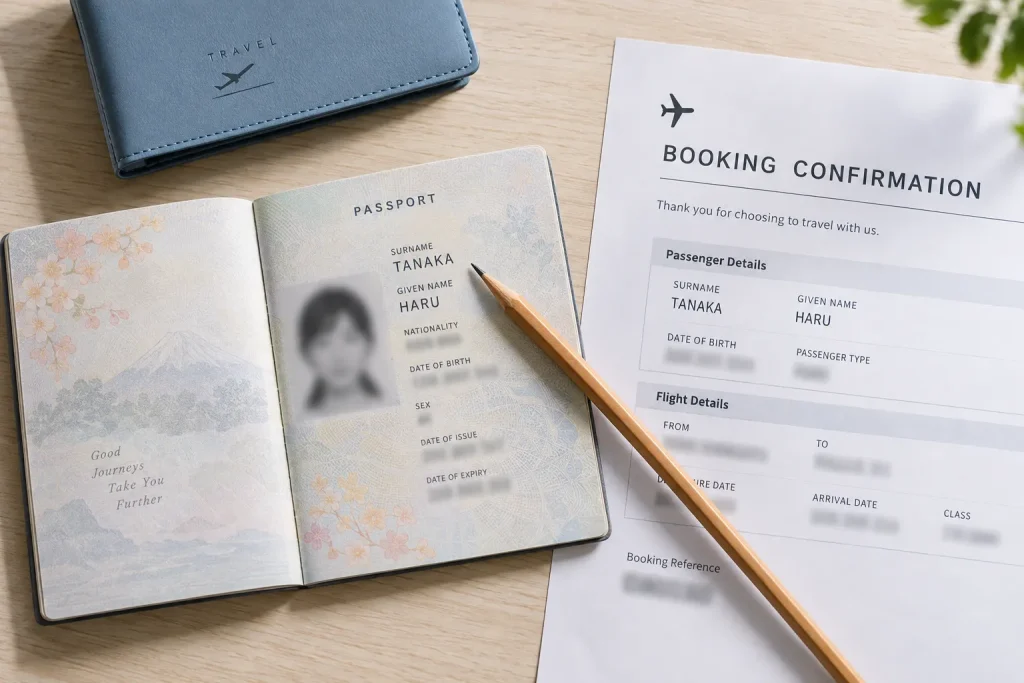
The safest reference is the machine-readable line in your passport, not the spelling you normally use on social media or business cards. A nickname such as “Mike” for “Michael” may be socially obvious but is not the passport name. A married surname that has not yet appeared in the passport creates the same structural problem. Booking systems compare recorded data, not the story behind it. Passport name requirements are consequently stricter where the product is personal and non-transferable.
What changed on June 1, 2020
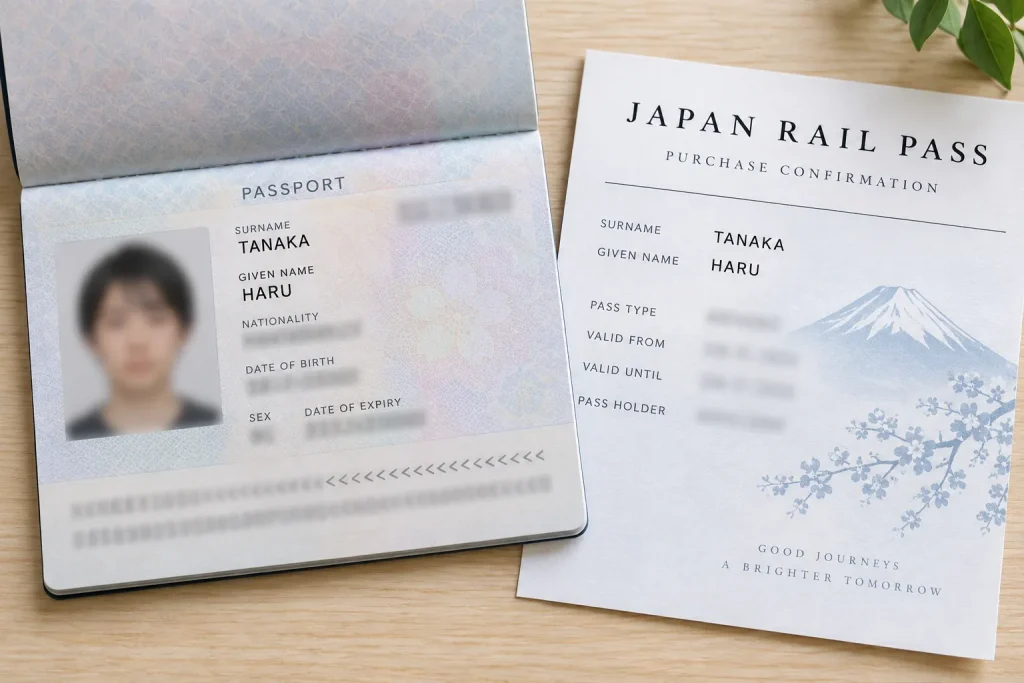
The new system allowed the pass to work at automatic ticket gates and enabled eligible customers to buy through the official reservation website. Online purchasers enter the user’s name and passport number, and each pass is registered to that passport information. Reserved-seat tickets issued under the pass carry a reservation number that must correspond with the pass. This created a more connected record from purchase to pickup and seat booking. It did not turn every ordinary JR ticket in Japan into a passport-controlled product.
| Before June 1, 2020 | From June 1, 2020 | Identity consequence |
|---|---|---|
| Laminated pass normally shown at staffed gates | Standard machine-readable pass works at automatic gates | The gate reads the pass, but identity may still be checked separately |
| Seat reservations mainly issued at staffed offices | Eligible users can reserve online or use designated machines | Reservations remain connected to the same pass holder |
| Overseas Exchange Order was a central purchase route | Official online purchase became available | Online purchase records the user’s passport details |
| Passport confirmed eligibility at exchange | Passport confirms eligibility at pickup and must be carried during use | The pass remains non-transferable |
The official conditions checked in September 2026 state that the pass is valid only for the person whose passport information is registered. They also require the user to carry that passport and present it to a station employee or conductor when requested. The distinction is precise: passport verification is mandatory at pickup, while presentation during travel is conditional on a request. Automatic-gate entry alone does not mean that the passport was checked. Claims that JR checks the passport during every boarding overstate the published rule.
A gate accepting the ticket proves that the ticket is readable. It does not convert a pass issued to one person into a pass usable by another.

Name mismatch on Japan tickets: the JR Pass protocol
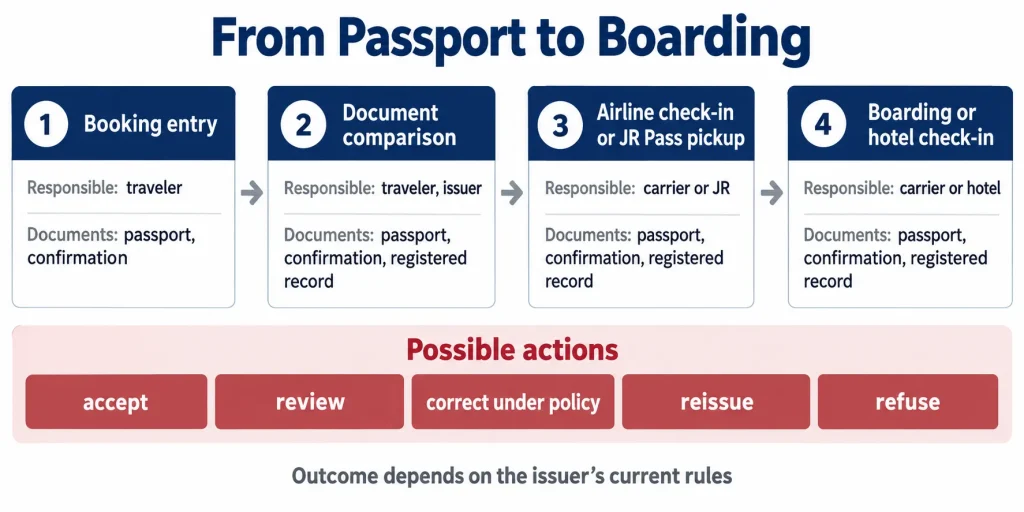
For an official online purchase, the user enters a name, email address, and passport number before the pass is issued. At pickup, every traveler covered by the purchase must present their passport, and JR verifies eligibility. A traveler using an overseas Exchange Order must present both the order and passport at a designated exchange office. If the documentation does not establish eligibility, the official conditions say that the pass will not be issued. JR also states that it does not compensate the traveler for replacement transportation costs caused by inadequate eligibility documents.
Once issued, the pass remains assigned to the registered user and cannot be transferred. It can be used through an automatic gate or shown at a staffed gate, but the passport must stay with the traveler. A station employee or conductor may request it. The published English conditions do not provide a comprehensive list of harmless name variations or promise counter correction for typographical errors. A mismatch should therefore be raised with the official seller or issuing agency before the exchange attempt.
The practical sequence is:
- Compare the purchaser and user fields with the passport used for entry into Japan.
- Check the passport number as well as the Roman-letter name.
- Confirm that every person in a group purchase has their own correct record.
- Contact the seller if any field differs rather than waiting for the exchange counter.
- Bring the physical passport and required proof of Temporary Visitor status to pickup.
This protocol describes what JR publishes without predicting what an employee will decide in an individual case. A spacing difference, omitted middle name, or reversed order may be understandable to a human reader, but no general JR promise says it must be accepted. A different traveler is not a spelling correction because the pass is expressly non-transferable. JR Pass passport checks concern both identity and eligibility, not typography alone.
Small differences that may be reviewed at the counter
Some discrepancies can describe the same person despite differences in display. Examples include an omitted middle name, a hyphen or space handled differently, an accent removed by a booking system, or the surname and given name appearing in reversed order. Airlines and booking platforms may have documented rules for particular cases. Staff may be able to annotate, correct, or accept a record after comparing the passport. None of those outcomes is universal across carriers, fares, or sales channels.
A first-name and surname reversal is especially common when a form uses labels such as “family name,” “last name,” “surname,” and “given name” inconsistently. Surname First or Last: What to Write Where covers that field-level problem. Reversal does not automatically mean the passenger has changed, but an automated system may still flag it. The booking company must decide whether its record can be amended. A traveler should use the company’s published contact channel before departure rather than rely on another passenger’s experience.
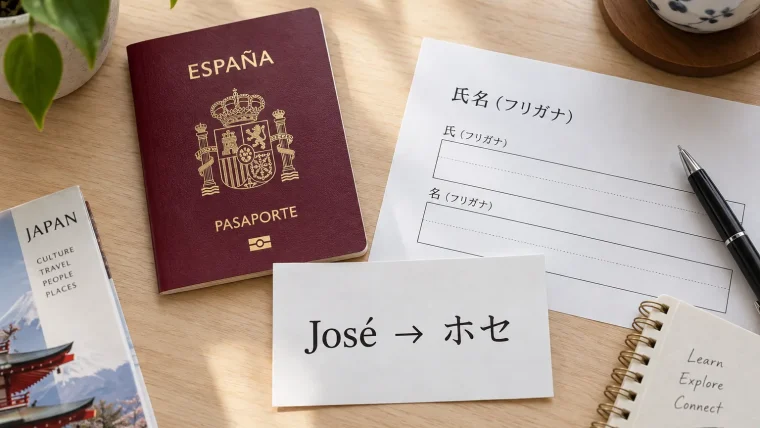
Katakana can introduce a separate discrepancy in domestic systems. A foreign name may be converted according to Japanese sound patterns, so its kana form will not reproduce every Latin letter. Katakana Name Rules, and the Names That Break Them explains those transformations without turning them into booking guarantees. Where a form asks for both ローマ字, rōmaji, literally “Roman letters,” and カタカナ, katakana, the passport spelling belongs in the Roman-letter field. The kana field is a reading aid or domestic-system representation, not a replacement for passport identity.
| Mismatch | What it may represent | Published universal outcome | Appropriate contact |
|---|---|---|---|
| Space or hyphen difference | Formatting of the same name | None | Carrier, JR seller, or booking platform |
| Middle name omitted | Shortened display or incomplete entry | None | Issuer before travel |
| Given and family names reversed | Field-order error | None | Issuer before check-in or pickup |
| Accent or diacritic removed | System character limitation | None | Carrier or seller |
| Katakana differs from Roman spelling | Phonetic Japanese rendering | None | Booking platform if both fields matter |
| Nickname replaces legal given name | A different recorded name | No guaranteed correction | Carrier or issuer |
| Different surname after marriage | Passport and booking use different identities | No guaranteed correction | Carrier, seller, and document issuer |
| Entirely different passenger | Attempted change of user | JR Pass is non-transferable | Original seller |
Differences that are not minor formatting errors
Replacing the booked passenger with another person is not a name correction. A reservation for “John Smith” cannot be assumed to belong to another John Smith, a spouse, or a companion merely because the itinerary is unchanged. Airlines generally separate spelling corrections from a change of passenger, but the definitions and fees are carrier-specific. Some tickets prohibit a passenger change entirely. Others may require cancellation and a new booking rather than editing the existing ticket.
A nickname can also become expensive because human familiarity does not make it a documentary match. “Kate” and “Katherine” may identify the same person socially, but a carrier is not required to infer that relationship. The same applies when a traveler books under a future married name before receiving a passport in that name. Supporting marriage or name-change documents may help a company investigate, yet they do not guarantee boarding or free reissue. The carrier that issued the ticket is the source that can describe the available procedure.
For a flight ticket name mismatch, contact the operating or ticketing airline through the channel listed on its official website. If an agent or third-party platform issued the ticket, the airline may direct the traveler back to that seller. Ask whether the case is classified as a correction or a passenger change, whether the ticket must be reissued, and whether the associated reservations remain intact. Request written confirmation when the company provides it. Do not edit a loyalty profile and assume that an already issued ticket changed with it.
Hotels do not use the airline rulebook
The claim that every Japanese hotel checks a reservation name against a passport in the same manner as an airline is too broad. Hotels need to identify the booking and register the guest, but their check-in systems and policies differ. Japanese accommodation rules require hotels to record guest information, and foreign guests without an address in Japan may be asked to provide nationality, passport number, and a passport copy. That legal recordkeeping purpose is different from airline security or JR Pass eligibility.
A reservation made under a shortened name may still be located by confirmation number, dates, contact information, or the lead guest’s name. Whether staff can change the named guest depends on the property, rate, platform, payment method, and anti-fraud procedures. A prepaid nonrefundable reservation can create a different problem from a pay-at-property booking. The hotel or booking platform must explain which name changes are permitted. No national hotel rule promises that a mismatch will be repaired free of charge.
If another person booked the room, the property may ask for the reservation holder’s details or advance authorization. A credit card used for payment may also trigger a separate verification process. These requirements are commercial policies rather than rules about writing foreign names in Japanese. How to Write Your Name in Japanese: The Complete Guide explains the language side but cannot determine a hotel’s payment policy. Identity, payment, and Japanese spelling should be treated as three separate questions.
A worked example across the itinerary
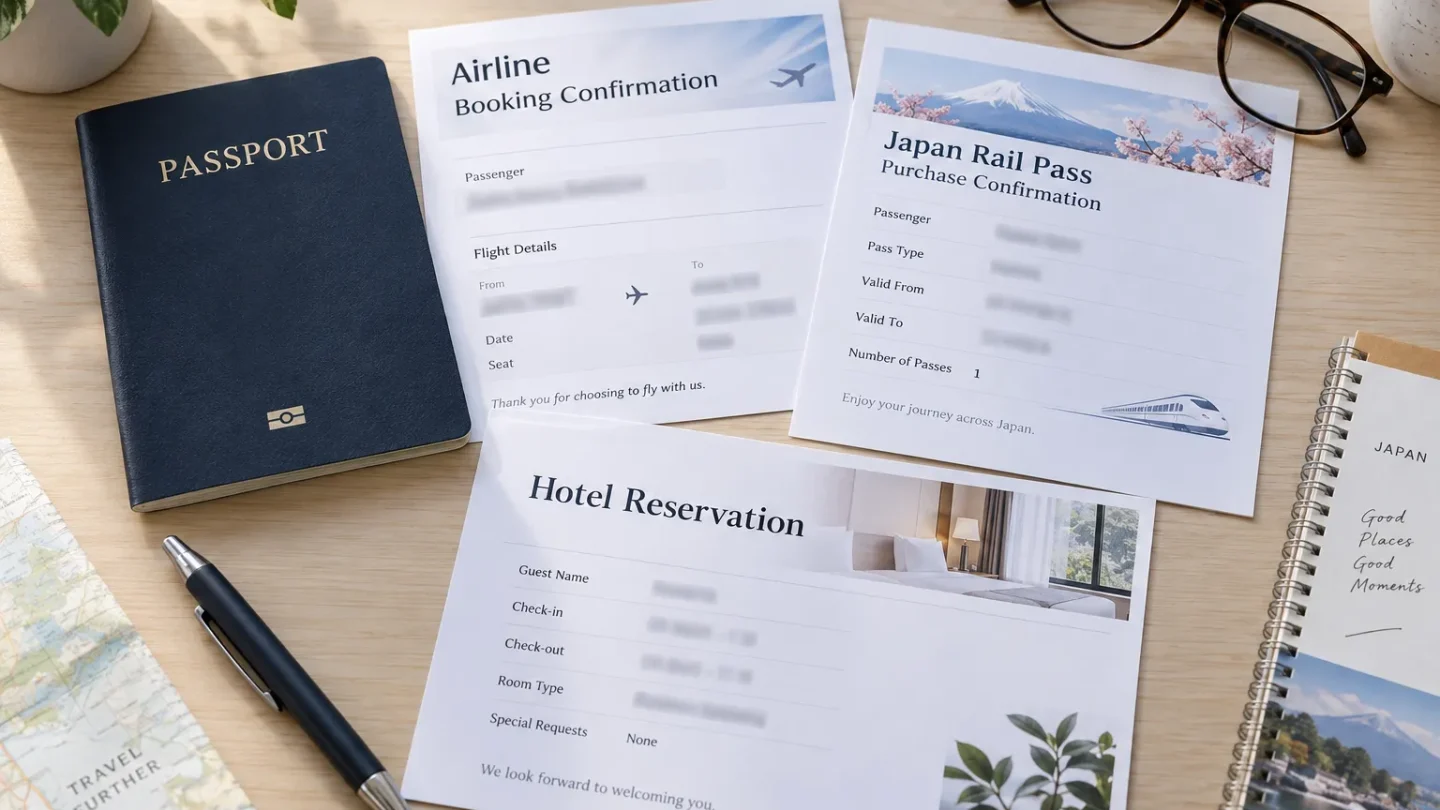
Suppose the passport says surname MARTÍNEZ, given names ELENA SOFÍA. The airline booking shows MARTINEZ/ELENASOFIA, the JR Pass record shows ELENA SOFIA MARTINEZ, and the hotel booking says Elena Martinez. The airline version may reflect removal of a diacritic and compressed spacing. The rail record may contain all the same Roman-letter components in a different display order. The hotel record omits a middle name, but the property may use it primarily to locate the reservation.
These records look related, yet an article cannot promise that all will be accepted. The airline must confirm its treatment of accents, spacing, and combined given names. The JR seller must confirm whether the recorded order corresponds with the passport data registered to the pass. The hotel must confirm that the lead guest can check in under the shortened reservation name. The correct test is not whether the spellings “look close enough” to the traveler.
For katakana, ELENA might appear as エレナ, Erena, because Japanese represents the pronunciation with its available sound units. That form should not be inserted into a passport-name field unless the system explicitly requests kana. The name converter with 898 checked names helps identify established katakana spellings on individual name pages. It does not alter an airline ticket, passport, or rail-pass record. Japanese name on bookings remains a field-specific question.
What has not changed since online sales began
The 2020 update did not make the national pass transferable, remove the passport requirement, or make an Exchange Order valid for boarding. The pass is still valid only for the registered user. An online confirmation still has to become an issued pass before travel. During use, the traveler must carry the passport and show it if requested. Automatic gates changed the route through the station, not the identity conditions.
Ordinary domestic train tickets are not automatically governed by the national pass rules. A standard unreserved fare, an IC-card journey, a named online reservation, and a Japan Rail Pass are different products. Some reservations are account-linked, while others operate more like conventional bearer tickets. Travelers should read the rules of the specific service rather than transfer the strictest rule from one product to every Japanese train. “JR ticket” is not one uniform legal category.
The handling of 漢字, kanji, literally “Chinese characters,” kana, Latin letters, hyphens, and spaces also remains system-specific. How a Foreign Name Becomes a Carved Seal explains another identity technology, but a 判子, hanko, literally “seal stamp,” does not fix a travel booking. A seal, passport, airline record, and hotel register serve different purposes. Visual similarity among names does not make the documents interchangeable.
What is scheduled and what must be rechecked
The official Japan Rail Pass conditions displayed during research were marked current as of April 2026 and explicitly said that details could change. They listed no scheduled relaxation of passport registration, pickup verification, non-transferability, or the requirement to carry the passport during use. Airline and hotel policies can change independently, including fees, correction channels, and third-party booking procedures. A decision based on an older forum post may therefore fail even when the other traveler’s story was accurate. The issuing company’s current rule controls the booking.
Immediately before relying on this article, check four sources: the passport data page, the booking confirmation, the issuer’s current name-correction policy, and any message confirming an approved amendment. For a JR Pass, check the official conditions and contact the original seller if the record differs. For a flight, contact the ticketing airline or issuing agency. For a hotel, contact the property or platform named on the confirmation. This article should be reviewed again before its scheduled publication on October 3, 2026, and whenever JR marks its conditions with a later effective date.