An American walking into a Japanese apartment listing will see the word マンション — manshon, from “mansion” — attached to a one-bedroom flat above a convenience store. Nobody is exaggerating. In Japanese, that word means a concrete apartment building, and it has meant that for decades.
Roughly one in ten words in everyday Japanese is borrowed, and the great majority come from English. That sounds like a shortcut for English speakers, and for the first week it is. Then you meet the words that changed on the way in, and it becomes a trap — because you’ll understand them wrongly with complete confidence.
Two categories, and only one is a problem
Straight loanwords — gairaigo — are English words taken into Japanese with the sound adapted and the meaning intact. コーヒー is coffee. テーブル is table. インターネット is internet. These are free vocabulary and there are thousands of them.
Wasei-eigo — literally “English made in Japan” — is the other category: words built from English parts inside Japanese, or borrowed and then reshaped, that no English speaker would recognize. サラリーマン, “salaryman,” for a white-collar office worker. ベビーカー, “baby car,” for a pushchair. These are Japanese words that happen to be made of English pieces, and treating them as English is where things go wrong.
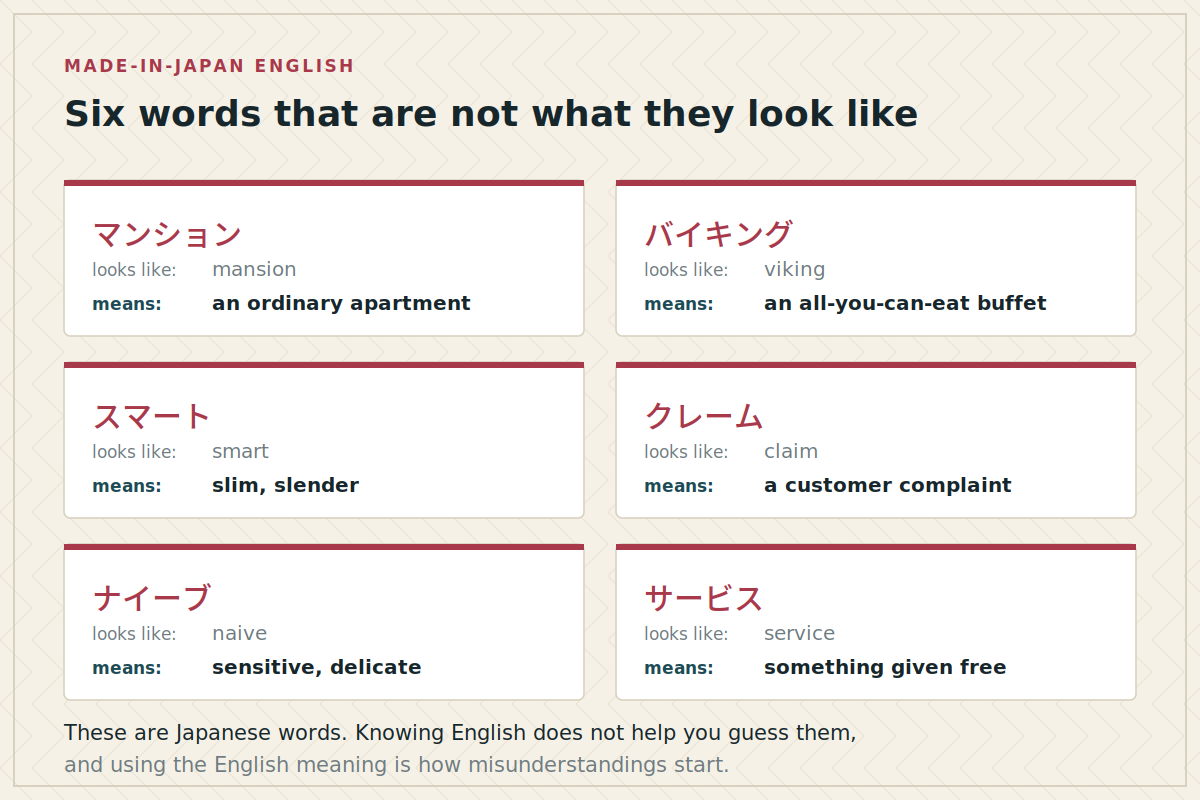
The tricky middle ground is words that are English, and mean something narrower or entirely different:
| Japanese | From | What it means now |
|---|---|---|
| マンション | mansion | an ordinary apartment, usually concrete-built |
| バイキング | viking | an all-you-can-eat buffet |
| スマート | smart | slim, slender — not clever |
| クレーム | claim | a customer complaint |
| ナイーブ | naive | sensitive, delicate — not gullible |
| サービス | service | something given free of charge |
| テンション | tension | mood or energy level, often positive |
That last one produces genuine confusion in both directions. A Japanese colleague saying テンションが高い means someone is upbeat and energetic, not stressed.
How a word changes on the way in
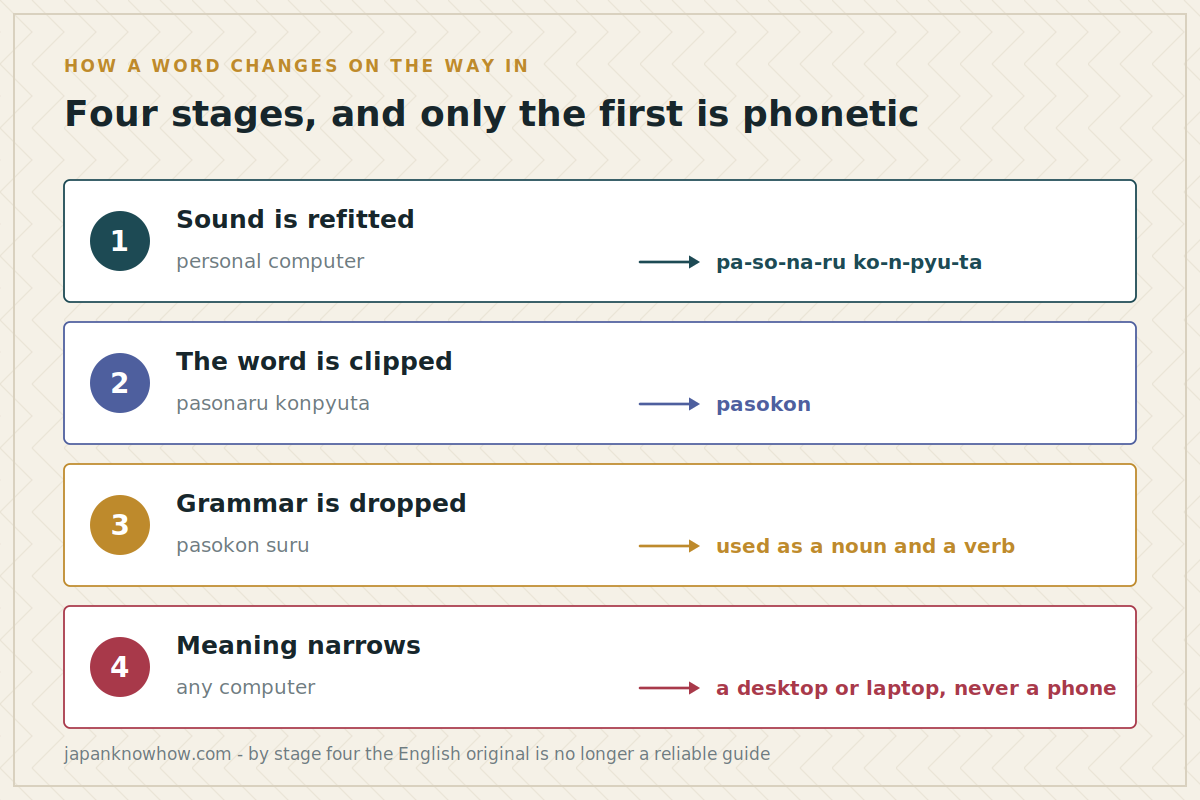
The process is regular enough to be worth knowing, because it lets you reverse-engineer words you haven’t met.
Stage one: the sound is refitted
Japanese syllables are consonant-plus-vowel, so English clusters get broken open with inserted vowels, and sounds Japanese lacks land on the nearest available ones. “Personal computer” becomes pāsonaru konpyūta. This stage is mechanical and predictable — it’s the same process that reshapes your name, described in our piece on the English sounds Japanese doesn’t have.
Stage two: the word gets clipped
Long borrowings get shortened, usually to four morae. Pāsonaru konpyūta becomes パソコン, pasokon. Convenience store becomes コンビニ, konbini. Air conditioner becomes エアコン, eakon. Family restaurant becomes ファミレス.
This is where recognition starts to fail, because the clipped form often keeps pieces from both words and drops the rest.
Stage three: the grammar goes
Borrowed nouns get pressed into service as verbs by adding する: メモする, to make a note; コピーする, to copy. Adjectives get Japanese endings. The word stops behaving like English at all.
Stage four: the meaning narrows or shifts
This is the stage that matters. A borrowed word usually enters Japanese attached to one specific context and stays there. パソコン means a desktop or laptop and never a phone, even though a phone is a personal computer by any reasonable definition. サービス entered through the phrase “service charge” and ended up meaning the opposite — something the shop throws in for free.
The sound survives the journey. The meaning often does not.The pattern behind every false friend on this page
Reading katakana without a dictionary
Most borrowed words are decodable if you sound them out and account for the four or five substitutions Japanese applies on the way in. A short worked example: ホットドッグ. Read it slowly — ho-t-to do-g-gu — and hot dog falls out. The small ッ marks the stopped consonant, and the trailing vowels are the inserted ones that let a Japanese syllable end properly.
Two habits make this faster. First, ignore the trailing u and o sounds; they were added by the syllable structure and carry no information. Second, remember that ラ行 covers both L and R, so a word that sounds wrong with an R may be obvious with an L: ラベル is label, not “rabel.” Once those two are automatic, a menu written in katakana becomes readable at walking speed.
Why so many?
Three reasons, and none of them is fashion.
First, Japanese has borrowed heavily for as long as it has been written — from Chinese for a millennium, from Portuguese and Dutch in the sixteenth and seventeenth centuries, from English since the nineteenth. Pan for bread is Portuguese. Arubaito, a part-time job, is German. The habit is old.
Second, katakana makes borrowing frictionless. There’s a ready-made script whose whole job is marking a word as foreign, so a new term can be adopted on Monday and read correctly on Tuesday without anyone having to agree on kanji for it. That mechanism is part of why the writing system has three components, which we cover in how Japanese writing works.
Third, borrowed words carry a register. A borrowing often feels modern, technical, or lightly aspirational next to its native equivalent — which is why advertising and business are full of them, and why the same idea may have both a native and a borrowed word with different flavours.
What to do about it
- Learn katakana early. It converts a wall of shapes into words you can half-guess, and it’s the fastest return on effort available to a traveller.
- Guess, then check. Sound out the katakana and see whether an English word falls out. It usually does — but treat the meaning as a hypothesis rather than a fact.
- Be suspicious of abstract words. Concrete borrowings — テーブル, コーヒー, バス — are almost always safe. Abstract ones — スマート, ナイーブ, クレーム, テンション — are where the drift happens.
- Don’t back-translate in conversation. Using an English word’s English meaning where Japanese has narrowed it is the single most common way this goes wrong, and it doesn’t sound like a language slip. It sounds like you meant something else.
One reassurance to finish on. Every language does this — English “entrée” is not a French entrée, and English “salary” and “salt” share an ancestor nobody thinks about. Japanese is unusual only in doing it recently enough and visibly enough that you can watch the process happen. Once you know the four stages, the surprises stop being surprising.
If you’re working the other direction — trying to get an English word or name into Japanese correctly rather than decoding one coming out — the mechanics are the same but the pitfalls are different, and they’re set out in our guide to writing your name in Japanese.