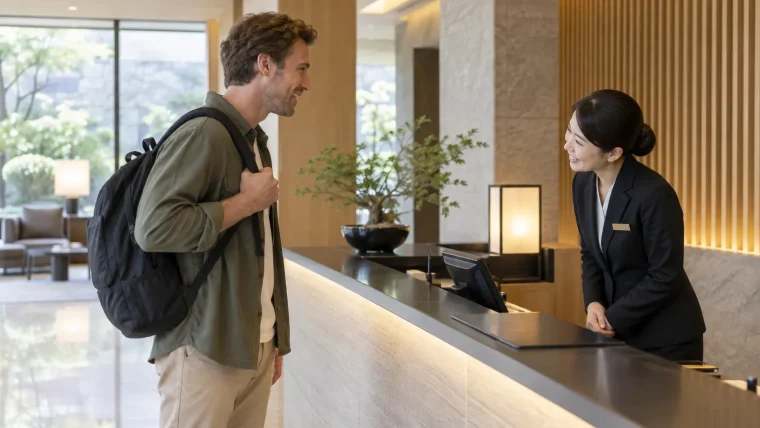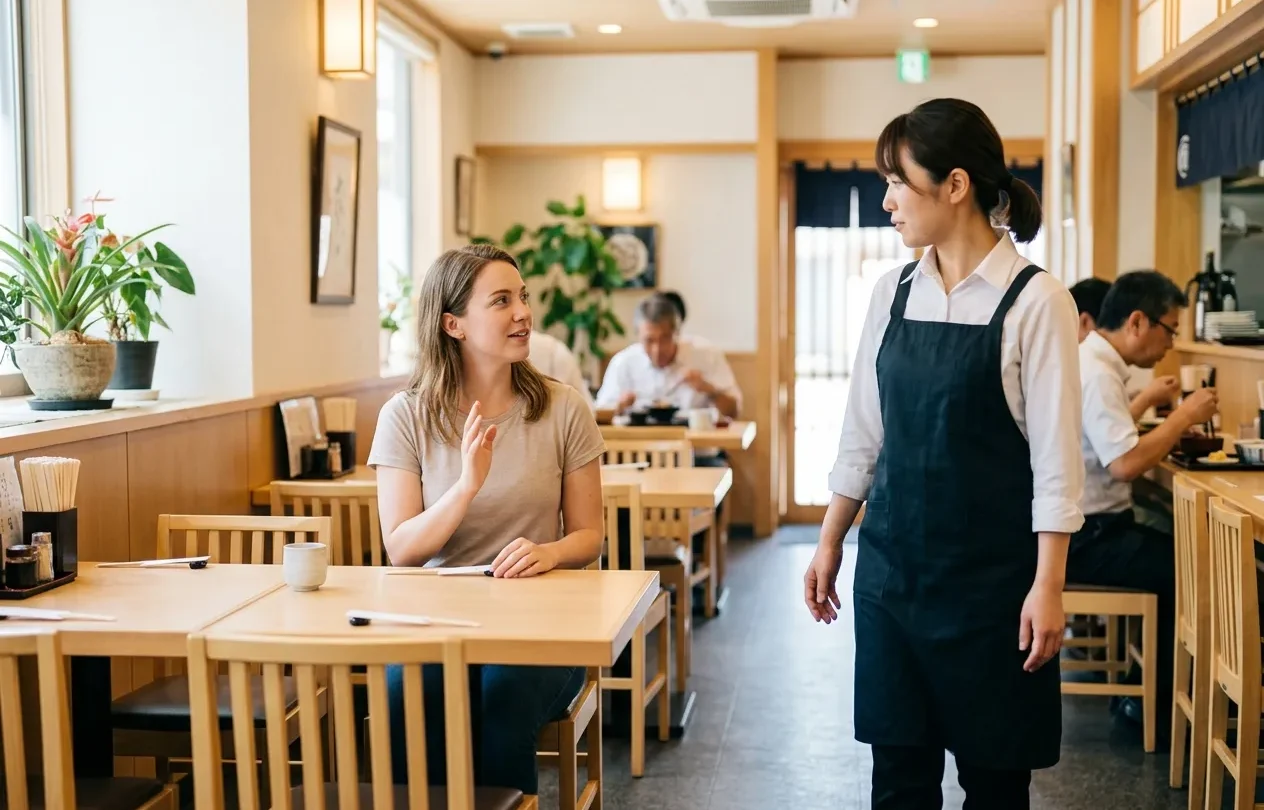
The Word You Will Use Fifty Times a Day: What Sumimasen Means
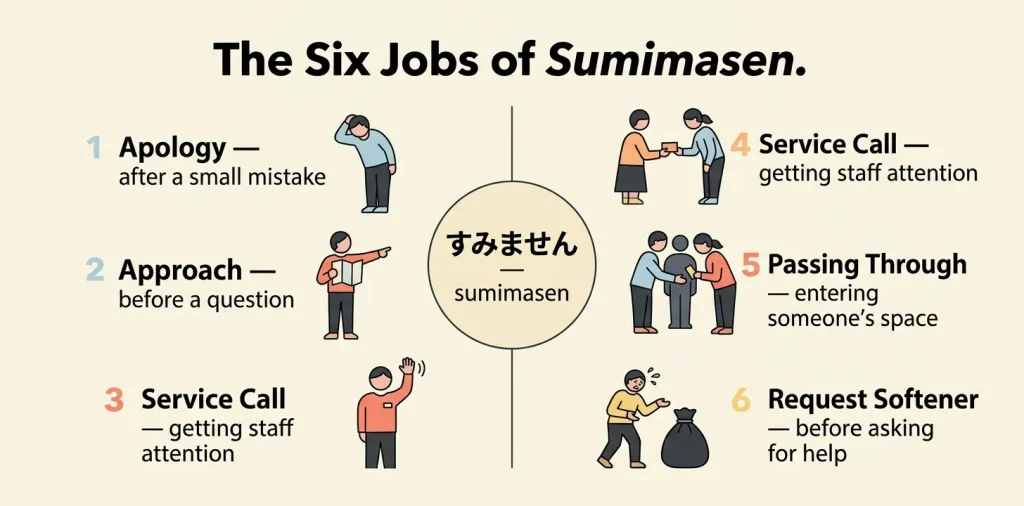
Six jobs come from one Japanese expression: すみません, sumimasen, literally “it is not settled” or “this does not end the matter.” If you are trying to understand what sumimasen means, translating it with a single English phrase creates more problems than it solves. Depending on the situation, it can call a waiter, begin a question, acknowledge a small fault, thank someone for taking trouble, help you move through a crowd, or soften a request.
That range makes sumimasen unusually useful for a visitor. However, the working number is six functions, not the “fifty times a day” promised by the title. No reliable primary source establishes that an average speaker says it fifty times daily, so the phrase should be read as a description of usefulness rather than a frequency statistic.
The word stays the same; the social job changes around it.
Where the six functions come from
The six-part count is a practical classification based on examples documented in Japanese-language teaching materials and research on apology, gratitude, attention-getting, and request strategies. It is not a claim that Japanese grammar officially recognizes exactly six dictionary definitions.
The Japan Foundation’s teaching resources introduce すみません, sumimasen, as an expression used for apologizing and getting someone’s attention. Academic work on Japanese gratitude also documents its use when a speaker recognizes that another person has accepted trouble or inconvenience on their behalf. Everyday speech then extends the same expression into questions, requests, and situations in which you briefly enter another person’s space.
The site’s guide Politeness Is a System, Not a List of Words explains the larger mechanism: Japanese politeness depends on timing, relationship, phrasing, and acknowledgment of another person’s position. Sumimasen is useful because it performs that acknowledgment before you state what you need.
Here is the six-part count in the open:
| Counted function | Typical situation | Shade of meaning | Closest natural English |
|---|---|---|---|
| 1 | You made a minor mistake | Apology | “I’m sorry” |
| 2 | You need a stranger’s attention | Approach signal | “Excuse me” |
| 3 | You call restaurant staff | Service call | “Excuse me” |
| 4 | Someone went to trouble for you | Gratitude with indebtedness | “Thank you—and sorry for the trouble” |
| 5 | You pass through or interrupt | Recognition of intrusion | “Pardon me” |
| 6 | You begin or soften a request | Consideration before asking | “Sorry to bother you, but…” |
| Total | Six recurring situations | Six contextual functions | One expression |
The arithmetic is therefore 1 apology + 2 attention uses + 1 gratitude use + 1 passage or interruption use + 1 request-softening use = 6 practical jobs. The two attention uses are counted separately because calling a restaurant server and approaching an unknown person place you in different interactional settings, even though English often translates both as “excuse me.”
“Sorry,” “excuse me,” and “thank you” are translations of outcomes, not permanent definitions of the Japanese word.
What sumimasen means in each situation
The expression is safer than many beginners expect because it does not force you to identify the perfect English category before speaking. Instead, the listener uses the setting, your timing, your voice, and what happens next to interpret the function.
A small apology
Use sumimasen when you bump someone lightly, arrive a little late, block a doorway, drop something near another person, or cause a manageable inconvenience. In these cases, sumimasen meaning in English is usually “I’m sorry.”
The important limit is scale. Sumimasen is not an all-purpose response to a serious injury, major professional failure, or situation requiring a formal apology and corrective action. A convenient beginner’s word cannot erase consequences.
For a completed minor incident, you may also hear すみませんでした, sumimasen deshita, literally “it was not settled.” The past form looks back at the inconvenience. That difference belongs to grammar and timing, not to a mathematical scale of how sorry the speaker feels.
Getting a stranger’s attention
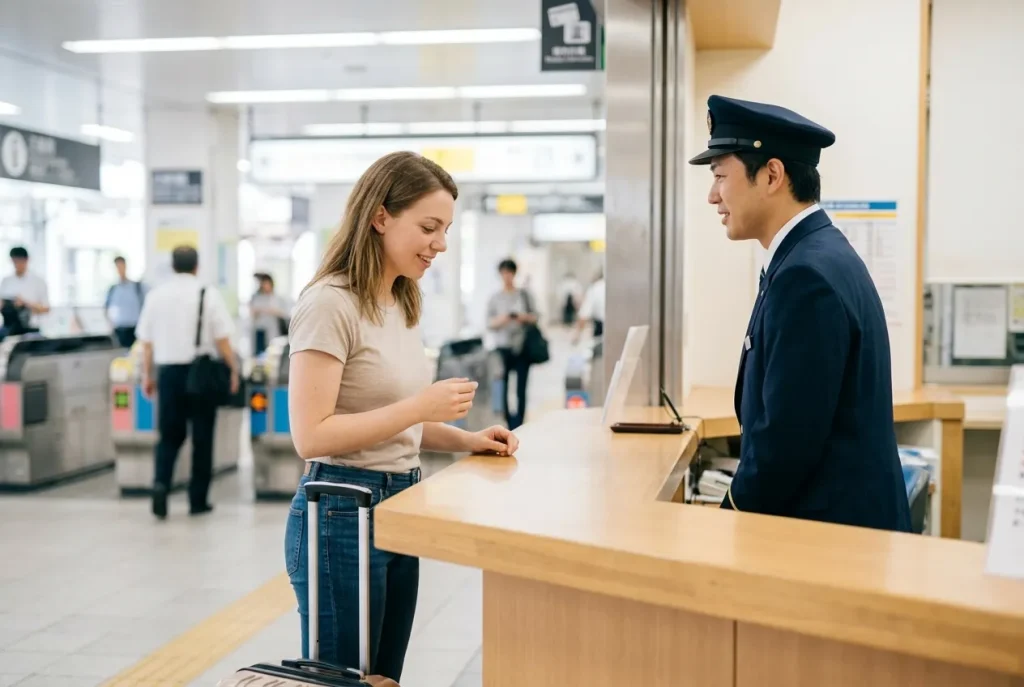
Say sumimasen before asking for directions, requesting help at a station, or approaching an employee. Here it tells the listener that you recognize you are entering their attention.
A clear pattern is:
- Say “Sumimasen.”
- Wait for acknowledgment.
- Ask the question.
- Thank the person after the exchange.
Do not shout a complete English question from several steps away and then add sumimasen at the end. The word works most naturally as the door into the interaction.
Calling a waiter
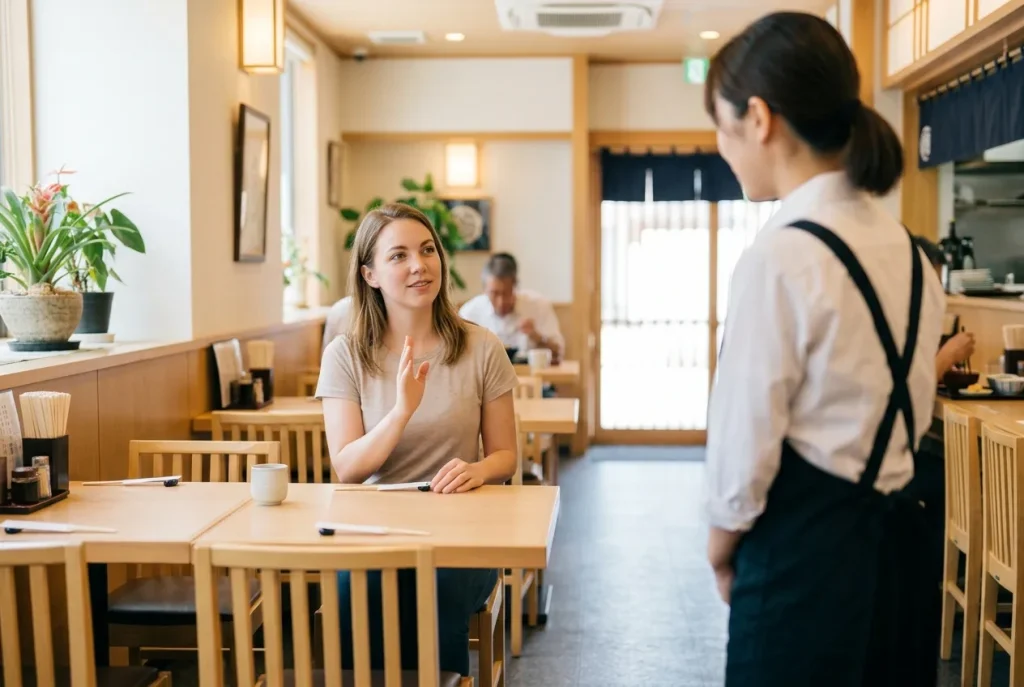
In a casual restaurant, a clear “Sumimasen” can call a server when there is no call button and staff have not already approached. It does not mean you have committed an offense. Its job is to request attention without treating the employee as if they were already listening.
This is one reason sumimasen in Japanese restaurants is so practical. You can use it before ordering another item, asking for water, or raising a problem with the meal. The separate guide to Ordering Food in Japanese, Start to Finish covers the full restaurant exchange, so the ordering script is not duplicated here.
Volume changes the result more than vocabulary does. The word must be loud enough for staff to hear, but an angry or commanding delivery can make a grammatically acceptable expression sound impatient.
Thanking someone for their trouble
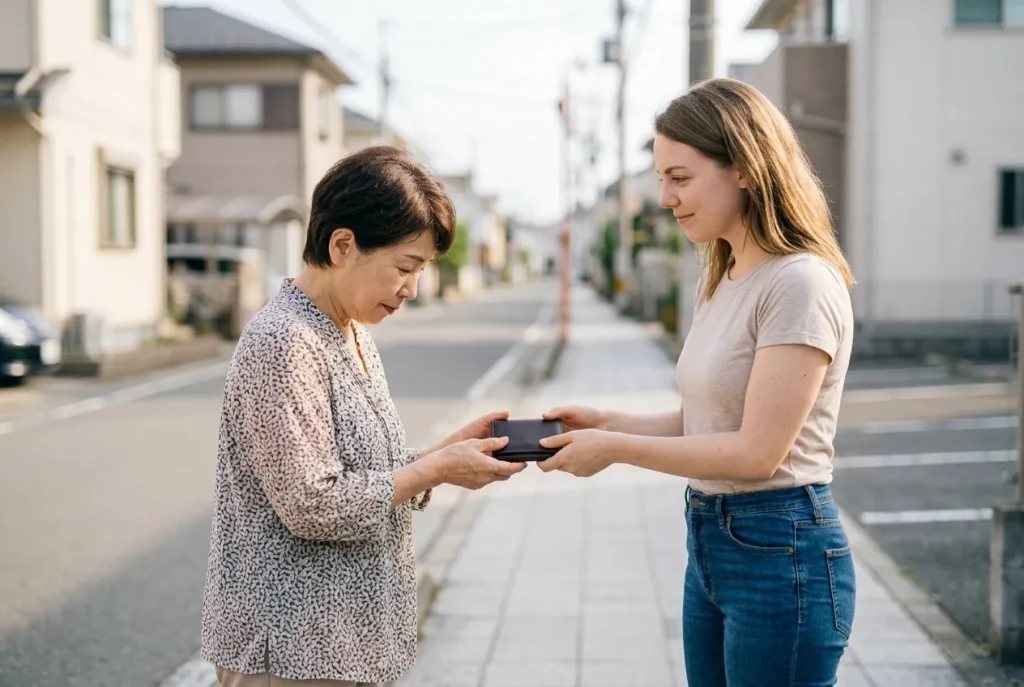
When another person has made an effort for you, sumimasen can carry gratitude. The feeling is not simply “I apologize for existing.” It recognizes both the benefit you received and the burden, time, or trouble the other person accepted.
Suppose someone returns a lost item, moves to make space, or brings something specifically for you. Sumimasen may communicate something close to “Thank you; you should not have had to go to that trouble.”
This does not make ありがとう, arigatō, literally associated with something being difficult or rare, unnecessary. Arigatou Literally Means This Rarely Happens examines the history and modern use of the gratitude expression. In ordinary contemporary speech, you should not force its historical word formation into every exchange.
Sumimasen thanks by noticing the burden; arigatō thanks by naming the gratitude more directly.
Why it can feel safer than arigatou
For a beginner, sumimasen covers the uncertain moment before you know whether you are apologizing, interrupting, requesting, or thanking. That flexibility is the source of its safety. It buys you a socially recognizable opening while the rest of the interaction becomes clear.
Arigatō is better when gratitude is the only relevant message. After receiving a purchase, compliment, gift, or expected service, ありがとうございます, arigatō gozaimasu, literally a polite “thank you,” states appreciation without foregrounding inconvenience.
The comparison is not “correct word versus incorrect word.” It is a difference in emphasis:
| Situation | Sumimasen emphasizes | Arigatō emphasizes | Safer initial choice |
|---|---|---|---|
| Asking a stranger for directions | The interruption | Not normally used as the opener | Sumimasen |
| Calling restaurant staff | The request for attention | Gratitude after service | Sumimasen first |
| Receiving ordinary service | Possible trouble taken | Direct appreciation | Arigatō gozaimasu |
| Someone retrieves your lost item | Trouble plus gratitude | Gratitude | Either, often both |
| You caused a minor inconvenience | Responsibility | Not an apology | Sumimasen |
| Someone gives you a gift | Burden or generosity | Direct thanks | Arigatō gozaimasu |
You will sometimes hear the two together: “Sumimasen, arigatō gozaimasu.” The first expression acknowledges the effort or intrusion, while the second makes the gratitude explicit. The combination is not mandatory, but it shows why searching for a one-word English equivalent produces an incomplete answer.
Squeezing past without creating a scene
A crowded train, narrow store aisle, theater row, or busy counter creates a fifth job. As you move through another person’s space, sumimasen works like “excuse me” or “pardon me.”
Your movement supplies much of the meaning. If you say it softly while turning sideways and indicating the direction you need to go, the listener understands that you want to pass. You do not need a long explanation.
However, saying the word does not give you permission to push. Pause long enough for the other person to react. In a crowded environment, a slight nod and restrained gesture make your intention clearer than repeated speech.
This usage also shows why a translation cannot be memorized in isolation. The same sound that apologized after a small collision can help prevent a collision before it happens.
For station-specific language, use Japanese Phrases for Trains and Stations. That article covers tickets, platforms, transfers, and travel problems rather than repeating them here.
Softening a question or request
The sixth function appears before something that may cost the listener attention or effort. You can begin with sumimasen before asking an employee to check an item, requesting clarification, or confirming whether a seat is available.
A common structure is:
Sumimasen + brief question or request.
The word does not make every demand polite. A large, unreasonable, or badly timed request remains large, unreasonable, or badly timed. Japanese listeners evaluate the content, relationship, and consequences as well as the opening formula.
That is the uncomfortable part of how to use sumimasen: learners sometimes treat it as a politeness coupon. It is not. It signals awareness of the other person, but your behavior must support that signal.
What changes the meaning
The six jobs are not six different pronunciations. Context assigns most of the meaning, while delivery adjusts the force.
Several variables matter:
- Timing: before an action, it can seek attention or soften a request; after an action, it can apologize or acknowledge help.
- Direction: movement toward a person suggests an approach; movement past them suggests “pardon me.”
- What follows: a question turns it into an opener, while a description of a mistake supports an apology.
- Tone: a sharp call can attract staff; a softer delivery suits a small interruption or expression of indebtedness.
- Relationship: friends, customers, coworkers, and strangers do not always choose the same level of formality.
- Severity: a serious wrong requires more than a versatile everyday phrase.
Japanese politeness also has levels that cannot be reduced to one expression. Japanese Politeness Levels, and Which One to Use explains how plain, polite, and honorific language relate to social distance and setting.
For a wider explanation of hedging, silence, timing, and acknowledgment, return to Politeness Is a System, Not a List of Words. That is the pillar principle underneath all six uses.
When not to rely on it
Do not use sumimasen to avoid a clear thank-you when someone has given you something or completed a service. It may be understood, but ありがとうございます, arigatō gozaimasu, communicates gratitude more directly.
Do not assume it resolves a serious mistake. If you damage property, miss an important obligation, or create a safety problem, the listener needs an explanation, responsibility, and a practical remedy. A polite opening is only the beginning.
You should also avoid using it continuously as verbal filler. Repetition can make you sound nervous, demanding, or unclear, especially if you never state the actual question. Say it, gain attention, and continue.
The site’s Essential Japanese Phrases for Travelers gives a compact travel set, while the phrasebook with 337 phrases in 25 situations lets you open the relevant situation instead of reading another duplicated phrase list.
Frequently asked questions
Does sumimasen mean sorry or excuse me?
It can mean either in natural English. After a minor fault, it functions as an apology. Before a question or when attracting attention, it functions as “excuse me.” The situation decides the translation.
Can sumimasen mean thank you?
Yes, particularly when your gratitude includes recognition that another person took trouble for you. It does not replace arigatō gozaimasu in every expression of thanks.
Is sumimasen formal?
It is a polite everyday expression suitable for many encounters with strangers, employees, and people you do not know closely. It is not automatically formal enough for every professional or serious apology.
Can I say sumimasen to restaurant staff?
Yes. In a casual restaurant without a call button, it is a normal way to attract a server’s attention. Say it clearly, then wait for acknowledgment before continuing.
What is the casual version?
すみません may be shortened in casual speech to すいません, suimasen. Beginners are safer learning the standard form first because casual pronunciation depends on setting and speaker.
Is sumimasen safer than arigatou?
It is safer when you are interrupting, approaching, apologizing, or acknowledging someone’s effort. When you simply want to express gratitude, arigatō gozaimasu is clearer.
Remember six: apology, approach, service call, burden-aware thanks, passage, and request softening. Recheck this classification and the linked site resources on September 18, 2027, because site content and teaching guidance may be revised even though the underlying expression is stable.