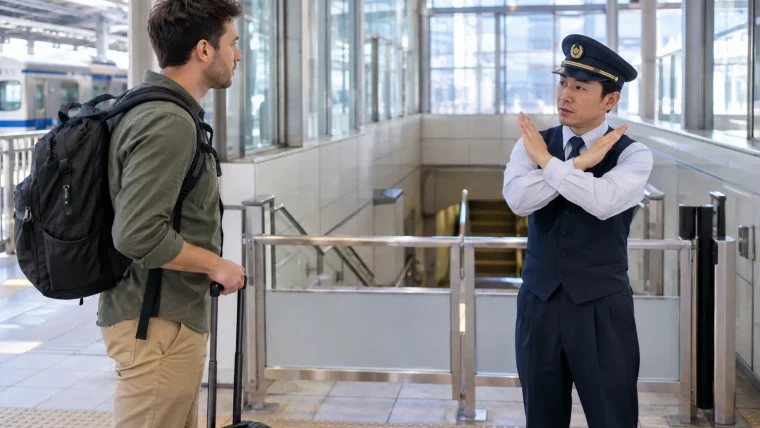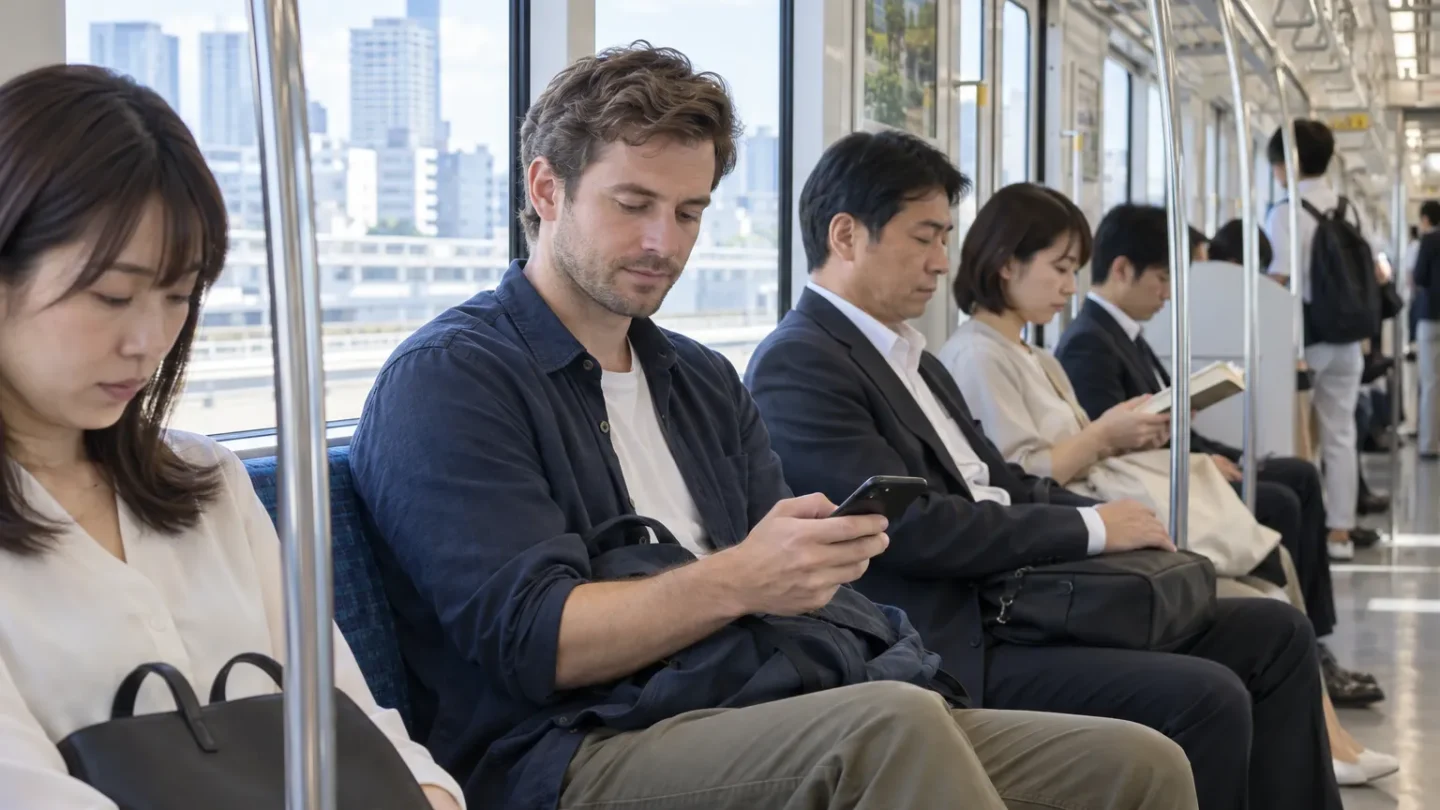
You step into a train car, answer your phone, and say, “Hey, I’m on the train, but I can talk.” The words are harmless. Your voice is cheerful rather than angry, and you may even be quieter than you would be on an American sidewalk. Yet several passengers look up because speaking volume in Japan is not treated only as a matter of personal taste. In a shared space, volume signals whether you have noticed everyone else—and a friendly American voice can land as pressure when the room expects restraint.
The first signal is the room around you
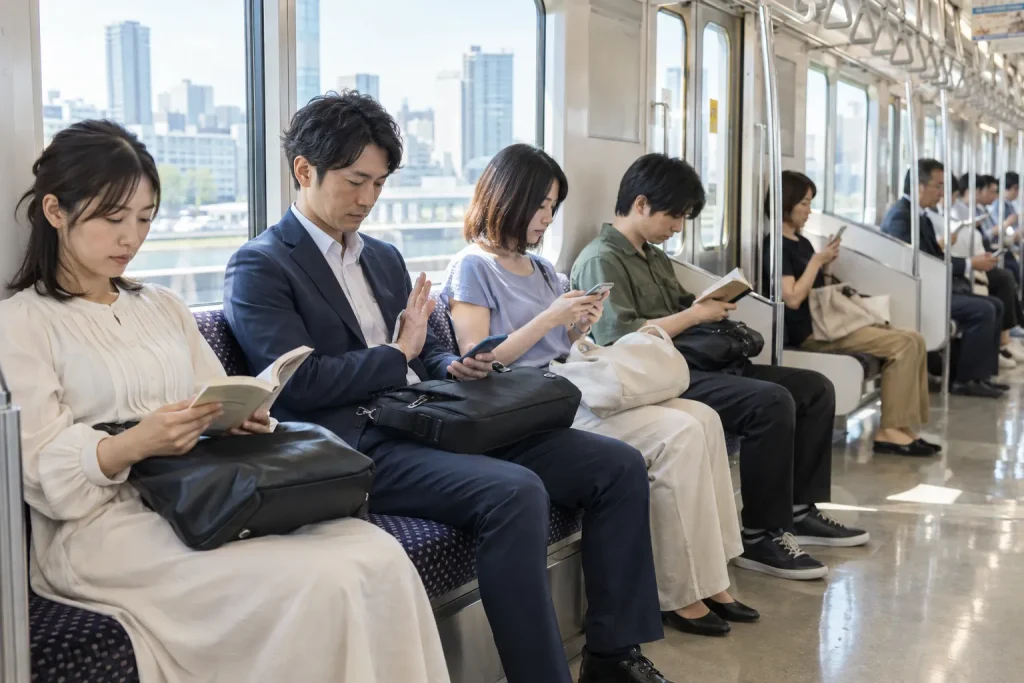
Before you say anything, listen to the space. A commuter train may contain hundreds of people without producing the sound level you expect from a similarly crowded public setting in the United States. Passengers may speak to companions, but many conversations remain low and contained. Phones are used constantly for reading and messaging, while voice calls are treated differently.
The same adjustment can apply in elevators, hotel corridors, waiting rooms, small cafés, and quiet restaurants. It is not that Japanese people never laugh loudly or speak with energy. The register changes with the setting, the people present, and whether your conversation forces strangers to participate as unwilling listeners.
This is part of the larger system explained in Politeness Is a System, Not a List of Words. A grammatically polite sentence does not cancel out a voice that dominates the room. The words, pitch, pace, volume, posture, and timing arrive together.
A useful first rule is simple: match the room before you try to project friendliness. If everyone nearby is speaking softly, begin below your usual conversational level. You can always increase your volume if the other person cannot hear you.
How the train encounter unfolds
Your phone vibrates while the train is moving. The expected action is not to begin a short call and promise to finish quickly. You silence the phone, reject the call, or send a message. If the matter cannot wait, you leave the car at the next suitable station and call from a place where telephone use is permitted.
Tokyo Metro’s current guidance asks passengers to set phones to silent mode and refrain from making calls inside the car. The Tokyo Metropolitan Bureau of Transportation publishes the same basic request. JR East also says that calls from your seat should be avoided outside designated work-oriented cars where limited calling is expressly allowed.
If you answer by mistake, the repair should be brief:
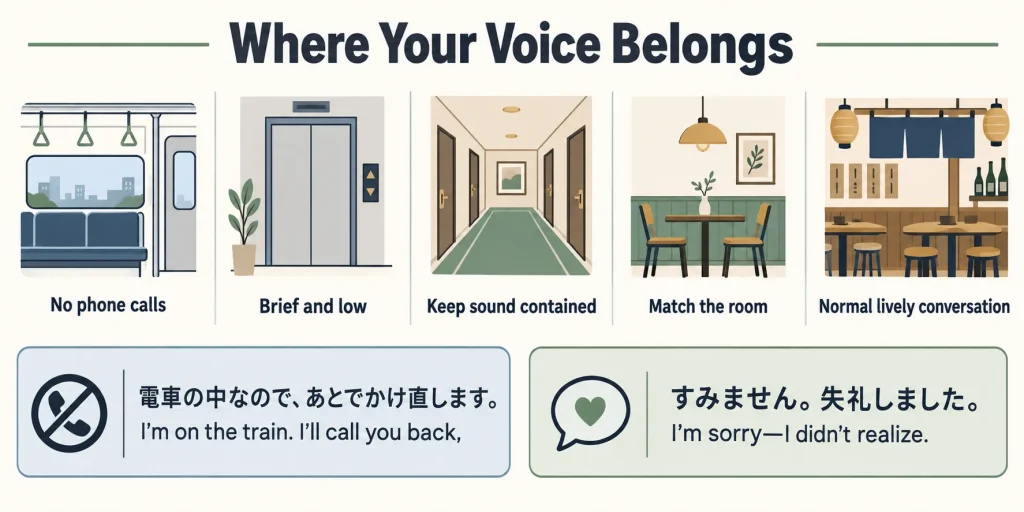
電車の中なので、あとでかけ直します。
Densha no naka na node, ato de kake-naoshimasu.
Literal: “Because I am inside the train, I will call again later.”
In practice: “I’m on the train. I’ll call you back.”
Then end the call. Do not continue explaining where you are going, why the call is inconvenient, or when you expect to arrive. The explanation itself prolongs the disturbance.
The railway language is 通話はご遠慮ください, tsūwa wa go-enryo kudasai, literally “please exercise restraint regarding calls.” ご遠慮ください, go-enryo kudasai, often functions as a polite institutional prohibition. It may sound optional in literal English, but in context it means that passengers are expected not to make voice calls.
| What happens | What you may assume | What the local signal usually means |
|---|---|---|
| No “phone calls prohibited” sign is visible | A short call is acceptable | The shared railway expectation still applies |
| Passengers are using smartphones | All phone use is treated alike | Silent use and voice calls belong to different categories |
| Nobody confronts you | Nobody minds | Passengers may avoid direct confrontation |
| The caller says it will take a moment | A brief exception is harmless | Everyone nearby still has to hear it |
| You speak in English | The content is private to others | The sound remains public even when the words are not understood |
What the other passengers are being asked to tolerate
A phone call occupies the car differently from a conversation between two people sitting together. The caller’s responses arrive without the other half of the exchange, and the voice often becomes clearer or louder to compensate for train noise. More importantly, the caller has chosen an outside conversation over the expectations of the people physically sharing the space.
Calling this personal “contempt” goes further than the official rules support. Railway operators describe calls as a nuisance or inconvenience to surrounding passengers. Still, deliberately continuing after you understand the expectation can communicate disregard: my conversation matters more than the common environment.
That is the uncomfortable part. Your intentions may be friendly, urgent, or efficient, but strangers cannot hear intentions. They receive the sound and the behavior. Phone etiquette in Japan is therefore less about whether you consider yourself loud and more about whether you claim attention from people who cannot leave.
Silence from other passengers is not approval. A person may glance at you, change seats, look down, or simply endure the call. Public correction is itself uncomfortable, so the social response may remain indirect.
For station-specific language rather than general etiquette, Essential Japanese Phrases for Travelers covers the practical requests you are more likely to need. It is better to prepare those phrases before traveling than to practice a long conversation inside the car.
The restaurant version begins with enthusiasm
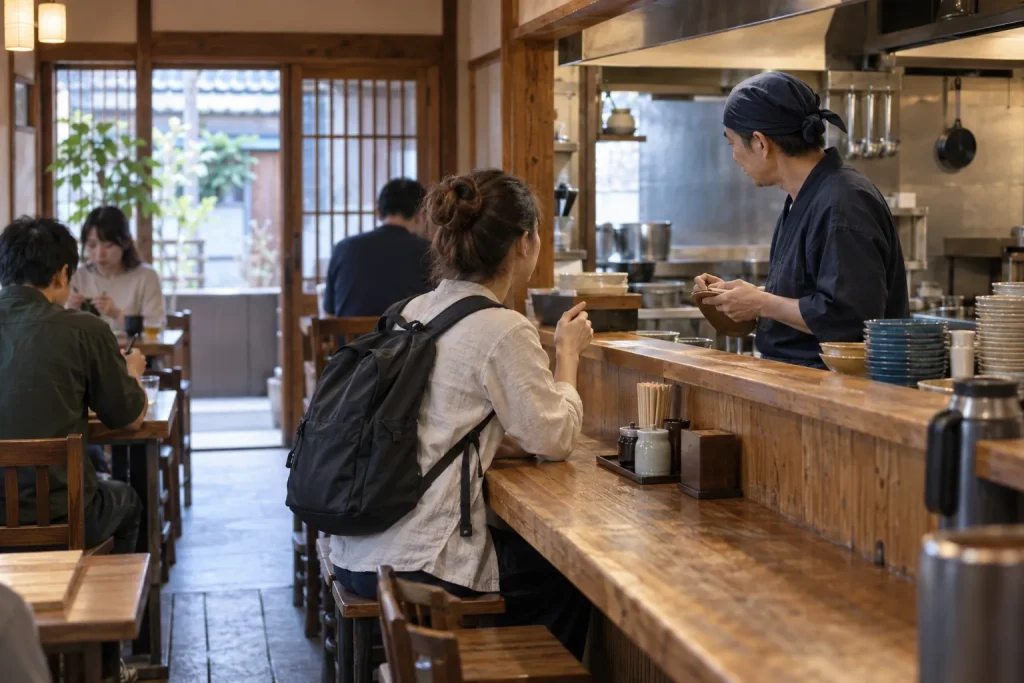
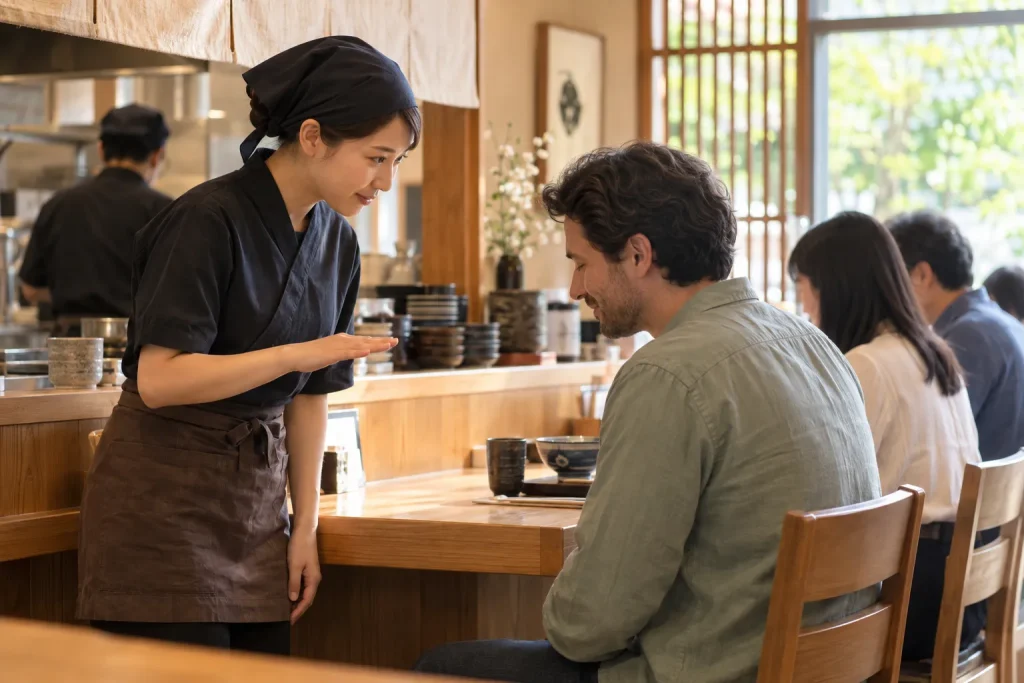
Now move the same voice into a small restaurant. You enter, greet the staff warmly, and answer questions with the clear forward projection that often communicates confidence and friendliness in the United States. Nothing is inherently wrong with that voice. The difficulty is that a compact room makes it carry across every table.
The staff member is listening for your order, not for proof that you are enthusiastic. A strong “HI! TABLE FOR TWO!” can sound less like warmth and more like a command, particularly when it arrives with a flat imperative rhythm. English does much of its social work through intonation, but that intonation does not always cross languages as intended.
Japanese customer-service exchanges often rely on a different balance. Staff may speak clearly in a practiced service voice, while the customer responds more briefly and at a lower volume. You do not have to imitate the employee’s pitch or elaborate politeness. A short acknowledgment is enough.
二人です。
Futari desu.
Literal: “We are two people.”
In practice: “A table for two, please.”
Add a slight nod and let the staff member lead the next step. If you need attention later, do not shout a full explanation across the room. A clear すみません, sumimasen, literally “it does not end” but used in practice as “excuse me” or “sorry,” is the normal opening.
The Word You Will Use Fifty Times a Day explains how sumimasen moves among apology, gratitude, and attention-getting. Here, its job is simply to open contact.
Friendly intonation can arrive as pressure
American service encounters often reward visible warmth: a broad greeting, sustained eye contact, quick familiarity, energetic agreement, and a voice designed to sound open. Japanese encounters may place more value on reducing the burden you create for the other person. These are tendencies, not personality tests for two entire countries.
Trouble begins when you increase volume because the listener hesitates. The hesitation may mean that the person is processing your Japanese, checking an instruction, or deciding how to answer politely. Repeating the same sentence louder does not make its grammar clearer. It can turn an ordinary request into something that feels impatient.
If you are not understood, shorten the sentence first:
すみません。もう一度、お願いします。
Sumimasen. Mō ichido, onegai shimasu.
Literal: “Excuse me. One more time, I request.”
In practice: “Sorry, could you say that again?”
If you need to repeat yourself, say:
ゆっくり言います。
Yukkuri iimasu.
Literal: “I will say it slowly.”
In practice: “I’ll say it more slowly.”
Slow down without exaggerating every syllable. Over-articulation can sound as forceful as shouting, especially when accompanied by large gestures. The goal is to make the message easier, not larger.
| American habit meant as friendly | How it may land in a quiet Japanese setting | Better adjustment |
|---|---|---|
| Projecting across the counter | Impatient or commanding | Move closer when appropriate and lower your voice |
| Repeating the same English more loudly | Pressure rather than clarification | Use fewer words or show the relevant information |
| Starting with immediate familiarity | Too much closeness too soon | Begin neutrally and follow the other person’s register |
| Filling every pause | Refusal to give the other person processing time | Let the pause remain |
| Calling to staff from across the room | Making the whole room hear the request | Use one clear sumimasen and wait |
What a soft answer actually communicates
A quieter voice is not automatically shy, weak, or uncertain. In many shared settings, it communicates control. You are showing that your message is meant for the person in front of you rather than for the whole room.
This is why volume behaves like a social register. Japanese has visible grammatical registers, including plain and polite forms, but the practical register extends beyond verb endings. Japanese Politeness Levels, and Which One to Use explains those language forms; volume determines how the chosen form reaches the listener.
Consider two deliveries of the same sentence:
これをお願いします。
Kore o onegai shimasu.
Literal: “I request this.”
In practice: “This one, please.”
Said toward the employee at a contained volume, it is an ordinary request. Projected across the room with a hard falling tone, it can sound like an order even though onegai shimasu is polite. Grammar has not changed, but the social action has.
Similarly, ありがとうございます, arigatō gozaimasu, literally “it is difficult to exist,” functions as a formal “thank you.” It does not become more sincere merely because it is louder. Arigatou Literally Means This Rarely Happens explains the phrase’s history and emotional weight; here, the practical point is to direct it to the person rather than announce it to the room.
The correction may be indirect
You may not hear “You are too loud.” A staff member might look toward other customers, lower their own voice, pause before answering, or say a softened request. Another passenger might use the established railway wording instead of accusing you personally.
A direct but polite correction could sound like this:
もう少し声を落としていただけますか。
Mō sukoshi koe o otoshite itadakemasu ka.
Literal: “Could I receive your lowering your voice a little more?”
In practice: “Could you lower your voice a little?”
Do not debate whether you were objectively loud. The speaker is telling you that your voice is carrying too far in that setting. The fastest repair is:
すみません。失礼しました。
Sumimasen. Shitsurei shimashita.
Literal: “Sorry. I did something discourteous.”
In practice: “I’m sorry—I didn’t realize.”
Lower your voice immediately. A long apology recreates the problem by keeping everyone’s attention on the exchange. Japanese public manners often favor a small correction followed by changed behavior.
The phrasebook’s 337 phrases across 25 practical situations can help you prepare short responses before you need them. Use it to find a compact sentence, not to conduct an extended language lesson at a ticket gate or restaurant counter.
Trains are not silent everywhere or at all times
The quiet-car idea should not become a cartoon of Japan. A late train may carry animated groups. Children make noise, friends talk, sports fans travel together, and passengers react to delays. Some long-distance services have vestibules or other areas where a necessary call may be handled more appropriately.
JR East’s TRAIN DESK cars are a useful modern exception. These designated work-oriented cars allow calls and web meetings from the seat, while asking passengers to use headsets or microphones, keep voices low, and consider others. The exception proves that the ordinary car remains governed by a different expectation.
The rule also changes outside the vehicle. A station concourse, outdoor platform, nightlife district, festival, or busy food hall has a different acoustic baseline. You still pay attention to people around you, but you do not need to whisper merely because you are in Japan.
The useful comparison is not “Japan quiet, America loud.” It is how quickly each setting asks you to change register. In the United States, a consistent confident voice may work across a sidewalk, store, café, and train. In Japan, the transition from station platform to train car can require an immediate drop in volume.
The signal matters more than the decibel count
There is no national decibel limit for an ordinary conversation in a restaurant or commuter train. Official railway guidance does not tell you to speak below a universal number. The standard is contextual: avoid calls, prevent sounds from inconveniencing other passengers, and adjust to the shared environment.
That means a sound meter cannot solve the problem. A short loud warning in an emergency is appropriate. A sustained call at a lower but still clearly audible level may remain intrusive. Content, duration, repetition, and who has agreed to hear the exchange all matter.
Use a practical sequence instead:
- Listen before speaking.
- Match the room’s general level.
- Aim your voice toward the listener.
- Shorten the message if communication fails.
- Treat hesitation as processing time, not permission to become louder.
- End a train call and return it later.
- If corrected, apologize once and change the behavior.
This is Japanese conversation etiquette in its most useful form: not an instruction to sound timid, but a reminder that voice occupies shared space.
Two phrases carry the repair
You do not need a theatrical Japanese persona. Keep your natural voice, remove unnecessary projection, and let the setting tell you how far the sound should travel. On a train, the correct audience for your phone call is somewhere outside the car. In a restaurant, your audience is the staff member in front of you, not every neighboring table.
Two phrases carry most of the exchange. 電車の中なので、あとでかけ直します, Densha no naka na node, ato de kake-naoshimasu, ends the call without drama. すみません。失礼しました, Sumimasen. Shitsurei shimashita, repairs the moment when your voice has already crossed the room.
Next time you enter a Japanese train car, notice the change before you speak. The social register is already audible in what everyone else has chosen not to make public.
Short FAQ
Are conversations prohibited on Japanese trains?
No. Quiet conversation between passengers is generally possible, but railway operators explicitly ask passengers not to make phone calls inside ordinary train cars. Follow any signs or announcements for the particular service.
Should I whisper in every Japanese restaurant?
No. Match the restaurant. A busy izakaya has a different sound level from a small counter restaurant, formal dining room, or quiet café.
What should I do if I must take an urgent call?
Reject or end the call, leave the train at a suitable station, and call back from a permitted place. On some long-distance services, staff or signs may direct you to an appropriate area.