Paying Before You Sit Down: Ramen Ticket Machines in Japan
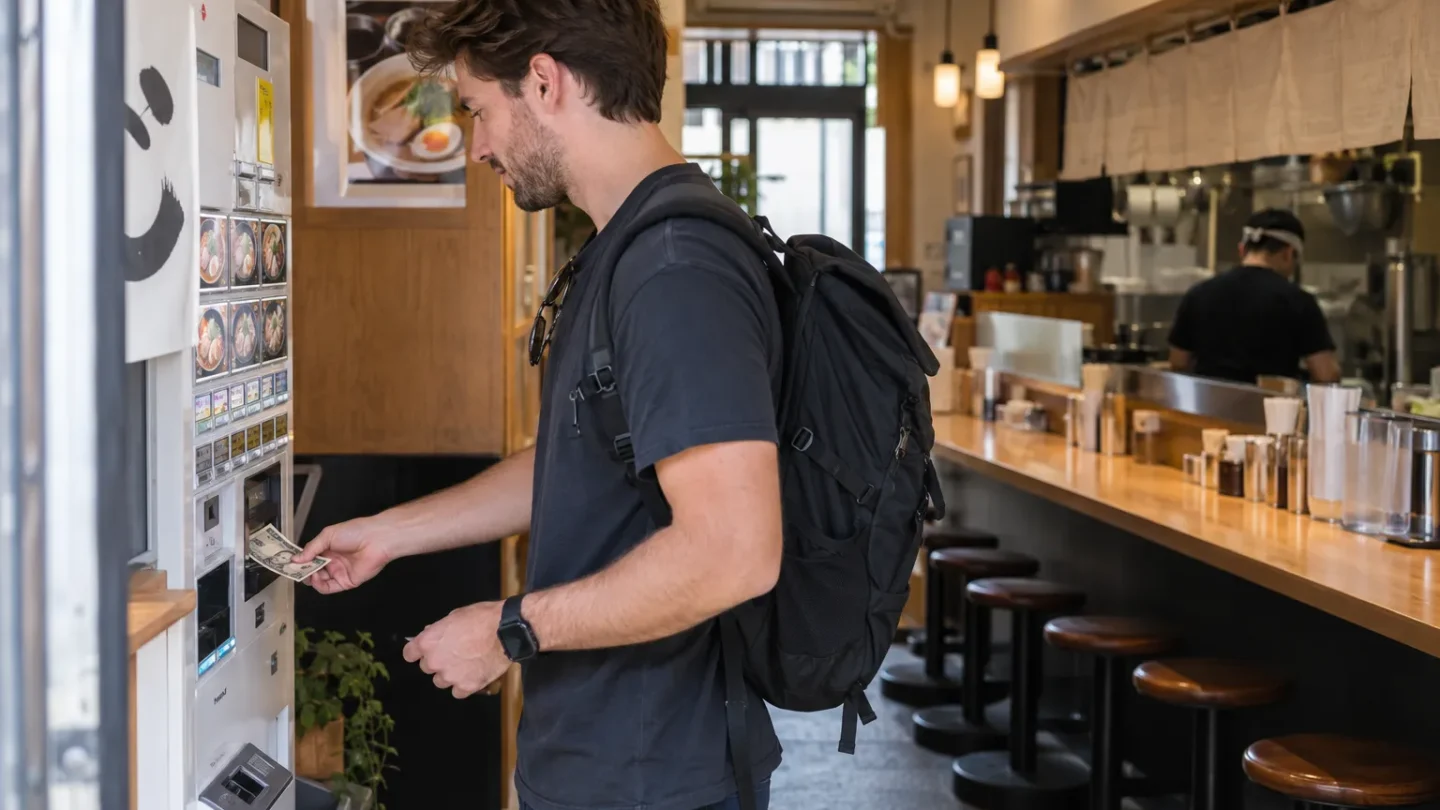
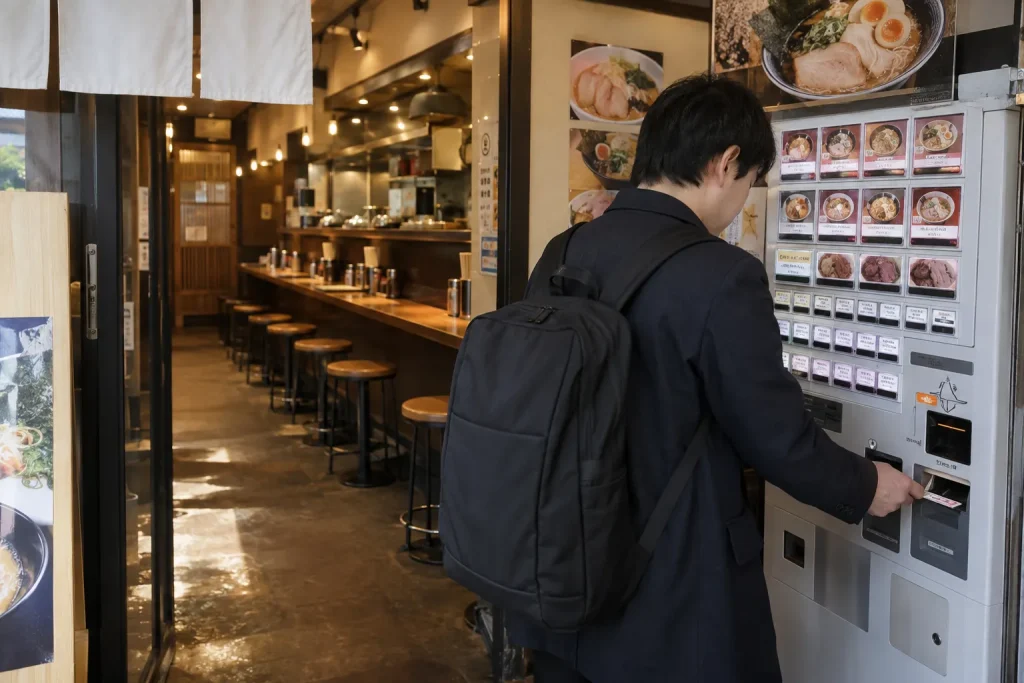
¥1,000 is the banknote to carry when you plan to use a ramen ticket machine in Japan. Many compact vending machines accept ¥1,000 notes but cannot process ¥5,000 or ¥10,000 notes. The safe protocol is equally compact: find the machine, insert accepted cash, select the ramen and extras, collect every ticket and your change, hand the tickets to the staff, and only then take the seat they indicate.
That order matters. A customer sitting down first can interrupt a tightly organized service system or lose a place in the queue. The machine is not decoration and usually is not an optional self-checkout. It is the shop’s menu, order terminal, cashier, and printed kitchen instruction.
The practical rule is machine first, seat second.
The number that prevents the first problem
Japan’s current banknote series has four denominations: ¥1,000, ¥5,000, and ¥10,000 notes, plus a ¥2,000 note that remains legal tender but is rarely encountered in ordinary circulation. The current series entered circulation on July 3, 2024, according to the Bank of Japan. That does not mean every restaurant machine accepts every denomination.
GLORY, a major Japanese ticket-machine manufacturer, separates its equipment into low-denomination and high-denomination models. Its compact VT-S20 specification accepts ¥1,000 banknotes, while larger high-denomination models can be configured for ¥1,000, ¥5,000, and ¥10,000 notes. The refusal of your ¥10,000 note is therefore often a hardware limitation rather than a damaged bill or an unfriendly restaurant policy.
“¥1,000 notes” is the important line to find beside the bill slot.
The uncomfortable part is that a valid ¥10,000 note may still be useless at the machine. Break it before joining the line by making a small purchase at a staffed store, using an ATM that dispenses smaller notes, or politely asking restaurant staff whether they can change it. Do not assume that a nearby convenience store will exchange money without a purchase.
For the wider differences among counter shops, table-service restaurants, and izakaya, read Ordering, Paying and the Rules Nobody States. That guide covers the full restaurant sequence; this article stays with the Japanese ramen ordering system at ticket-machine shops.
What your money is buying
There is no defensible nationwide “standard ramen price.” Each restaurant programs its own machine, and prices can differ by branch, bowl, portion, and topping. A cost calculation must therefore use the amounts printed on the machine you are standing in front of.
The total has several possible components:
- the base bowl;
- a topping ticket;
- a larger noodle portion;
- a side dish or drink;
- 替え玉, kaedama, literally “replacement noodles,” if the shop offers an extra serving;
- any branch-specific set or upgrade.
The following table is a reusable calculation, not a claim about one restaurant’s menu. Replace letters A through D with the dated prices displayed on the machine.
| Order component | Machine price | Quantity | Calculation |
|---|---|---|---|
| Base ramen | ¥A ($A ÷ R) | 1 | ¥A |
| Egg or other topping | ¥B ($B ÷ R) | 1 | ¥B |
| Kaedama | ¥C ($C ÷ R) | 1 | ¥C |
| Side dish | ¥D ($D ÷ R) | 1 | ¥D |
| Total shown for calculation | — | — | ¥A + ¥B + ¥C + ¥D |
Here, R is the current number of yen per US dollar. Check that rate on the day you publish or travel, because a dollar conversion is only an estimate and does not change what the machine charges. The yen amount displayed on the machine is the amount that controls the purchase.
For example, if your chosen buttons show ¥A for ramen and ¥B for an egg, your subtotal is ¥A + ¥B. Adding kaedama changes it to ¥A + ¥B + ¥C. This open formula is more useful than a sample total copied from a different shop whose prices may already have changed.
Reading the buttons without blocking the line
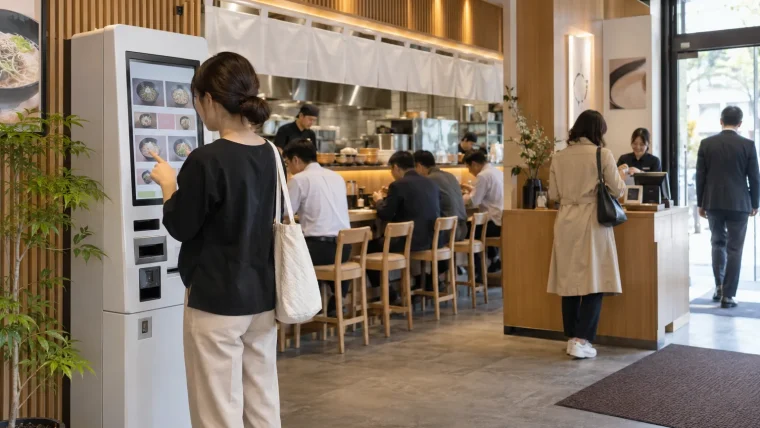
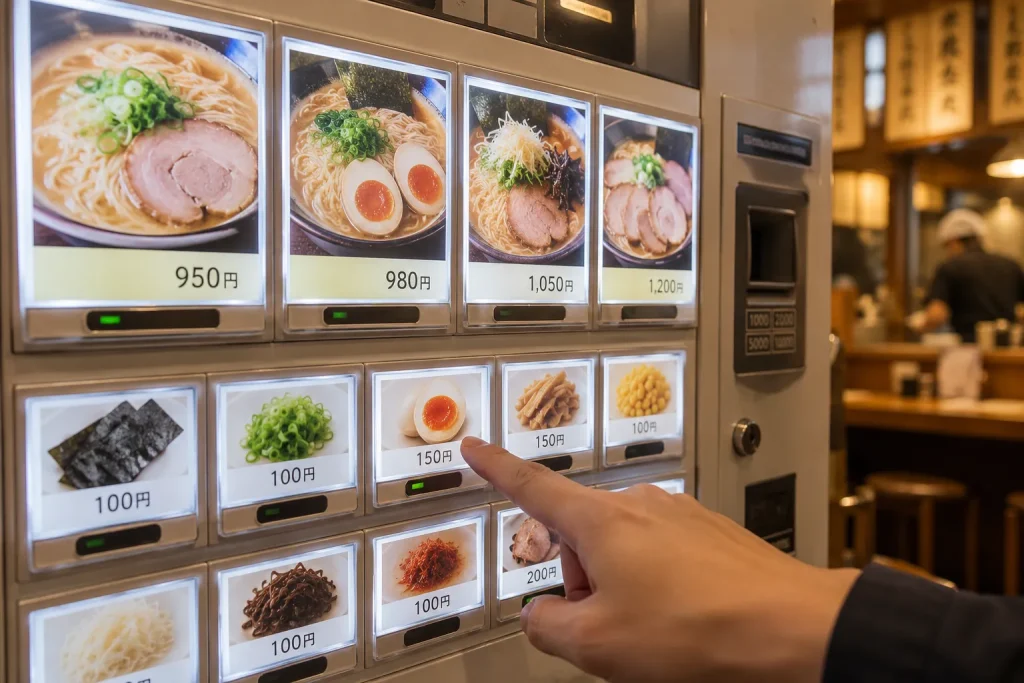
Older machines may present a wall of illuminated physical buttons. Newer kiosks use a touchscreen with category tabs and confirmation screens. In either design, the main bowls usually occupy the most prominent area, while ramen toppings in Japan are grouped in a separate row, column, or on a second screen.
Look for these labels:
| Japanese label | Reading | What it adds |
|---|---|---|
| 味玉 | ajitama | Seasoned egg |
| 煮卵 | nitamago | Simmered egg |
| チャーシュー | chāshū | Braised or roasted pork slices |
| のり | nori | Dried seaweed |
| ねぎ | negi | Green onion |
| 大盛 | ōmori | Larger serving |
| 替え玉 | kaedama | Extra noodles |
Do not treat the photographs as a complete translation. A bowl image may represent the base ramen, a special version with several toppings, or a set. Match the picture to its Japanese label and price before pressing the button.
Japanese Food for Beginners: How to Read a Menu explains the menu vocabulary that applies across restaurant types. It is the better place to learn dish categories, so there is no need to reproduce that guide at the machine.
A useful sequence is:
- Photograph the machine only if the shop allows it and nobody is waiting behind you.
- Identify the base bowl before considering extras.
- Find the topping section marked トッピング, toppingu, meaning “toppings.”
- Check whether noodle size is included in the ramen button or sold separately.
- Insert only a denomination shown beside the slot.
- Press the base bowl and then each separate extra.
- Select the confirmation button if the machine has a touchscreen.
- Collect the food tickets, change, and any receipt before moving away.
- Give the food tickets to staff and wait for seating instructions.
If several small slips emerge, do not discard the ones that look like receipts until staff have checked them.
Finding kaedama before and after ordering
Kaedama is not simply another word for “large ramen.” It is another portion of noodles intended for broth still in your bowl. It is particularly associated with Hakata-style ramen, but availability depends on the shop.
On a physical machine, the kaedama button is often among the toppings, side items, or additional noodle options rather than beside the main bowls. On a touchscreen, it may appear under トッピング, サイドメニュー (saido menyū, “side menu”), or an additional-order screen. Search for 替玉 as well as the fully written 替え玉.
Some shops expect you to buy the kaedama ticket at the beginning. Others allow you to order another serving from your seat, sometimes through a second machine, an order slip, a tabletop device, or a direct request to staff. Because this varies by business, the machine and posted instructions override any general travel guide.
If you need to ask, say “Kaedama wa arimasu ka?”—“Do you have extra noodles?” The site’s phrasebook with 337 phrases, including ordering and allergies provides situational language without turning this machine guide into a duplicate phrase list.
How extras change the final total
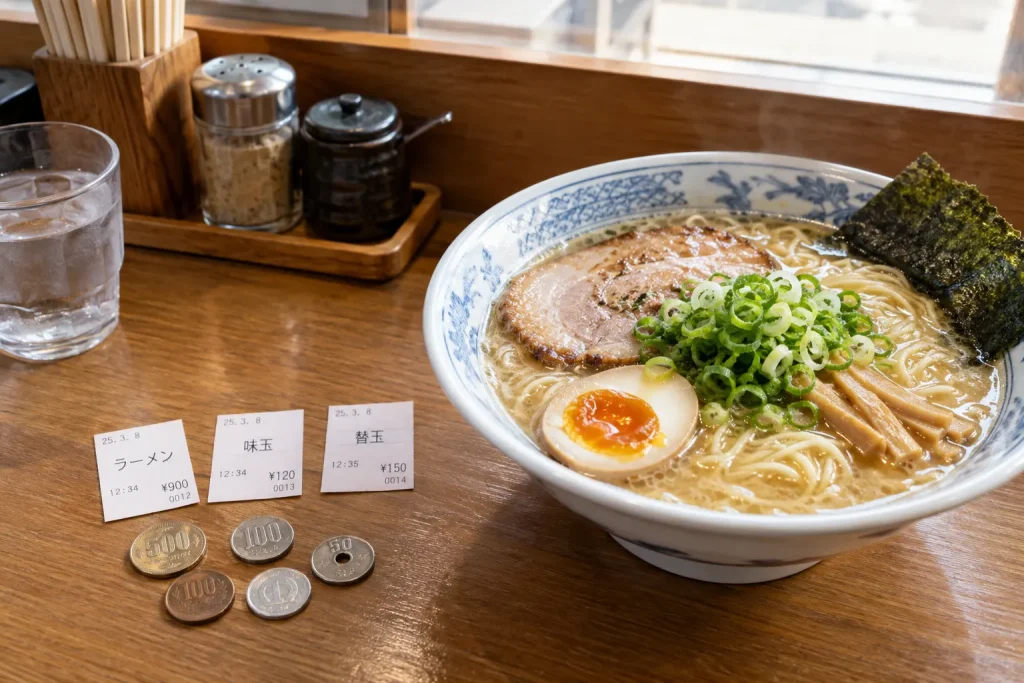
Every additional button creates a separate cost unless the screen explicitly presents a set. The variables that most often move your total are the bowl version, noodle quantity, individual toppings, side dishes, drinks, and kaedama. Their precise effect is the number printed beside each option on that machine on that day.
Use this worksheet before inserting money:
| Decision | Change to total | What to verify |
|---|---|---|
| Choose the basic bowl | +¥A | Base price printed on the main button |
| Upgrade to a special bowl | +¥E instead of ¥A | Whether toppings are already included |
| Add one topping | +¥B | Separate topping price |
| Select a larger portion | +¥F | Whether the bowl supports an ōmori option |
| Add one kaedama | +¥C | Whether it can be purchased now |
| Remove an item | Usually ¥0 change | Machines may not discount omissions |
| Final amount | Selected bowl + all paid extras | Confirm before payment |
The last uncomfortable detail is the “special” bowl. It may already include an egg, pork, or seaweed. Buying the same topping again can mean paying for a duplicate rather than customizing the bowl intelligently. Read the photo and label before adding separate tickets.
Likewise, an allergy request is not solved by omitting a visible topping. Broth, seasoning sauce, flavored oil, and noodles may contain ingredients that the picture cannot show. The machine completes payment, but it does not guarantee that a modified dish is medically safe.
Why the ticket system feels different from a US checkout
At a US counter-service restaurant, you normally order from an employee or screen, pay, receive an order number, and then choose a seat. The ramen-machine version moves payment to the entrance and converts the order into a paper ticket before staff become involved.
The financial difference is not an automatic surcharge. The ticket machine displays item prices and charges for the buttons selected. You should not add a tip merely because the interaction was short; ordinary Japanese restaurant service does not use the US tipping model. The broader payment guide, Ordering, Paying and the Rules Nobody States, explains when you pay at a register, table, or machine.
An izakaya is a different comparison. It may add お通し, otōshi, literally “through item,” a small compulsory starter or seat charge that was not selected from a vending machine. The Small Dish You Never Ordered and Must Pay For covers that system. A ramen ticket should not be used as evidence that every Japanese restaurant has fully prepaid, button-by-button pricing.
What to do when the machine refuses payment
First, read the symbols printed next to the payment area. A machine that shows coins and a ¥1,000 note but no ¥5,000 or ¥10,000 note is telling you its limit. Repeatedly reinserting the larger bill will not add hardware support.
Then use this order:
- Check that the banknote is unfolded and inserted in the indicated direction.
- Confirm that its denomination appears beside the slot.
- Look for a cashless-payment logo on the actual machine.
- Ask staff before leaving if payment has been accepted but no ticket appears.
- If the denomination is unsupported, obtain smaller cash before trying again.
- Collect any returned money before stepping away.
Do not assume that cashless payment at ramen shops is universal. GLORY sells both conventional cash machines and newer self-order kiosks with electronic-payment options. That product range itself shows why “all machines take cash” and “all new machines take cards” are both unreliable rules.
The practical comparison is simple: a ¥1,000 note works in the low-denomination GLORY model documented in September 2026, while a ¥10,000 note requires a high-denomination machine. Carrying smaller notes removes a hardware gamble before lunch.
The order from entrance to bowl
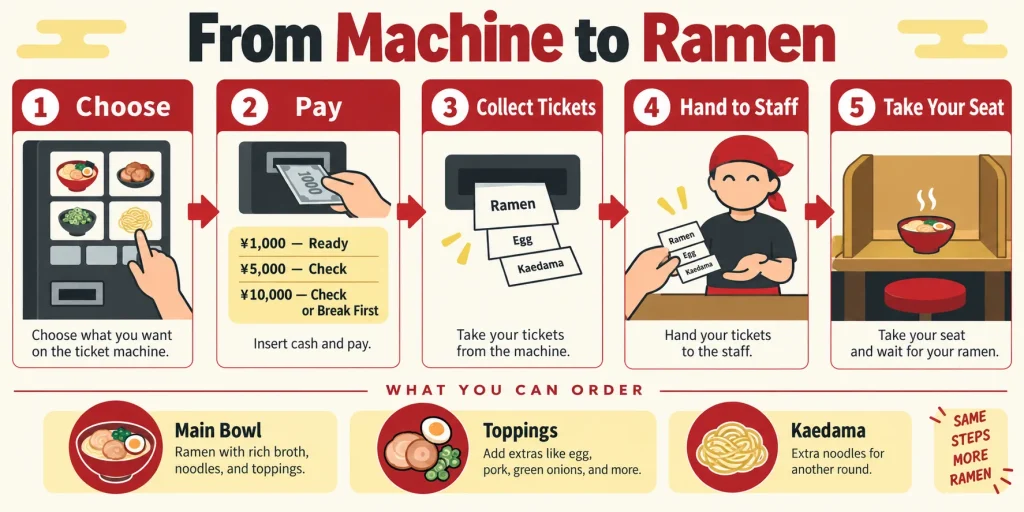
The whole protocol can be reduced to one operational sequence:
“Machine, tickets, staff, seat.”
Stand aside while deciding if the shop posts its menu outside. At the machine, choose the bowl and extras, pay, and collect everything issued. Hand the food tickets to the employee; they may ask about noodle firmness, portion, or seating. Sit only after the employee points you to a place or the shop’s queue procedure makes the next step clear.
Do not leave change in the tray. A machine may return several coins, multiple food tickets, and a receipt through different openings. Check each compartment before moving away.
The ticket is your order, not merely proof that you paid.
Frequently asked questions
Do I buy a ticket before joining the ramen-shop line?
Follow the shop’s posted arrangement. If the queue reaches the machine, staff may direct customers to buy first or wait until they reach the entrance. Once admitted, the normal ticket-shop protocol is to complete the machine order before sitting down.
Where are the topping buttons?
They are commonly placed below or beside the main bowls on button machines. Touchscreens may put them on a toppings, side-menu, or customization screen. Look for トッピング and compare any “special” bowl with separate extras to avoid buying the same topping twice.
Can I use a ¥10,000 note?
Only if the machine marks that denomination as accepted. GLORY’s compact VT-S20 takes ¥1,000 notes, while its high-denomination models support larger notes. Break a ¥10,000 note beforehand unless you have confirmed that the restaurant’s machine accepts it.
When should I buy kaedama?
Buy it with the main order if a 替え玉 or 替玉 button is available and you know you want extra noodles. Otherwise, check the shop’s instructions because some businesses accept additional orders from the seat.
Do ramen ticket machines accept cards or IC cards?
Some do, but payment support depends on the installed machine and the restaurant’s configuration. Trust the logos displayed on the terminal itself, not a general assumption about Japan.
What figure should I remember?
Remember ¥1,000: it is the banknote denomination accepted by the compact low-denomination machine verified in GLORY’s product specifications on September 10, 2026. Recheck the machine models, restaurant prices, and exchange rate before this article’s scheduled annual review on September 18, 2027.