Japan’s rail network is the best in the world and the most intimidating to arrive into. Shinjuku alone handles more passengers than any other station on earth, across a dozen operators, with over two hundred exits.
The good news: you need one phrase, one card, and about eight kanji. Everything else is navigable by following signs.
The one phrase
何番線ですか — nanbansen desu ka — which platform?
Say your destination, then the phrase. “Kyoto, nanbansen desu ka?” Staff at the gate will point, and often walk you there. This single sentence solves the problem that actually causes missed trains, which is not buying a ticket but standing on the wrong platform.
Three more that earn their place:
- この電車は東京に行きますか — kono densha wa Tōkyō ni ikimasu ka — does this train go to Tokyo?
- 乗り換えはどこですか — norikae wa doko desu ka — where do I change?
- 切符をなくしました — kippu o nakushimashita — I’ve lost my ticket
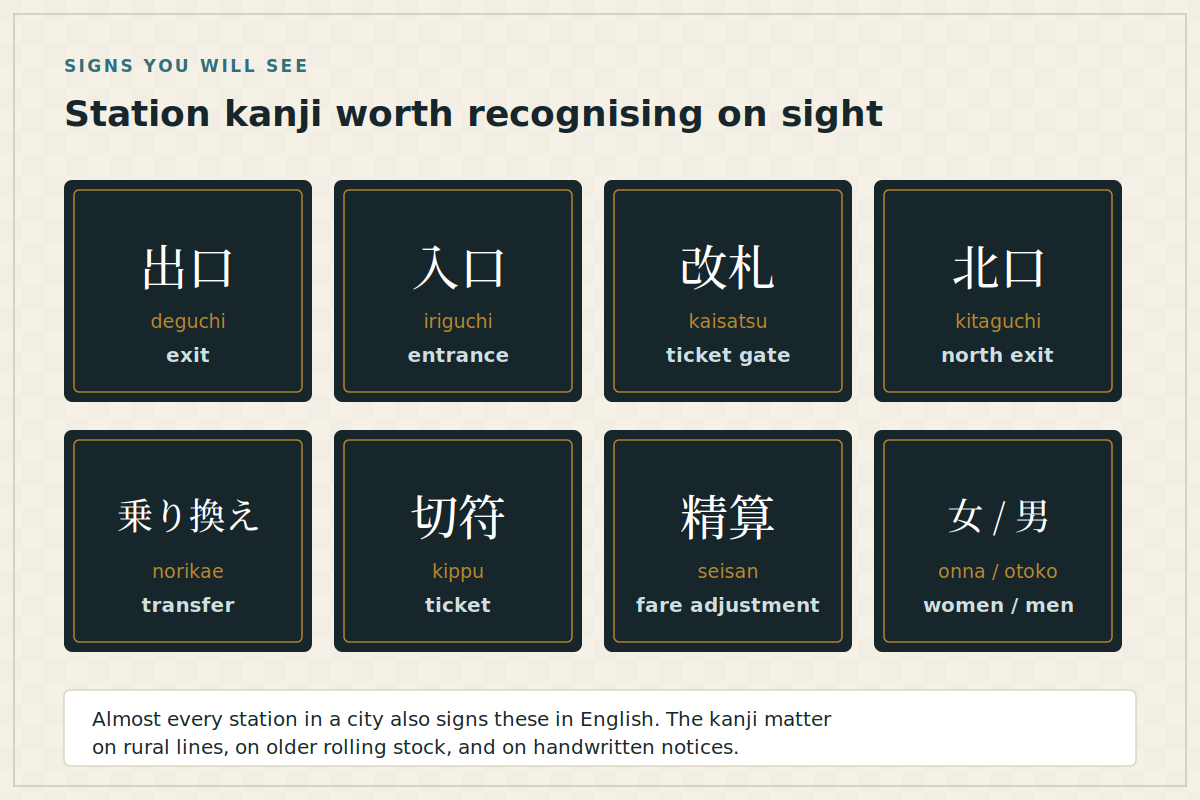
The kanji on the signs
| Kanji | Reading | Meaning |
|---|---|---|
| 出口 | deguchi | exit |
| 入口 | iriguchi | entrance |
| 改札 | kaisatsu | ticket gate |
| 乗り換え | norikae | transfer |
| 精算 | seisan | fare adjustment |
| 東口 / 西口 / 北口 / 南口 | higashi / nishi / kita / minami -guchi | east / west / north / south exit |
That last row is the one that matters in big stations. Choosing the wrong exit at Shinjuku or Osaka can put you a fifteen-minute walk from where you meant to be, on the far side of a building you cannot cut through. Check which exit your destination wants before you go through the gate, not after.
Train types, which are the real puzzle
Same line, same platform, different trains — and an express will sail past your stop. The types, slowest to fastest:
- 各駅停車 / 普通 — kakueki teisha / futsū — local, stops everywhere
- 快速 — kaisoku — rapid, skips minor stops
- 急行 — kyūkō — express
- 特急 — tokkyū — limited express, often needs a supplement
Platform boards show the type in Japanese and usually in English, colour-coded. If your stop is small, take the local. The rule of thumb: if you can’t confirm the train stops where you’re going, take the slower one.
Paying: card, not ticket
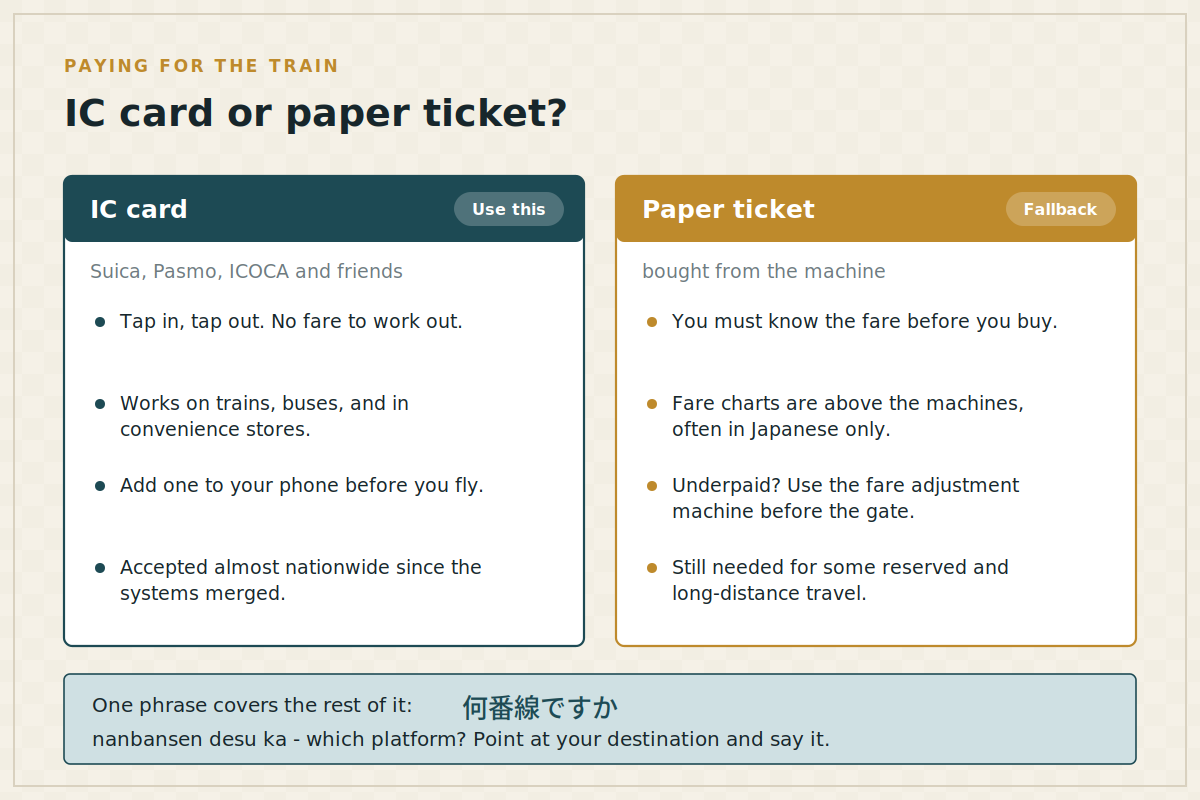
Get an IC card — Suica, Pasmo, ICOCA or one of their siblings. Tap in, tap out, and the correct fare is deducted. No fare charts, no arithmetic, no wrong-value tickets. They work on trains, subways and buses in most of the country, and in convenience stores and vending machines besides.
You can add one to an iPhone or an Android phone with a Japanese wallet before you fly, which is the smoothest option — no queue at the airport, and topping up doesn’t need a machine.
If you do end up with a paper ticket and underpaid, look for the 精算 fare-adjustment machine before the gate. Feed in the ticket, it tells you what you owe, and you exit normally. This is a routine thing that happens to Japanese commuters too — nobody minds.
Say your destination and “nanbansen desu ka.” Staff will not just answer — they will frequently walk you to the platform.The single most useful sentence in a Japanese station
Etiquette, briefly
Train manners are more visible in Japan than most places, and following them is easy:
- Phones on silent, and no calls. Signs call this “manner mode.”
- Queue on the platform markings. Doors stop exactly on them. Let people off first.
- Backpacks off in a crowd, carried at the front or by your feet.
- Eating is fine on long-distance trains — the boxed ekiben lunches are part of the experience — and out of place on a commuter line.
- Priority seats near the doors are for elderly, disabled and pregnant passengers. Sitting there is acceptable when the train is empty; give the seat up without being asked.
The Shinkansen, which has its own rules
The bullet train is a different product from a commuter line and worth understanding separately.
Seats come in two kinds. 自由席 jiyūseki, non-reserved, means you queue on the platform for the marked cars and take whatever is free. 指定席 shiteiseki, reserved, gives you a specific seat. Non-reserved is cheaper and fine outside peak periods; during the New Year, Golden Week in late April and early May, and the August Obon holiday, reserve or expect to stand for hours.
Large luggage now needs a reservation of its own. On the Tōkaidō, Sanyō and Kyūshū Shinkansen, bags whose combined dimensions exceed 160 cm require a seat booked with an oversized-baggage space, at no extra cost if you book it in advance and with a fee if you do not. Two large suitcases will hit this; a normal carry-on will not.
Which is also why a great many visitors ship their bags instead. Takkyūbin, the overnight luggage service, will move a suitcase between hotels for around two thousand yen and it usually arrives before you do. Hotel front desks arrange it in five minutes, and it turns a transfer through Tokyo Station from a wrestling match into a walk.
When something goes wrong
Two situations come up often enough to prepare for.
Left something on a train. Report it at the station office — wasuremono is the word for a lost item — and be specific about the train and carriage. Japan’s return rate for lost property is genuinely high; assume you’ll get it back rather than assuming you won’t.
Missed the last train. Services stop around midnight in most cities and the first train is usually just after five. The options are a taxi (expensive, but they exist all night), a capsule hotel, or a 24-hour café. Nothing here is an emergency, but it’s worth knowing before a late evening out — the wider set of phrases for things going sideways is in our article on trouble.
Apps that do the heavy lifting
Japanese rail is a problem that software solves well, and the right app removes most of what this article describes.
A route planner that knows Japanese rail will give you platform numbers, transfer times measured in minutes, which car to board for the fastest exit, and the fare. Several do this; the important thing is to use one built for Japan rather than a generic maps app, because the generic ones handle multi-operator transfers badly and do not know about train types.
Offline maps are worth downloading before you land, and a translation app with camera input is genuinely useful for handwritten notices and rural timetables. Almost every station and most convenience stores have free wi-fi, but a travel SIM or eSIM removes the question entirely and costs little.
What to have ready
Two more paragraphs of preparation save most of the friction. Before you arrive: an IC card on your phone, a route app that handles Japanese rail, and the exit name for wherever you’re staying. On the day: nanbansen desu ka, and a willingness to ask.
Staff at Japanese stations are unusually helpful, and asking early costs you nothing. The general phrases that carry the rest of a trip are in the essential phrases guide, and if you’re wondering why sumimasen works to flag down a station attendant as well as a waiter, that’s covered in the piece on politeness levels.