English marks politeness with words you add: please, would you mind, sorry to bother you. Japanese marks it inside the verb. The same sentence has a casual shape, a polite shape and a formal shape, and choosing between them is not optional — every sentence you speak has already chosen one.
This is the part of Japanese that most alarms visitors and turns out, in practice, to have a very short answer. But the short answer is more useful if you understand what it’s short for.
The three levels
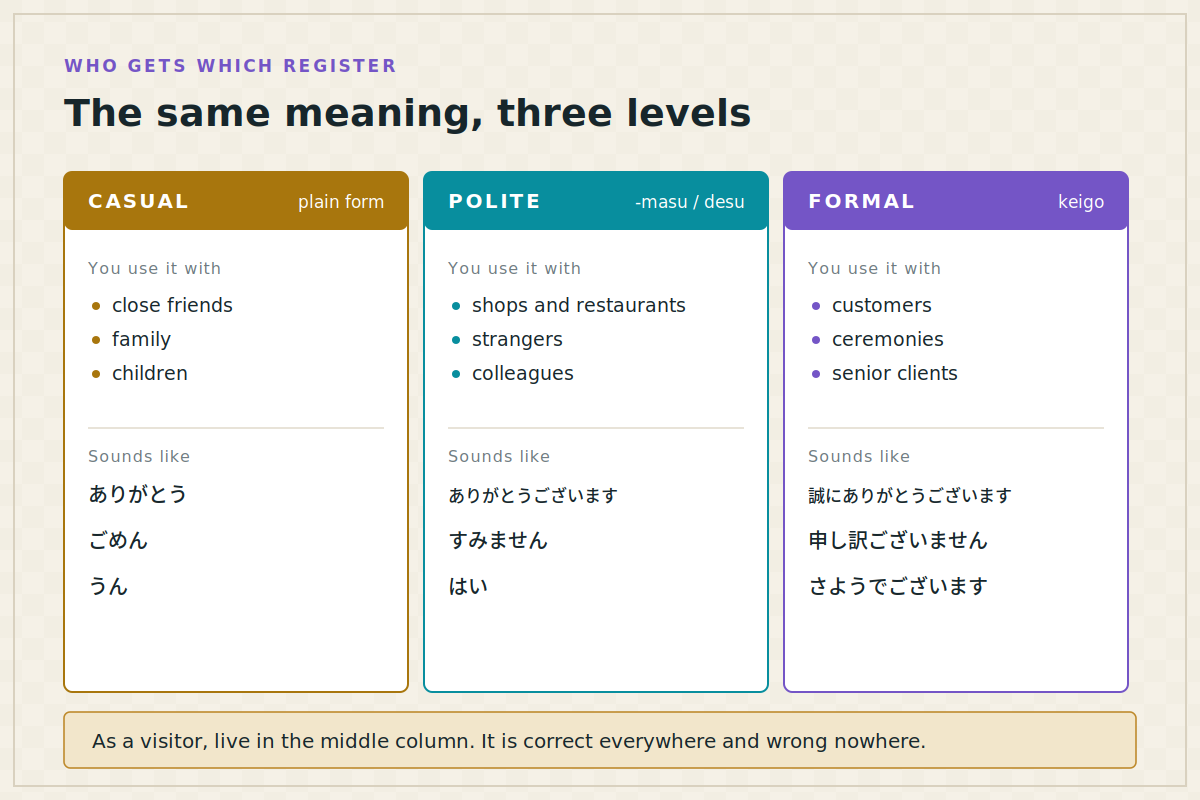
Casual — the plain form
The dictionary form of the verb, with no politeness marker attached. Arigatō rather than arigatō gozaimasu. Iku rather than ikimasu. Used with close friends, family, and by adults to children.
It’s also what you’ll hear in most anime and drama, which is a trap: dialogue is written for characters who already know each other. Learning Japanese from subtitles gives you a fluent casual register and no polite one, which is precisely backwards for a visitor.
Polite — the -masu form
The verb takes -masu, and desu attaches to nouns and adjectives. Arigatō gozaimasu. Ikimasu. This is the default for anyone you don’t know well: shop staff, hotel staff, strangers, colleagues.
This is the register to live in. It is correct with everyone you will meet as a visitor, and its worst failure mode is sounding slightly formal with someone who’d have accepted casual.
Formal — keigo
A whole system rather than a single form, and where Japanese gets genuinely complex. Keigo splits into three:
- Teineigo, polite language — the -masu/desu forms above.
- Sonkeigo, respectful language — elevates the person you’re talking about. Different verbs entirely: iku (to go) becomes irassharu.
- Kenjōgo, humble language — lowers yourself. The same verb becomes mairu.
This is what shop staff and announcers use with customers, and it’s why the Japanese you hear in a department store sounds nothing like the Japanese in a textbook. You need to recognise keigo, not produce it. Japanese office workers spend years getting it right, and nobody expects a visitor to try.
What you actually hear as a customer
Almost all the keigo aimed at you is a small set of fixed phrases. Learn them as sounds rather than grammar:
| What you hear | Reading | What it means | What to say back |
|---|---|---|---|
| いらっしゃいませ | irasshaimase | welcome, on entering a shop | Nothing. A nod is plenty |
| 少々お待ちください | shōshō omachi kudasai | one moment, please | はい, hai |
| お待たせしました | omatase shimashita | sorry to keep you waiting | Nothing needed |
| ありがとうございました | arigatō gozaimashita | thank you (past tense, on leaving) | ありがとうございます |
| かしこまりました | kashikomarimashita | certainly, understood | Nothing needed |
The one that surprises people is the first. Irasshaimase is a call, not a greeting — it’s directed at the room, and there’s no expected reply. Answering it marks you out more than ignoring it does.
Sumimasen, and why it is everywhere
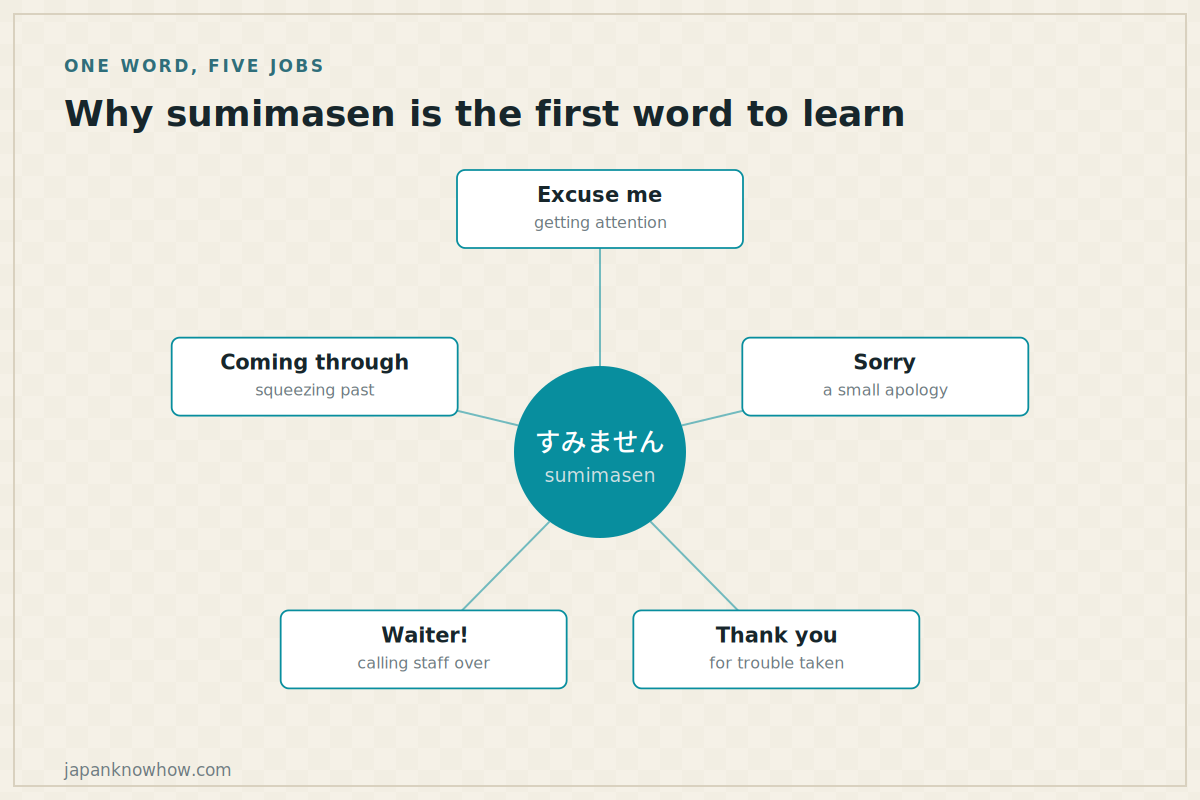
The word sits at exactly the right level — polite without being formal, apologetic without being heavy — which is why it has absorbed so many jobs:
- Excuse me, getting attention.
- Sorry, for something small. For something serious you want mōshiwake arimasen.
- Thank you, when someone went to trouble for you — the sense is closer to “sorry to have put you out.”
- Waiter, called across a restaurant. Perfectly normal and not rude.
- Coming through, squeezing past on a crowded train.
That third use is the interesting one, and it’s a small window into how Japanese politeness works: gratitude and apology are much closer together than they are in English, because both acknowledge that someone has spent effort on you.
Over-politeness is invisible. Under-politeness isn’t. When you cannot decide, go up a level.The rule that makes the whole system manageable
Three things that trip people up
Don’t use honorifics about yourself. -san attaches to other people’s names, never your own. Introducing yourself as “Smith-san” is the single most common visitor error, and it’s the equivalent of calling yourself “Mr Smith” in the third person.
Don’t drop into casual because someone was warm to you. Friendliness and register are separate axes in Japanese. A shop assistant can be delighted to see you and still be speaking keigo.
Watch what you learned from subtitles. Anime dialogue is overwhelmingly casual, and some of it is deliberately rough for characterisation. Omae and kisama both translate as “you” and both are confrontational. Stick to the person’s name plus -san, which is what Japanese speakers do anyway — the second person pronoun is used far less than English speakers expect.
The honorific suffixes
Politeness also attaches to names, through a small set of suffixes. Getting these approximately right matters more than getting the verb forms right, because names come up constantly.
| Suffix | Used for | Notes |
|---|---|---|
| -san | almost everyone | The safe default. Works for any gender, any age, colleagues and strangers alike |
| -sama | customers, deities, addresses on mail | You will be called this in shops. Do not use it about yourself |
| -kun | younger men, junior colleagues | Downward or peer-to-peer. Not for a visitor to use |
| -chan | children, close friends, pets | Affectionate. Misjudged, it is patronising |
| -sensei | teachers, doctors, lawyers | Replaces -san entirely for those professions |
Use -san with everyone and you will never be wrong. Japanese speakers also default to it with foreigners regardless of what they’d use with each other, so the register you get back is not always a guide to the register you should give.
One more habit worth copying: Japanese uses second-person pronouns far less than English does. Rather than “you,” speakers repeat the person’s name plus -san. It sounds odd translated literally and it is the normal, polite thing to do.
The practical rule
Learn the -masu and desu forms, use them with everyone, and recognise keigo when it’s aimed at you. That’s the whole strategy, and it will carry you through a trip without a single misstep.
Everything in our phrasebook is marked for register, which is unusual — most phrasebooks give you one form and don’t say which. The situational lists build on this one: ordering food is where you’ll hear the most keigo, and the trouble phrases are deliberately at the polite level, since you may be saying them to a police officer or a doctor. If you’re starting from zero, begin with the ten essential phrases — they’re all already in the middle register.