
Arigatou Literally Means This Rarely Happens
You are standing at a hotel desk, restaurant door, or train-station counter. Someone has just solved a problem for you, and a response is expected before the interaction moves on. If you have wondered why Japanese say arigatou gozaimasu when a quick English “thanks” would seem sufficient, the answer begins inside the word itself. Japanese thanks does more than acknowledge a useful act. It frames what happened as something not ordinary or automatically owed to you.
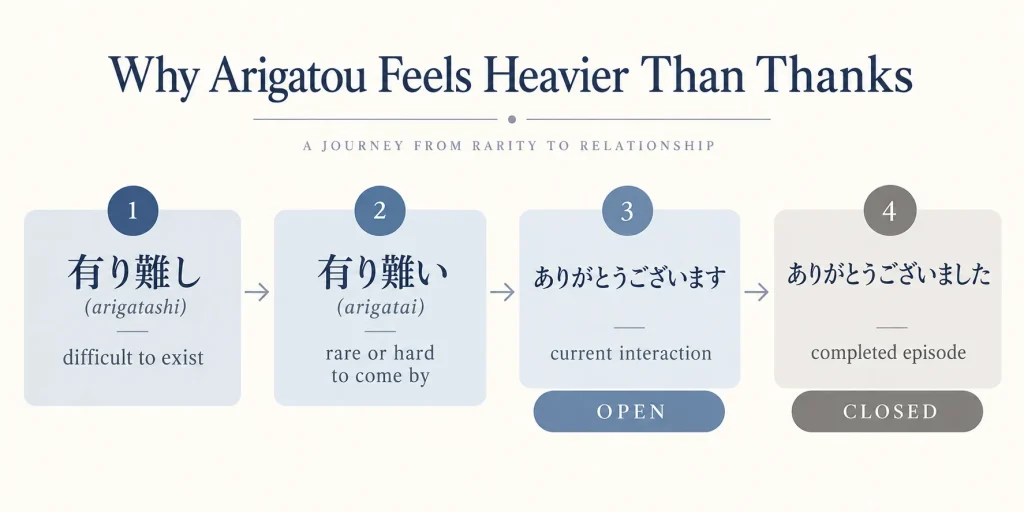
有り難い, arigatai, literally means “difficult to exist” or “hard to come by.” Its older form is 有り難し, arigatashi, carrying the sense of something rare or difficult to obtain. That history gives ありがとう, arigatou, more weight than its familiar English translation suggests. You are not literally announcing that an event was statistically improbable. You are recognizing that another person did something you should not treat as inevitable.
“Thank you” is the natural translation, but “this was not something I could simply assume” is closer to the idea underneath it.
Why Japanese Say Arigatou Gozaimasu With More Weight
The modern expression ありがとうございます, arigatou gozaimasu, literally joins “rare or difficult to come by” with a polite form of “to exist.” In everyday speech, however, Japanese speakers do not consciously reconstruct that grammar whenever they thank a cashier. The phrase functions as an ordinary expression of gratitude. Its history explains the emotional logic of the expression, not a secret sentence that speakers translate in their heads.
This is also why arigatou meaning cannot be reduced to “thanks” plus extra syllables. The longer phrase marks the relationship as well as the favor. It can acknowledge effort, maintain respectful distance, and show that you understand the other person was not obliged to help.
The useful lesson is practical: choose the level that fits the relationship and the moment. Do not perform a dramatic speech because the etymology sounds profound. Japanese politeness works through choices among ordinary forms, timing, voice, and context. Politeness Is a System, Not a List of Words explains that larger system and why memorizing the longest expression is not always the safest strategy.
| Expression | Romaji | Basic function | Natural setting |
|---|---|---|---|
| ありがとう | arigatou | Warm, direct thanks | Friends, family, familiar coworkers |
| ありがとうございます | arigatou gozaimasu | Polite thanks connected to the present interaction | Stores, hotels, workplaces, people you do not know well |
| どうもありがとうございます | doumo arigatou gozaimasu | Stronger or more emphatic gratitude | Meaningful help, formal service, a substantial favor |
| ありがとうございました | arigatou gozaimashita | Thanks for something treated as completed | Leaving, finishing a service, closing an event |
Polite Japanese is not a contest in which the longest phrase wins. The right ending matters more than maximum formality.

The Thank-You Sequence From Favor to Exit
The following sequence is not a mandatory ceremony. It is a reliable way to handle the moment when somebody assists you and you need to respond without freezing. Each step shows what to do, what the exchange looks like, and what normally follows.
- Notice that the action is complete enough to acknowledge.
Wait until the person has handed over the item, finished the explanation, or solved the immediate problem. Look toward them and say ありがとうございます, arigatou gozaimasu. The other person will usually accept it with a nod, a brief reply, or no verbal response at all. - Choose the relationship before choosing the length.
Use ありがとう, arigatou, with a friend or someone with whom casual speech is already normal. Use the polite form with staff, strangers, senior colleagues, hosts, and people helping you in an official role. The interaction can then continue without making the relationship unexpectedly intimate or stiff. - Connect the thanks to what is happening now.
When someone is currently holding a door, explaining a route, processing a request, or bringing something you need, ありがとうございます fits naturally. You are acknowledging help within an active exchange. What happens next may be another question, a payment, or the completion of the task. - Add emphasis only when the favor deserves it.
どうもありがとうございます, doumo arigatou gozaimasu, expresses more emphatic gratitude. Use it when somebody has made a real effort, corrected a complicated problem, or gone beyond routine assistance. It should sound sincere, not mechanically upgraded. - Let your delivery support the phrase.
Face the person, use a clear voice, and add a small nod or bow if it feels natural. A deep theatrical bow is unnecessary in an ordinary store or café. The other person is listening for acknowledgment, not grading your posture. - Complete the remaining business.
Pay, collect your belongings, confirm the arrangement, or listen to the final instructions. Do not treat the first thank-you as a signal that you have stopped paying attention. If you need more language for these transitions, Essential Japanese Phrases for Travelers covers the compact expressions that keep practical exchanges moving. - Use the completed form when the episode closes.
As you leave after a service, lesson, visit, guided activity, or sustained piece of help, say ありがとうございました, arigatou gozaimashita. The final ました, mashita, is grammatically past or completed. Pragmatically, it places the appreciated action into a completed frame. - Exit instead of reopening the exchange.
After ありがとうございました, collect your bag, step away, or follow the closing cue. This form often sounds like “thank you for what you did” rather than “thank you for what you are doing.” Unless another question genuinely remains, the interaction can now end.
Why Arigatou Gozaimashita Closes the Episode
The distinction between ありがとうございます and ありがとうございました is not a mechanical present-versus-past rule. Japanese tense and aspect do not map perfectly onto English tense labels. Context decides whether the speaker is treating the favor as ongoing, currently relevant, or complete.
The non-past ございます keeps gratitude attached to the present interaction. You might use it when receiving directions while the explanation continues or when an employee is still handling your request. The completed ございました looks back on the assistance as a bounded event. That is why it is common at the end of a lesson, after a meeting, when leaving a restaurant, or once a problem has been resolved.
This does not mean the gratitude itself has expired. The past form does not say, “I used to be grateful.” It marks the service, visit, or shared episode as complete. In English, “Thank you for everything today” can perform a similar closing function even though the grammar is different.
| Moment | Best default | What the grammar frames | Likely next move |
|---|---|---|---|
| Help is being given | ありがとうございます | The favor remains part of the current exchange | Continue listening or responding |
| An item has just been handed over | ありがとうございます | The immediate action is acknowledged | Pay, confirm, or move on |
| A lesson or visit is ending | ありがとうございました | The shared episode is complete | Say goodbye and leave |
| A problem has been fully resolved | ありがとうございました | The assistance is viewed retrospectively | Close the conversation |
The uncomfortable part is that you cannot always determine the form from a clock. Something that happened seconds ago may already be treated as complete, while earlier help may remain part of an ongoing relationship. You are choosing how to frame the interaction, not timestamping it.
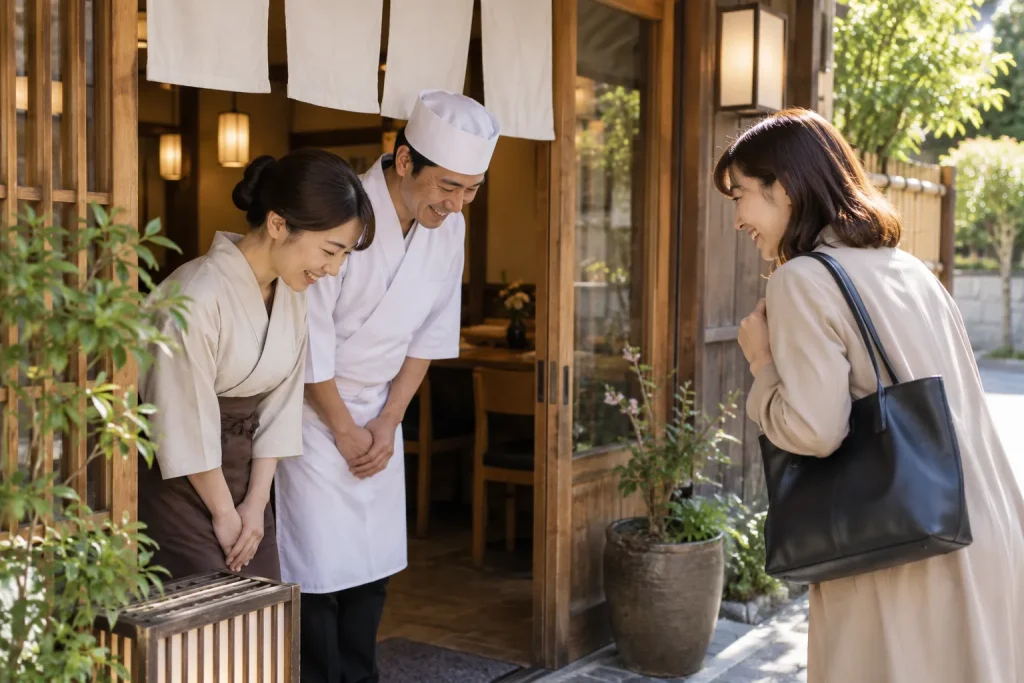
The Places Where Visitors Commonly Stall
Visitors usually do not fail because they pronounce one vowel imperfectly. They stall because they try to calculate social rank, tense, bowing depth, and vocabulary at the same time. A workable default is more useful than a theoretically perfect answer.
Common sticking points include:
- Waiting for an invitation to speak. Say the thanks when the helpful action reaches a natural pause.
- Using casual arigatou with everyone. If you are uncertain, begin with the polite ありがとうございます.
- Treating gozaimashita as merely “more polite.” It is not simply an upgraded form; it also frames the appreciated episode as complete.
- Repeating thanks until the exchange becomes awkward. One clear expression is normally enough, with a completed form at departure if the situation warrants it.
Foreign learners also tend to overestimate the importance of choosing between ありがとうございます and どうもありがとうございます. The difference is real, but it is rarely a social emergency. Using a calm polite form at the correct moment usually communicates more than adding every available intensifier.
For a closer comparison of plain, polite, and more formal registers, Japanese Politeness Levels, and Which One to Use explains how the speaker’s relationship with the listener changes the choice. That article covers register; this one focuses on the favor as something acknowledged rather than assumed.

How the Pattern Changes by Setting
At a convenience store, ありがとうございます is safe when an employee does something specifically helpful, such as locating an item or explaining a payment problem. You are not required to answer every formulaic line spoken by staff. A nod may be enough after a completely routine exchange, although a brief thank-you is never strange.
At a restaurant, use the polite form when someone accommodates a request or brings something you asked for. When leaving after the meal, ごちそうさまでした, gochisousama deshita, literally acknowledges the feast or hospitality and functions as “thank you for the meal.” It does a job that generic gratitude does not fully replace. Ordering Food in Japanese, Start to Finish covers the restaurant sequence, so there is no need to turn every dining interaction into a list here.
At work, the correct expression depends heavily on roles and established office habits. A colleague may receive ありがとう in a casual team, while a client, supervisor, or unfamiliar coworker generally calls for a polite form. Formal email language can go beyond the expressions discussed here, so copying conversational arigatou into every business message is not automatically appropriate.
At a home visit, thank your host during the visit for specific kindnesses, then use the completed form as you leave. If you see the host again later, you can refer back to what they did and thank them once more. The event has ended, but its importance to the relationship has not.
Season does not change the grammar of arigatou. What changes is the setting: year-end gatherings, school ceremonies, departures, and completed seasonal events naturally create more opportunities for ありがとうございました. The completed form follows the closing frame, not the weather or calendar by itself.
What Nobody Actually Minds
Nobody expects a visitor to reproduce every local speech habit perfectly. A small accent does not erase an intelligible thank-you. Most people will not analyze whether your bow was a few degrees too shallow, and they will not be offended because you used the polite non-past form where a completed form might have sounded slightly more natural.
People also do not require you to recite the etymology. Knowing that 有り難い, arigatai, developed from the idea of being difficult to exist or obtain helps you understand the cultural logic. Saying ありがとうございます remains an ordinary act, not a declaration that you have witnessed a miracle.
The etymology explains the weight of the phrase; it does not make every cup of tea a rare historical event.
You should care about audible speech, a respectful tone, and whether the interaction is still open or already closing. You do not need to obsess over perfect pitch accent during a busy transaction. If the person understands your gratitude and the exchange moves forward naturally, the phrase has worked.
The site’s Japanese phrasebook is useful when you need the expression inside a specific situation rather than as isolated vocabulary. It contains 337 phrases across 25 situations, with separate pages showing kana, romaji, literal readings, and usage notes. Those totals were checked on the phrasebook page on September 9, 2026.
The Meaning Worth Remembering
The strongest part of the etymology is not a poetic claim that Japanese people experience gratitude more deeply than English speakers. Languages package social actions differently, and cultures contain people with every possible temperament. The defensible point is narrower: the lexical history of Japanese thank you connects gratitude with something difficult to come by.
That history supports the feeling that help should be recognized rather than treated as an entitlement. Polite grammar adds distance and respect. The past form then places the helpful episode behind both speakers, allowing them to close it cleanly.
Understanding this also prevents a common mistake in translation. “This rarely happens” is an explanatory gloss, not a line you should substitute every time arigatou appears. Depending on context, natural English may still be “thanks,” “thank you very much,” or “thank you for your help.”
The Five-Move Version
Use this short checklist when you need the sequence quickly:
- Notice the favor.
- Choose casual or polite.
- Thank during the action.
- Use past when finished.
- Acknowledge, then move on.
FAQ About Arigatou and Japanese Thank-Yous
Does arigatou literally mean “this rarely happens”?
Not as a complete modern sentence. The expression is historically connected to 有り難い, arigatai, “difficult to exist” or “hard to come by,” and the older 有り難し, arigatashi. “This rarely happens” is a useful explanation of that history, but “thank you” remains the correct everyday translation.
Is arigatou gozaimasu too formal for a tourist?
No. Arigatou gozaimasu usage is broad enough for hotels, stores, stations, restaurants, and conversations with unfamiliar adults. It may sound distant among close friends, where ありがとう is more natural, but it is a dependable default when you are uncertain.
Is arigatou gozaimashita more polite?
It is polite, but its main difference is not simply a higher degree of respect. The completed form frames the relevant act or interaction as finished. That is why it works well at departures and after a service has ended.
Can I say arigatou to store staff?
Yes, especially when an employee helps you directly. You are not socially required to answer every standard service phrase. A short polite thank-you or a nod is enough in routine situations.
What is the safest expression if I am unsure?
Use Japanese polite thank you, ありがとうございます, arigatou gozaimasu. Say it clearly and naturally. If you are leaving after a completed service or visit, switch to ありがとうございました, arigatou gozaimashita.