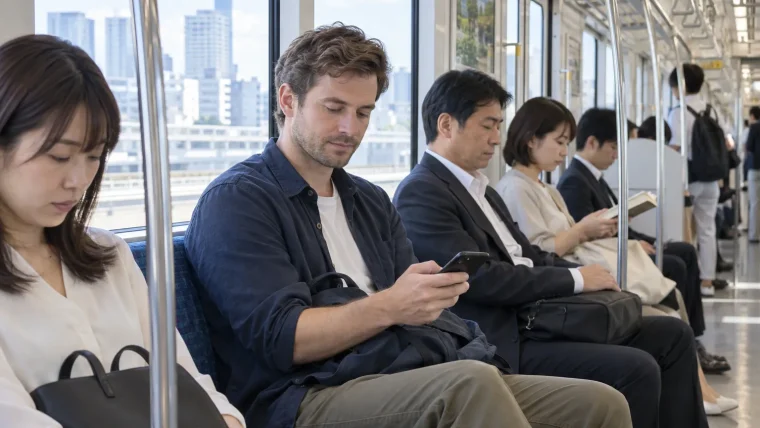
The most repeated claim about japanese hand gestures is that they form a silent language every visitor must memorize. That is only partly true. People in Japan do use recognizable movements that can replace short sentences, especially in crowded stores, restaurants, stations, and workplaces. Yet these signs are not a secret national code, and their meaning changes with context, age, and the relationship between the people involved.
The useful lesson is simpler: a crossed X can stop you, a vertical hand can ask you to make room, and a finger touching the nose can mean “Me?” Learn those signals and you will understand more of what happens around you. You still need words, facial expressions, and context to know exactly what the other person intends.
“Crossing your arms always means something is forbidden”
Mostly true — the crossed-arms gesture in Japan commonly communicates “no,” “not possible,” or “not allowed.”
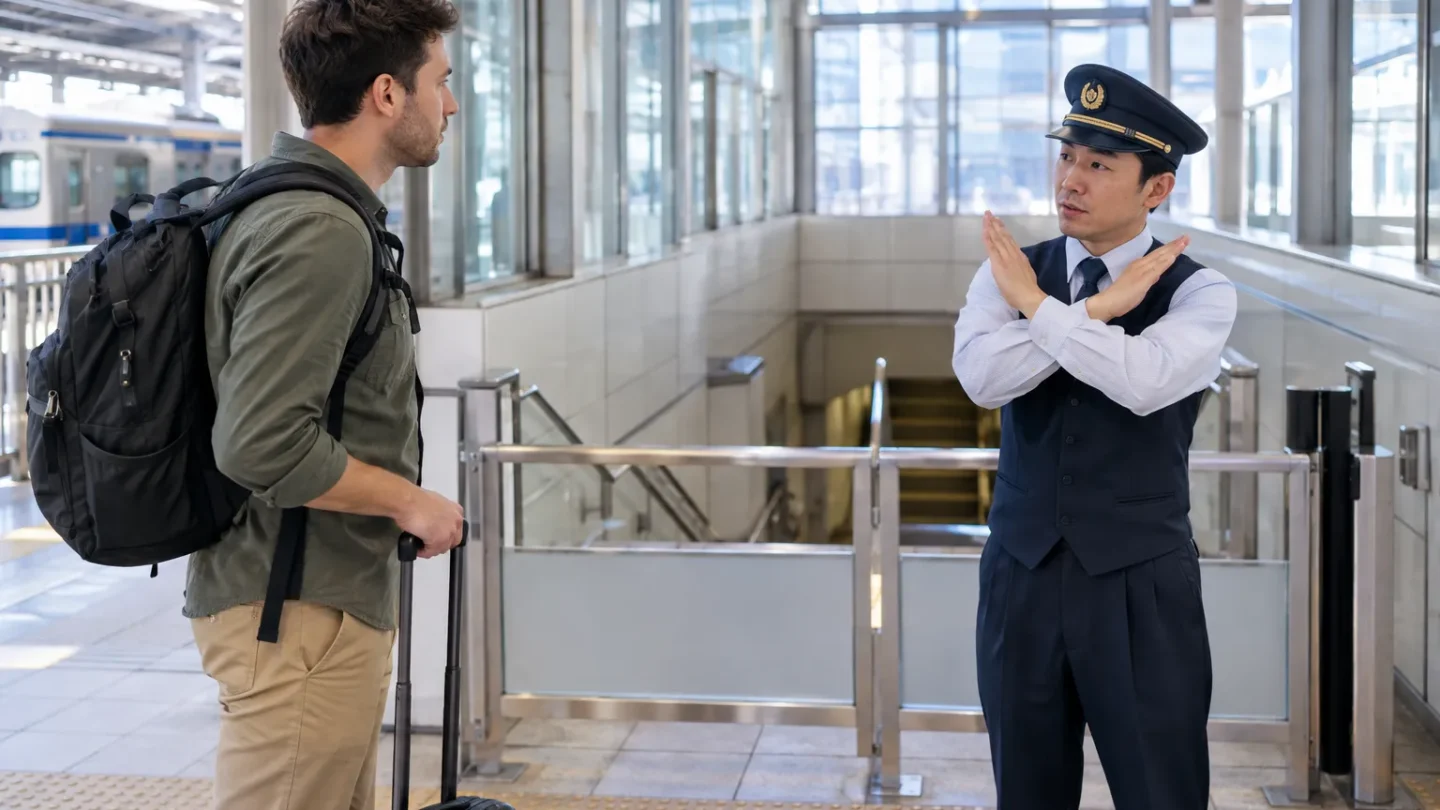
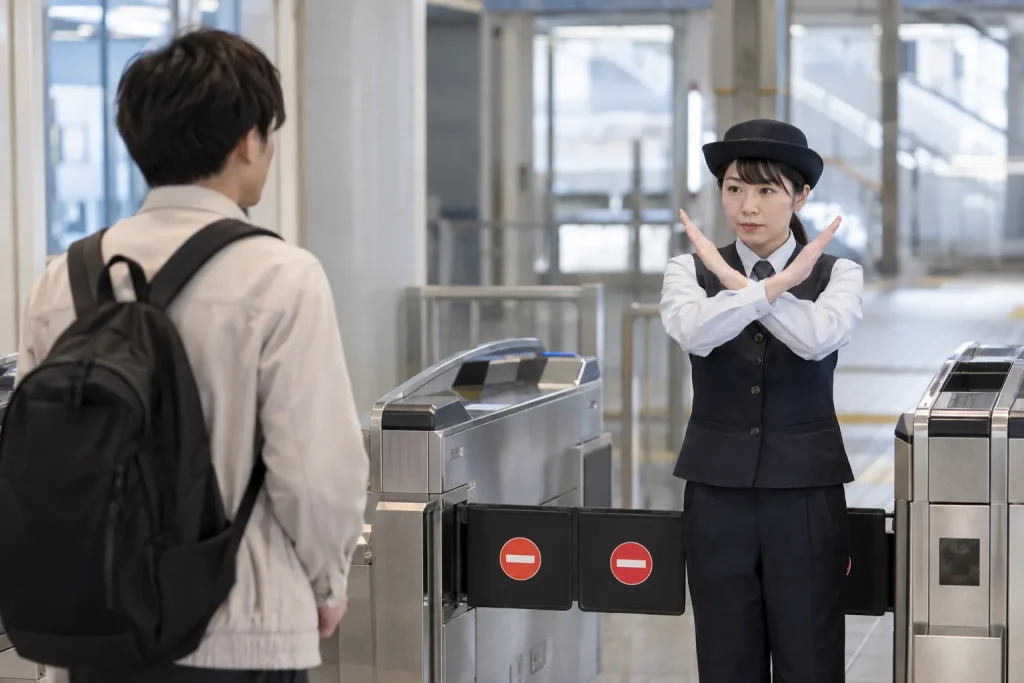
Crossing both forearms into a large X is one of the clearest signals a traveler will encounter. A staff member may use it when an entrance is closed, photography is prohibited, a ticket is invalid, or a request cannot be accommodated. The gesture visually resembles the Japanese X mark, バツ batsu, meaning a cross, mistake, or incorrect answer.
What is not true is that the gesture always refers to a formal prohibition. A smaller X made with the index fingers may simply mean “No,” “That will not work,” or “We do not have it.” Friends can also use it playfully. The larger and firmer the movement, the more final the refusal usually appears.
“To show disagreement or say ‘no,’ people often wave their hand side to side in front of their face.”
That description from JCB’s Japan Tips also points to a softer alternative. A small hand wave near the face often rejects a compliment, corrects a misunderstanding, or says that something is unavailable. It is less visually forceful than the full-arm X.
Understanding the movement is easier when you also understand the language surrounding it. Politeness Is a System, Not a List of Words explains why tone, hesitation, and indirect phrasing can carry as much weight as the literal words.
“A hand held like a blade means ‘let me through’”
Mostly true — the chopping-hand signal is a practical request for space, not an aggressive gesture.
In a crowd, someone may hold one hand upright in front of the body, with the fingers together, and move through a narrow gap. The hand appears to “cut” a line through the space. It means something close to “Excuse me,” “I am passing through,” or “Please let me by.”
The movement is commonly accompanied by a slight bow, lowered shoulders, or a quiet すみません sumimasen, literally “it does not end,” but used here as “Excuse me.” It is not normally aimed at another person like a karate chop. The hand marks the speaker’s intended path while making the body smaller and less intrusive.
The gesture is particularly useful on trains, in elevators, and between closely placed restaurant seats. It does not grant automatic priority, however. You should move carefully and watch whether the people ahead have noticed you. For the word that often accompanies this movement, The Word You Will Use Fifty Times a Day covers apology, gratitude, and attention-getting without repeating the gesture itself.
| Gesture | Usual message | Common setting | Important limit |
|---|---|---|---|
| Forearms crossed into an X | No, prohibited, impossible | Entrance, counter, attraction | May signal practical refusal rather than a written rule |
| Upright “chopping” hand | Excuse me, let me pass | Train, elevator, crowd | It requests space; it does not demand it |
| Hand waved near the face | No, not me, not available | Conversation, shop, restaurant | Meaning depends heavily on the question |
| Open palm pushed forward | Stop, wait, stay there | Queue, platform, workplace | Follow staff instructions rather than copying it |
“Japanese people point to their nose to mean ‘me’”
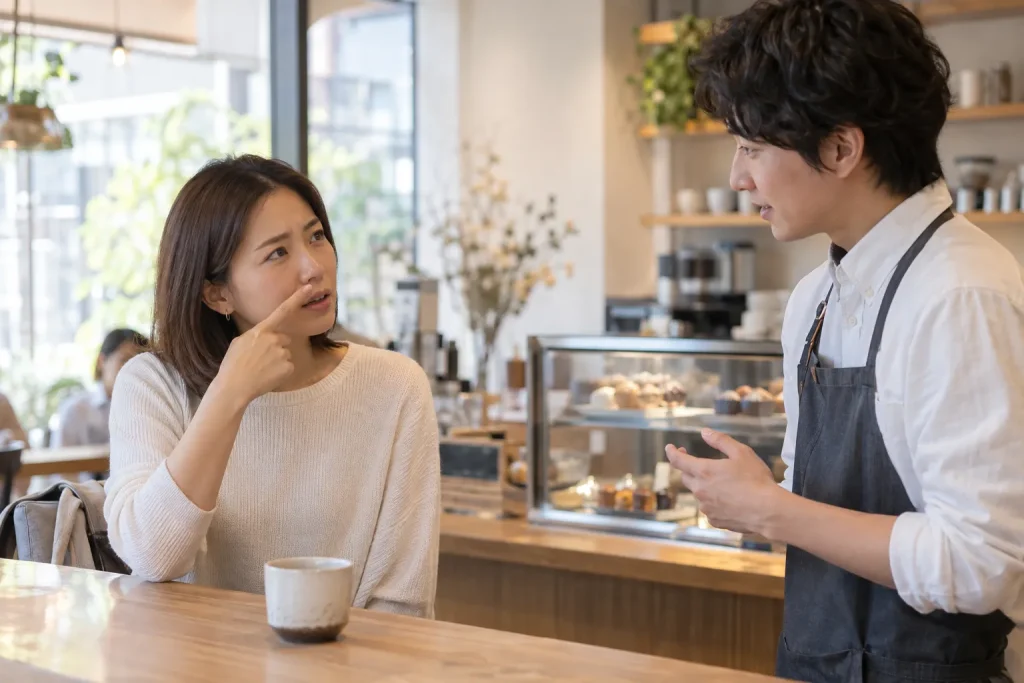
True in recognizable use — pointing toward the nose or center of the face can mean “Me?” or “Are you referring to me?”
An American is more likely to indicate the chest when identifying themselves. In Japan, the index finger may instead touch or point toward the nose. You will often see it after a name is called unexpectedly or when someone is surprised to learn that they have been chosen.
The gesture is not mandatory, and many people also point toward their chest. Its real value is receptive: you should recognize it when someone else uses it. Copying it theatrically in every introduction can look like an imitation of a cultural stereotype.
This signal probably survives because the face can function as an immediately visible marker of the person. Claims about one precise historical origin are much harder to support. Practical language guides document the meaning, but they do not establish when or why the convention began.
“A circle made with the fingers just means ‘OK’”
Uncertain — the finger circle can mean “OK,” money, or nothing specific, depending on the speaker and situation.
The thumb-and-index-finger circle is familiar to Americans as “OK.” In Japan, the same shape has also represented money because it resembles a coin. Someone discussing a budget, payment, or price may form the circle with the palm facing upward or sideways.
The uncomfortable part is that travel guides often present “circle equals money” as a permanent rule. That is too neat. Global media, workplace habits, emoji, and age differences have made the American “OK” reading familiar as well. A younger person may understand it immediately as approval, while another speaker may read it through the subject already being discussed.
Do not rely on this sign when settling a bill or confirming an important arrangement. Say お会計お願いします okaikei onegaishimasu, literally “The bill, please,” or use the appropriate phrase from the phrasebook, which organizes 337 expressions across 25 situations. Here the gesture is a clue, not a dependable substitute for speech.
| Hand shape | Possible Japanese reading | Possible American reading | Safest response |
|---|---|---|---|
| Thumb and index finger forming a circle | Money, coin, OK | OK | Check the conversational topic |
| Thumb pointing toward the chest | A man or male partner in older shorthand | Me | Do not assume without words |
| Raised little finger | A woman or female partner in older shorthand | Promise or no fixed meaning | Treat as dated and context-dependent |
| Palm-up curling finger | Calling a person or animal; potentially abrupt | Come here | Avoid using it with strangers |
| Palm-down finger wave | Come here | May look like “go away” | Watch the direction of the person’s gaze |
“A thumb means a man and a little finger means a woman”
Partly true but dated — these signs exist, although they are poor choices for a visitor to copy.
Some Japanese gesture guides identify an upright thumb as shorthand for a man, boyfriend, or husband and a raised little finger as a woman, girlfriend, or mistress. You may encounter the gestures in older television, casual joking, or conversations among people who already share the context.
These meanings are not neutral labels you should use for everyone. They can sound old-fashioned, reductive, or suggestive, particularly when they refer to someone’s private relationship. A raised little finger may imply a romantic partner rather than simply “a woman,” while a thumb can be misread as the international sign of approval.
Their origins are not documented consistently in the accessible sources. That makes this the article’s genuinely uncertain claim: the usage is recorded, but simple stories about where it began should not be repeated as fact.

“The Japanese beckoning motion means ‘go away’”
Mostly false — a palm-down flutter usually means “come here,” although Americans can easily read its direction backward.
To beckon in Japan, a person commonly holds the palm downward and moves the fingers toward themselves. From an American viewpoint, the motion can resemble shooing someone away. The face, gaze, and surrounding situation normally resolve the ambiguity: a restaurant employee directing you toward a table is inviting you forward, not dismissing you.
The American palm-up beckon with one curling index finger is understood by many Japanese people, but it can appear too commanding or be associated with calling an animal. That does not mean every use will cause offense. It means you should not summon a server, older person, or workplace superior with a sharp finger curl.
Use an open hand, eye contact, and a small verbal request instead. Travelers who need the spoken version can use Essential Japanese Phrases for Travelers, which covers functional expressions rather than turning body language into a vocabulary list.
“A nod in Japan always means yes”
False — nodding can mean “I hear you” without meaning “I agree.”
A Japanese listener may nod several times while you speak. This backchannel behavior helps show attention and encourages the conversation to continue. It does not automatically confirm a booking, accept a proposal, or promise that a request will be fulfilled.
Americans can misread attentive nodding because they often associate a deliberate nod with agreement. In Japan, you need to listen for the verbal response and notice whether it is direct, qualified, or hesitant. A phrase such as そうですね sō desu ne, literally “That is so, isn’t it,” may acknowledge what was said while giving the speaker time to think.
This is where gestures and politeness overlap most clearly. Japanese Politeness Levels, and Which One to Use explains the language choices behind formal and informal interaction. The movement alone cannot tell you whether the answer is yes.
“American hand signals work normally in Japan”
Mostly false — familiar signs are often recognized, but the social effect can change.
The middle finger remains offensive and should not be used. Pointing directly at another person can also feel accusatory or abrupt, even when an American speaker intends only to identify someone. Indicate a person with an open hand when possible.
A vigorous thumbs-up will usually be understood as approval, especially in international or online settings. It can still feel unusually emphatic in a quiet exchange. The crossed-fingers sign for luck is recognizable to some people but is not a dependable local substitute for saying 頑張って ganbatte, meaning “Do your best” or “Keep going.”
The biggest mistakes come from assuming recognition equals appropriateness. People may know exactly what your gesture means through movies and social media while still finding it too forceful for the setting. The same principle applies to gratitude: Arigatou Literally Means This Rarely Happens explains why the weight of a thank-you depends on the situation and relationship.
Before using a gesture, make three quick checks:
- Look at the other person’s face and the subject being discussed.
- Decide whether the movement is informing, requesting, or commanding.
- Add a short spoken phrase when the result affects access, payment, directions, or consent.
Signals worth recognizing first
The most useful gestures are the ones you are likely to receive rather than perform:
- crossed forearms for “no” or “not allowed”;
- a vertical hand for “excuse me, I am passing”;
- a finger toward the nose for “me?”;
- a small wave near the face for denial or refusal;
- a palm-down beckon for “come here”;
- an open palm for “wait” or “stop”;
- a finger circle that may refer to money;
- nodding that confirms attention, not necessarily agreement.
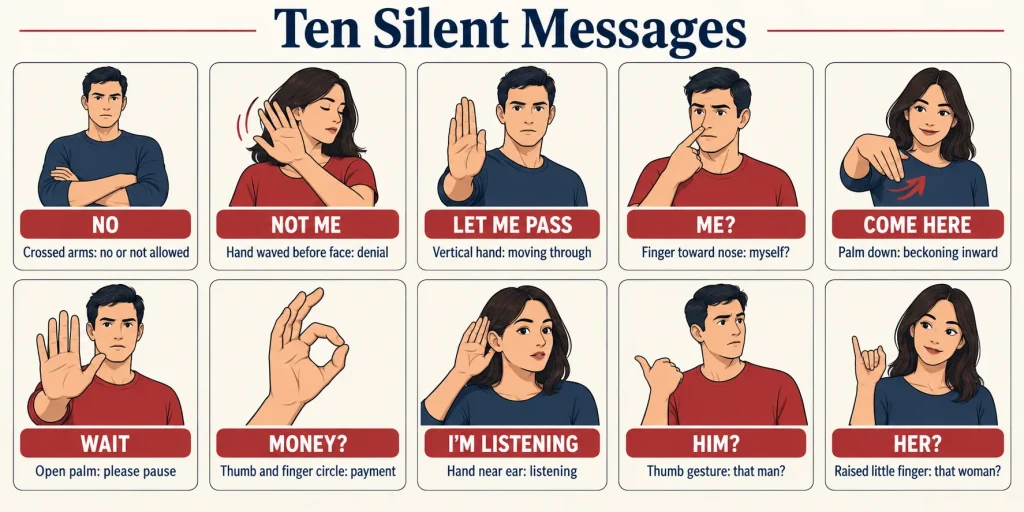
| Label shown | Visual cue | Short meaning |
|---|---|---|
| NO | Forearms crossed | Not allowed or not possible |
| NOT ME | Hand waved near face | Denial or polite refusal |
| LET ME PASS | Upright hand moving forward | Excuse me |
| ME? | Finger at nose | Are you referring to me? |
| COME HERE | Palm down, fingers moving inward | Approach |
| WAIT | Open palm facing forward | Stop or pause |
| MONEY? | Thumb-index circle | Price or payment in context |
| I’M LISTENING | Repeated small nods | Attention, not guaranteed agreement |
| HIM? | Raised thumb | Older shorthand for a man or male partner |
| HER? | Raised little finger | Older shorthand for a woman or female partner |
Short FAQ
Is it rude to point in Japan?
Pointing at an object is normally understood, but pointing directly at a person can feel blunt. Use an open hand when identifying someone or indicating where they should go. You do not need to panic if you point accidentally; simply soften the movement and continue.
Should visitors copy Japanese gestures?
Copy practical gestures only when their meaning is clear. A small bow, an open-hand indication, or the chopping-hand signal can help, but exaggerated imitation looks unnatural. Recognizing a gesture is more important than performing it.
Does bowing replace saying thank you?
A small bow can accompany thanks, an apology, a greeting, or acknowledgment. Its meaning comes from the situation rather than the movement alone. Use the words you know and let the bow support them.
Japanese gestures do sometimes replace whole sentences, but they do not operate independently of voice, expression, and setting. Believe the clear signals—X for no, a vertical hand for passing, a finger at the nose for “me?”—and remain cautious with gestures that have several possible readings. When the outcome matters, confirm it in words.