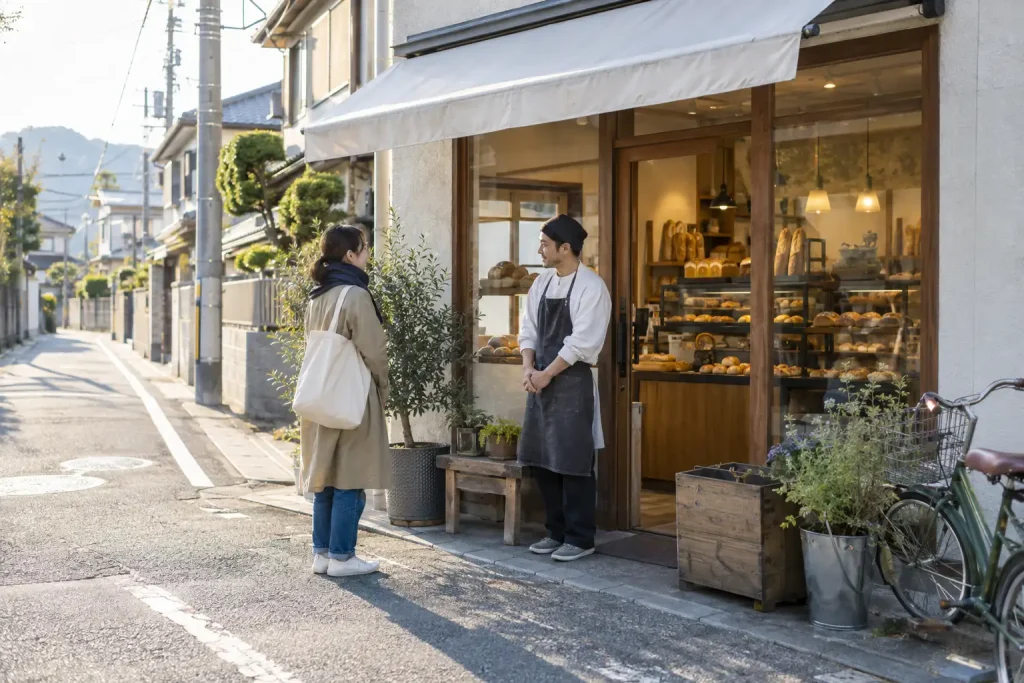
You walk into a Japanese bakery in the morning and hear ohayō gozaimasu. You meet someone outdoors during the day and hear konnichiwa. Later, the greeting changes to konbanwa—unless you are entering the staff area of a restaurant, where someone may say ohayō gozaimasu long after dark.
That is the whole system as you first meet it. To understand Japanese greetings by time of day, you have to take it apart into four pieces: the clock, the relationship, the place, and the reason the speakers have met.
Konnichiwa is not Japan’s all-purpose equivalent of “hello.” It is the daylight member of a larger set.
The morning piece: おはようございます, ohayō gozaimasu
おはようございます, ohayō gozaimasu, literally carries the sense of “it is early.” It is the standard polite greeting used when meeting someone in the morning.
The shorter おはよう, ohayō, is casual. You use it with family members, friends, children, and people with whom you already have a relaxed relationship. With a hotel employee, colleague, teacher, host, or someone you do not know well, the longer form is safer.
There is no official minute at which the phrase becomes wrong. The National Institute for Japanese Language and Linguistics explains that greetings are shaped by the relationship between speakers as well as the time. Individual workplaces and broadcasters may develop their own working boundaries, but those are house practices rather than rules governing the whole language.
| Situation | Natural choice | Why |
|---|---|---|
| Meeting a friend after waking | おはよう, ohayō | Casual morning greeting |
| Entering a hotel breakfast room | おはようございます, ohayō gozaimasu | Polite morning greeting |
| Greeting a teacher in the morning | おはようございます, ohayō gozaimasu | Relationship requires the longer form |
| Entering work for an evening shift | Often おはようございます, ohayō gozaimasu | Marks the start of work, not the sunrise |
| Walking into a store as a customer | Usually no greeting required | Staff initiate the service exchange |
If you are learning only the travel essentials, Essential Japanese Phrases for Travelers explains which expressions carry the largest share of ordinary transactions. Greetings matter, but sumimasen and arigatō gozaimasu will do more practical work during a trip.
The daylight piece: こんにちは, konnichiwa
こんにちは, konnichiwa, literally begins with “as for today.” The modern greeting developed from a longer expression in which the rest of the sentence was understood and eventually dropped.
The final は is the topic particle, so it is written ha but pronounced wa. This is why こんにちわ is common in playful digital writing but is not the standard spelling you should learn.
Konnichiwa meaning is closer to “good day” than to a completely unrestricted “hello.” It suits daytime encounters, particularly with someone outside your close household or immediate work group.
“Konnichiwa is difficult to use with people on the inside of a close relationship.”
That point, made by the National Institute for Japanese Language and Linguistics, explains why the word can feel unexpectedly distant between coworkers or family members. A Japanese employee arriving in the afternoon does not necessarily greet close colleagues with konnichiwa, even though the sun is up.
This is the first part of the system that is not what it looks like. The textbook presents konnichiwa as a translation of “hello,” but the phrase tells you two things at once: it is daytime, and the encounter is socially outside rather than intimate.
The evening piece: こんばんは, konbanwa
こんばんは, konbanwa, literally begins “as for this evening.” Like konnichiwa, it comes from an unfinished longer expression and retains the topic particle は, pronounced wa.
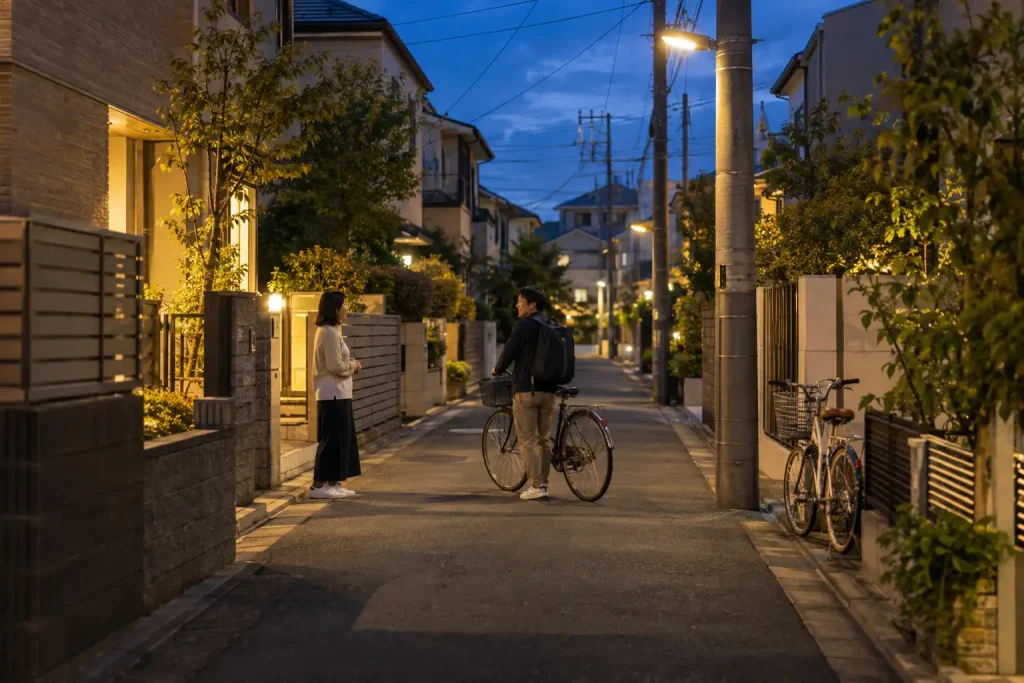
You use it when meeting someone in the evening or after the surroundings have become dark. That means its starting point moves with the season, weather, and local sense of daylight.
There is no universal national cutoff. A bright summer evening can keep konnichiwa natural later than a dark winter afternoon. Around the uncertain boundary, either greeting may sound acceptable depending on the light and the speaker.
This difference matters for Americans accustomed to schedules that label evening by the clock. Japanese greetings are partly clock-based, but when to say konbanwa is also decided by what the day looks like outside.
| What you notice first | Greeting most likely to fit | What can change it |
|---|---|---|
| Morning activity | おはようございます, ohayō gozaimasu | A close relationship allows the shorter form |
| Full daylight | こんにちは, konnichiwa | It can sound distant inside a close group |
| Dusk or darkness | こんばんは, konbanwa | Seasonal sunset changes the transition |
| Beginning a work shift | おはようございます, ohayō gozaimasu | Workplace culture can override the clock |
| Entering a restaurant as a guest | No set reply needed | Staff use service language instead |
Do not replace konbanwa with おやすみなさい, oyasuminasai, literally “please rest.” That is a leave-taking phrase used when someone is going to bed or when the speakers are parting for the night, not an evening greeting on arrival.
The hidden piece: why ohayō can be correct at night
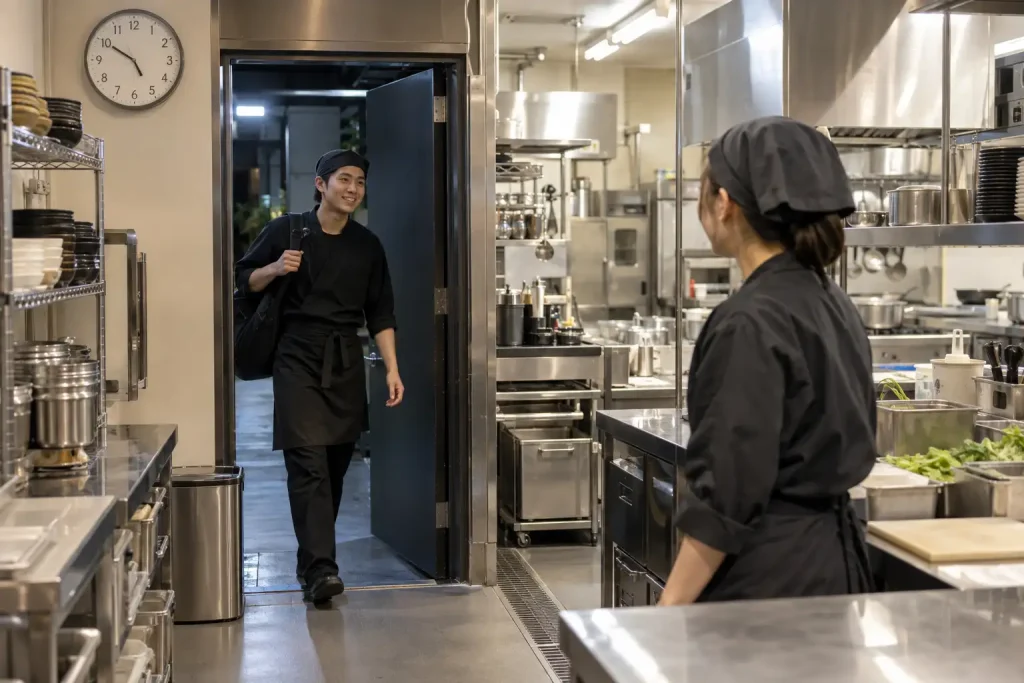
At a restaurant, hotel, television studio, theater, or another workplace with staggered shifts, an employee may enter at night and say おはようございます, ohayō gozaimasu. Nobody thinks the employee has confused evening with morning.
In this setting, the expression marks the first meeting at the start of that person’s work period. The National Institute for Japanese Language and Linguistics explains that ohayō expanded into afternoon use partly because Japanese lacks an equally convenient greeting for close colleagues meeting for the first time that day.
Konnichiwa belongs comfortably to a daytime encounter, but it does not always carry the sense of shared membership that coworkers need.
This usage is documented across industries with irregular starting times. However, “restaurant staff always say ohayō at night” would be too strong. Workplace habits differ, and some businesses prefer another greeting or allow staff to greet each other less formally.
The practical exchange may sound like this:
A: おはようございます。
Ohayō gozaimasu.
Literal: “It is early.”
In practice: “I am here and beginning my shift.”
B: おはようございます。
Ohayō gozaimasu.
Literal: “It is early.”
In practice: “I acknowledge that you have arrived for work.”
The greeting is not really reporting the hour. It is opening the working relationship for that shift.
The politeness piece: why gozaimasu changes the audience
ございます, gozaimasu, is the polite element that turns ohayō into a greeting suitable for people outside your intimate circle. Removing it does more than save syllables: it changes the relationship implied by the phrase.
A visitor is safer using ohayō gozaimasu than ohayō with an adult they have just met. Japanese listeners will normally forgive excessive politeness, while unexpected casualness can sound too familiar.
Ohayou gozaimasu usage therefore depends on rank and distance as well as time. A manager may say ohayō to a junior employee who replies with ohayō gozaimasu. Both speakers are greeting each other correctly from their respective positions.
This article does not need to rebuild the grammar behind that difference. Japanese Politeness Levels, and Which One to Use explains the casual, polite, and formal registers—and why a visitor can remain safely in the middle one.
Pronunciation also carries social information. A clear but calm greeting usually lands better than a loud, exaggerated one. The Register Americans Do Not Notice covers how volume, pace, and delivery change an otherwise correct sentence.
The service piece: why staff do not greet you the same way
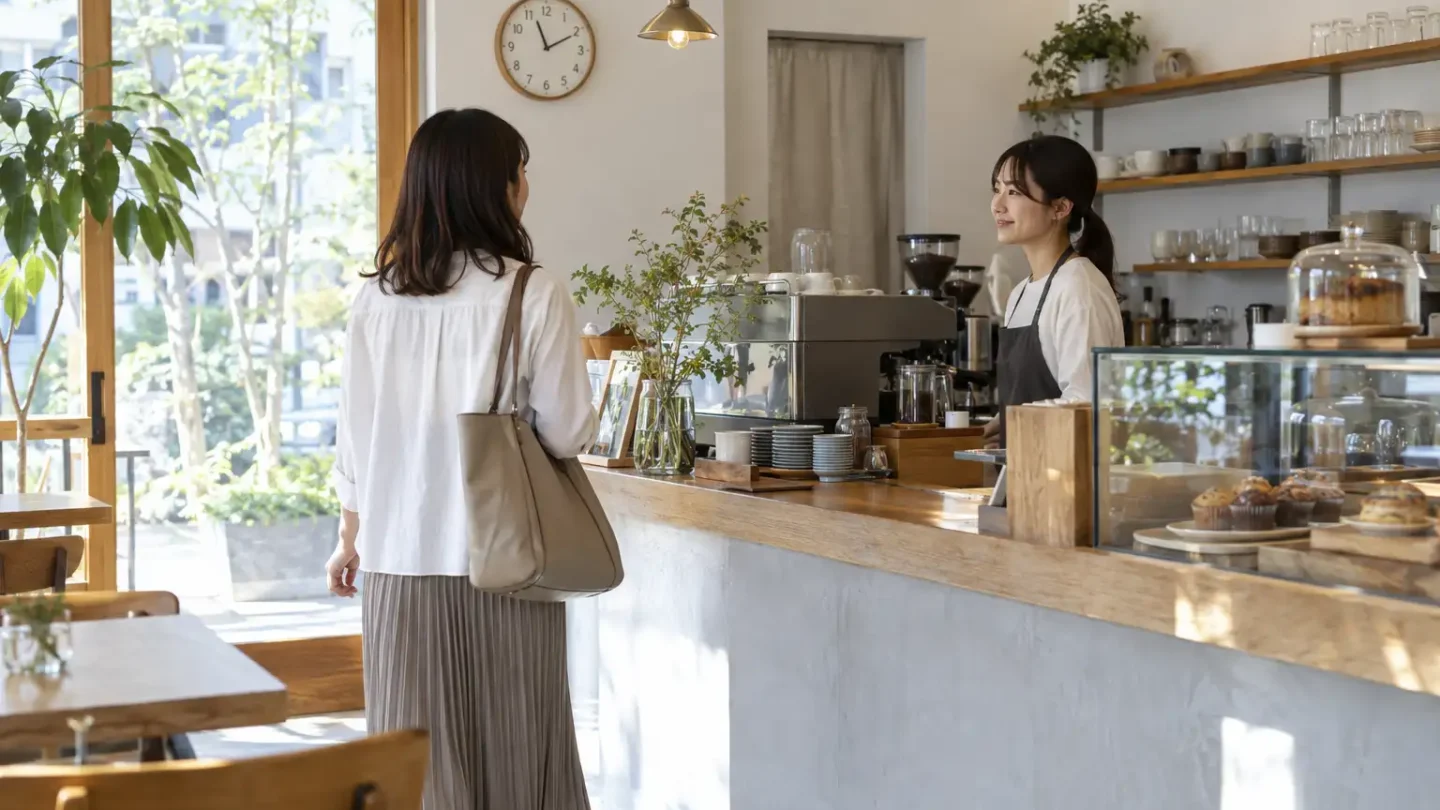
When you enter a Japanese restaurant, staff usually call いらっしゃいませ, irasshaimase, literally “please come” or, in practice, “welcome.” This is a service call, not an invitation to begin a conversation.
You are not expected to answer with konnichiwa, repeat irasshaimase, or explain how many Japanese words you know. A nod is enough until someone asks about your party or seating.
This is where memorized basic Japanese greetings can create unnecessary work. American customers are accustomed to exchanging “Hi, how are you?” with staff, while the Japanese restaurant opening is less symmetrical. The employee acknowledges your arrival, but the customer does not need to return the same phrase.
Once the seating exchange begins, the useful vocabulary changes. Ordering Food in Japanese, Start to Finish follows the restaurant sequence from the door to the register, including what to say when ordering and leaving.
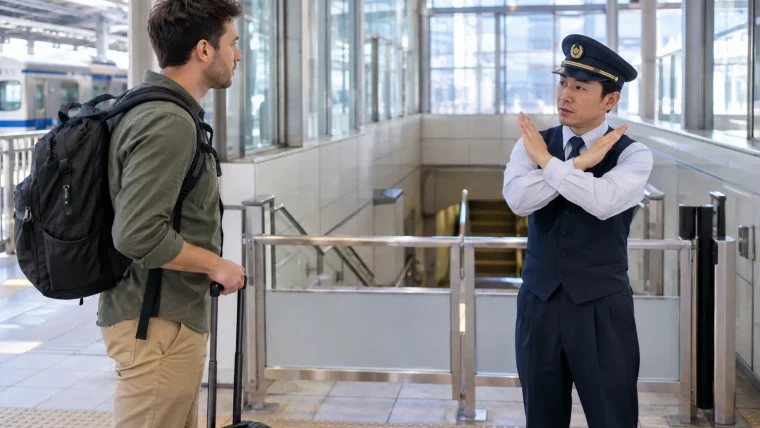
Gesture can also replace an unnecessary sentence. The Hand Signals You Will See Before You Hear explains the physical cues that accompany service exchanges and other everyday situations.
Reading the whole greeting instead of one word
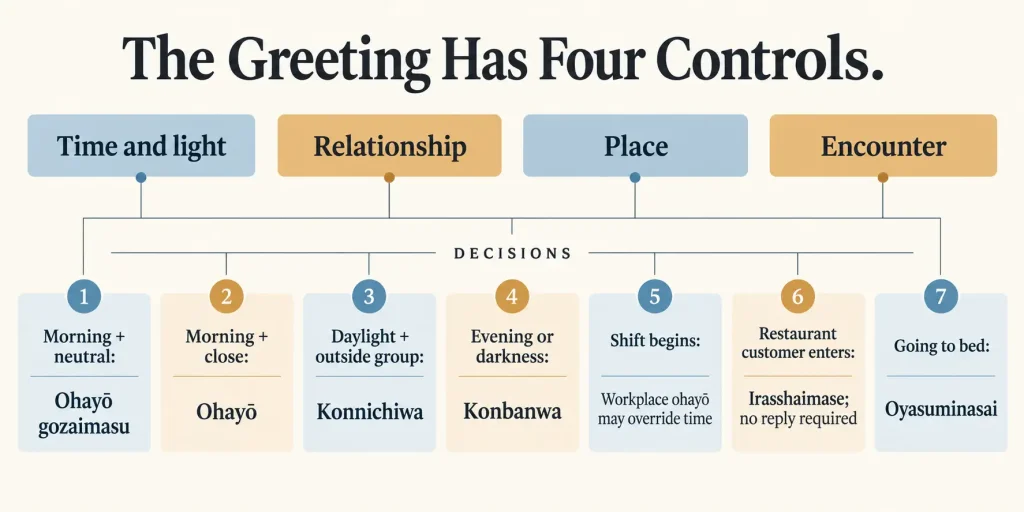
A greeting does not merely tell you the time. It reports the speaker’s reading of the entire encounter: whether this is morning, whether the speakers are close, whether work is starting, and whether one person is serving the other.
That combination produces four useful questions:
- Is it morning, daylight, or evening?
- Are you greeting a friend or someone who expects polite speech?
- Are you outside, at home, or inside a workplace?
- Is this a mutual greeting or a service call that requires no answer?
If you meet a hotel employee in the morning, ohayō gozaimasu fits the time and relationship. If you meet an acquaintance outdoors in daylight, konnichiwa is natural. If you arrive for an evening restaurant shift, workplace custom may make ohayō gozaimasu correct even though konbanwa describes the time.
This is why a single translation fails. Japanese hello phrases are not three interchangeable labels pasted onto the same English word. Each phrase selects a situation.
For audio, register labels, and phrases organized by context, use the phrasebook with 337 phrases in 25 situations. The tool is more useful than reproducing long vocabulary lists here because it lets you hear the rhythm and check the setting for each expression.
What changes across regions, seasons, and modern speech
The basic contrast among morning, daytime, and evening is understood throughout Japan. Regional accents change pronunciation, and workplaces develop local habits, but there is no separate Osaka or Hokkaido system that replaces these greetings.
Season creates a more noticeable variation. Because konbanwa follows the perception of evening rather than one nationwide minute, the transition comes earlier when darkness arrives early and later during long summer daylight.
Online communication weakens the clock rule. A social media post can begin with konnichiwa because the writer does not know when readers will see it. Video hosts also use greetings as part of a recognizable opening style rather than as a precise report of local time.
Casual speech shortens the forms further. Friends may reduce ohayō to おはよ, ohayo, or use やあ, yā, “hi,” and どうも, dōmo, a flexible acknowledgment. These variations change tone, but they do not turn konnichiwa into a universal answer for every setting.
Modern Japanese stretches the system, but it has not abolished the difference between meeting a stranger at noon and joining coworkers at the start of a shift.
The Greeting Has Four Controls
Short FAQ
Can I use konnichiwa at any time?
No. It is primarily a daytime greeting and can sound wrong early in the morning or after the setting has clearly become evening. It may also feel distant between close coworkers.
What time should I switch to konbanwa?
There is no nationally fixed hour. Switch as daylight fades and the encounter feels like an evening meeting.
Why do restaurant workers say ohayō at night?
For some workplaces, ohayō gozaimasu marks an employee’s arrival and first contact with the team. It greets the beginning of the shift rather than the morning.
Should I answer irasshaimase?
No verbal reply is expected. A small nod is sufficient.
Which detail should I notice next time?
Do not look only at the clock. Notice whether the speakers are meeting as strangers, friends, customers, or coworkers beginning a shift—that relationship often explains the greeting better than the hour does.