Why the Second Alphabet Trips Everyone: Katakana vs Hiragana Difficulty
Four characters cause a disproportionate share of beginner errors: シ, shi; ツ, tsu; ソ, so; and ン, n. Any honest comparison of katakana vs hiragana difficulty has to start there. Katakana may look cleaner because many symbols use straight strokes, but visual simplicity is not the same as reliable reading.
The difficulty comes from four separate tasks. You must distinguish similar characters, interpret ー as a sound instruction, rebuild foreign words through Japanese phonology, and retrieve a script that often appears less consistently than hiragana. Calling katakana “the easy alphabet” hides all four costs.
Katakana is not hard because it contains more basic symbols. It is hard because recognizing a symbol is only the first half of the job.
Where the four-part difficulty comes from
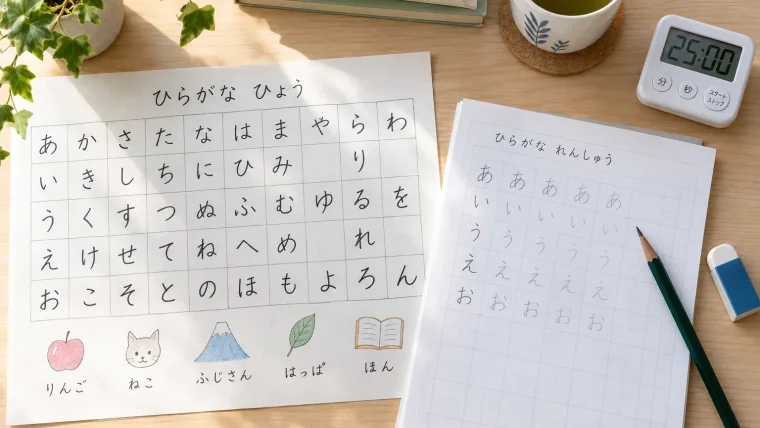
Modern beginner charts conventionally teach 46 basic hiragana and 46 corresponding basic katakana. Together, that produces 92 basic kana entries. The First 92 Characters, in Order covers that inventory and its learning sequence, so this article does not reproduce the complete charts.
The arithmetic does not support the claim that katakana is harder because it has more core characters:
Component
Hiragana
Katakana
Difference
Basic chart entries
46
46
0
Basic entries across both scripts
—
—
92 total
Main katakana failure points examined here
—
4 tasks
Not a character-count difference
The four tasks are counted as follows:
Distinguish two easily confused pairs containing four characters.
Interpret the long-vowel mark correctly.
Decode adapted foreign words rather than reading them as untouched English.
Build enough exposure for fast retrieval.
That gives 1 visual-discrimination task + 1 vowel-length task + 1 phonological-reconstruction task + 1 exposure task = 4 learning costs. This is an editorial framework, not an official Japanese proficiency score.
Learning cost
What you must process
Error produced when skipped
Count
Similar forms
シ/ツ and ソ/ン
Wrong mora or impossible word
1
Long vowels
ー and the preceding vowel
Shortened or misread word
1
Loanword conversion
Japanese sound pattern
False English reconstruction
1
Lower familiarity
Slower visual retrieval
Hesitation and guessing
1
Total
Four additional operations
Four recurring failure routes
4
The count comes from the writing system itself and from the reading operations it requires. It does not prove that every learner finds katakana harder. A learner surrounded by product names, games, menus, or technical terms may encounter enough katakana to reverse the usual pattern.
“Same number of basic signs” does not mean “same reading burden.”
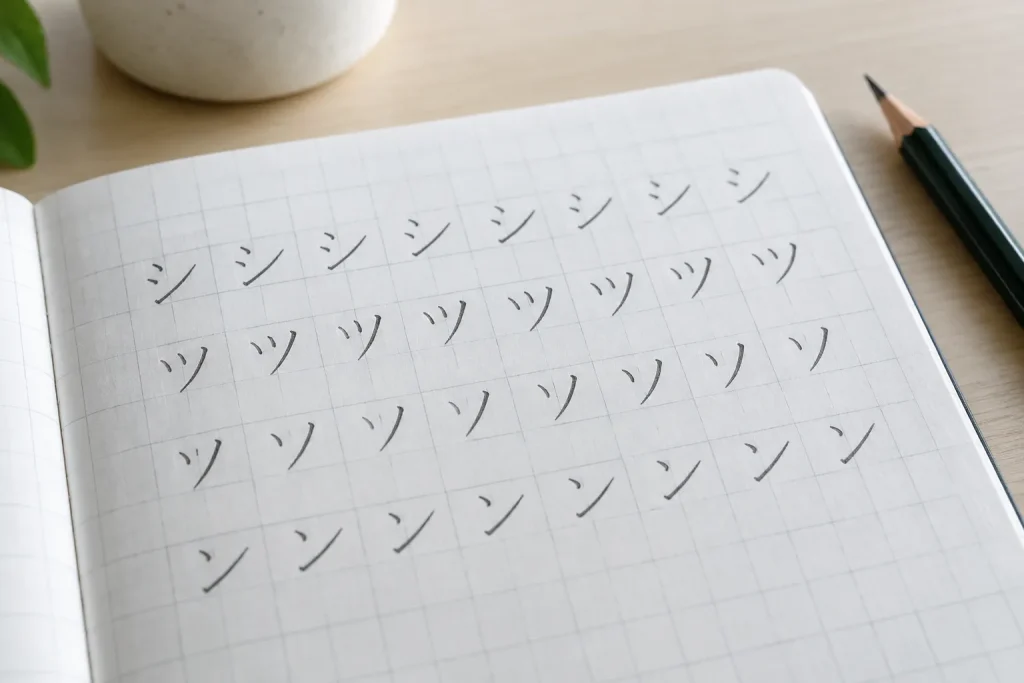
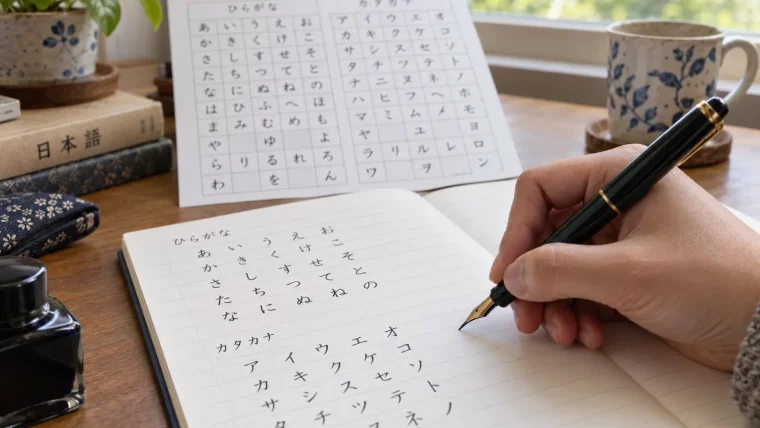
The four katakana characters シ, ツ, ソ, and ン written in a learner’s notebook
Katakana vs hiragana difficulty begins with four shapes
シ, shi, and ツ, tsu, contain similar strokes. So do ソ, so, and ン, n. The distinction is not a decorative detail added to otherwise identical symbols. Stroke direction, starting position, and the angle of the short marks differ.
A useful comparison is to look at where the short strokes seem to lead:
Character
Reading
Main visual cue
シ
shi
Short strokes are arranged more horizontally; the long stroke rises from below
ツ
tsu
Short strokes are arranged more vertically; the long stroke sweeps down from above
ソ
so
Upper short stroke and lower sweeping stroke form a more vertical movement
ン
n
Short stroke and longer rising stroke create a more horizontal movement
Fonts change the exact appearance. That is why a mnemonic tied to one typeface can fail when you meet a station sign, restaurant menu, game interface, or handwritten note. Learn the construction rather than memorizing a screenshot.
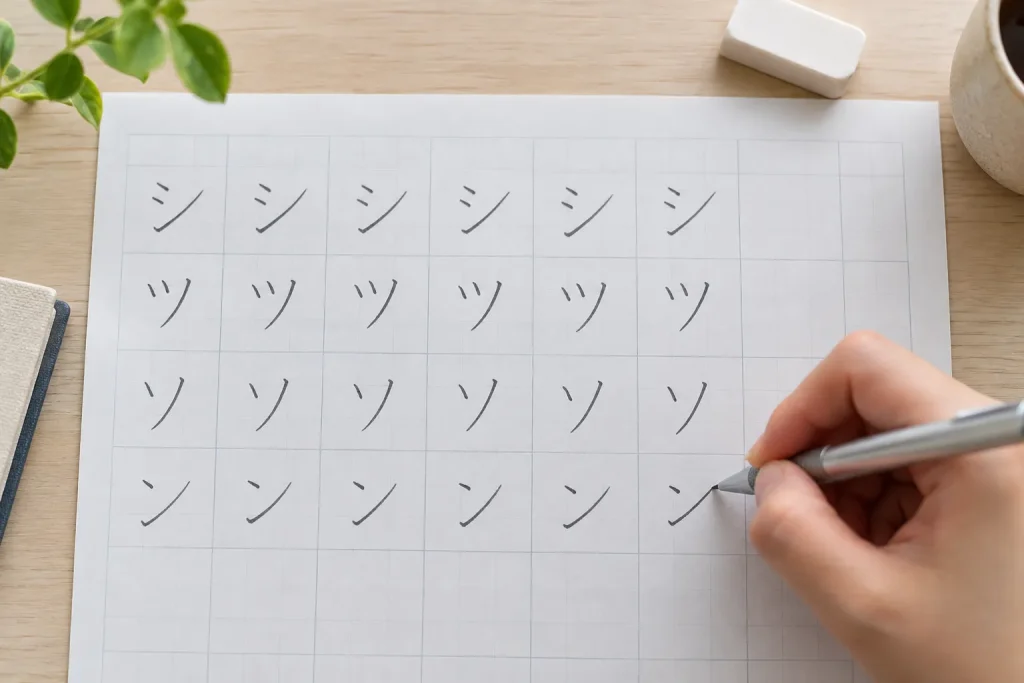
Writing helps because the movement exposes differences that a flashcard may flatten. For シ, shi, the longer stroke rises. For ツ, tsu, it begins higher and moves downward. The same directional contrast helps separate ン, n, from ソ, so.
Use this practice cycle:
Write シ and ツ next to each other while saying their readings.
Add ソ and ン underneath.
Cover the model and reproduce all four.
Mix them into short real words.
Change the font and repeat the recognition test.
Review only the characters you actually confuse.
The point is not beautiful handwriting. You are training your eye to notice stroke direction and spatial arrangement before your brain guesses from the general silhouette.
The bar that is not punctuation
The mark ー is called 長音符, chōonpu, literally “long-sound symbol.” In horizontal writing it looks like a dash, but it does not connect clauses or indicate a range. It extends the vowel sound that comes immediately before it.
The Japanese government’s guidance on writing loanwords states that long vowels are generally represented with the long-vowel mark. This makes the symbol structurally important in katakana. Hiragana normally expresses long vowels through vowel kana instead, although stylized exceptions can occur.
Consider ケーキ, kēki, “cake.” The ー tells you to lengthen the /e/ sound in ケ, ke. It is not read as a separate consonant, an English hyphen, or a pause. In コーヒー, kōhī, “coffee,” each bar extends the preceding vowel.
Vowel length can distinguish Japanese words, so treating the mark as optional creates a pronunciation error rather than a minor accent. A learner who reads only the visible syllable-like characters may recognize コ and ヒ but still fail to produce kōhī.
The mark also changes direction in vertical writing. It appears vertically so that it follows the direction of the text. It is still the same sound-length instruction.
The long-vowel bar does not have a sound of its own; it changes the duration of the sound before it.
Much katakana vocabulary comes from languages other than Japanese, but you cannot safely pronounce an English word and merely give it a Japanese accent. The source word is adapted to Japanese sound patterns. Consonant clusters may be separated by vowels, final consonants may acquire a following vowel, and sounds without a direct Japanese equivalent may be approximated.
This creates a backward-decoding task. You read the katakana as Japanese first, identify the Japanese word, and only then connect it to a possible foreign source. Reversing that sequence encourages you to see the English word you expect instead of the Japanese word actually written.
Take these examples:
Katakana
Japanese reading
Source connection
Why direct guessing fails
ホテル
hoteru
hotel
The final consonant becomes ル, ru
バス
basu
bus
A final vowel is added
アイス
aisu
ice or ice cream
Japanese usage may narrow or shift the meaning
コンビニ
konbini
convenience store
The borrowed expression is shortened
サラリーマン
sararīman
salaried office worker
The Japanese compound does not function as ordinary US English
Stroke-direction practice for シ, ツ, ソ, and ン on squared Japanese writing paper
This is the main trap in reading Japanese loanwords. Familiarity with English can help you after accurate decoding, but it can also supply a convincing wrong answer. Katakana does not promise that a word came from English, kept its original length, or retained its original meaning.
Why Japanese Loanwords Are Not the English You Think covers semantic changes, shortened forms, and Japanese-made expressions. Link to that analysis instead of treating every katakana word as English in disguise.
Why hiragana often becomes automatic first
Hiragana appears in grammatical endings, particles, function words, and many native Japanese words. Once you begin reading sentences, it repeatedly returns in connected text. Katakana exposure can be more uneven because it clusters around loanwords, names, sound symbolism, scientific terminology, advertising, and visual emphasis.
That difference can make your second kana set feel less stable even after you have memorized its chart. You may know every character during a flashcard test yet hesitate when several appear together in an unfamiliar word.
The problem is retrieval, not initial recognition. Recognition asks whether you can identify ア, a, in isolation. Retrieval asks whether you can move through アメリカ, Amerika, “America,” without mentally translating each sign into romaji.
A learner who practices only isolated cards pays the same decoding cost again for every word. Word-level reading reduces that cost because frequent combinations begin to function as familiar units.
For hiragana practice before adding the second script, A Two-Day Schedule for 46 Characters is intended to provide a focused first-stage plan. Its URL should be confirmed before publication because it did not resolve during the pre-draft check.
A worked method for decoding unfamiliar katakana
Suppose you meet the word スマートフォン, sumātofon, “smartphone.” Guessing immediately from its appearance may work, but a repeatable method is safer.
First, divide it into mora-sized units:
ス + マ + ー + ト + フォ + ン
Next, apply the long-vowel instruction. マ, ma, followed by ー becomes mā. Then notice フォ, fo, which combines フ with a small オ to represent a sound not found in the traditional basic chart.
Now read the entire Japanese form: sumātofon. Only after that should you connect it to “smartphone.” The Japanese abbreviation スマホ, sumaho, also means “smartphone,” but it cannot be recovered by mechanically converting every English letter.
The repeatable process is:
identify every full-size and small kana;
apply dakuten or handakuten marks;
extend vowels marked with ー;
keep mora boundaries clear;
pronounce the Japanese form;
test possible source words;
confirm the Japanese meaning in context.
This method prevents common katakana mistakes because it separates reading from etymological guessing. You can pronounce a word correctly even when you do not yet know what language supplied it.
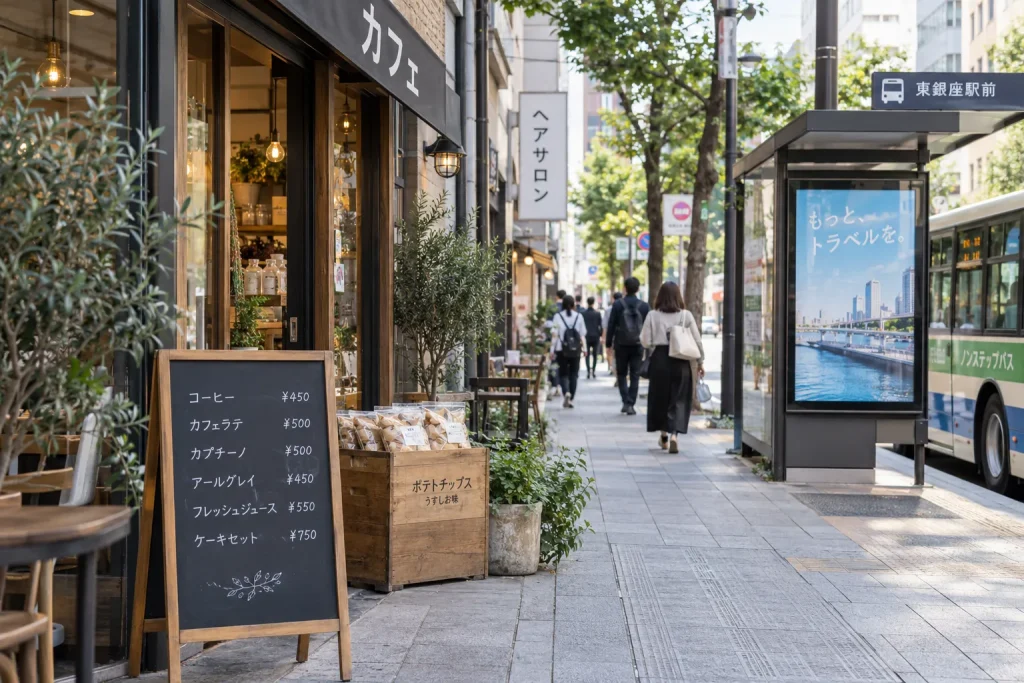
Katakana loanwords on everyday Japanese signs, packages, and menus
What can make katakana easier
Katakana is not universally harder. Several variables can reduce its difficulty:
regular exposure to menus, maps, packaging, games, or technology;
practice with complete words instead of isolated characters;
attention to stroke direction;
knowledge of Japanese sound patterns;
familiarity with loanwords from languages besides English;
reading without converting every kana into romaji.
The type of task also matters. Copying angular katakana may feel easier than writing curved hiragana. Recognizing an isolated symbol may be easy while recovering the intended loanword remains difficult. Those are separate skills and should not be combined into one vague judgment.
Names provide useful practice because they force you to match sounds rather than translate meanings. The site’s name converter with 898 checked names in katakana can show established spellings without requiring this article to reproduce the tool’s output.
The uncomfortable part is that English fluency does not remove the need to learn Japanese phonology. It may increase overconfidence. If you keep asking, “Which English word does this resemble?” before accurately reading the kana, you train guessing rather than literacy.
A better practice budget
Do not divide study time equally simply because the chart contains parallel rows. Give more attention to the operations producing errors.
A practical session can be allocated by task rather than by character count:
Practice block
Share of one session
Purpose
シ/ツ and ソ/ン contrast
1 part
Visual discrimination
Long-vowel words
1 part
Duration and spelling
Loanword decoding
1 part
Japanese-first reading
Mixed real-world text
1 part
Retrieval in context
Total
4 equal parts
Complete error-focused session
The table uses proportional units rather than minutes, so you can apply it to any session length. If your available study period is T, each block receives T ÷ 4. If one error disappears, move its share toward the remaining weak point rather than repeating material you already retrieve accurately.
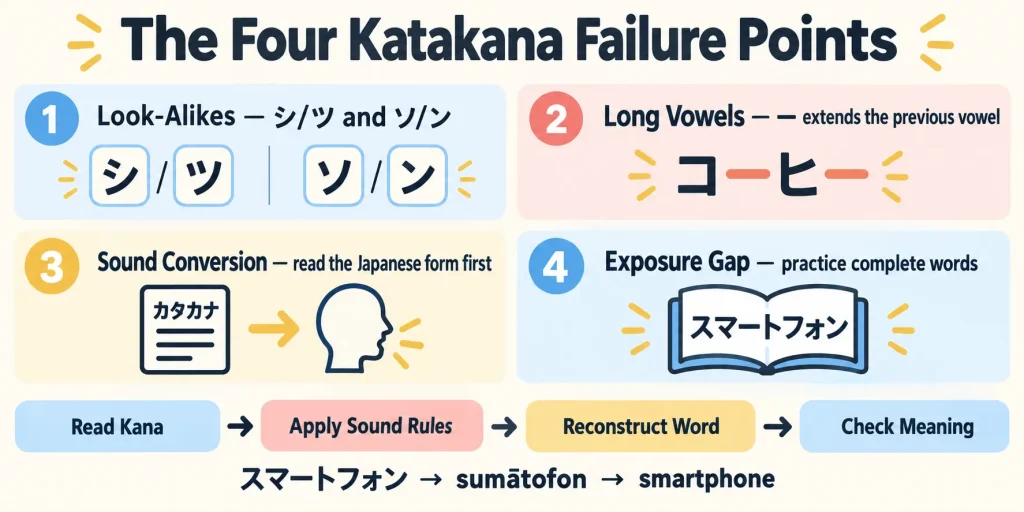
THE FOUR KATAKANA FAILURE POINTS
Frequently asked questions
Is katakana really harder than hiragana?
Not for everyone. Both scripts have the same conventional set of 46 basic chart entries. Katakana often feels harder because of similar shapes, long-vowel notation, irregular exposure, and the extra work of identifying adapted foreign words.
How can I remember シ and ツ?
Compare stroke direction rather than the overall outline. The short strokes in シ, shi, sit more horizontally, while those in ツ, tsu, are arranged more vertically. Writing the pair side by side makes the movement easier to see.
What is the difference between ソ and ン?
The characters differ in stroke orientation and the movement of the longer stroke. Practice them as a contrast and test yourself in several fonts instead of memorizing one printed form.
What does ー mean in katakana?
The 長音符, chōonpu, “long-sound symbol,” extends the vowel in the preceding kana. It looks like a dash in horizontal text but functions as a sound marker.
Are all katakana words borrowed from English?
No. Katakana can represent words from numerous languages, foreign names, sound effects, technical vocabulary, species names, and emphasis. Even English-derived words may be shortened or used with a different meaning in Japanese.
Should I translate katakana back into English?
Read it as Japanese first. Apply Japanese sound rules, pronounce the complete word, and then identify a possible source and meaning. Some words will not map neatly back to current US English.
Should I learn katakana immediately after hiragana?
You need both for ordinary Japanese reading. A short hiragana head start can reduce confusion, but delaying katakana indefinitely creates another problem. Begin reading real katakana words as soon as you can identify the basic signs.
Remember four: the look-alikes, the long-vowel bar, backward loanword decoding, and the exposure gap. Recheck the linked tools, internal resources, and character totals on September 18, 2027.