Eating in Japan is easier than the guidebooks suggest and follows a more fixed script than most Western countries. Once you know the sequence, you can eat anywhere — including the places with no English menu, which are usually the good ones.
Here is the whole thing, from the door to the till, with the phrase for each step and the two conventions that surprise Americans most.
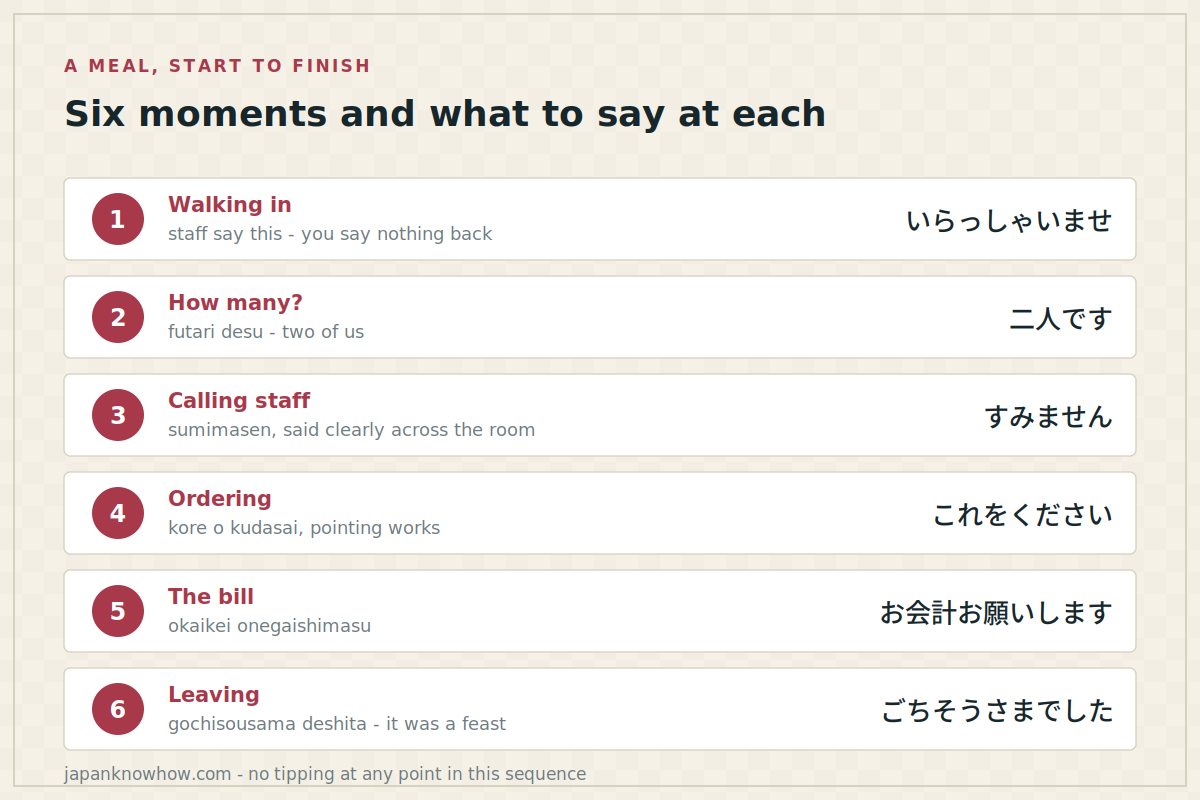
Walking in
Staff will call irasshaimase — welcome. This is directed at the room and needs no reply; a small nod is more than enough. Answering it is the commonest visitor tell.
You’ll then be asked nanmei-sama desu ka, how many people. Answer with the native number plus desu: hitori desu for one, futari desu for two, sannin desu for three. Holding up fingers works too, with one caveat — Japanese counts on fingers starting from the thumb folding inward, so an American “two” can read oddly. Say the word.
Then wait to be seated. Seating yourself is unusual outside casual counters.
Getting the menu, and the staff
Many places hand you a menu with photographs, which solves most problems immediately. If you want an English one: eigo no menyū wa arimasu ka.
To call staff over, say sumimasen — clearly, across the room. This feels rude to Americans and is entirely normal in Japan. Waving discreetly and hoping to catch an eye can leave you sitting a long time; some restaurants have a call button on the table instead, which does the same job.
Two phrases cover ordering itself. Kore o kudasai, this one please, while pointing at the menu — the most efficient sentence in the language. And osusume wa nan desu ka, what do you recommend, which reliably produces something good and is a pleasant thing to ask.
Two conventions worth knowing before you sit down
No tipping. Not in restaurants, not in taxis, not for hotel staff. It isn’t merely unnecessary — leaving money on a table can cause genuine confusion, and staff may chase you down the street to return it. Service is included in the price, and the standard is high without it.
The wet towel is for your hands. The oshibori that arrives before the meal is for hands only, not your face or the table. Fold it and set it aside when you’re done.
| Phrase | Reading | When |
|---|---|---|
| 二人です | futari desu | two of us, on arriving |
| すみません | sumimasen | calling staff over |
| これをください | kore o kudasai | ordering, with pointing |
| おすすめは何ですか | osusume wa nan desu ka | what do you recommend? |
| お会計お願いします | okaikei onegaishimasu | the bill, please |
| ごちそうさまでした | gochisōsama deshita | on the way out |
Paying, and leaving
In most restaurants you pay at the till by the door rather than at the table. Ask for the bill with okaikei onegaishimasu, or make a small crossed-fingers gesture, which is the recognised signal. Often the bill is already on your table face down; take it to the counter.
On the way out, say gochisōsama deshita — literally “it was a feast.” It’s the standard closing phrase after any meal, and it lands well every time. Its partner, itadakimasu, is said before eating; both are worth having.
Gochisōsama deshita is the highest-value four seconds of Japanese a visitor can spend. It costs nothing and it is always noticed.The phrase to learn first, after sumimasen
Ticket machines, and why they’re your friend
Ramen shops, curry chains, and many cheap restaurants use a vending machine by the door. You buy a ticket for your dish, hand it to the counter, and sit down. No ordering conversation at all.
The machines are often Japanese-only, but nearly all have photographs, and the top-left button is conventionally the house speciality. If you’re stuck: press the top-left button. It’s what the regulars order.
Allergies and diets, which need care
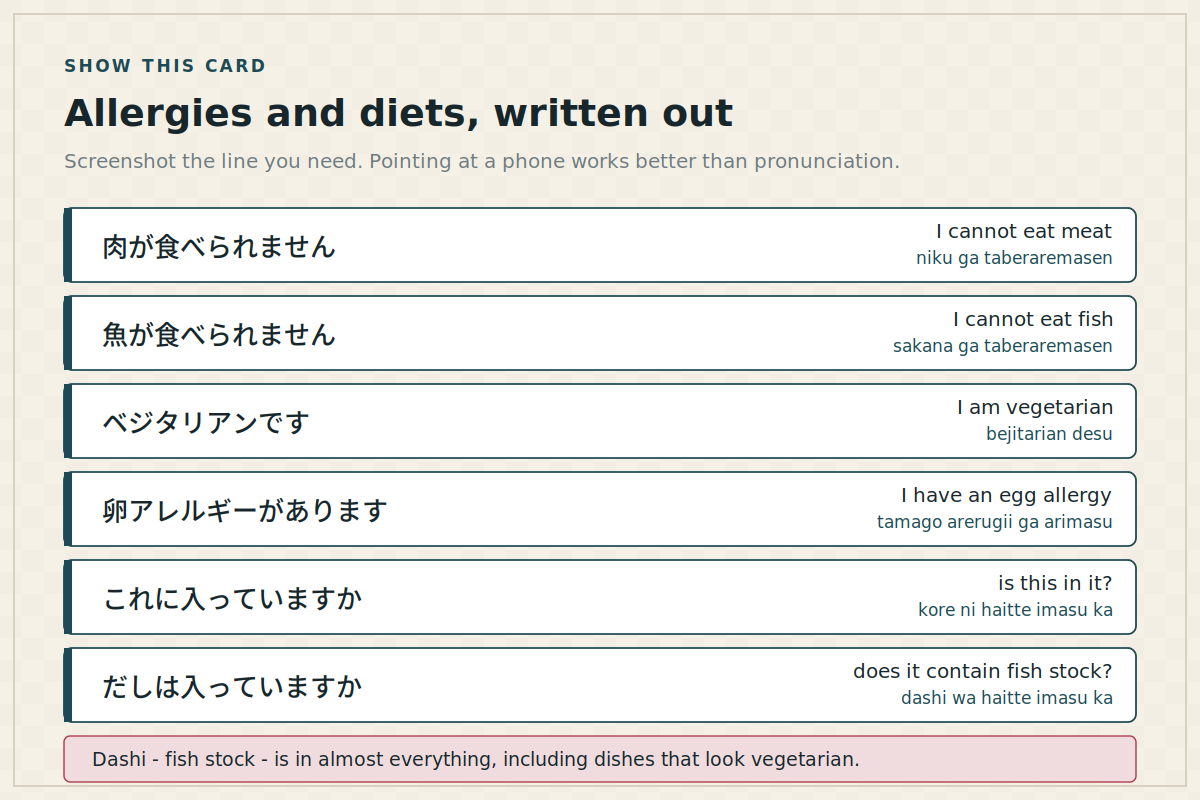
This is the one area where casual improvisation is a bad idea, and where a visitor genuinely needs to prepare.
Dashi — fish stock — is in almost everything. Miso soup, simmered vegetables, many sauces and dressings, and dishes that look entirely plant-based. Japan has a long vegetarian tradition in temple cooking, but everyday restaurant food is not built around it, and “vegetarian” is often understood as “no visible meat.”
Useful lines, worth screenshotting rather than pronouncing:
- 肉が食べられません — niku ga taberaremasen — I cannot eat meat
- 魚が食べられません — sakana ga taberaremasen — I cannot eat fish
- 卵アレルギーがあります — tamago arerugī ga arimasu — I have an egg allergy
- だしは入っていますか — dashi wa haitte imasu ka — does it contain fish stock?
Swap the first word for your own allergen: 小麦 wheat, 乳 dairy, 落花生 peanuts, えび shrimp, そば buckwheat. For a serious allergy, a printed card in Japanese is worth more than any phrase, and worth having a native speaker check before you travel — the same reasoning we apply to anything permanent on our tools page.
Knowing what kind of place you have walked into
Japanese restaurants specialise, and the type tells you what to expect before you sit down.
- 定食屋 teishokuya — set-meal restaurants. One main dish with rice, miso soup and pickles. Cheap, fast, balanced, and the everyday lunch of the country.
- ラーメン屋 rāmen-ya — usually a counter and a ticket machine. Eat, pay, leave. Lingering is not the custom, and slurping is genuinely fine.
- 居酒屋 izakaya — the Japanese pub. Small plates, ordered gradually over an evening. Many charge a small cover called otōshi, which arrives as a snack you did not order; this is not a scam.
- 回転寿司 kaiten-zushi — conveyor-belt sushi. Plates are priced by colour, and most chains now have a touchscreen with English. The easiest sushi experience for a first-timer by a wide margin.
- 喫茶店 kissaten — an old-style coffee shop. Slow, quiet, and often serving a set breakfast until eleven.
One convention that surprises people at izakaya: you order in rounds through the evening rather than all at once, and the group shares. Ordering one dish each at the start marks you out as a tourist more than anything you say.
Where the register shows up
Restaurants are where you’ll hear the most keigo, because staff use formal language with customers as a matter of course. You’ll catch shōshō omachi kudasai (one moment), omatase shimashita (sorry for the wait) and kashikomarimashita (certainly) constantly.
None of it needs a formal reply. Polite forms from you are correct and sufficient — the reasoning is in the article on politeness levels, and if you’re building your vocabulary from scratch, the ten essential phrases already include everything in this article’s table except the last two.