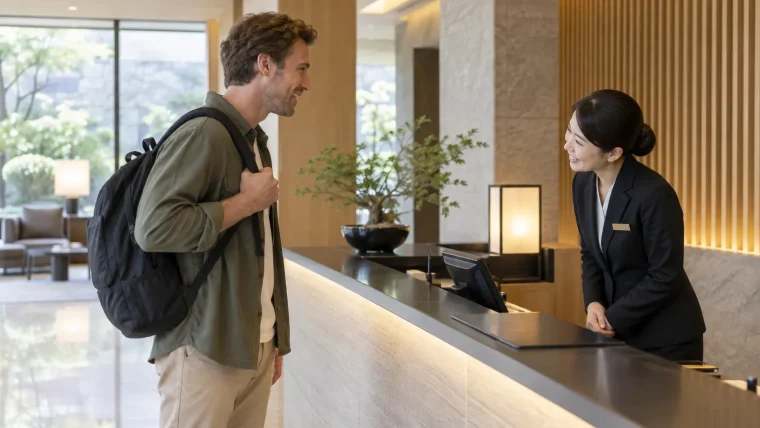
You do not need to learn Japanese to travel in Japan. You need about ten phrases, and three of them will do most of the work.
What follows is the short list, in the order you’ll actually need it, plus the thing most phrasebooks bury: which words are safe to say to anyone, and which ones change depending on who you’re talking to.
Start with four words
すみません — sumimasen
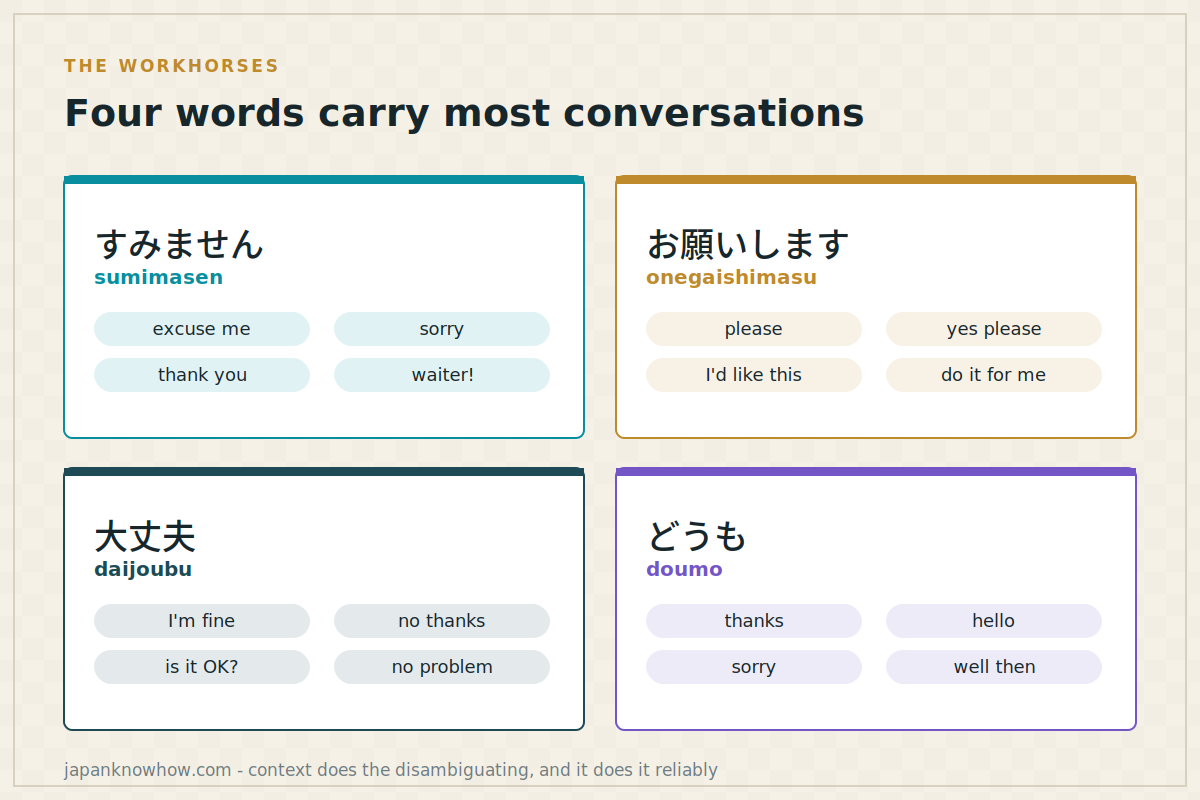
If you learn one word, learn this one. It means excuse me, sorry, and thank you, and it’s also how you call a waiter across a restaurant. Nothing else in Japanese does as much work per syllable.
Say it when you need someone’s attention, when you brush past somebody on a train, when a shop assistant goes to the stockroom for you, and when you drop something. It’s not a formal word and it’s not a casual one — it sits comfortably in the middle, which is exactly where a visitor wants to be. We’ve broken down all five of its jobs in the article on politeness levels.
ありがとうございます — arigatō gozaimasu
Thank you, in the polite form. The short version, arigatō, is casual and fine with people you know; the full version is what you say to shop staff, hotel staff and strangers. When in doubt, use the long one — over-politeness is invisible, under-politeness isn’t.
お願いします — onegaishimasu
Roughly “please,” but specifically when you’re asking for something. Point at what you want on a menu and say it. Hand over your ticket and say it. It’s also the standard way to say yes when someone offers you something.
大丈夫です — daijōbu desu
Literally “it’s fine,” and the most useful way to decline something without being blunt. Offered a bag you don’t need, a receipt you don’t want, more rice? Daijōbu desu. It also works as a question — daijōbu desu ka? — to ask whether something is all right.
The rest of the ten
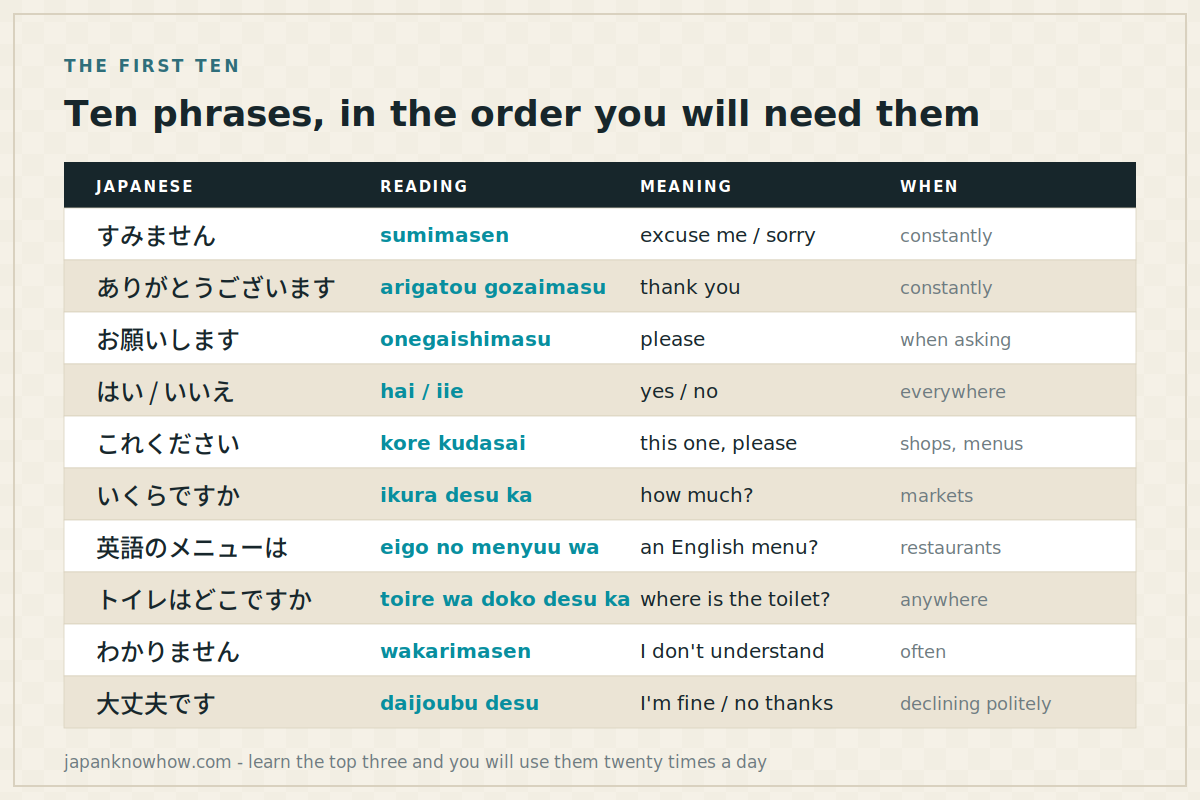
| Japanese | Reading | Meaning |
|---|---|---|
| はい / いいえ | hai / iie | yes / no |
| これください | kore kudasai | this one, please — with pointing |
| いくらですか | ikura desu ka | how much is it? |
| 英語のメニューはありますか | eigo no menyū wa arimasu ka | is there an English menu? |
| トイレはどこですか | toire wa doko desu ka | where is the toilet? |
| わかりません | wakarimasen | I don’t understand |
Two notes on that list. Kore kudasai plus pointing is the single most efficient transaction tool in the language — it works in shops, restaurants, markets and ticket offices, and nobody minds. And wakarimasen is worth learning precisely because it ends an awkward moment cleanly instead of extending it.
How to say them
Japanese pronunciation is genuinely easy for English speakers, with three things to know.
Every syllable gets equal weight. English stresses one syllable and swallows the rest; Japanese gives each one the same length. Sumimasen is su-mi-ma-sen, four even beats, not “sooMEEmasen.”
Vowel length is meaningful. A held vowel is a different sound, not just a longer one — and occasionally a different word. When you see a doubled vowel or a macron in our romanization, hold it for two beats.
The u at the end often disappears. Desu comes out closer to “dess,” and arigatō gozaimasu ends in “-mass.” This isn’t sloppiness; it’s how the language is spoken. Why romanization writes it one way and speakers say it another is covered in our piece on romaji systems.
The part phrasebooks skip: register
Japanese has levels of formality built into its grammar rather than added on with tone. The same thought has a casual form, a polite form and a formal one, and they aren’t interchangeable.
For a visitor this sounds alarming and turns out to be simple: learn the polite forms and use them with everyone. Polite Japanese to a close friend sounds slightly stiff and nothing worse. Casual Japanese to a shop assistant sounds like a stranger being over-familiar, which is a real misstep. Everything in this article is already in the polite register, so you’re covered.
Say the wrong register and you are not wrong. You are odd — and odd is the harder thing to recover from.Why we teach the middle level and nothing else
Three phrases worth more than they look
None of these is on a standard survival list, and all three land better than anything else you can say for the effort.
いただきます — itadakimasu. Said before eating, by everyone, including alone. It has no good English equivalent; the sense is closer to gratefully receiving than to saying grace. Its partner ごちそうさまでした closes the meal. Say both and you look like someone who has been paying attention.
よろしくお願いします — yoroshiku onegaishimasu. Untranslatable and everywhere. Roughly “I’m counting on you,” said when meeting someone, starting a transaction, or handing over a task. If you only ever use it after introducing yourself, that alone is worth it.
お疲れ様です — otsukaresama desu. Literally “you must be tired,” used as a greeting and a sign-off among people who have been working. You’ll hear it constantly in any workplace. As a visitor you’ll rarely need to say it, but recognising it explains a lot of overheard Japanese.
What you don’t need
A short list of things worth skipping, because effort spent here is effort not spent on the ten phrases above.
- Grammar. Set phrases carry you a long way, and half-built sentences are harder to understand than a clear phrase plus pointing.
- Kanji. Useful, but a much bigger investment. Around thirty characters cover the signs that matter — the full picture is in how many kanji you actually need.
- Perfect pronunciation. Nobody expects it and everybody appreciates the attempt.
- Counting past ten. You’ll point at prices far more often than you’ll say them, though the counters are genuinely interesting: see numbers and counters.
Where to go from here
Three situations account for almost all the Japanese a visitor speaks, and each has its own small vocabulary:
- Ordering food — the six-step sequence from walking in to walking out, including the phrase you say on the way out and the fact that nobody tips.
- Trains and stations — the handful of kanji on the signs, and the one question that gets you to the right platform.
- When something goes wrong — lost property, illness, and the three numbers worth saving before you fly.
Our phrasebook has all of these organised by situation, with each phrase marked for politeness level and read aloud so you can hear the rhythm. What it does and where we’d want you to double-check it is on the tools page.