The labels you will actually meet are 姓, sei, “family name,” and 名, mei, “given name,” on divided forms; 氏名, shimei, “full name,” when only one box appears; and パスポート記載名, pasupōto kisai-mei, “name as shown in the passport,” when an official document or international booking controls the answer. A separate box for a middle name in Japanese is unusual because Japanese name fields are generally built around family name and given name, not the American first–middle–last pattern.
The practical decision is straightforward. If your passport identifies your surname as ROTHWELL and your given names as MEGAN LOUISE, write ROTHWELL in the family-name field and MEGAN LOUISE in the given-name field. For an international ticket, visa application, or immigration record, do not silently drop LOUISE merely because the Japanese form has no “middle name” box.
There is one necessary correction to the phrase “character for character.” The identity components and spelling must follow the passport, but some reservation systems remove spaces, join given names, or print them in a different order. MEGANLOUISE on a ticket can represent the same submitted given names as MEGAN LOUISE in a passport. A display difference is not automatically an identity mismatch, but omitting a passport name because the interface looks unfamiliar can create a real problem.
For the wider system behind documentary names, phonetic readings, banks, municipal records, and online accounts, start with Every Japanese Form That Asks for Your Name. The present guide answers the narrower question: where the middle name goes.
The middle name in Japanese identity fields
姓 — sei — “family name”
You meet 姓 on government applications, membership forms, hospital paperwork, and booking screens that divide a name into parts. It means family name or surname. For MEGAN LOUISE ROTHWELL, this field receives ROTHWELL.
The common mistake is putting LOUISE into 姓 because it appears near the surname in Western writing order. A middle name that belongs to the passport’s “given names” component remains part of the given name. Position on the printed line does not turn it into a surname.
姓 can also be labeled 苗字, myōji, “surname,” on less formal forms. The two labels usually request the same component, although only the organization operating the form can settle an unclear case.
名 — mei — “given name”
You meet 名 beside 姓. It means given name, but on a form designed around Japanese names it may function as the only available destination for all passport given names. MEGAN LOUISE therefore goes into 名, with spacing handled according to the form’s instructions.
The common mistake is reading “given name” as “first name only.” On an American passport, the printed label is “Given Names,” and more than one name may appear beneath it. A Japanese system with a single 名 field is not instructing you to discard the additional given name.
“Given name” describes an identity component, not necessarily one word.
When the boxes are reversed, follow their labels rather than their visual order. Surname First or Last: What to Write Where explains how Japanese display order differs from the underlying family-name and given-name categories.
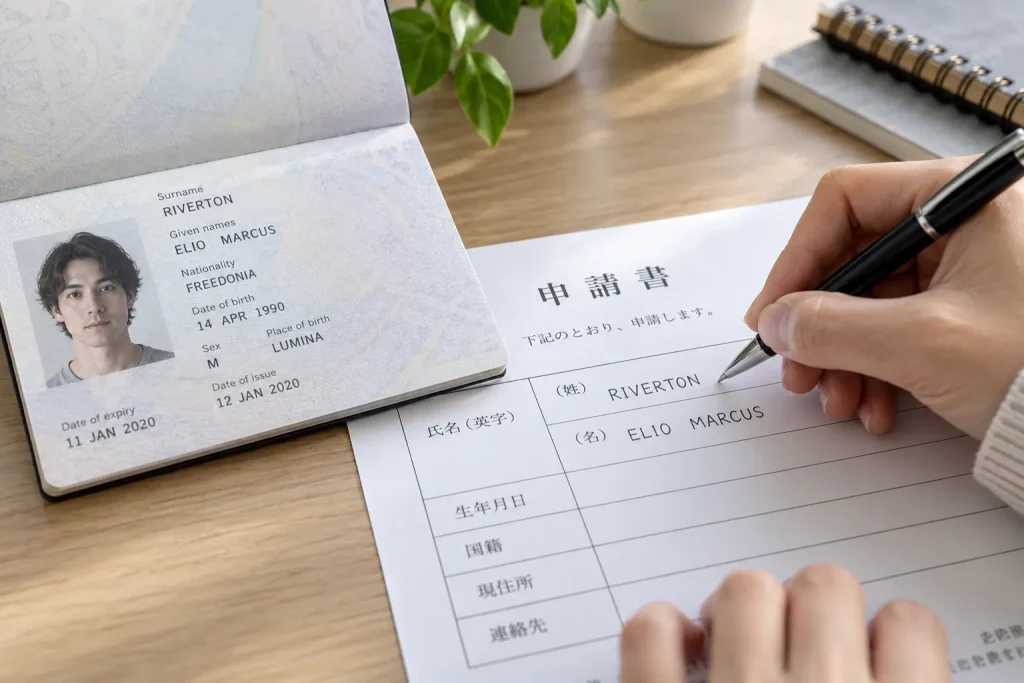
ミドルネーム — midoru nēmu — “middle name”
You may meet ミドルネーム in explanatory notes, customer-support pages, or a rare commercial form designed for international users. It is the Japanese rendering of the English expression “middle name.” Unlike 姓 and 名, it is not a standard third component of the traditional Japanese naming structure.
The mistake is assuming that every Japanese institution maintains a hidden middle-name field even when its form does not show one. Usually it does not. The institution may store your first and middle names together as the given-name component or store the entire documentary name in one field.
This is why asking “How do Japanese people translate middle names?” starts from the wrong problem. For official use, you are mapping passport components into available fields, not translating a name into a new legal category.
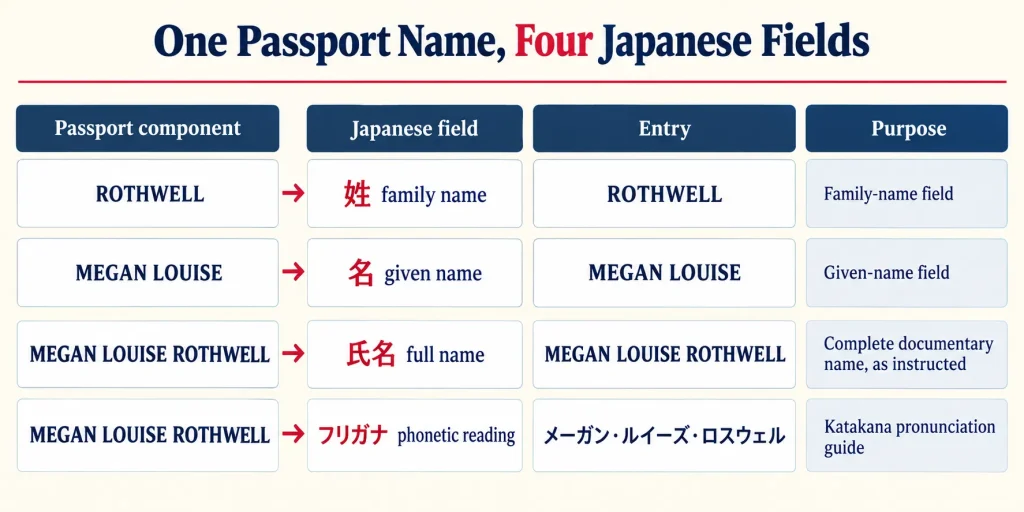
| Passport component | Example | Japanese divided field | What not to do |
|---|---|---|---|
| Surname | ROTHWELL | 姓: ROTHWELL | Do not add LOUISE here |
| Given names | MEGAN LOUISE | 名: MEGAN LOUISE | Do not shorten this to MEGAN when a passport match is required |
| Full documentary name | ROTHWELL, MEGAN LOUISE | 氏名: enter as instructed | Do not invent a Japanese order without reading the form |
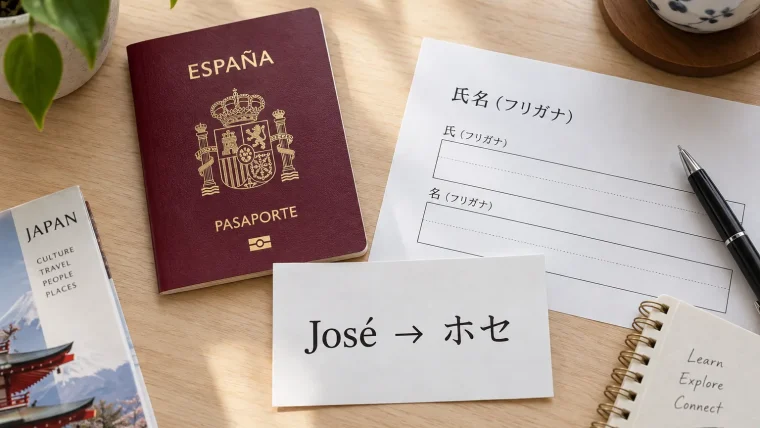
| Phonetic rendering | メーガン・ルイーズ・ロスウェル | フリガナ or カナ | Do not substitute this for the Roman-letter legal name |
When the whole name belongs in one box
氏名 — shimei — “full name”
You meet 氏名 when a form provides one box instead of separate family-name and given-name fields. The literal components refer to family name and personal name, but together the term means your full name. Enter the version requested by the instructions or the identity document named beside the field.
The mistake is writing only the name you normally use. MEGAN ROTHWELL may be socially sufficient, but it is not the complete documentary name if the passport says MEGAN LOUISE ROTHWELL. On an identity-linked form, convenience does not outrank the source document.
A 氏名 field does not by itself tell you the required order. Some forms show examples, while others specify 姓・名, “family name, given name,” near the box. If no instruction appears and the record has legal or financial consequences, ask the issuing organization rather than guessing.
ローマ字 — rōmaji — “Roman letters”
You meet ローマ字 above fields that require the Latin alphabet. Despite its literal wording, it does not ask you to translate your name into Latin or use a special Roman name. It requests letters such as those used in the Roman-alphabet portion of a passport or residence card.
This is one of the terms that means something narrower than its English appearance suggests. The mistake is entering katakana because the website is Japanese. If the box says ローマ字, MEGAN LOUISE belongs there; メーガン・ルイーズ does not.
Capitalization rules vary by system. Some interfaces automatically convert letters to capitals, while others preserve what you type. Match the requested script first and avoid changing the spelling to imitate Japanese pronunciation.
パスポート記載名 — pasupōto kisai-mei — “name written in the passport”
You meet パスポート記載名 on airline, hotel, travel, and identity-verification forms. 記載, kisai, means recorded or written. This label makes the controlling document explicit: use the name shown in the passport.
The mistake is entering a nickname, married name not yet reflected in the passport, preferred spelling, or first name without the middle name. If the instruction points to the passport, your everyday usage is irrelevant. The form is trying to identify the traveler represented by that document.
Before submitting, compare the following:
- Surname spelling and all surname components
- Every given name shown in the passport
- Hyphens, apostrophes, and spaces, subject to the booking system’s published rules
- Name order requested by the fields
- The machine-readable line if the provider tells you to use it

Tickets, bookings, and names without spaces
予約 — yoyaku — “advance arrangement”
You meet 予約 when reserving a flight, hotel, train service, or appointment. It usually translates as “reservation,” but it can refer to the record created before payment or ticket issuance, not necessarily the final ticket itself.
The mistake is assuming that a name can always be corrected after the reservation is made. Airlines distinguish between correcting a spelling error and transferring a ticket to another person. Depending on the fare and operating carrier, a correction can require direct support or a new booking.
Enter your middle name with your given name when the booking form has only family-name and given-name fields and instructs you to follow the passport. If the box rejects spaces, do not independently delete part of the name. Follow the carrier’s formatting instructions or contact it before payment.
航空券 — kōkūken — “air ticket”
You meet 航空券 in booking confirmations, airline notices, and airport instructions. 航空 means aviation, and 券 means ticket or certificate. The name stored in the passenger reservation is used to issue the international ticket and connect it with passport information.
The mistake is treating the printed boarding pass as the only record that matters. Airline systems may concatenate first and middle names, omit spaces, or display only part of a long name. The underlying reservation data can still be correct, but you should confirm that with the airline rather than deciding from appearance alone.
The safe sequence is:
- Read the passport’s surname and given-names fields.
- Put every surname component into the booking’s family-name field.
- Put the first and middle names into the given-name field.
- Follow the carrier’s instructions for spaces and punctuation.
- Review the confirmation immediately and request correction before travel if a name is missing or assigned to the wrong field.
The expensive error is not that MEGANLOUISE may print without a space. It is that LOUISE was never submitted at all when the carrier required every passport given name.
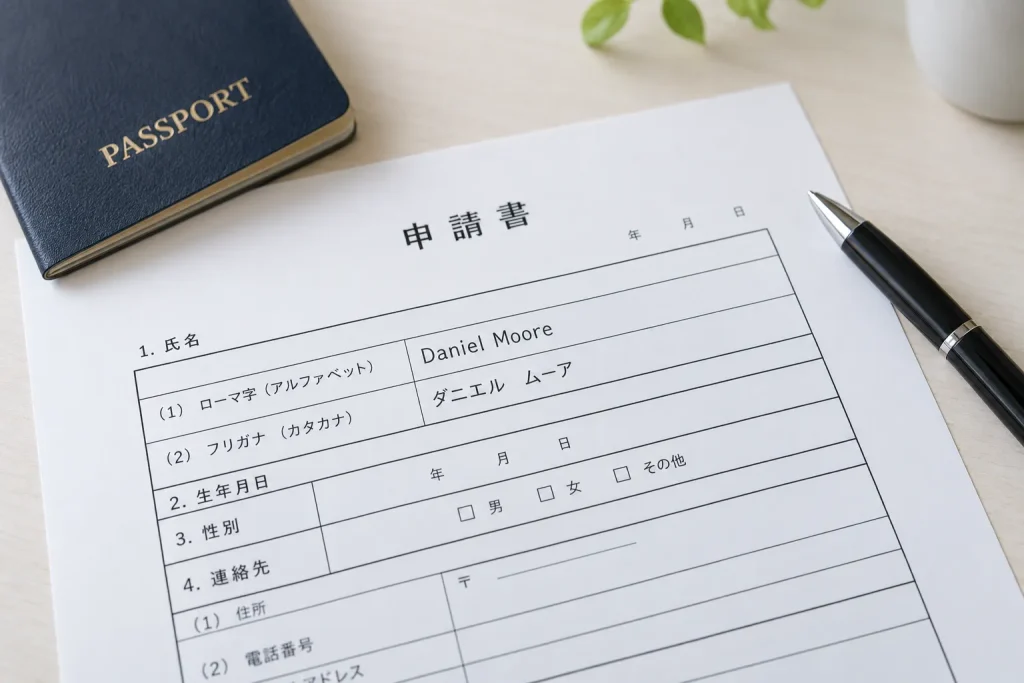
パスポート — pasupōto — “passport”
You meet パスポート in almost every international travel workflow. The word is borrowed from English, but Japanese instructions commonly use it to mean the physical document and the identity record that controls the form.
The mistake is copying the name you remember instead of looking at the identity page. Americans often think of “first name,” “middle name,” and “last name,” while travel systems usually work with “given names” and “surname.” Copy the categories printed in the document, not the categories you use casually.
For a worked example:
| Record or field | Correct entry for the example | Reason |
|---|---|---|
| Passport surname | ROTHWELL | Documentary surname |
| Passport given names | MEGAN LOUISE | Both words belong to the given-names component |
| Airline family name | ROTHWELL | Must map to the passport surname |
| Airline given name | MEGAN LOUISE or MEGANLOUISE if the airline removes spaces | Both passport given names remain present |
| Incorrect shortened booking | MEGAN ROTHWELL | LOUISE has been omitted |
The reading is not the legal spelling
フリガナ — furigana — “phonetic guide”
You meet フリガナ above or beside a name field when the organization needs to know how to pronounce or process your name. 振り仮名, the full Japanese form behind the word, means kana placed as a reading guide. On modern forms, フリガナ written in katakana commonly signals that the response should also be in katakana.
The mistake is treating furigana as an alternative legal name. メーガン・ルイーズ may represent the reading of MEGAN LOUISE, but it does not replace the Roman-letter name in a passport-matching field. The two entries serve different purposes.
If you need to establish the katakana form rather than the documentary field placement, How to Write Your Name in Japanese: The Complete Guide explains the sound-based process. Katakana Name Rules, and the Names That Break Them covers established spellings that defeat mechanical conversion.
カナ — kana — “kana characters”
You meet カナ as a compact field label on bank, shopping, delivery, and membership forms. It normally requests a phonetic version of the name, often in full-width katakana. The exact character set and treatment of spaces depend on the system.
The mistake is assuming that the kana field can hold only your first and last names because Japanese forms lack a separate middle-name category. If the service needs the reading of your full registered name, the middle name also requires a reading. A likely example is メーガン・ルイーズ・ロスウェル, subject to the organization’s separator rules.
The Japanese name converter provides 898 checked given-name pages and can help with an individual name’s established katakana form. It cannot decide what an airline, bank, or government database has registered, so it should not override an existing official record.
Signatures and seals are separate questions
サイン — sain — “signature”
You meet サイン when a hotel, courier, card terminal, or private agreement asks you to sign. This loanword looks like the English “sign,” but in this context it generally means a handwritten signature rather than a notice, symbol, or roadside sign.
The mistake is converting your name to katakana simply because you are signing in Japan. If your usual signature is in Roman letters, you normally continue using it unless the document gives a specific instruction. A signature is an act of authentication, not a transliteration exercise.
For official or contractual paperwork, keep your signature consistent with the version you normally use. Do not add or remove a middle initial merely to make the signature resemble a printed Japanese name field.
印鑑 — inkan — “seal impression instrument”
You meet 印鑑 on forms that expect a personal seal or provide a box marked 印, in, “seal.” In casual English this is often called a hanko, although Japanese administrative language distinguishes the physical seal, its impression, and its registration depending on context.
The mistake is assuming that a carved seal replaces the documentary name everywhere. A foreign resident may use a seal for particular transactions, but eligibility, character limits, accepted scripts, and registration rules depend on the municipality or institution. How a Foreign Name Becomes a Carved Seal addresses that separate process.
A seal also does not solve an airline-ticket mismatch. The booking must still map to the passport name under the carrier’s rules.
Immigration records follow documentary identity
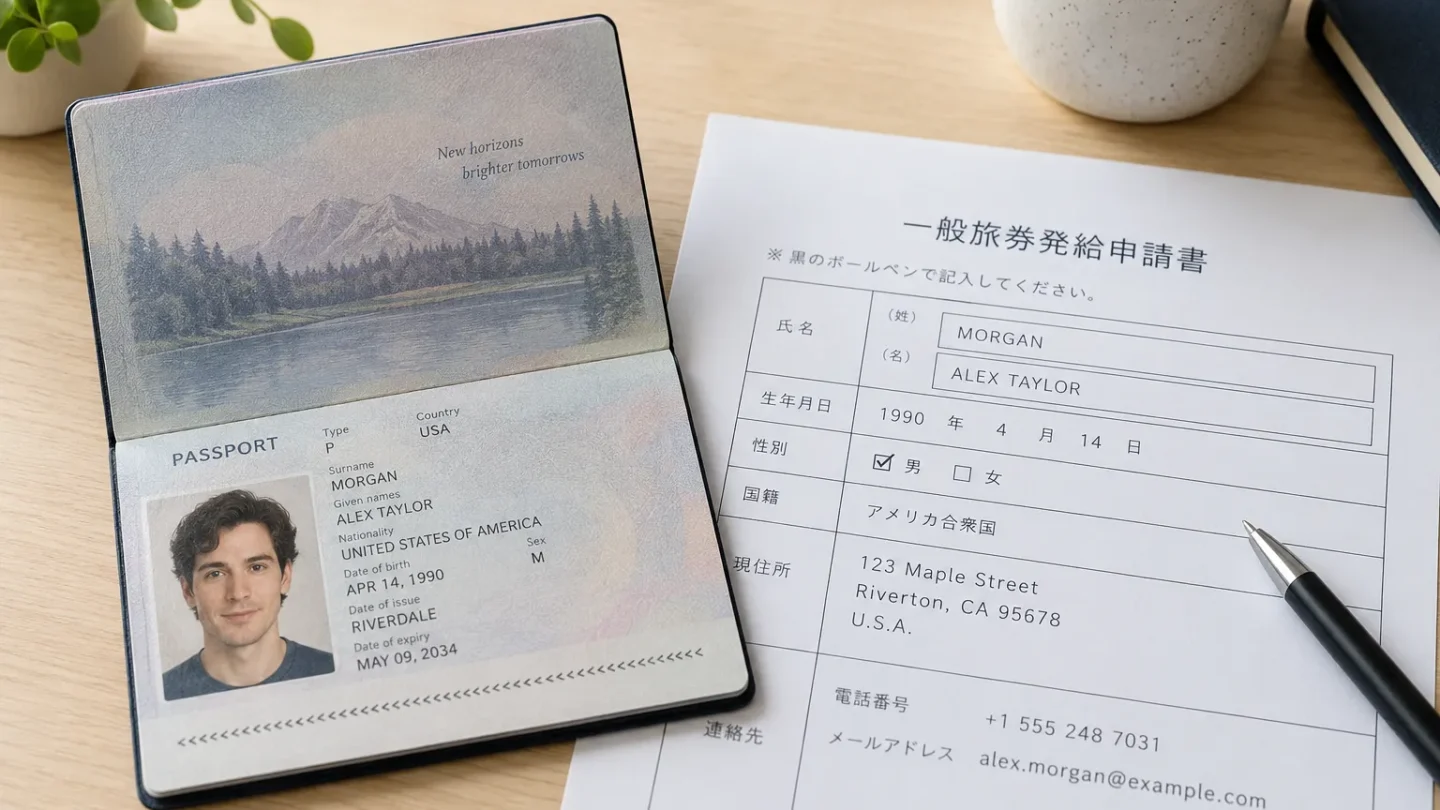
旅券 — ryoken — “travel document”
You meet 旅券 in government Japanese, including visa and immigration materials. It is the formal Japanese word for passport: 旅 means travel, and 券 means document or certificate. パスポート is more familiar in everyday speech, while 旅券 often appears in legal and administrative wording.
The mistake is thinking the formal word identifies a different document. When an application asks for the name recorded in the 旅券, it means the name in your passport. For the worked example, that documentary structure remains ROTHWELL as the surname and MEGAN LOUISE as the given names.
Japan’s visa application form explicitly labels its surname and given/middle-name lines as entries to be completed “as shown in passport.” That wording supports the central decision: a middle name is not discarded merely because the form does not treat it as an independent Japanese name category.
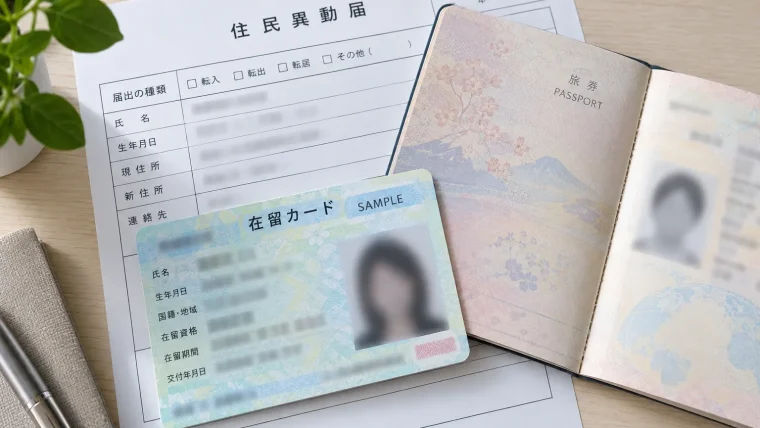
在留カード — zairyū kādo — “residence card”
You meet 在留カード after receiving a qualifying status of residence in Japan. 在留 means residing or staying, and カード is the English loanword “card.” The Immigration Services Agency uses the passport’s Roman-letter identity as the basis for the foreign resident’s name record, subject to its published procedures.
The mistake is assuming that a residence card will neatly reorganize an American full name into three familiar boxes. It records a documentary identity within a Japanese administrative system. Long names and multiple given names may therefore appear in an order or layout that feels unfamiliar without becoming different names.
Once a residence-card spelling becomes the source for a bank, employer, municipal record, or phone contract, inconsistent abbreviations can spread. Do not remove a middle name from a later application simply to make it fit more elegantly. Ask the receiving organization how it handles long names and whether it requires the full residence-card version.
What to memorize before filling the next form
The three terms worth memorizing are 姓, sei, because it identifies the surname field; 名, mei, because it receives the passport’s given names when no separate middle-name box exists; and パスポート記載名, pasupōto kisai-mei, because it tells you that the passport controls the answer.
Keep 氏名, shimei, ローマ字, rōmaji, and フリガナ, furigana, recognizable. They tell you whether the form wants the complete name, Roman letters, or a phonetic reading. The remaining vocabulary can stay reference-only until a booking or official application places it in front of you.
For MEGAN LOUISE ROTHWELL, the rule is not “delete the middle name because Japan has nowhere to put it.” The rule is “map the passport components into the fields available”: ROTHWELL under family name and MEGAN LOUISE under given name. If the system joins the given names as MEGANLOUISE, verify the carrier’s rule; if it omits LOUISE entirely, correct the record.