Why Spanish names in Japanese begin with sound
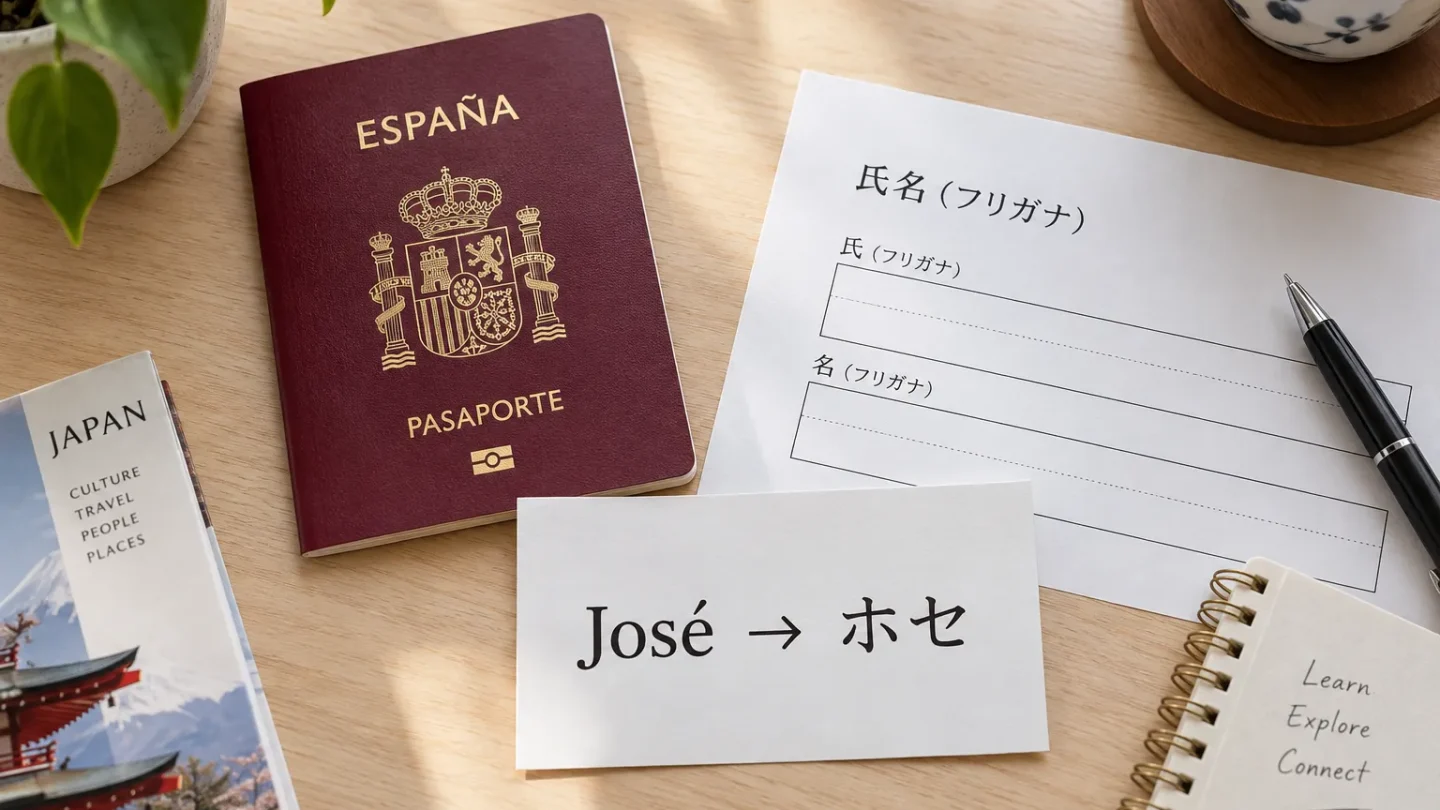
The words you will actually meet are カタカナ katakana on name fields, フリガナ furigana above unfamiliar names, and ローマ字 rōmaji when Latin letters are required. You may also see 氏名 shimei on official forms, 旅券 ryoken at passport control, and 予約名 yoyakumei when checking a reservation. Each term belongs to a different moment, and treating them as interchangeable creates practical errors. Before any of those words matter, however, you need the central rule behind Spanish names in Japanese: start from the way the person says the name, not the way an American English speaker might read its letters. That is why José becomes ホセ, approximately Hose, rather than ジョーセイ, Joe-say.
Japanese does not provide a mechanical substitute for every letter of the Spanish alphabet. It represents a sequence of sounds using the closest available kana, and established Japanese usage can outweigh a conversion invented from first principles. The site’s How to Write Your Name in Japanese: The Complete Guide explains the broader process, including why pronunciation must come before spelling. This article applies that principle specifically to Spanish j, ñ, ll, r, and rr. The uncomfortable fact for American readers is simple: an English pronunciation is not a neutral starting point—it is already a change to the name.
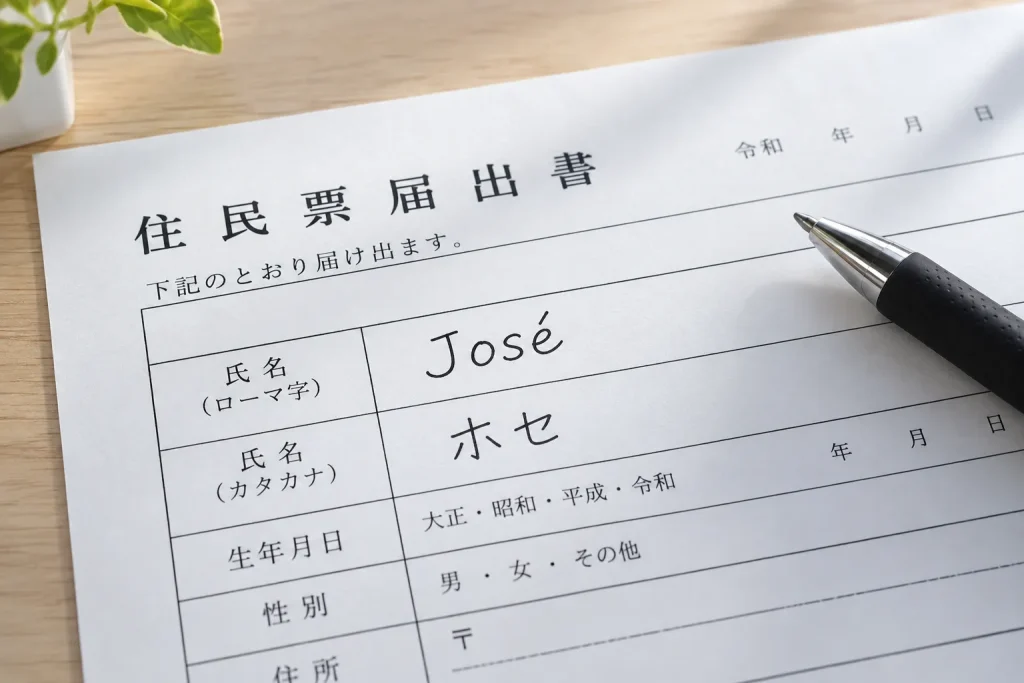
The worked example: José becomes ホセ
José is written ホセ, Hose, in standard Japanese usage. Spanish j is commonly pronounced as a voiceless velar or uvular fricative, depending on the speaker and region, and Japanese has no exact equivalent. Before o, Japanese convention approximates that sound with ホ ho, while Spanish se is represented by セ se. The accent mark tells a Spanish reader where the stress falls, but katakana does not copy that mark. The common mistake is to pass the spelling through American English first and produce something resembling ジョーセイ, which represents neither the Spanish pronunciation nor established José in Japanese.
Calling this “j becomes h” is a useful shortcut, but it is not a complete transcription rule. The selected ハ-row kana depends on the vowel that follows: Javier is commonly ハビエル, Habieru, while Juan is commonly フアン, Fuan. Japanese フ fu is used in Juan because the consonant occurs before the Spanish ua sequence, not because j has suddenly become the letter f. The kana are approximating the whole sound pattern rather than replacing isolated letters. This is also why a letter-by-letter converter can produce a technically legible but unnatural result.
“The kana in the first table are generally used to write loanwords and foreign place and personal names.” — Agency for Cultural Affairs, Japan, translated from its official guidance
The government guidance leaves room for forms that aim more closely at an original sound and for sounds not covered by its tables. It does not publish a dedicated universal chart that assigns every Spanish letter to one fixed katakana symbol. Actual Japanese spellings therefore combine available kana, pronunciation, and precedent. When a well-established spelling exists, that spelling normally deserves more weight than an improvised phonetic experiment. The distinction matters most when your name will appear in public or remain attached to a record.
| Spanish name or feature | Usual katakana | Practical reading | What disappears or changes |
|---|---|---|---|
| José | ホセ | Hose | j is approximated by the ハ row |
| Javier | ハビエル | Habieru | Spanish j has no exact Japanese equivalent |
| Juan | フアン | Fuan | the opening sound is adapted to フア |
| Peña | ペーニャ | Pēnya | ñ becomes a ニャ-row sound |
| Guillermo | ギジェルモ | Gijerumo | ll reflects a Spanish pronunciation convention |
| Herrera | エレーラ | Erēra | rr is not written as a doubled Japanese r |
Ñ enters the ニャ row
Ñ is not an n followed by a decorative mark; it represents a palatal nasal consonant. Japanese has a close structural match in the ニャ, ニュ, ニョ series: nya, nyu, nyo. Peña can therefore appear as ペーニャ, Pēnya, with ニャ carrying the sound that English speakers may recognize from “canyon.” Writing ペナ, Pena, removes the palatal quality and changes how Japanese readers will say the name. The typical mistake is to ignore the tilde because an English keyboard or booking field makes it inconvenient.
The long-vowel mark ー in ペーニャ is a separate decision from the treatment of ñ. It extends the preceding vowel by one mora, or timing unit, in Japanese. A person’s preferred spelling may differ when family usage, nationality, or an existing Japanese record has established another form. You should therefore treat ペーニャ as a strong conventional example, not as permission to rewrite every surname automatically. For a permanent or official use, compare reliable Japanese-language usage and ask the name holder how they write it.
LL depends on the speaker behind the name
Spanish ll does not have one pronunciation across the entire Spanish-speaking world. In many varieties it has merged with y, while other speakers maintain different regional realizations. Japanese spellings may therefore use combinations such as ジャ, ジュ, ジョ or forms closer to リャ, リュ, リョ, depending on the name’s real pronunciation and established usage. Guillermo is widely seen as ギジェルモ, Gijerumo, but that example should not be turned into an inflexible “ll equals ジ” formula. The mistake is assuming that the spelling alone tells you which Japanese series to select.
Ask the person to pronounce the name naturally before deciding on the kana. If you cannot ask, identify the country or speech community connected to the name and then check how Japanese sources render the same person or a securely comparable name. Do not substitute an American pronunciation of “ll,” because English reading habits can create a sound that the original name never contained. This is where a converter reaches its limit: it can provide a candidate, but it cannot infer a person’s regional pronunciation from letters alone. The broader reasons common names defeat simple rules are covered in Katakana Name Rules, and the Names That Break Them.
![A language notebook showing Peña, Guillermo, and Herrera beside their katakana forms, photographed in soft daylight]](https://japanknowhow.com/wp-content/uploads/2026/10/mtzgwcn8_0003_70ul9t4a-1024x683.webp)
Rolled r does not create a doubled kana consonant
Spanish distinguishes the tap in pero from the trill in perro, but standard Japanese does not preserve that contrast directly. Both are normally routed through the ラ row: ラ, リ, ル, レ, ロ. A written rr does not automatically trigger small ッ, because ッ marks a Japanese timing effect rather than a Spanish rolled consonant. Herrera can be rendered エレーラ, Erēra, without doubling the Japanese r sound. The frequent mistake is to see two letters and assume that Japanese must also display two consonants.
This is one place where “disappears” needs careful wording. The name does not lose every trace of r; it loses the distinction between the Spanish tap and trill. Japanese readers still encounter a ラ-row consonant, but they are not instructed by the spelling to produce a Spanish trill. Adding ッ would suggest a blocked or geminated consonant that does not accurately solve the problem. If preserving the Spanish pronunciation matters in conversation, the katakana spelling can only serve as an approximation.
The same caution applies to single r. Japanese ラ-row sounds are not identical to either an English r or an English l, and neither English category provides a perfect description. Readers who need the general sound inventory rather than the Spanish-specific cases can use Five English Sounds Japanese Does Not Have, which covers the larger substitution problem in one place. For this article, the practical point is narrower: Spanish r and rr normally collapse into the same Japanese row. Spanish pronunciation must remain the source even when the target script cannot preserve every contrast.
The Japanese terms you meet while converting a name
カタカナ — katakana — “fragmentary kana”
カタカナ katakana, literally “fragmentary kana,” is the script you meet when writing a foreign personal name for Japanese readers. It gives the reader a Japanese approximation of the name’s sounds, not a translation of its meaning. José becomes ホセ because the script follows pronunciation through Japanese sound patterns. The English loanword “katakana” can mislead beginners into thinking it is simply a Japanese alphabet with a character for every foreign letter. It is instead a syllabary with conventions, gaps, and established spellings.
原音 — gen’on — “original sound”
原音 gen’on, literally “original sound,” appears in discussions of representing foreign words as closely as Japanese allows. You meet the idea when choosing between a familiar conventional spelling and a less common form designed to resemble the source pronunciation. “Original” does not mean perfectly preserved, because katakana still operates within Japanese phonology. In José, ホセ is an approximation, not a recording of the Spanish consonant. The mistake is claiming that one katakana spelling reproduces a Spanish name exactly.
表記 — hyōki — “written representation”
表記 hyōki, literally “written representation,” is the term used when discussing how a word or name is written. You meet it in style guidance, administrative instructions, and questions about preferred name spelling. It concerns the written form, not necessarily a guarantee of exact pronunciation. English speakers sometimes treat “notation” or “spelling” as though each foreign letter must remain visibly recoverable. Japanese katakana name spelling may instead preserve a pronounceable approximation while discarding distinctions such as r versus rr.
長音符 — chōonpu — “long-sound mark”
長音符 chōonpu, literally “long-sound mark,” is the ー used to extend a vowel in katakana. You meet it in names such as ペーニャ, where it indicates Japanese vowel length rather than the Spanish tilde. It is not a dash, minus sign, or decorative stroke. Removing it can change the rhythm Japanese readers assign to the name. The common mistake is to copy only the large kana and omit the marks that carry timing information.
中黒 — nakaguro — “middle black mark”
中黒 nakaguro, literally “middle black,” is the centered dot ・ commonly used to separate parts of a foreign name in Japanese text. You meet it between given names and surnames, or between other name components, when a boundary needs to remain visible. It is not the same as a period at the bottom of the line. It also does not become part of the legal Latin-letter spelling of your name. The mistake is inserting it into passport-style fields simply because it appears in a Japanese article.
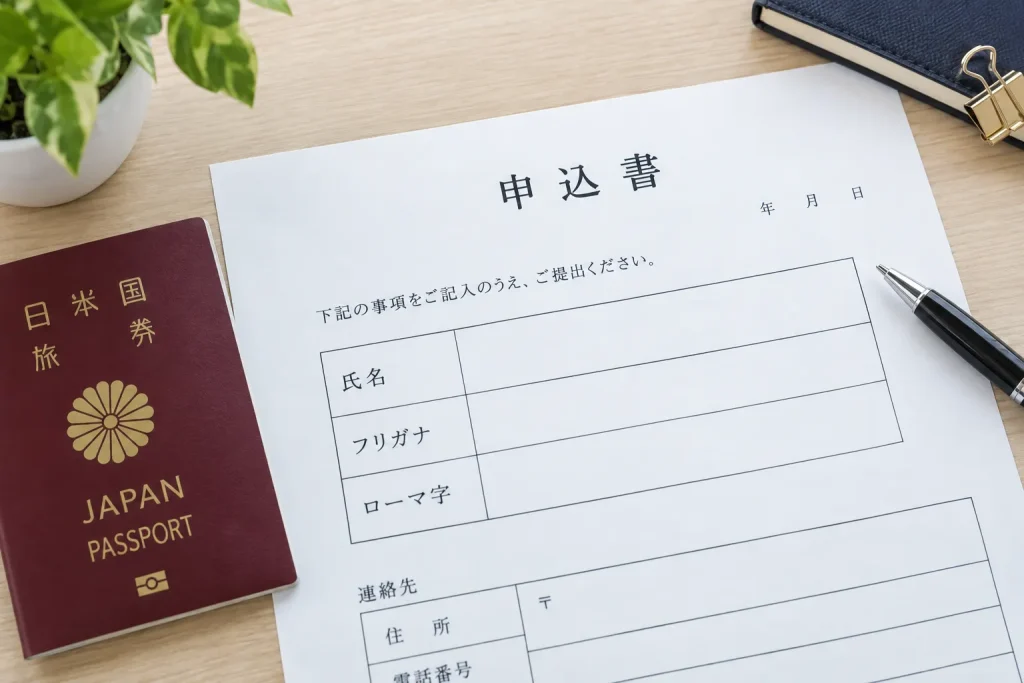
Terms on forms and identification
氏名 — shimei — “family name and given name”
氏名 shimei, literally “family name and given name,” labels the full-name field on many forms. You meet it at clinics, schools, offices, banks, and service counters. It does not by itself tell you whether the institution wants Latin letters, katakana, or another script; nearby instructions decide that. English speakers may mistake it for “signature” and sign instead of printing their name. When space permits, match the format requested and keep your official spelling consistent.
フリガナ — furigana — “reading kana”
フリガナ furigana means kana supplied to show how written characters are read. You meet it above or beside a name field when an organization needs a searchable Japanese reading. Despite its foreign-looking katakana form, it does not mean “phonetic spelling in any alphabet.” A フリガナ field commonly expects kana, and the printed form may signal the preferred script by displaying フリガナ or ふりがな. The mistake is entering Latin letters because the English loanword “phonetic” feels equivalent.
ローマ字 — rōmaji — “Roman letters”
ローマ字 rōmaji, literally “Roman letters,” refers to the Latin alphabet used to write Japanese or other names. You meet it on websites, cards, account forms, and identity-related records. It does not mean the Roman language, and it does not automatically mean an English translation. For a Spanish name, José in a Latin-letter field generally remains the holder’s official Latin spelling, subject to the field’s technical character limits. The mistake is converting the name to katakana and then romanizing that result back as “Hose.”
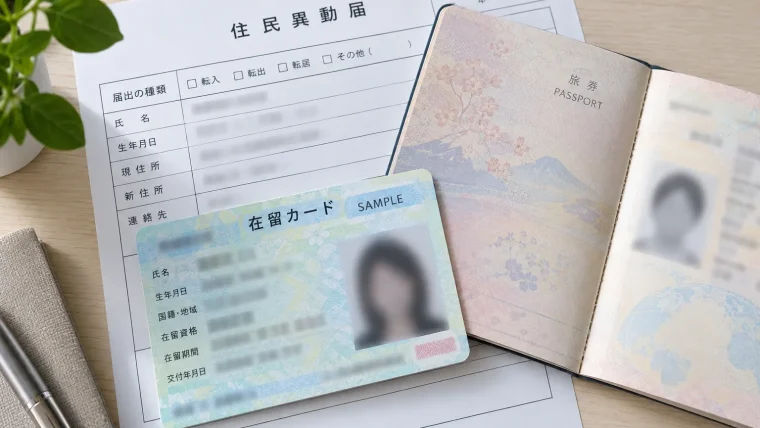
The distinction between kana convenience fields and legal identity fields is practical rather than academic. A residence card has its own limits and does not operate as a canvas for a preferred katakana nickname. What the Zairyu Card Prints and What It Cannot explains which identity information the card carries and where expectations commonly go wrong. Do not replace an official Latin spelling merely because your katakana form is easier for Japanese speakers. You may need both versions, but they perform different jobs.
| Term | Reading | Literal meaning | Where you meet it |
|---|---|---|---|
| カタカナ | katakana | fragmentary kana | Japanese rendering of a foreign name |
| 原音 | gen’on | original sound | pronunciation and transcription discussions |
| 表記 | hyōki | written representation | style rules and preferred spellings |
| 長音符 | chōonpu | long-sound mark | extended vowels in katakana |
| 中黒 | nakaguro | middle black mark | separation between foreign name parts |
| 氏名 | shimei | family name and given name | full-name fields |
| フリガナ | furigana | reading kana | pronunciation fields on forms |
| ローマ字 | rōmaji | Roman letters | Latin-alphabet fields |
| 旅券 | ryoken | travel document | passport-related instructions |
| 予約名 | yoyakumei | reservation name | airline, hotel, and ticket bookings |
Terms that matter when you travel
旅券 — ryoken — “travel document”
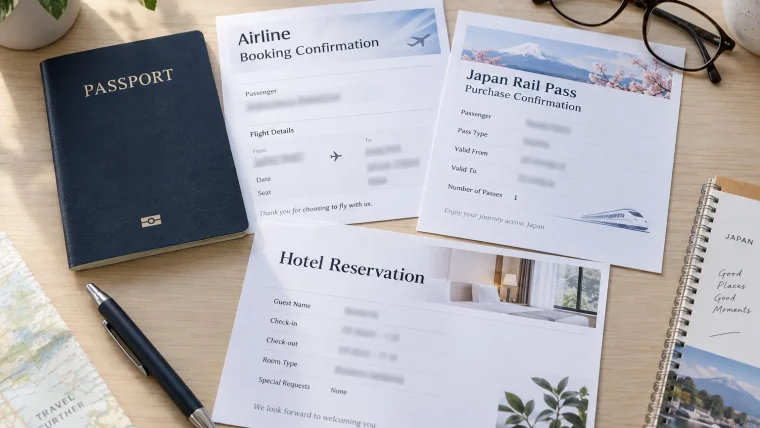
旅券 ryoken, literally “travel document,” is the formal Japanese term for a passport. You meet it in immigration, airline, and government instructions, although パスポート pasupōto is common in ordinary conversation. The loanword can make the document sound interchangeable with any photo identification, but the formal term points to the specific travel document. For an international booking, the name associated with that document has priority over a newly chosen katakana spelling. The mistake that costs effort is booking under a translated, shortened, or respelled version of the passport name.
予約名 — yoyakumei — “reservation name”
予約名 yoyakumei, literally “reservation name,” is the name attached to a booking. You meet it at airline desks, hotels, restaurants, and ticket counters. In casual settings it may be a kana reading or a spoken surname, but international travel systems can require the passport spelling. The term does not promise that every booking platform stores accents, spaces, and hyphens in the same way. Before paying, read When the Ticket Name Does Not Match the Passport and follow the carrier’s current instructions rather than guessing.
A safe workflow separates pronunciation from identity data. First, say the Spanish name as its holder says it; next, choose the closest established katakana; then keep the official Latin spelling unchanged wherever the form requires it. The name converter is useful for checking whether a name appears among the site’s 898 reviewed name pages, but its result is still not a replacement for a passport or the holder’s preference. A tool can propose a name in katakana; it cannot decide what an airline, government office, or individual accepts as authoritative. That final distinction prevents more trouble than perfecting a single kana.
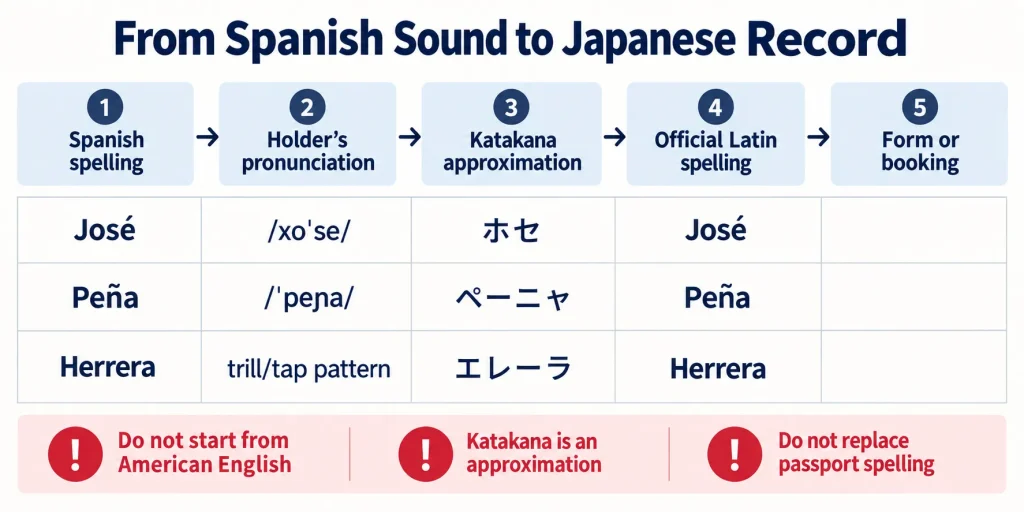
The three terms worth memorizing
Memorize カタカナ katakana, フリガナ furigana, and ローマ字 rōmaji. Together, they answer the most frequent practical questions: how your foreign name is represented for Japanese readers, where its kana reading belongs, and where Latin letters belong. Keep 氏名, 旅券, 予約名, 表記, 原音, 長音符, and 中黒 at recognition level until a form or discussion puts one in front of you. More vocabulary will not repair a transcription built from English sounds rather than Spanish ones. If you remember only one process, make it pronunciation first, katakana second, and official Latin spelling unchanged where identity records require it.
The substitutions are consequently less arbitrary than they initially appear. José is ホセ because Japanese starts from the Spanish sound, ñ uses the ニャ row because that is the closest available pattern, and rr loses its separate trill contrast because Japanese does not encode it through doubled ラ-row kana. Ll requires more caution because its pronunciation varies among Spanish-speaking communities. None of these adaptations translates the person or changes the legal name. They provide Japanese readers with a workable pronunciation while acknowledging that Spanish consonants in katakana cannot retain every distinction.