The words you will actually meet begin before dinner: おまかせ, omakase, when choosing the menu; 予約, yoyaku, on the booking page; and キャンセル料, kyanseru-ryō, beside the rule that can cost you the entire meal. At the counter, the useful vocabulary changes to 握り, nigiri, しゃり, shari, and お好み, okonomi. The omakase sushi price only makes sense once you know what those words promise—and what they do not.
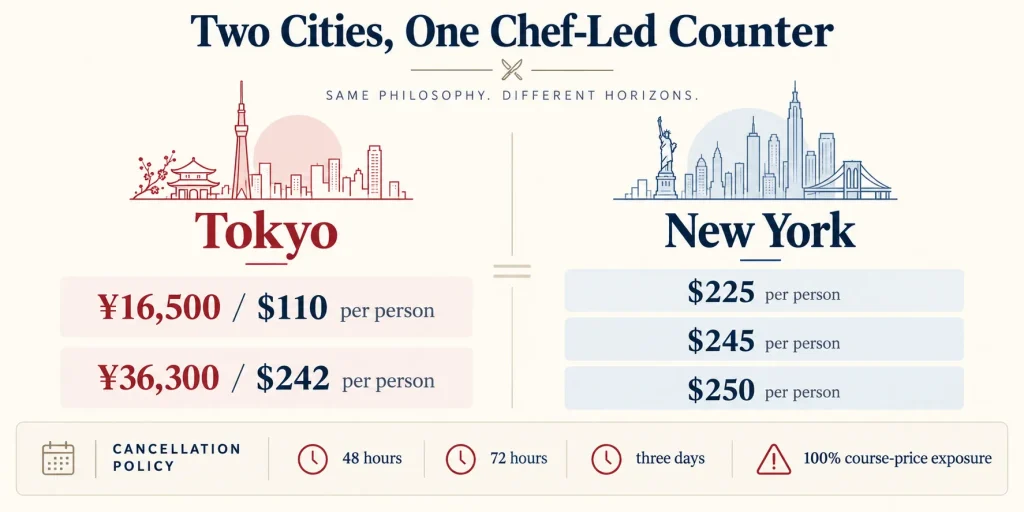
Here is the short correction. At established Tokyo counters, a useful planning range is about ¥15,000–¥40,000, or roughly $100–$267 using a round editorial conversion of ¥150 to $1. Verified examples sit inside or near that band: Ginza Kyubey lists a ¥16,500 ($110) sushi course, while Sushi Kanesaka lists a ¥36,300 ($242) lunch nigiri course. In New York, Bar Miller lists its tasting menu at $250, Jōji states a $225 dinner cancellation charge tied to its menu, and Sushi by Scratch Restaurants lists a $245 menu price in its cancellation policy.
Omakase does not mean “the most luxurious meal available.” It means that you leave the selection to the chef.
Before booking, read Ordering, Paying and the Rules Nobody States for the wider restaurant system: where you order, when you pay, and why the rules change with the type of venue.
What the Tokyo–New York price gap includes
Comparing only the printed menu price hides part of the difference. Japanese prices may include consumption tax, but service charges differ by restaurant and hotel. In New York, sales tax and any gratuity not already included can raise the final bill above the advertised menu price. Drinks, supplements, and extra pieces ordered after the set sequence may also be separate in either city.
| Verified counter or restaurant | Published amount | Approximate comparison | What the amount represents |
|---|---|---|---|
| Ginza Kyubey, Tokyo | ¥16,500 | $110 | Sushi course listed by the restaurant |
| Sushi Kanesaka, Tokyo | ¥36,300 | $242 | Lunch nigiri course on its reservation page |
| Jōji, New York | $225 | ¥33,750 | Dinner amount used in its cancellation policy |
| Sushi by Scratch Restaurants, New York | $245 | ¥36,750 | Menu price charged for late cancellation |
| Bar Miller, New York | $250 | ¥37,500 | Tasting menu before tax |
These examples support the narrower claim that comparable US counter menus are often more expensive, especially once tax and gratuity are added. They do not prove that every New York omakase costs more than every Tokyo meal. Both cities have less expensive formats, and both have counters far above this range. The honest comparison is between similar fixed-seat, chef-led dinners—not between a Tokyo lunch special and a celebrated Manhattan dinner.
New York also imports much of the prestige economy surrounding Japanese seafood, ceramics, skilled labor, and small counter capacity. Tokyo has high ingredient and labor costs too, but it operates within a deeper local network of wholesalers and sushi businesses. Currency movements can widen or narrow the apparent gap for an American traveler without changing the price printed in yen.
Before you reserve: the words attached to the bill
おまかせ — omakase — “I leave it to you”
You meet おまかせ when selecting a menu or answering what you would like to eat. It comes from 任せる, makaseru, meaning to entrust or leave something to another person. At a sushi counter, it usually means the chef chooses the sequence according to the restaurant’s format, available ingredients, and seasonal judgment.
The common mistake is treating omakase meaning as “luxury tasting menu.” A neighborhood restaurant can offer an inexpensive omakase selection, while an expensive restaurant may sell a fixed course with almost no spontaneous choice involved. In English-language restaurant marketing, “omakase” often suggests a premium counter experience. In Japanese, the core promise is delegated choice, not a guaranteed price or prestige level.
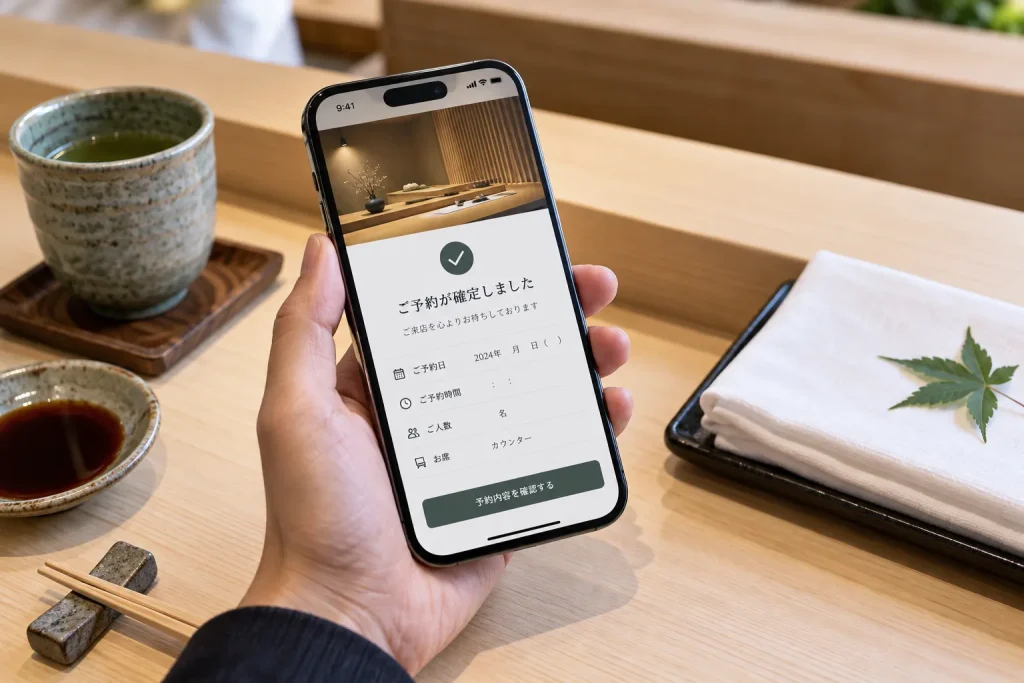
予約 — yoyaku — “advance arrangement”
You meet 予約 on restaurant websites, booking platforms, and confirmation messages. The practical English translation is “reservation,” although the literal sense is an arrangement made beforehand. At small counters, the reservation may purchase a prepared course rather than merely hold a chair.
The mistake is assuming the restaurant can absorb an empty seat as easily as a large American dining room. Fish may have been bought and prepared for the booked number of guests, while a synchronized seating gives the restaurant little opportunity to resell your place. That is why a card guarantee or prepayment is common.
コース — kōsu — “course”
You see コース beside a price during booking. This English loanword does not mean a route, school subject, or single dish. In restaurant Japanese, it means a predetermined sequence of dishes sold as one menu.
The mistake is assuming that おまかせ and コース are interchangeable. A course describes the meal’s structure; omakase describes who makes the selection. A restaurant can offer an omakase course, a chef-selected sequence whose length and boundaries are still fixed.
キャンセル料 — kyanseru-ryō — “cancellation fee”
This appears in the terms immediately before payment or card authorization. 料, ryō, means a fee or charge. The important text nearby tells you when the penalty begins and whether it is a fixed amount or a percentage of the course.
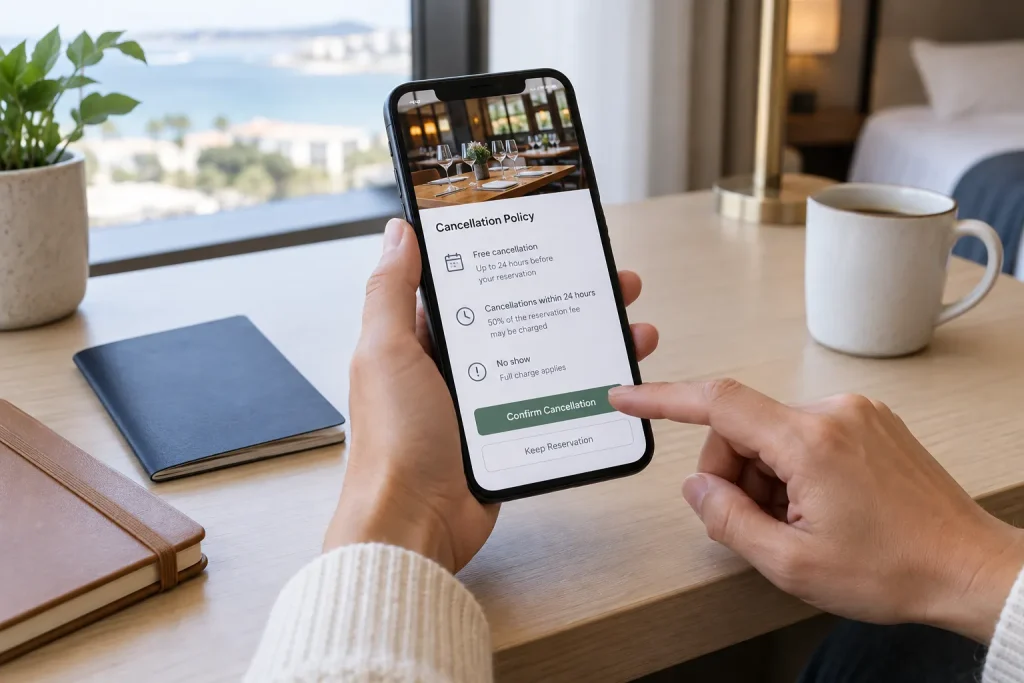
The mistake is reading this as a small administrative fee. Sushi Kanesaka’s OMAKASE reservation listing states a 100% cancellation charge beginning three days before the visit. Aoyama Sushi Kanesaka likewise states that cancellations within 72 hours incur 100% of the reserved course price. In New York, Sushi by Scratch Restaurants charges the full $245 menu price for cancellations received less than 48 hours before the reservation.
“Cancellation fee” can mean the whole dinner, not the loss of a modest deposit.
The safest booking routine is simple:
- Save the deadline in the restaurant’s local time.
- Check whether reducing the party size counts as a partial cancellation.
- Confirm whether tax, booking fees, or service charges are refundable.
- Contact the restaurant immediately if a flight delay or illness makes attendance doubtful.
- Keep the cancellation confirmation rather than relying on an unanswered message.
At the counter: what the chef is serving
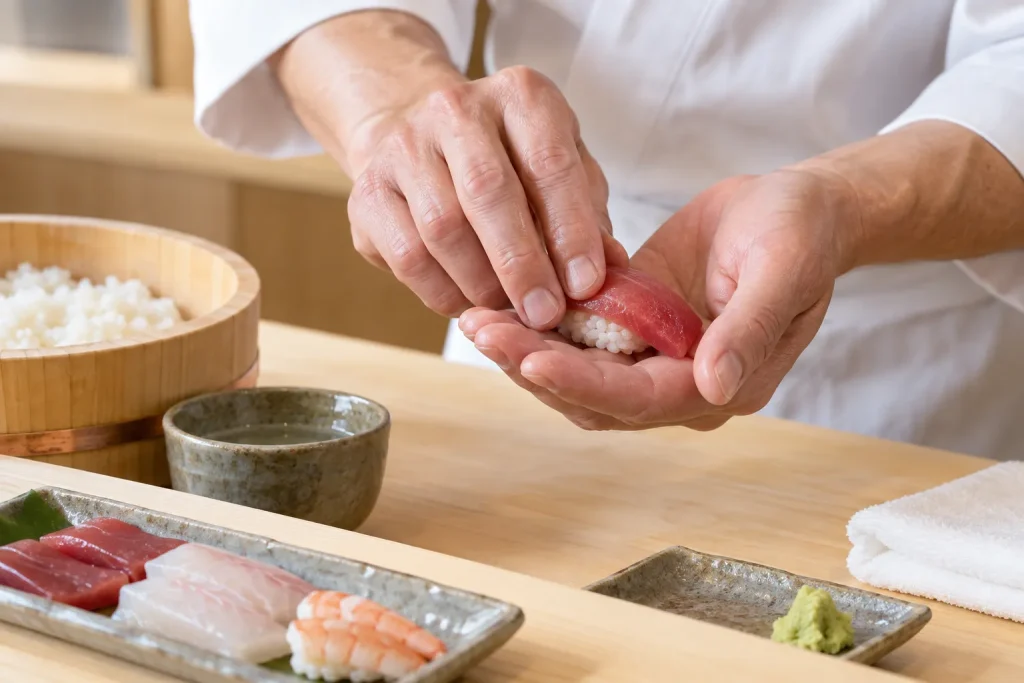
握り — nigiri — “gripped” or “formed by hand”
You hear 握り when the sushi portion of the meal begins. It refers to vinegared rice shaped by hand with a topping placed over it. The verb 握る, nigiru, means to grip or grasp, although the chef’s movement is controlled rather than forceful.
The mistake is using nigiri as another word for all sushi. Rolls and other preparations are also sushi because the defining element is seasoned rice. Sushi vs Sashimi: The Difference Is the Rice covers that distinction without repeating the full explanation here.
つまみ — tsumami — “something picked up”
You meet つまみ near the beginning of a longer dinner, often before the nigiri sequence. In this context it means small dishes designed to accompany a drink. They may include sashimi, grilled seafood, steamed items, or carefully prepared seasonal ingredients.
The mistake is expecting every omakase to consist only of individual pieces of sushi. Some counters emphasize nigiri, while others devote a substantial part of the meal to tsumami. Compare the course description before booking if you want a sushi-dominant dinner.
しゃり — shari — sushi rice
You may hear the chef or staff use しゃり for the seasoned rice under a sushi topping. The word has a historical association with small grains resembling Buddhist relics, but at the counter its working meaning is simply sushi rice.
The mistake is treating rice as neutral packing beneath expensive fish. Temperature, vinegar, firmness, salt, and portion size shape the entire bite. If you dislike strongly seasoned or warm rice, that preference affects almost every piece rather than one ingredient.
ねた — neta — the topping or featured ingredient
At a sushi restaurant, ねた means the seafood or other ingredient paired with the rice. It is related to 種, tane, meaning material or a source, with the syllables reversed in trade slang. A menu, chef, or regular customer may use it when discussing what is available that day.
The mistake is translating neta only as “raw fish.” A topping may be cured, simmered, marinated, seared, or cooked. Egg, shellfish, and other prepared ingredients also belong to the counter’s neta vocabulary.
For help recognizing ordinary menu categories without duplicating a complete food primer, see Japanese Food for Beginners: How to Read a Menu.
When the fixed sequence becomes flexible
お好み — okonomi — “what you like”
You may hear お好み after the planned sequence, when the chef asks whether you would like anything else. It signals choice according to your preference. At some sushi counters, it refers to ordering individual pieces rather than leaving the whole selection to the chef.
The mistake is hearing the English loan association with okonomiyaki and expecting a specific dish. Here, okonomi describes preference. It can also add substantially to the bill because extra pieces may be priced individually and may not appear on the original course page.
おすすめ — osusume — “recommendation”
You use or hear おすすめ when asking what the restaurant recommends. It is helpful when you want guidance without committing to a full chef-controlled menu. Staff may point to a seasonal item, a course, or a drink.
The mistake is assuming “recommended” means complimentary or included. Ask whether the suggestion belongs to the prepaid course, particularly when the chef offers an additional piece after the set menu.
追加 — tsuika — “addition”
You meet 追加 on a menu, booking option, or final bill when something has been added. At the counter, it can describe extra nigiri, a premium ingredient, or another drink. It is the clearest warning that the listed course price may not be your final food total.
The mistake is saying yes to an offered extra without establishing whether it carries a separate charge. You do not need to turn the meal into a negotiation, but you can ask politely. The site’s Japanese phrasebook contains 337 phrases, including restaurant ordering and allergy language, so those phrases do not need to be rebuilt here.
Small words that shape the final minutes
がり — gari — pickled ginger
You meet がり on the counter between pieces of sushi. Its name imitates a crisp biting or chewing sound. It refreshes the palate and may be replenished during the meal.
The mistake is placing a large mound on top of every piece. Eat it separately between bites unless the chef has intentionally included ginger in the sushi itself. You can request more, but it is an accompaniment rather than a garnish for building your own combinations.
むらさき — murasaki — “purple”
In traditional restaurant vocabulary, むらさき can refer to soy sauce. The literal meaning is “purple,” a name linked to the sauce’s dark reddish-purple appearance. You may hear it behind the counter more often than you need to say it yourself.
The mistake is expecting a purple condiment or assuming every guest should dip every piece. Many omakase counters season sushi before serving it. Watch the chef and follow the restaurant’s setup rather than automatically reaching for soy sauce.
あがり — agari — tea at the end
You may hear あがり when tea is served toward the close of the meal. It is restaurant jargon for the finishing tea, not the ordinary everyday word you need when requesting tea. Its literal associations include “rising” or “the end state,” depending on context.
The mistake is performing insider vocabulary at the counter. お茶, ocha, remains the normal, polite word for tea. Recognizing agari is useful; insisting on saying it is not.
The table below is designed for recognition at the exact moment each word matters.
| Term | Reading | Literal or working meaning | Where you meet it |
|---|---|---|---|
| おまかせ | omakase | I leave it to you | Menu selection |
| 予約 | yoyaku | Advance arrangement | Booking page |
| コース | kōsu | Fixed course | Menu and checkout |
| キャンセル料 | kyanseru-ryō | Cancellation fee | Reservation terms |
| 握り | nigiri | Hand-formed sushi | Main sushi sequence |
| つまみ | tsumami | Small accompanying dish | Before nigiri |
| しゃり | shari | Sushi rice | At the counter |
| ねた | neta | Sushi topping | Menu or chef’s explanation |
| お好み | okonomi | What you like | Individual ordering |
| おすすめ | osusume | Recommendation | Asking for guidance |
| 追加 | tsuika | Addition | Extras and final bill |
| がり | gari | Pickled ginger | Counter setting |
| むらさき | murasaki | Purple; soy sauce jargon | Counter speech |
| あがり | agari | Finishing tea | End of the meal |
The payment mechanics can be completely different in less formal restaurants. Paying Before You Sit Down explains meal-ticket machines, while The Small Dish You Never Ordered and Must Pay For covers the izakaya table charge. Neither system should be used as a model for a reserved sushi counter.
The three words worth keeping
Memorize おまかせ, omakase, because it tells you who chooses; 予約, yoyaku, because it controls whether you have a seat; and キャンセル料, kyanseru-ryō, because ignoring it can cost the full menu price. Keep nigiri, shari, and tsuika recognizable so you understand the meal and notice an extra charge. The remaining terms can stay passive vocabulary until you hear them naturally.
The practical price expectation remains ¥15,000–¥40,000 in Tokyo, approximately $100–$267 at the editorial conversion used here. A comparable New York counter often starts higher, and its printed price may still exclude tax or gratuity. The expensive mistake is not mispronouncing a fish name. It is booking a fixed seat without reading when that seat becomes nonrefundable.
Mini-FAQ
Does omakase always mean expensive sushi?
No. Omakase means leaving the selection to the chef. Price depends on the restaurant, ingredients, meal structure, location, and booking model rather than the word itself.
Can a restaurant charge the full price if I do not arrive?
Yes, if that condition was part of the reservation policy. Verified counter policies in Tokyo and New York can charge 100% of the course or the complete menu price after the stated cancellation deadline.
Should I ask the price of an extra piece?
Yes, especially if the booking page does not publish individual prices. A brief question is better than discovering several 追加, tsuika, charges on the final bill.