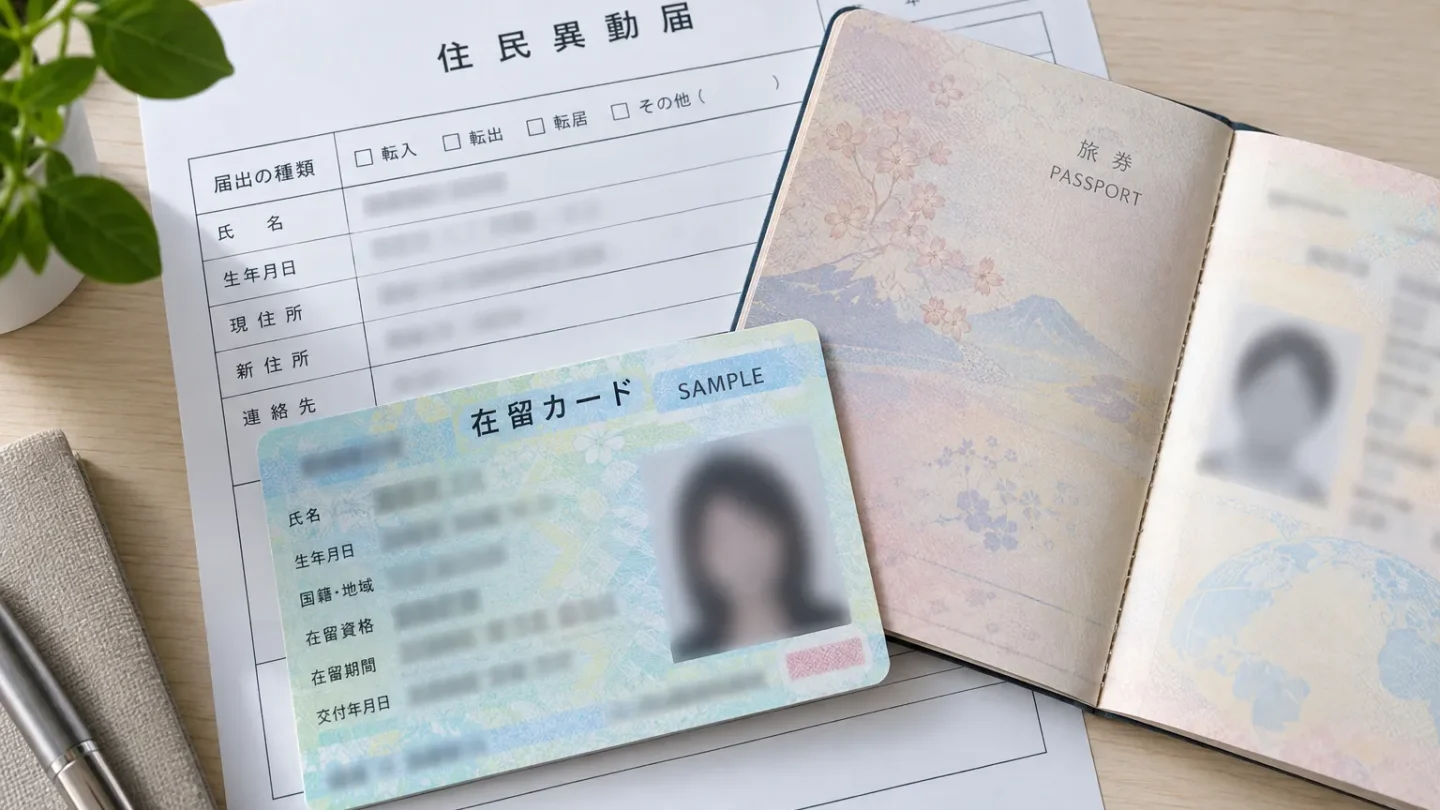
Your first decision is whether you need your legal name alone, an officially supported kanji notation, or a registered everyday alias. Choosing the wrong route can leave the name on residence card Japan issued to you inconsistent with the records used by a municipality, employer, bank, or utility provider. The answer depends on what your passport or other national documents establish, which Japanese record you are trying to change, and whether you can prove prior use of another name. 在留カード, zairyū kādo, literally “residence card,” normally prints a foreign resident’s name in Roman letters. A kanji notation is available only where official evidence supports it, while 通称, tsūshō, “commonly used name,” is a separate municipal record rather than a replacement name on the residence card.
The distinction matters because Japanese offices do not treat every written version of your name as the same identifier. Your legal Roman-letter name, a supported kanji notation, a katakana pronunciation, and a registered alias may appear in different systems. For the wider paperwork problem, Every Japanese Form That Asks for Your Name explains what to copy into each field. This article deals only with the choice among the official residence-card name, kanji co-notation, and a municipal alias. The rules described here were checked on September 12, 2026, and immigration or municipal procedures can change.
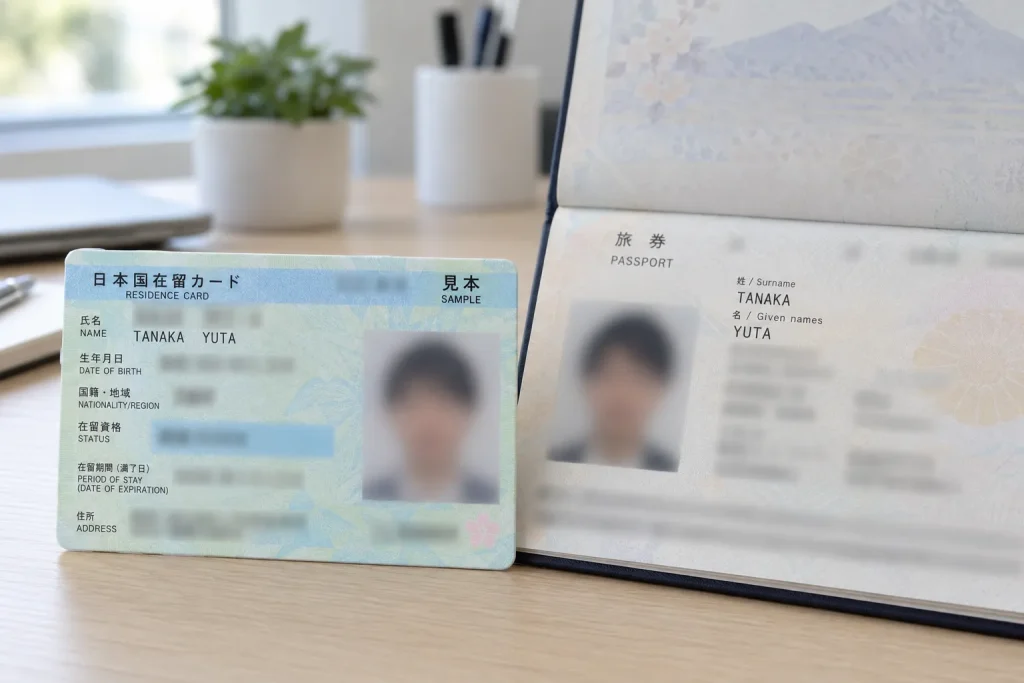
Option one: keep the official Roman-letter name
The default option is the name in Roman letters supported by your passport and immigration record. This gives you the strongest match across documents because you are not creating an additional written identity. It suits residents whose national documents do not contain an official kanji name and anyone who does not need another name recorded for daily administrative use. It also avoids suggesting that a katakana spelling or decorative kanji rendering has legal status. The cost is practical rather than legal: some Japanese databases may handle spacing, middle names, hyphens, or character limits poorly.
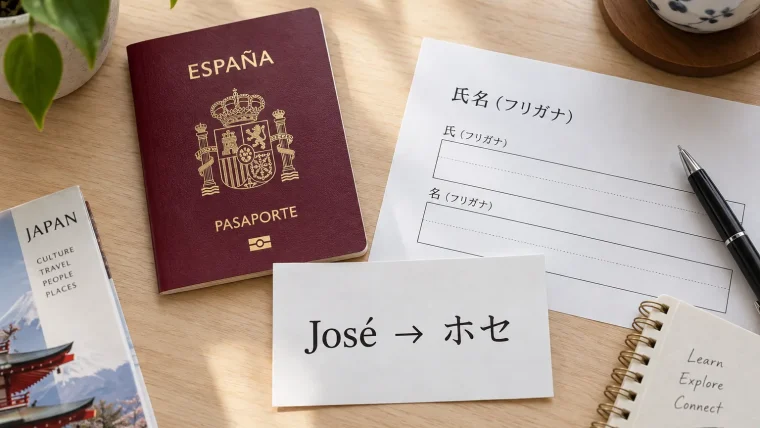
The Immigration Services Agency states that names on residence cards are written in Roman letters as a rule. “Roman letters” is the more precise term here, although people often say “English name.” The card is not a place to select the katakana spelling you prefer or to shorten a long name for convenience. A form may ask for フリガナ, furigana, literally “reading aids,” but that reading field does not change the legal name printed on the card. How to Write Your Name in Japanese: The Complete Guide covers transliteration and ordinary written use instead of repeating those rules here.
The useful question is not “Which Japanese version looks best?” It is “Which version does this particular authority recognize?”
Option two: request supported kanji notation
A person whose name is officially written with kanji in their home country may be able to request that those characters appear alongside the Roman-letter name. The Immigration Services Agency publishes a 在留カード漢字氏名表記申出, zairyū kādo kanji shimei hyōki mōshide, “request for kanji name notation on a residence card.” The procedure requires material proving that the name uses those characters in the person’s home country. This option therefore suits someone with an existing official kanji name, not someone who has merely selected attractive Japanese characters. Approval and the precise printed form depend on the official evidence and the Agency’s character-conversion rules.
That is narrower than “foreigners may choose a kanji name.” A Chinese-character name appearing in an authoritative national document is fundamentally different from 当て字, ateji, literally “assigned characters,” created for their sound or associations. Immigration notation records an established name; it does not certify a new artistic interpretation of an English name. The uncomfortable part is that a personally meaningful kanji spelling can be valid socially and still be unusable for the residence card. If your case depends on a foreign document or a character variant, confirm the accepted evidence with the Immigration Services Agency’s Foreign Residents Support Center rather than assuming that visual similarity is enough.
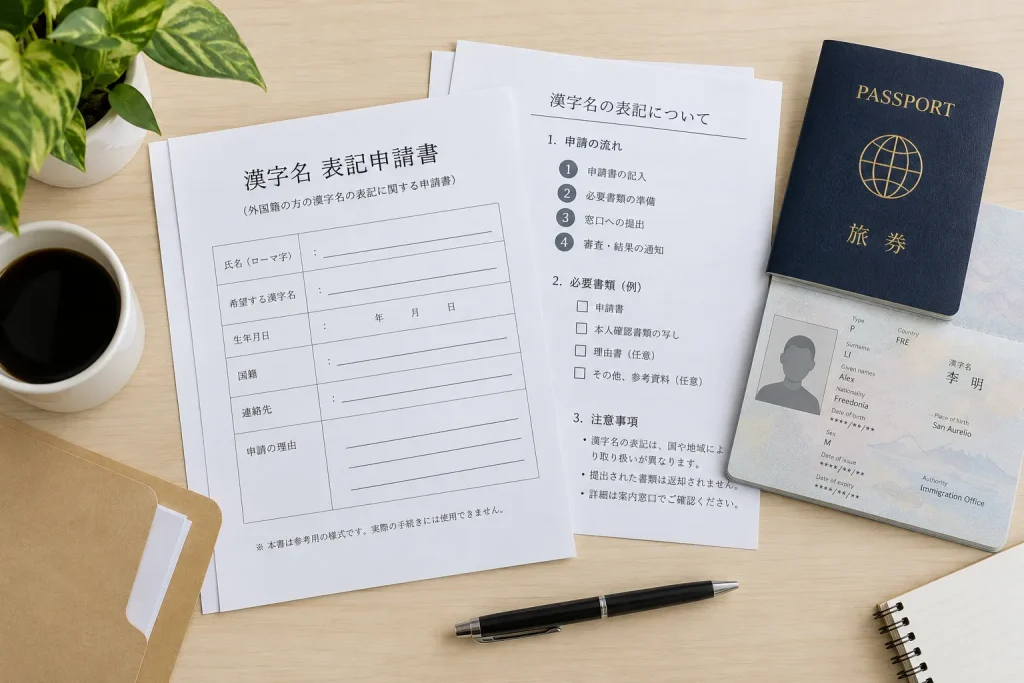
Option three: prove a commonly used name to the municipality
A commonly used name follows a different route because it belongs to the resident-record system administered by your municipality. It may be entered on the 住民票, jūminhyō, literally “resident record,” after the municipality accepts evidence that the applicant already uses it in social life. It does not replace the legal name and is not converted into the residence-card name merely because city hall records it. This option may suit a resident who consistently uses a married name, Japanese family name, or another established identifier in work and daily affairs. It does not suit someone who has just invented a preferred alias and wants official paperwork to make it established.
Municipal evidence requirements must be checked locally. Shiki City, for example, says an applicant must present two items proving everyday social use, while Matsumoto City also asks for at least two supporting materials. Other municipalities publish their own acceptable-document lists and procedures, so those examples are not a nationwide promise. Materials may include documents issued by employers, schools, financial institutions, or other organizations, but acceptance depends on the municipal rules and the facts of the application. Ask the resident-registration counter what it currently accepts before relying on a generic checklist.
Which name system are you actually trying to change?
The deciding threshold is the target record. Immigration manages the Japanese residence card name, while a municipality manages the resident record and its commonly used name entry. A private organization may maintain another customer name, phonetic field, or display name without changing either government record. These systems interact, but an entry in one does not automatically rewrite the others. You therefore need to identify the document causing the problem before selecting a procedure.
| Name form | What establishes it | Where it may appear | What it does not do |
|---|---|---|---|
| Roman-letter legal name | Passport and immigration record | Residence card and related official records | Does not supply katakana automatically |
| Supported kanji notation | Official proof of kanji use in the home country plus an Immigration Services Agency request | Alongside the Roman-letter name on an eligible residence card | Does not let you invent a new kanji identity |
| Commonly used name | Evidence of established social use accepted by the municipality | Resident record and associated municipal documents | Does not replace the residence-card name |
| Katakana rendering | Pronunciation adapted to Japanese writing | Reading fields and private records | Does not become a legal name by repeated typing |
The second threshold is evidence. If a home-country authority already records your name in kanji, there may be an immigration procedure to request co-notation. If organizations already address you consistently by another name, there may be evidence for a municipal alias application. If neither condition exists, the practical option is usually to keep the official name and use katakana only where a form requests pronunciation. A personalized rendering from the name converter with 898 checked names can help with katakana, but the tool does not create immigration evidence or a registered alias.
Worked examples: count the records, not the spellings
Consider an American resident whose passport says “ALEXANDER MORGAN REED” and contains no kanji name. The residence-card baseline is one official Roman-letter identity: ALEXANDER MORGAN REED. アレクサンダー・モーガン・リード, Arekusandā Mōgan Rīdo, may be useful in a furigana field, but adding that rendering does not create a second legal identity. Inventing kanji from the sounds does not supply the missing official evidence. The document arithmetic is therefore one legal name plus one phonetic rendering, but only the first controls the residence card.
Now consider a resident whose passport or another accepted national document records both “LI MEI” and 李梅. The person still has one identity, expressed in two scripts. The relevant arithmetic is one Roman-letter name plus one supported kanji notation, both attached to the same card record if the Agency accepts the request. The characters are evidence-based rather than chosen after arrival. This is the narrow situation behind kanji on a zairyu card.
A third resident uses a spouse’s Japanese surname at work, on correspondence, and in community activities, while the passport and residence card retain the birth name. That produces one immigration name and potentially one municipal commonly used name, subject to proof and local acceptance. It does not produce two residence-card names, and it does not erase the passport name. If city hall accepts the alias, the person must still expect some organizations to request the legal name. The arithmetic is two recorded identifiers across different systems, not two interchangeable legal identities.
| Profile | Roman-letter legal name | Kanji evidence | Evidence of alias use | Relevant route |
|---|---|---|---|---|
| US passport holder using katakana | Yes | No | No | Keep the residence-card name; use katakana only where requested |
| Holder of an officially documented kanji name | Yes | Yes | Not required for kanji request | Ask Immigration about kanji co-notation |
| Resident consistently using another social name | Yes | Not necessarily | Yes | Ask the municipality about common-name registration |
The mistakes that create mismatched records
The most common mistake is treating katakana as an official replacement name. Katakana solves pronunciation, but a phonetic field and an identity field do different jobs. The next mistake is inventing kanji and presenting them as if personal preference were equivalent to a foreign government document. A third mistake is assuming that a registered alias in Japan will be printed on the residence card. It may affect municipal and related records, but the residence card remains an immigration document.
Another mistake is rearranging the name whenever a form looks Japanese. The card’s spelling and sequence should be copied faithfully when the form asks for the residence-card name, even if another document displays family and given names differently. Surname First or Last: What to Write Where explains how to identify the field rather than imposing one order everywhere. Small differences in spaces, hyphens, and middle names can create unsuccessful electronic matching even when a human recognizes the person immediately. Do not “fix” those differences by guessing which system should surrender first.
The final mistake is ordering a seal before deciding which name the receiving organization will accept. A seal can be carved in katakana, Roman letters, or permitted kanji, but its physical existence does not grant that inscription legal status. How a Foreign Name Becomes a Carved Seal explains the inscription choices and registration issue separately. Confirm the accepted name with the bank, employer, landlord, or municipal seal-registration counter before commissioning one. The problem is institutional matching, not calligraphy.
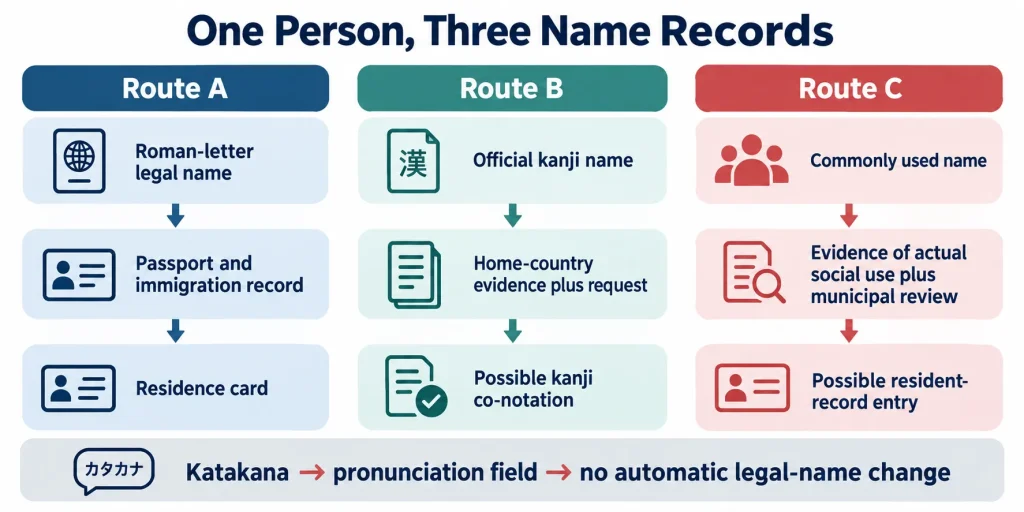
What the card cannot settle for you
The residence card proves information within the immigration system; it does not force every private database to reproduce that information cleanly. A long name may exceed an online field, while a bank may request katakana for account processing and an employer may maintain both legal and display names. Those requests do not automatically change your immigration record. They also do not prove that a new spelling is a municipal alias. When a mismatch could affect a contract, account, or official application, ask the receiving organization which document and exact field it uses for verification.
The card also cannot certify pronunciation. Roman letters may not tell a Japanese reader how you say your name, while kanji can have multiple readings. That is why forms often separate 氏名, shimei, “full name,” from furigana. Katakana Name Rules, and the Names That Break Them covers the sound decisions without presenting katakana as immigration law. Keeping these layers separate is less elegant than having one universal spelling, but it is more accurate.
Check the authority before changing anything
Rules and required evidence can change, and municipal practice is not identical across Japan. For residence-card kanji notation, check the Immigration Services Agency procedure and ask its Foreign Residents Support Center about the documents relevant to your nationality and record. For a commonly used name, check the official page of the city, ward, town, or village maintaining your resident record. For a bank or employer mismatch, ask that organization which government document it uses as the controlling source. A blog, converter, colleague, or previous applicant cannot promise how an authority will treat your case.