Surname First or Last: What to Write Where
January 1, 2020 is the date to remember. From that day, Japanese ministries and agencies were expected to present Japanese people’s names in Roman letters as family name followed by given name. That change explains why you may now see ABE Shinzo rather than Shinzo Abe in an English-language government document. It does not mean that an American named Sarah Miller should become MILLER Sarah everywhere in Japan. For a foreign applicant, the safest rule for Japanese name order on forms is simpler: identify what each field asks for, then reproduce your legal name exactly as it appears in your passport.
The distinction matters because Japan’s policy governs how public bodies present Japanese names, while your passport establishes how your own name is recorded for international identification. A form labeled 姓, sei, literally “family name,” asks for Miller. A field labeled 名, mei, literally “given name,” asks for Sarah. If a single box requests your full name “as shown in passport,” you should preserve the passport spelling and order instead of trying to look more Japanese. Every Japanese Form That Asks for Your Name covers the wider paperwork system; this article isolates the order question that creates the most preventable mismatches.
The form’s labels decide which component goes where; your passport decides how each component is spelled.
The 2020 rule has a narrow target
Japan’s Agency for Cultural Affairs announced the policy after the Council for Cultural Affairs reviewed the long-standing practice of reversing Japanese names for foreign-language contexts. The adopted principle was 姓名, seimei, literally “family name and given name,” in that sequence when Japanese names are written in Roman letters. The policy was agreed in 2019 and applied to central-government documents from January 1, 2020. Its purpose was to make the Roman-letter presentation consistent with the order already used in Japanese writing. It was not a general instruction to rearrange every foreign visitor’s name.
Capital letters can provide an additional clue, but they are not the rule you should build your application around. Government guidance allows the family name to be emphasized, commonly as ABE Shinzo, when readers could otherwise misidentify the two components. Capitalization identifies the surname; it does not create a different legal name. Other organizations may use Abe Shinzo without capitals, and older English-language material may still say Shinzo Abe. The useful information is the labeled role of each component, not the typography.
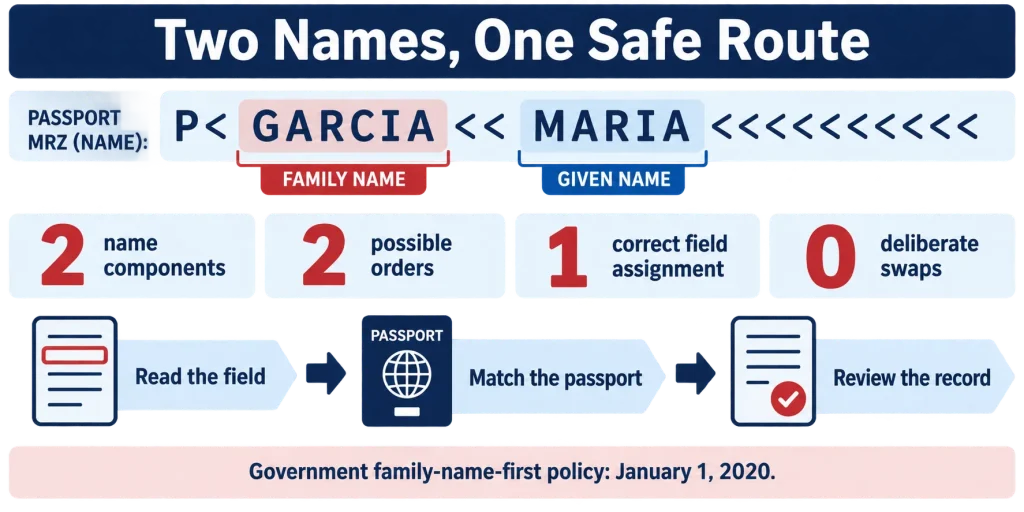
Two components, two possible orders, one correct entry
For a typical two-part American name, the arithmetic is small enough to show openly. Start with one family name and one given name. Those two components can appear in two linear orders, but only one arrangement belongs in a particular field or matches a specific document. The form therefore gives you the order, while the passport supplies the spelling. This is a classification problem rather than a translation exercise.
| Counted item | Quantity | What determines it | Source and date |
|---|---|---|---|
| Family-name component | 1 | Passport identity page | Passport in force on the application date |
| Given-name component | 1 | Passport identity page | Passport in force on the application date |
| Possible two-part orders | 2 | Family–given or given–family | Basic permutation of 2 components |
| Acceptable improvised rearrangements | 0 | Do not override labeled fields or passport instructions | Relevant official form, checked September 10, 2026 |
| Total components to place | 2 | One component in each labeled field | Recheck when the form or passport changes |
Take the worked example Sarah Miller. If a form has a “Surname/Family name” box and a “Given name” box, enter Miller in the first and Sarah in the second. The completed screen may display MILLER Sarah, Sarah MILLER, or the names in separate rows, depending on how that system formats records. You do not “correct” the display by exchanging the contents of the boxes. The correct calculation is one family name plus one given name, entered once each, producing two correctly classified components and zero deliberate swaps.
- Read the field label before entering any letters.
- Find the matching component on the passport identity page.
- Copy the spelling, spaces, and hyphens used by the passport.
- Put the family name only in the surname field.
- Put all requested given names in the given-name field.
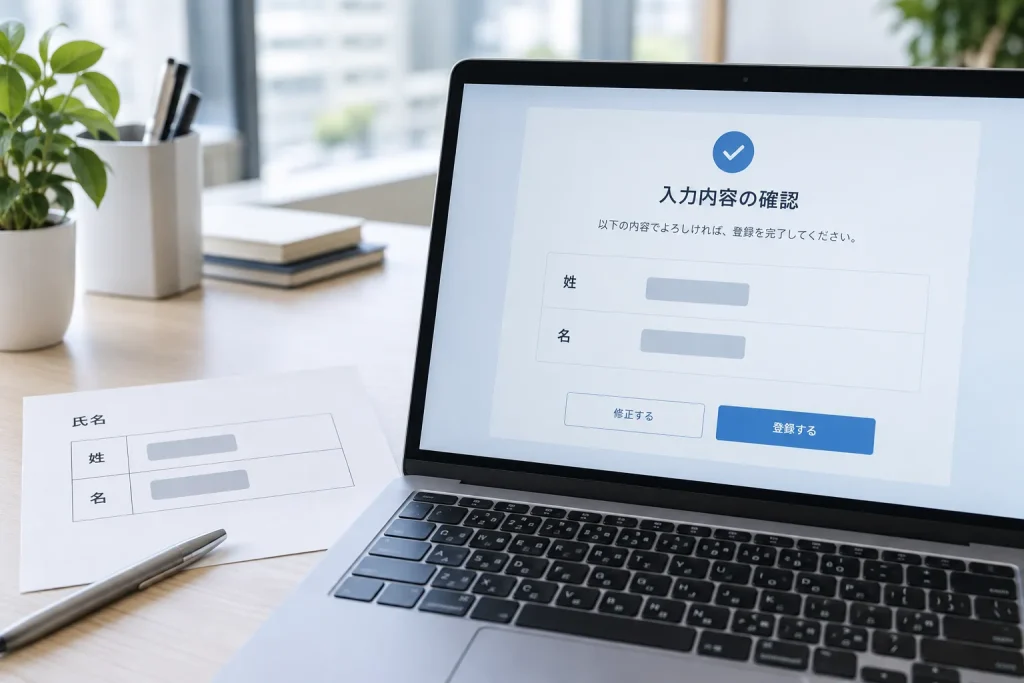
- Review the confirmation screen without assuming that display order equals field order.
The same logic applies when an application uses uppercase labels such as SURNAME and GIVEN NAME. “First name” and “last name” can be less helpful because they mix position with function, particularly when names move between cultural conventions. “Family name” and “given name” tell you what the components are. If the instructions say “as shown in passport,” that sentence takes priority over your guess about local style. Matching the identity document is more important than making the finished line resemble a Japanese person’s name.
What can actually change the answer
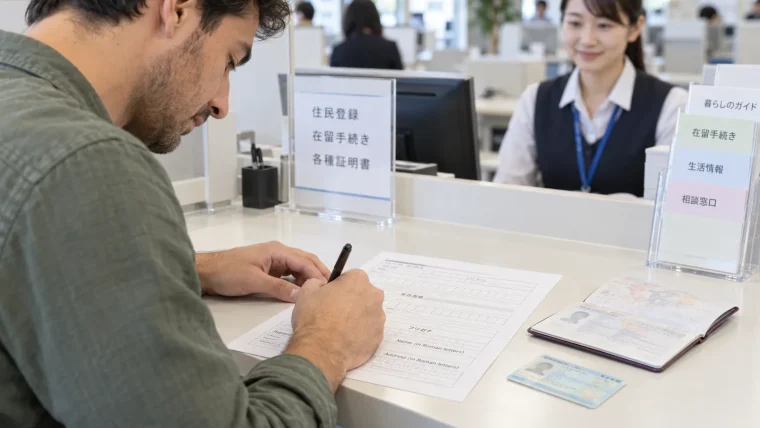
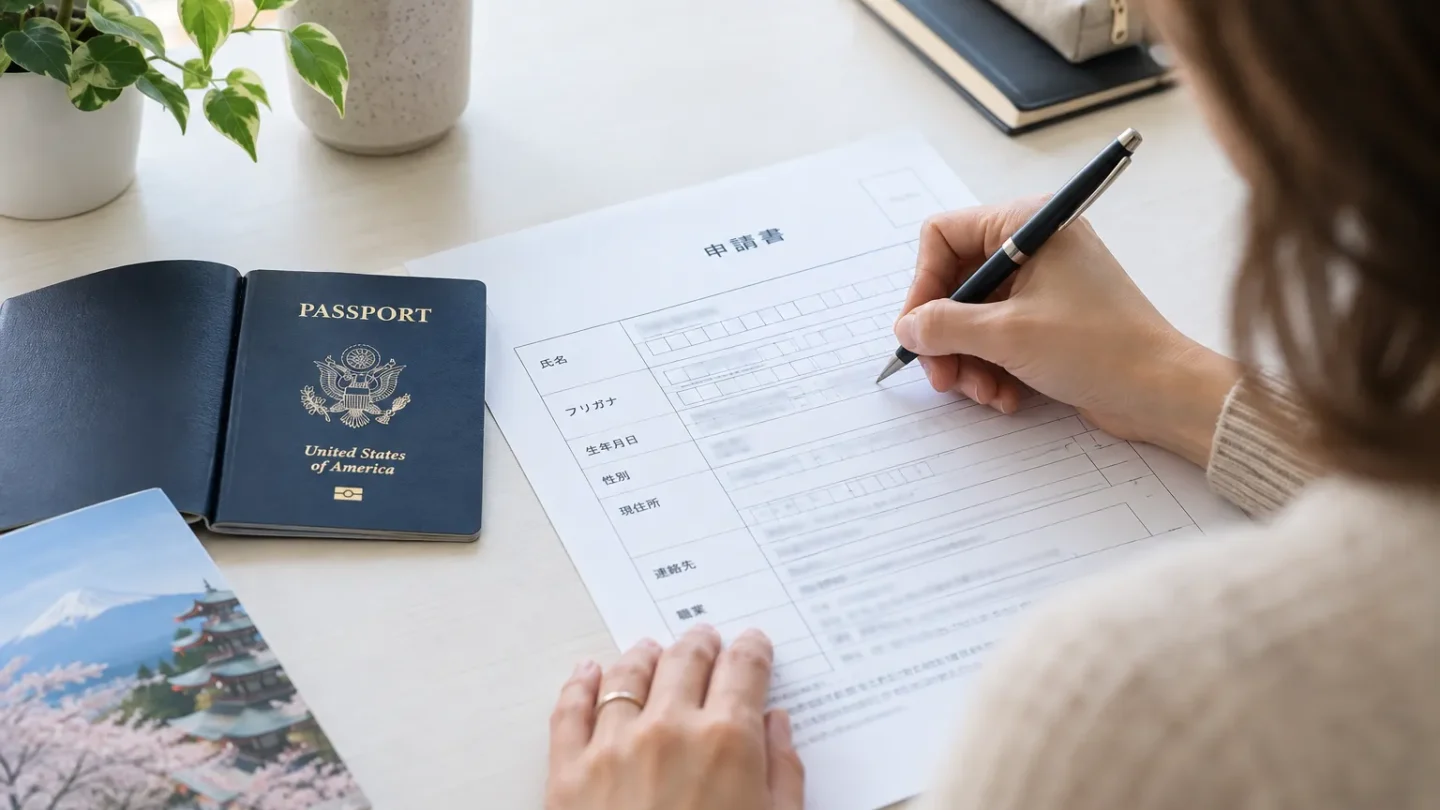
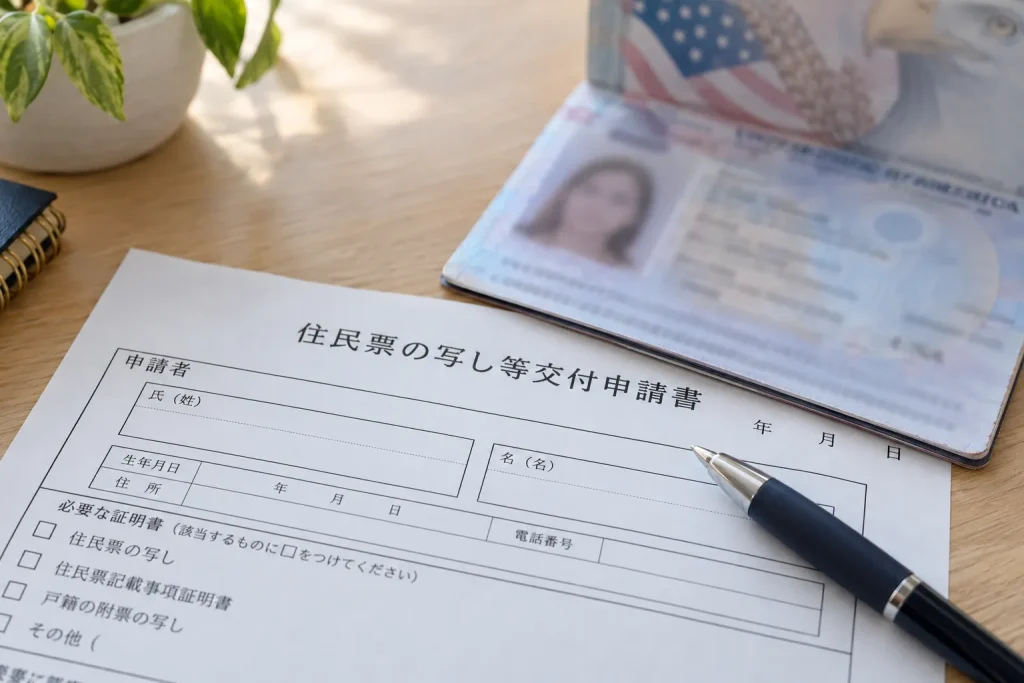
The most important variable is the form design. Two separately labeled fields remove the order question because each box has a defined job. A single “full name” field requires you to read the instruction beside it, especially if it mentions passport order. A Japanese-only field may use 姓, sei, “family name,” and 名, mei, “given name.” A フリガナ, furigana, literally “reading aid,” field asks for the name’s reading rather than permission to alter its legal order.
The second variable is the identity document named by the institution. Immigration and visa processes generally organize names using the surname and given-name divisions found in the passport. Airlines and reservation systems also warn travelers that booking details must correspond to travel documents, although their display order can vary. A bank, employer, school, or municipal system may compare your new entry with an existing Japanese record. Once one organization has registered a particular spacing or sequence, consistency with that record can become as important as the original form instructions.
| Situation | Family-name entry | Given-name entry | Safe governing reference |
|---|---|---|---|
| Two labeled Roman-letter fields | Passport surname | Passport given name or names | Field labels plus passport |
| One box marked “as shown in passport” | Copy as presented or instructed | Copy as presented or instructed | Passport and form directions |
| 姓 and 名 fields | 姓: family name | 名: given name | Japanese labels |
| Furigana or katakana fields | Reading of family name | Reading of given name | Institution’s script instructions |
| Existing Japanese account or record | Match registered family name | Match registered given name | Current record and official ID |
| Japanese person cited in government English | Family name generally first | Given name generally second | Government policy effective January 1, 2020 |
Middle names, compound surnames, suffixes, and mononyms make the two-part example less complete, but they do not change the method. Do not silently delete a middle name because a small form looks inconvenient. Do not remove a hyphen, merge spaces, or invent a surname for a one-name passport holder unless the receiving authority provides a documented method. Where a digital form cannot represent your passport accurately, save the error message and ask the institution how it records that name type. The uncomfortable part is that a tidy but invented entry may pass the first screen and create the mismatch later.

Roman letters and katakana do different jobs
Roman-letter order is only one layer of Japanese paperwork. A foreign name may also be requested in カタカナ, katakana, literally “fragmentary kana,” the script normally used for foreign names. Katakana records pronunciation rather than replacing the identity written in your passport. If you need the spelling process, How to Write Your Name in Japanese: The Complete Guide explains the scripts and the decisions behind a usable Japanese rendering. The name in katakana and the passport name should correspond, but they are not interchangeable records.
Pronunciation can also resist automatic conversion. Katakana Name Rules, and the Names That Break Them explains why established usage sometimes beats a mechanical letter-by-letter result. The site’s name converter contains 898 checked first names, with a separate page for each, and reports that 323 require a spelling different from a basic rule-generated form. Those counts describe the site tool as checked on September 10, 2026; they are not government totals. Use the tool to investigate pronunciation, never to rewrite the Roman-letter identity supplied by your passport.
Why copying the visible order can fail
A confirmation page can display your name differently from the order in which you entered it. Databases often store family name and given name in separate fields and then assemble them according to the interface language or document template. Seeing MILLER Sarah on a Japanese screen therefore does not prove that you entered your surname into a “first name” box. It may simply mean that the software displays family names first. Reversing the inputs to force Sarah Miller onto the screen can put both components in the wrong database fields.
This is why surname first in Japan is an incomplete rule for foreign applicants. It accurately describes ordinary Japanese name order and the government’s modern Romanization policy for Japanese names. It does not override a passport, a labeled application field, or instructions issued for a specific procedure. The U.S. comparison is a tax or airline form that stores surname and given name separately even when a later screen prints them in another sequence. What matters is correct classification at entry, not the cosmetic order of the preview.
The practical cost of a swap cannot be stated as one sourced dollar or yen figure. Different institutions have different correction processes, and some corrections are free while others may require cancellation, rebooking, a personal visit, or a fresh application. No primary source establishes a universal “wrong name order fee” for Japanese paperwork. Any article claiming a single nationwide price would manufacture precision that the rules do not support. The honest total is zero deliberate swaps, not a fictional correction charge.
When the seal follows the registered name
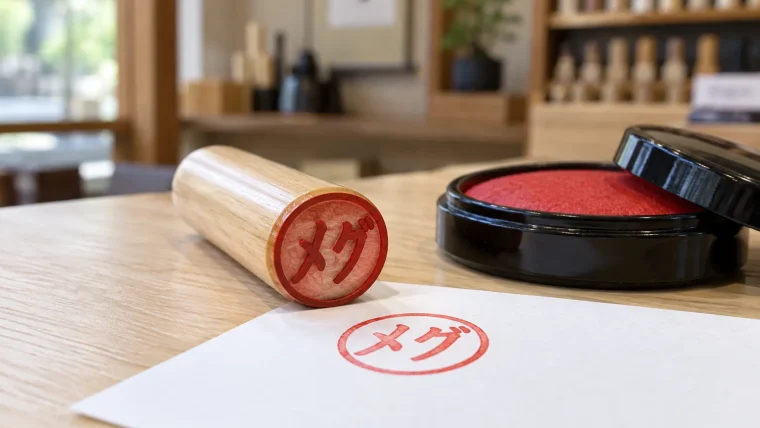
Long-term residents may encounter another representation of their name when ordering a 印鑑, inkan, literally “seal impression,” or 判子, hanko, literally “name stamp.” The permitted characters, dimensions, and registration conditions can depend on the municipality and the resident record used there. That means a visually attractive stamp is not automatically registrable. How a Foreign Name Becomes a Carved Seal explains how spelling, script, and local registration rules shape the result. Check the municipality before paying for a custom carving if official registration is the goal.
A seal also cannot repair inconsistent paperwork. If your bank record, residence documentation, and application use different component orders, carving one version into a stamp does not make the records agree. Begin with the legal identity already recognized by the relevant authority. Decide whether the seal is for informal use or registration, since those are different requirements. Then order the carving only after the acceptable name form has been confirmed.
A safer checklist before you submit
Before submitting, compare every entry with the document the form names as its reference. Read 姓 as family name and 名 as given name, even if the final preview places the components in an unfamiliar sequence. Preserve hyphens, spaces, and multiple given names whenever the system permits them. Treat an inability to enter your legal name as a form limitation that needs clarification, not as permission to invent a workaround. Save a screenshot or copy of the submitted version when the transaction matters.
Use this short review for passport name matching:
- Both surname and given-name fields contain the correct components.
- Roman-letter spelling follows the passport.
- Middle names have not been silently omitted where requested.
- Katakana is entered only in fields requesting a phonetic reading.
- The display order has not prompted you to reverse correctly classified fields.
- An existing Japanese record has been matched where the form requires it.
If uncertainty remains, ask a precise question: “Should this single full-name field follow the machine-readable passport order or the printed name line?” That is more useful than asking whether Japan uses surnames first, because the general cultural answer may not resolve the specific form. Include a screenshot with personal numbers and photographs removed or covered. Record the institution’s answer if the application affects immigration status, travel, banking, employment, or education. A written reply gives you something concrete to follow if the interface behaves differently later.
Frequently asked questions
Should an American write the surname first on every Japanese form?
No. You should place the surname in the surname or family-name field and the given name in the given-name field. If the form has one full-name box, follow its instructions and any requirement to copy the passport. Japan’s family-name-first convention does not authorize you to rearrange a foreign legal name without checking the form. When instructions conflict or the interface is unclear, contact the organization before submitting.
Does the January 1, 2020 policy apply to foreign names?
The government policy specifically addresses the Roman-letter presentation of Japanese people’s names in official documents. It does not establish a universal new order for the names of foreign applicants. Foreign travelers and residents remain tied to the identity information in their passports and relevant Japanese records. The policy explains ABE Shinzo; it does not automatically turn Sarah Miller into MILLER Sarah in every database.
What do 姓 and 名 mean?
姓, sei, means family name or surname, while 名, mei, means given name. On a two-field form, Sarah Miller would normally place Miller under 姓 and Sarah under 名. Those labels describe the components, not the visual order Americans expect in a complete name. Always check whether the form also provides English guidance or passport-specific instructions.
Should I capitalize my surname?
Capitalization can make the family name clear, and Japanese government examples may emphasize a Japanese surname in capitals. However, you should not alter the capitalization required by a specific application merely to imitate that presentation. Use the format accepted by the form and remain consistent with your identity documents. Capital letters are a clarification device, not a substitute for correct fields.
What single figure should I remember?
Remember January 1, 2020, the effective date for the Japanese government’s family-name-first presentation of Japanese names in Roman letters. Recheck the rule and the current form instructions by September 19, 2027, or sooner if the relevant ministry, immigration procedure, passport, or application interface changes. For your own entry, the enduring rule is still to match the passport and obey the labels. Do not swap name components simply because the finished screen looks unfamiliar.