Learn Hiragana Fast: A Two-Day Schedule for 46 Characters
You are at a desk with blank paper in front of you, and by Sunday night you expect yourself to read hiragana without an app supplying the answer. The practical way to learn hiragana fast is not to swipe through an endless flashcard deck. You will divide the basic kana into two groups, learn five gojūon rows each day, and test every block on real Japanese words. The goal is accurate recognition, not beautiful calligraphy or permanent mastery in a single weekend.
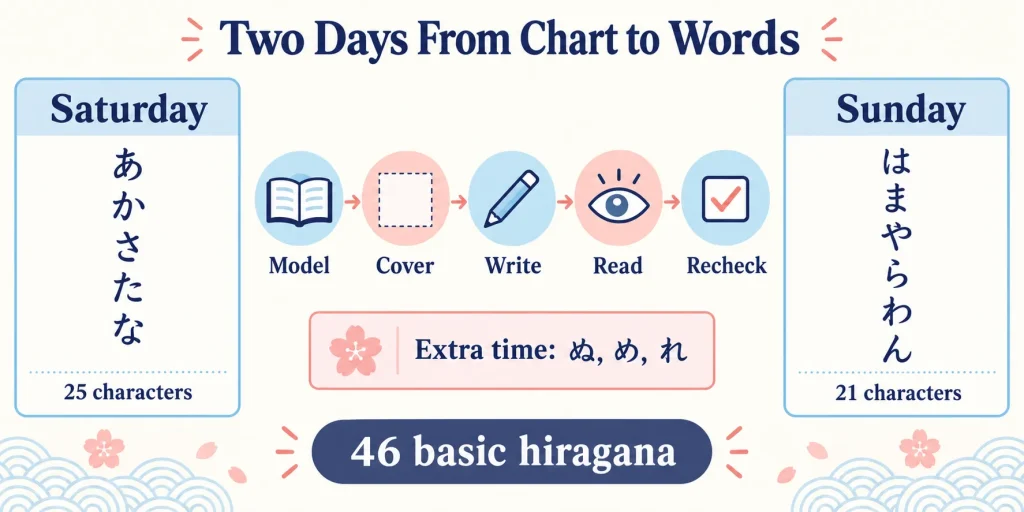
The modern basic hiragana set contains 46 characters. The name 五十音, gojūon, literally “fifty sounds,” survives even though the standard chart has gaps where older or unused combinations might seem to belong. You will cover the five vowel-based rows from あ to の on the first day, then the remaining rows and ん on the second.
“I recognized it in the app” and “I read it inside a word” are not the same achievement.
What You Need Before the First Hour
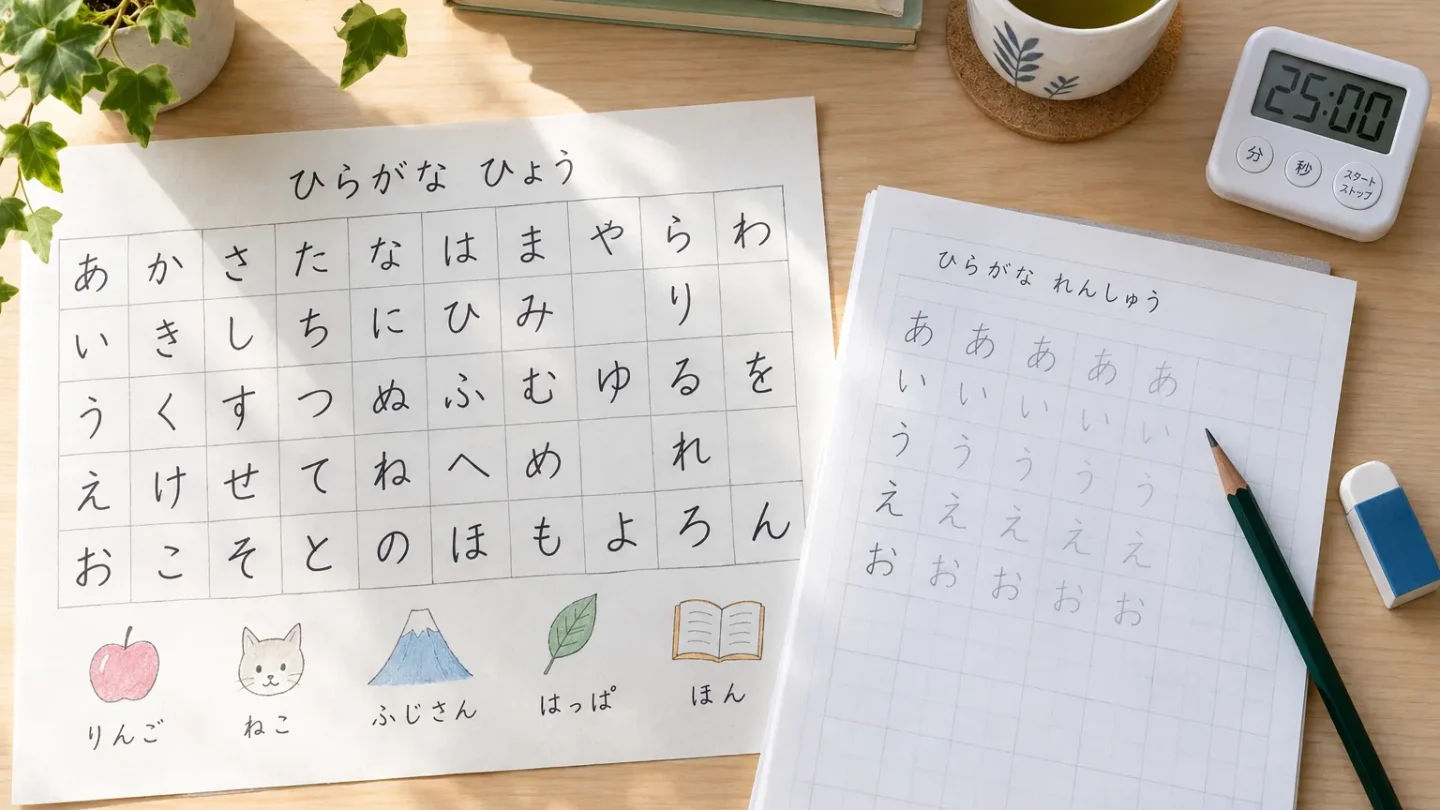
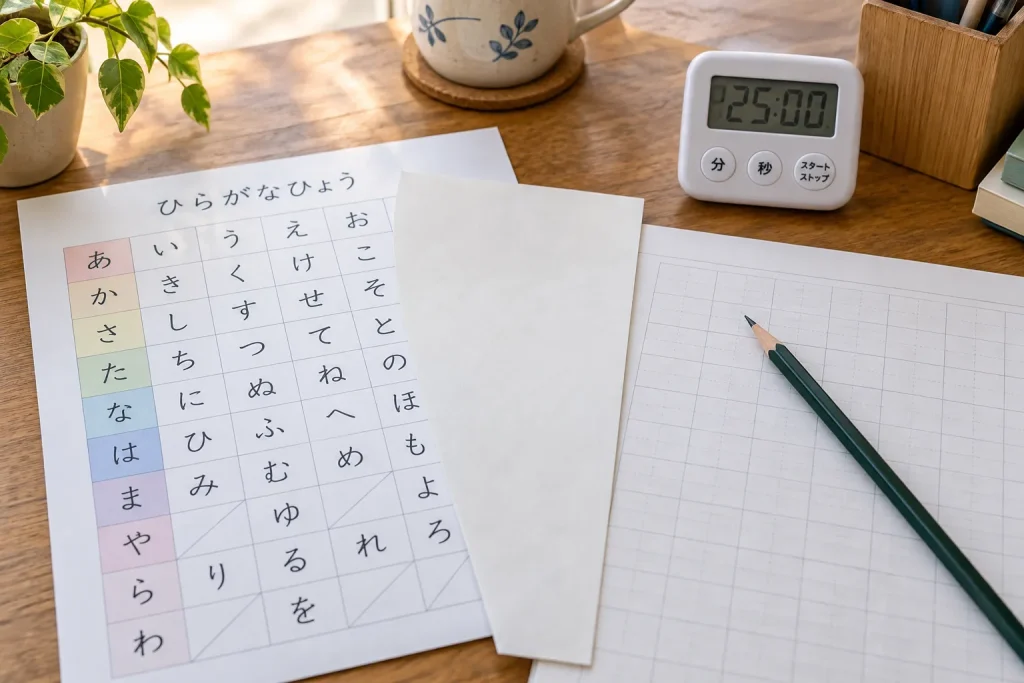
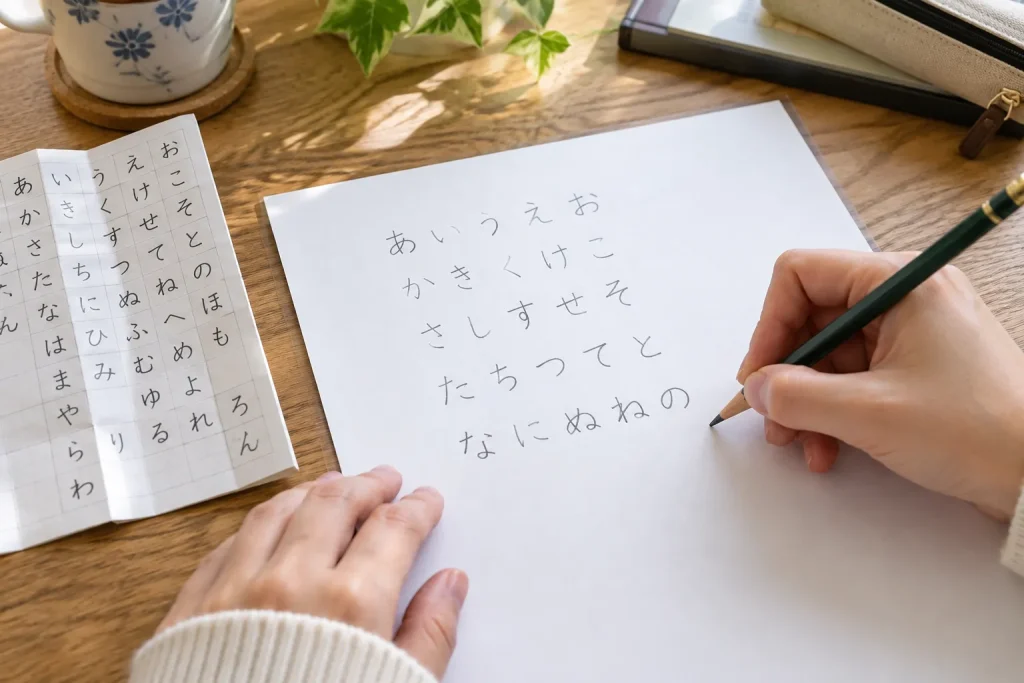
Prepare paper, a pencil or pen, a timer, and one printed or handwritten kana chart. Fold or cover the chart so you can reveal only the row you are studying. You may use audio to confirm pronunciation, but your main work happens on paper and inside real words.
Do not begin by decorating a notebook or searching for the perfect application. The uncomfortable truth is that shopping for study tools can consume the time you meant to spend learning. A plain sheet of paper is sufficient because the protocol depends on retrieval, handwriting, and reading—not premium features.
Before starting, understand what hiragana does. 平仮名, hiragana, literally “plain kana,” represents Japanese morae, rhythm units that are often slightly shorter and more regular than English syllables. If you need the larger distinction among scripts, Hiragana, Katakana, Kanji: How Japanese Writing Works explains their separate jobs without turning this weekend into a history lesson.
The Two-Day Map at a Glance
Each study hour has the same internal pattern: learn one row, write it from memory, read words containing familiar characters, and perform a short delayed check. An “hour” here is a scheduled study block rather than a claim about how long every learner must need. If fatigue makes your recall collapse, pause and resume later instead of copying symbols without attention.
| Day | Study block | New material | Character total after block | Real-word check |
|---|---|---|---|---|
| Saturday | First hour | あ い う え お | 5 | あい, いえ, うえ |
| Saturday | Second hour | か き く け こ | 10 | あか, かお, えき |
| Saturday | Third hour | さ し す せ そ | 15 | すし, あさ, せかい |
| Saturday | Fourth hour | た ち つ て と | 20 | した, つき, ちかい |
| Saturday | Fifth hour | な に ぬ ね の | 25 | なつ, ねこ, にく |
| Sunday | First hour | は ひ ふ へ ほ | 30 | はな, ひと, ふね |
| Sunday | Second hour | ま み む め も | 35 | みみ, あめ, まち |
| Sunday | Third hour | や ゆ よ | 38 | やま, ゆめ, やさい |
| Sunday | Fourth hour | ら り る れ ろ | 43 | そら, くるま, さくら |
| Sunday | Fifth hour | わ を ん | 46 | わたし, ほん, にほん |
The sequence follows the conventional gojūon order. The First 92 Characters, in Order gives the complete path through hiragana and katakana; this protocol isolates the first script so you can finish a defined task before adding another set.
Saturday: Build the First Half
Follow the numbered sequence in order. At every stage, say the sound, cover the model, write the character, and then read it in a word. Copying while looking at the answer may improve pen movement, but it does not prove recall.
- First hour: anchor the five vowels.
Learn あ, い, う, え, and お in that order. Look at each model, trace its major movement once, then cover it and write it from memory. Shuffle the order before reading あい, ai, “love”; いえ, ie, “house”; and うえ, ue, “above.” What happens next is important: the vowels become the right-hand framework for every consonant row that follows. - Second hour: add the k-row.
Learn か, き, く, け, and こ while keeping the vowel order visible only as a heading. Read あか, aka, “red”; かお, kao, “face”; and えき, eki, “station.” If you can write the row but hesitate inside えき, return to the word rather than copying き repeatedly. - Third hour: handle the irregular romanization in the s-row.
Learn さ, し, す, せ, and そ. Notice that し is normally written shi in Hepburn romanization, not si, but do not let the Roman letters become the answer you read first. Test すし, sushi, “sushi”; あさ, asa, “morning”; and せかい, sekai, “world.” - Fourth hour: slow down for ち and つ.
Learn た, ち, つ, て, and と. The forms ち and つ need deliberate visual comparison because their curved strokes can blur together when you rush. Read した, shita, “below”; つき, tsuki, “moon”; and ちかい, chikai, “near.” What happens next is your first mixed-row reading test. - Fifth hour: finish with the n-row and a cold review.
Learn な, に, ぬ, ね, and の. Test なつ, natsu, “summer”; ねこ, neko, “cat”; and にく, niku, “meat.” Put the chart away, take a real break, then write every character learned that day in chart order from memory. Circle omissions instead of filling them in invisibly.
Saturday succeeds when you can retrieve the characters after a delay, not when the practice page looks full.
Sunday: Finish the Chart and Read Across It
Do not start Sunday by adding new material immediately. First, read Saturday’s word list with the romanization covered. Then write the five earlier rows once from memory. This review is where fragile recognition becomes usable recall.
- First hour: learn the h-row without trusting English spelling.
Study は, ひ, ふ, へ, and ほ. In standard Hepburn romanization, ふ is commonly written fu, although its Japanese pronunciation does not exactly match a forceful English “foo.” Read はな, hana, “flower”; ひと, hito, “person”; and ふね, fune, “boat.” - Second hour: add the m-row and compare curved forms.
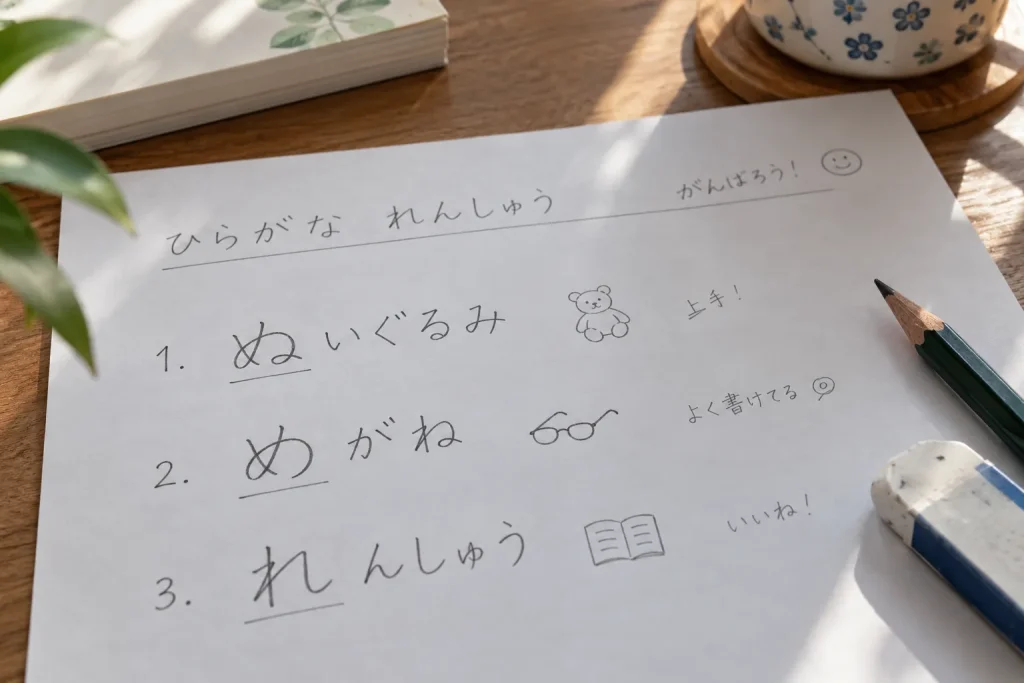
Learn ま, み, む, め, and も. Read みみ, mimi, “ear”; あめ, ame, “rain” or “candy” depending on pitch and context; and まち, machi, “town.” Give め extra attention because it can become confused with ぬ when you remember only a general loop. - Third hour: learn the shortened y-row.
Study や, ゆ, and よ. The standard row does not contain modern basic characters corresponding to “yi” and “ye,” so do not invent empty items merely to preserve a five-column pattern. Read やま, yama, “mountain”; ゆめ, yume, “dream”; and やさい, yasai, “vegetables.” - Fourth hour: add the r-row through whole words.
Learn ら, り, る, れ, and ろ. Do not force these sounds into an English “r” or “l”; Japanese uses a different tongue movement. Read そら, sora, “sky”; くるま, kuruma, “car”; and さくら, sakura, “cherry blossom.” Spend extra review time on れ because its open shape is easy to misremember. - Fifth hour: close the basic set.
Learn わ, を, and ん. In ordinary modern Japanese, を usually marks an object and is generally pronounced like お, although it retains a separate written form. Read わたし, watashi, “I”; ほん, hon, “book”; and にほん, Nihon, “Japan.” Finish by reading the weekend word list in a new order, with no romanization visible.
The three characters worth extra time on the second day are ぬ, め, and れ. This is a practical recommendation based on their potential for visual confusion, not an official ranking of difficulty. Write each inside a known word instead of producing an isolated page of identical symbols.
| Character | Likely confusion | Better comparison | Word-level check |
|---|---|---|---|
| ぬ | め or ね | Identify the loop and finishing line | いぬ, inu, “dog” |
| め | ぬ | Compare the ending rather than the center | あめ, ame, “rain” |
| れ | わ or ね | Watch the open right side | はれ, hare, “clear weather” |
Where the Weekend Plan Breaks
The first failure point is passive recognition. You see き, think “that looks familiar,” and reveal the answer before producing a sound. Instead, keep the answer covered until you have made a decision. A wrong attempt gives you useful information; instant revealing does not.
The second failure point is dependence on romaji. ローマ字, rōmaji, literally “Roman letters,” can label a new sound, but it should not remain underneath every word. If you want the differences among the major spelling conventions, Romaji Explained: Three Systems and Which One to Use covers that subject. During this weekend, conceal the Roman letters as soon as you can pronounce the row accurately.
The third failure point is confusing copying with writing. Looking at さ while producing ten versions of さ rehearses your hand, but the model is still doing the memory work. Close the chart after the first guided attempts. Retrieve the form, compare it with the model, and correct only what changed.
The fourth failure point is studying characters without reading. Flashcards may tell you that you recognized は, but a word such as はな shows whether you can move from one sign to the next. This is why the protocol uses hiragana practice words after every row.
Adjust the Schedule Without Losing the Method
The plan can change around your location and available time, but its order should remain stable: limited input, handwritten recall, word reading, then delayed testing. At home, you can speak every item aloud. In a library or on a train, whisper or subvocalize while still writing and reading.
If you cannot complete five continuous study hours, divide the blocks between morning and afternoon. Do not merge several rows into one late-night cram session simply to keep the label “one weekend.” Sleep and delayed recall reveal which forms are genuinely available without prompts.
If handwriting is difficult because of a disability or injury, use a tablet, tracing input, or a keyboard-based recognition test. The essential feature is active retrieval. You must produce or identify the character before the tool displays it.
There is no seasonal variation in the kana themselves. Your practice vocabulary can change with your surroundings, however. はれ, hare, “clear weather,” is useful on a bright day, while あめ, ame, “rain,” is easy to remember when it is actually raining. That connection is a memory cue, not a different curriculum.
Formality also does not alter the shape of hiragana. Formal and informal Japanese use the same writing system, even though their vocabulary and grammar differ. This weekend teaches decoding; it does not teach when an entire sentence is socially appropriate.
What Nobody Will Notice
Nobody minds if your handwritten characters do not resemble a typeface. Fonts, handwriting, and brush forms differ. Your goal is a recognizable structure with the correct major strokes, not mechanical imitation of a computer font.
Nobody checking your beginner work expects calligraphy. Stroke order matters because it supports readable proportions and efficient writing, but an imperfect line does not invalidate an otherwise recognizable character. Correct the recurring structural error and keep reading.
You also do not need native-speed recognition by Sunday night. If you pause and then identify the right kana without revealing the answer, the memory is working. Speed develops through repeated encounters with words and sentences.
Finally, nobody benefits when you pretend the weekend created permanent mastery. Without review, many forms will fade. The weekend gives you a first working map; the following days determine whether the map remains accessible.
The honest weekend result is not “I finished hiragana forever.” It is “I can now practice Japanese without treating every hiragana character as new.”
What the Weekend Does Not Cover
The basic set is only the foundation of how to read hiragana. You will still need 濁点, dakuten, literally “voicing mark,” as in が, and 半濁点, handakuten, literally “half-voicing mark,” as in ぱ. You will also meet small ゃ, ゅ, and ょ in contracted sound combinations, plus small っ for a following doubled consonant.
Those additions should come after the base forms are stable because they modify or combine characters you already know. Trying to absorb every variation during the same first session makes the finish line difficult to define. Complete the basic chart first, then extend it.
Hiragana also does not replace katakana or kanji. It lets you read grammatical endings, particles, many native words, and pronunciation guides, but normal Japanese text combines scripts. The linked writing-system overview explains that division of labor; duplicating it here would distract from the weekend protocol.
The site’s name converter is useful when you later want to see how an English-language name is represented in katakana. Its listed names are checked individually rather than produced only by a mechanical transliteration rule. It is a katakana tool, so it should not become part of this hiragana weekend.
The Sunday-Night Test
Make a fresh sheet with four sections. In the first, write the chart from memory. In the second, read a shuffled list of familiar words. In the third, identify characters selected randomly from the chart. In the fourth, write several kana after hearing their sounds.
Use three honest marks:
- Correct immediately
- Correct after hesitation
- Incorrect or omitted
A hesitant answer is not the same as an error, but it is not yet automatic. Put hesitant and incorrect characters into Monday’s review set. Do not restart the entire chart because a small group remains weak.
Your final word test should contain only material built from the characters you studied. Examples include いえ, ねこ, すし, くるま, さくら, やさい, わたし, and にほん. Read the kana first, then confirm the meaning. If you recognize the English gloss before decoding the characters, shuffle the order again.
FAQ About Learning Hiragana in a Weekend
Can you really learn hiragana in two days?
You can build first-pass recognition and handwritten recall of the basic set during a concentrated weekend. You should not claim permanent mastery after one pass. Continued review and reading determine whether the characters remain available.
Should I learn to write or only recognize the characters?
Do both during the first weekend. Handwriting forces you to retrieve the complete shape, while reading words tests recognition in sequence. If handwriting is inaccessible, replace it with another active-production task rather than passive viewing.
Why use real words instead of only flashcards?
Words reveal whether you can recognize consecutive characters without depending on an isolated card format. They also connect the forms to vocabulary you will encounter again. Flashcards can support review, but they should not be the only test.
Should I learn katakana at the same time?
Not in this schedule. Finish a stable first pass through hiragana, then begin katakana with the same retrieval-and-word method. Mixing both sets immediately can make similar-looking forms harder to separate.
Do I need perfect stroke order?
Learn the standard order and direction because they help produce consistent, readable shapes. However, do not spend the whole weekend polishing one character. Fix major structural mistakes, then return to reading.
What should I review on Monday?
Review every item marked hesitant or incorrect during the Sunday-night test. Give particular attention to hiragana characters you confuse with another form. Read them inside words before testing them alone again.