The First 92 Characters, in Order
Japanese solves the problem of writing an entire spoken language with two symbol sets of 46 characters each — hiragana (平仮名, ひらがな, hiragana, “ordinary kana”) and katakana (片仮名, カタカナ, katakana, “fragmentary kana”) — by running both sets on the same underlying grid, and that grid is the actual reason how to learn hiragana stops being a memorization slog once you see it. Ninety-two characters sounds like a lot until you remember that English speakers already juggle 52 letter shapes plus ten digits without much trouble; the difference is that most courses hand you a hiragana and katakana chart and call it a system, when the system underneath the chart is what actually makes the characters predictable.
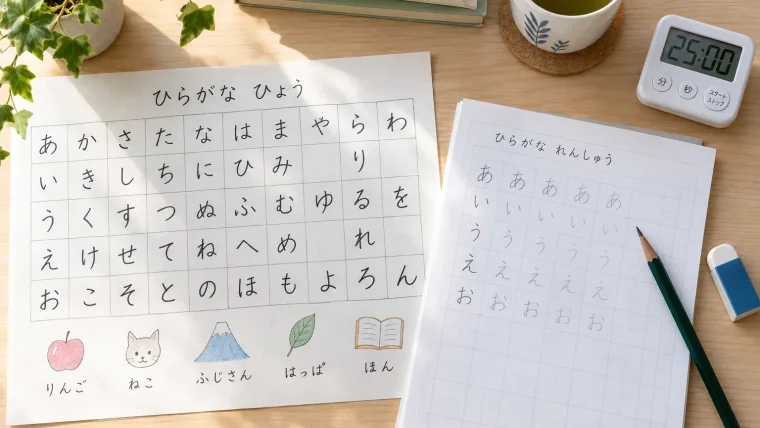
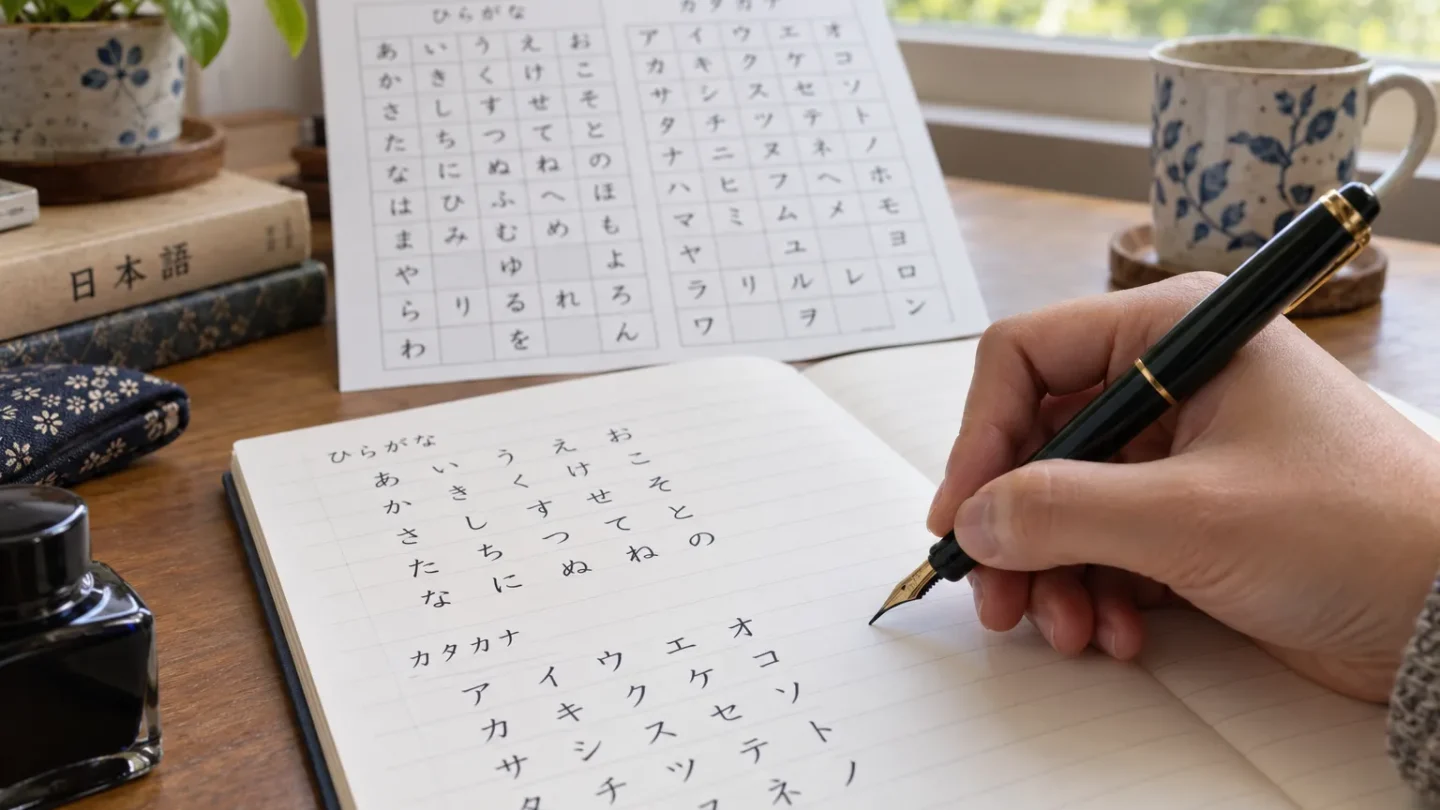
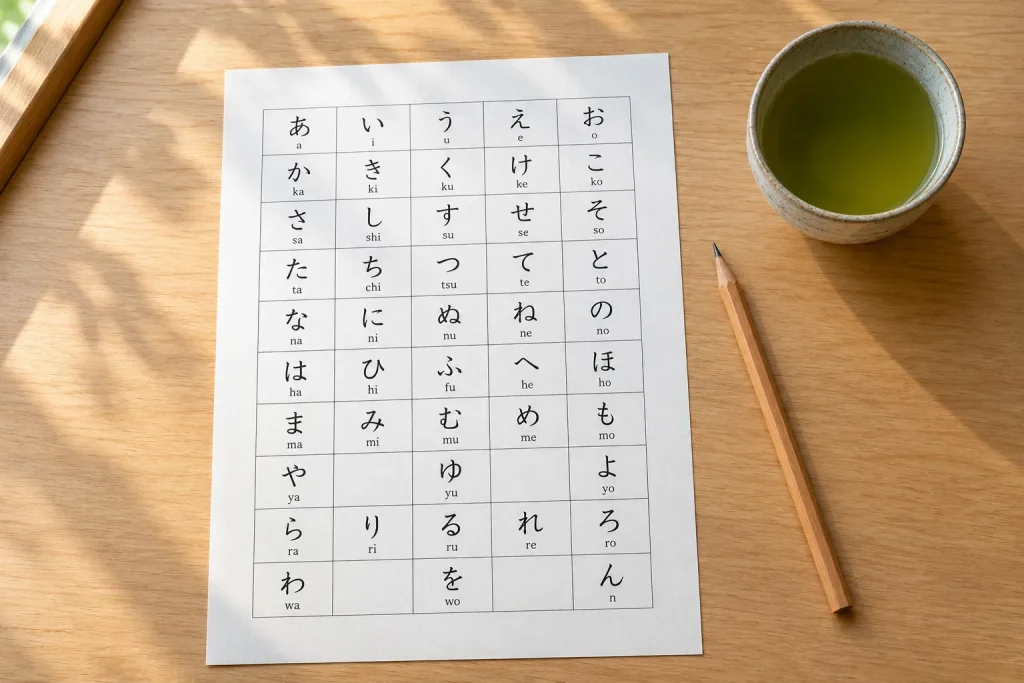
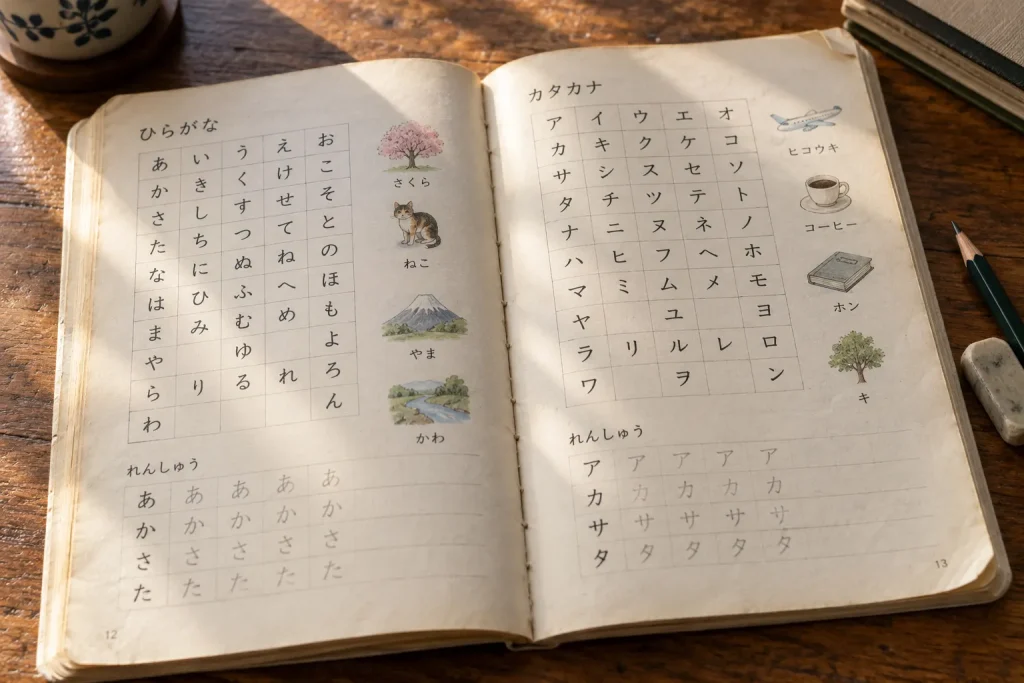
The mechanism is a table called gojūon (五十音, ごじゅうおん, gojūon, “fifty sounds”). Every character in hiragana and every character in katakana sits at the intersection of one of five vowels and one of roughly ten consonant sounds, and both scripts are built on exactly the same grid — they just draw the cells differently. Once that grid is in your head, you are not memorizing ninety-two unrelated shapes; you are memorizing ten short columns, twice, plus a short, well-documented list of cells that break the pattern.
That is also why a full pass through both scripts fits into a single week if the week is organized around the grid instead of around a printed chart — provided two days are reserved for the parts every rushed schedule skips: the day for voiced sounds, and the day for the two character pairs that even people who read Japanese daily sometimes have to double-check.
The Vowel Spine Underneath Both Scripts
Both kana sets open with the same five sounds, in the same order: a, i, u, e, o. That sequence is not arbitrary the way A-B-C-D is arbitrary. It traces back to the vowel ordering used in Sanskrit-based Buddhist phonetics, which reached Japan well before the shapes of hiragana and katakana were fixed, and it became the backbone of the gojūon table used to organize both scripts from the Heian period onward. What outsiders usually get wrong here is assuming the row has to be memorized separately from everything else. It doesn’t: every consonant column that follows keeps this exact five-vowel sequence and just swaps the leading consonant sound, so once “a-i-u-e-o” is automatic, you already know the shape of every other row before you have seen it.
How to Learn Hiragana by Column, Not by Chart
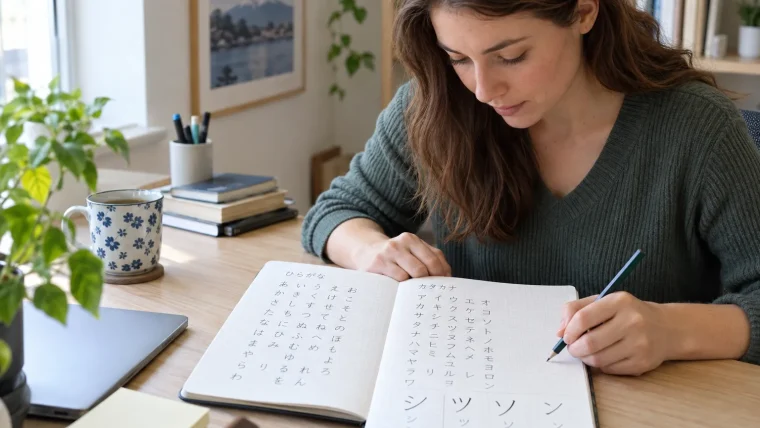
The practical version of how to learn hiragana is: learn one consonant column at a time, in both scripts, before moving to the next column — not all of hiragana first and then all of katakana. Ka-ki-ku-ke-ko, then カ-キ-ク-ケ-コ, in the same sitting, because the two scripts share pronunciation and column logic, and drilling them together cuts the number of new sounds you’re learning in half. The detail most self-study guides skip is that four cells in the basic table don’t match what a straight vowel-consonant reading would predict: し is “shi,” not “si”; ち is “chi,” not “ti”; つ is “tsu,” not “tu”; ふ is “fu,” not “hu.” These irregularities are also exactly where the three competing systems for romanizing Japanese disagree most, since some render し as “si” and others as “shi.” Knowing the four irregular cells are a fixed, short list — rather than a sign you’re misreading the chart — saves real time in week one.
Voicing Marks That Double the Alphabet for Free
Five of the ten consonant columns can take a small diacritic called dakuten (濁点, だくてん, dakuten, “voiced mark”) — two short strokes in the upper right corner of the character — which turns k into g, s into z, t into d, and h into b. か becomes が, し becomes じ, and so on down each column. A sixth mark, handakuten (半濁点, はんだくてん, handakuten, “half-voiced mark”), applies only to the h-row and turns h into p: は becomes ぱ. Between them, these two marks generate every voiced sound in Japanese without introducing a single new base shape, which is the part of the mechanism most chart-memorizers never notice: you aren’t learning new characters here, you’re learning that a mark you already recognize changes a sound you already know.
The Two Pairs That Break Nearly Every Beginner
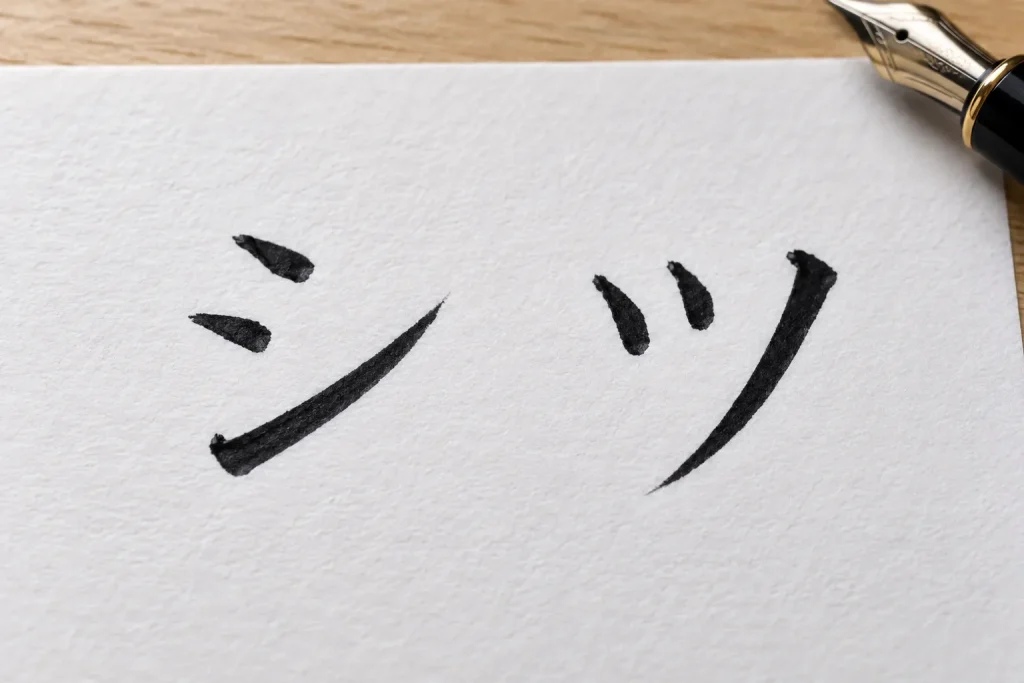
More than any other question of hiragana stroke order, two look-alike pairs cause more misreadings than every other confusable character combined — and neither pair is voiced or unusual; both sit in the plain, unmarked basic set. シ (shi) and ツ (tsu) differ only in the direction and slant of their final two strokes: シ’s strokes curve down and to the right, roughly parallel to each other, while ツ’s strokes curve down and slightly toward each other. ソ (so) and ン (n) share the identical problem in miniature — ソ’s stroke runs from upper right to lower left, ン’s runs the opposite way, from upper left to lower right. None of the four characters is rare: these katakana look-alike characters show up constantly, because katakana renders every foreign name and brand sold in Japan, and all four appear in ordinary vocabulary within the first month of study.
| Pair | Reading | Stroke direction that tells them apart |
|---|---|---|
| シ / ツ | shi / tsu | Strokes tilt right, roughly parallel (シ) vs. curve toward each other (ツ) |
| ソ / ン | so / n | Stroke runs upper-right to lower-left (ソ) vs. upper-left to lower-right (ン) |
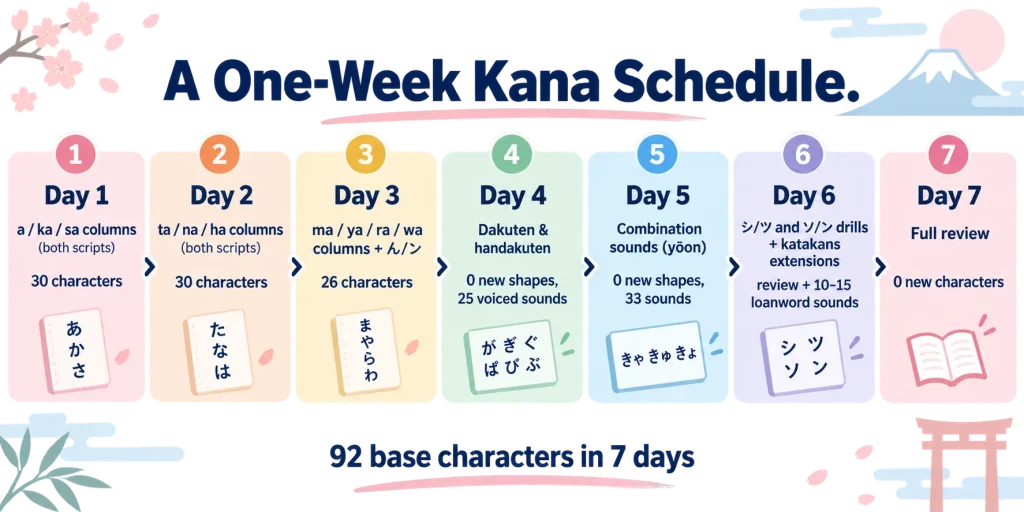
A one-week schedule that treats these pairs as their own study day, rather than letting them arrive mixed in with everything else, is the single biggest change a self-taught learner can make. The table below is the schedule this article is built around: five columns of new characters, one day for voicing marks, and one day set aside specifically for the confusable pairs and general review, instead of assuming review will happen on its own.
| Day | Focus | New characters |
|---|---|---|
| 1 | a / ka / sa columns, both scripts | 30 |
| 2 | ta / na / ha columns, both scripts | 30 |
| 3 | ma / ya / ra / wa columns, plus ん / ン | 26 |
| 4 | Dakuten and handakuten (voiced sounds) | 0 new base shapes; 25 sounds |
| 5 | Combination sounds (kya, sha, chu, etc.) | 0 new base shapes; 33 sounds |
| 6 | シ/ツ and ソ/ン drills, plus katakana-only extensions | Review + 10–15 loanword sounds |
| 7 | Full review, reading practice | 0 new characters |
What Follows Once You See the Grid
Learning kana this way instead of as a flat list produces a few results that aren’t obvious in advance:
- You can guess the pronunciation of a character you haven’t memorized yet, because its position in the grid tells you the vowel and the consonant family — an unfamiliar katakana character in a foreign brand name stops being a guessing game.
- Handwriting improves as a side effect, not a separate task, because columns share stroke logic; the ta-column and the na-column both open with a similar top stroke, so column-based practice trains muscle memory that a character-a-day method doesn’t.
- Typing gets easier before reading does. Japanese input methods on a phone or computer are built on this exact grid — typing “shi” or “si” both produce し — so learners often become fluent typists of kana weeks before they can read the same characters quickly on a page.
- The hardest characters to unlearn are the ones learned first and wrong. Because early study sessions build the deepest habits, getting シ/ツ and ソ/ン right in week one heads off a correction problem that otherwise resurfaces for months, since muscle memory formed early is disproportionately durable.
Where the Order Breaks Down
The grid isn’t perfectly square, and pretending otherwise causes its own confusion. Five cells that the vowel-consonant pattern predicts simply don’t exist in the modern table: there is no standard “yi,” “ye,” “wu,” “wi,” or “we.” Two of those — ゐ (wi) and ゑ (we) — did exist historically and were dropped from ordinary use once Japan’s postwar writing reforms standardized modern kana usage in 1946, the same reform that fixed most of the spelling conventions still taught today. The w-row that survives, わ/ワ and を/ヲ, has effectively shrunk to two working characters, with を surviving mainly as a grammatical particle rather than a sound anyone reaches for elsewhere. None of this affects a first-week schedule, and it doesn’t need to; it matters once a learner starts reading anything older than a current textbook, where the missing characters occasionally resurface.
Katakana’s Extra Sounds for Foreign Words
Katakana carries an extra layer the basic 46-character set was never designed for: sounds that don’t occur naturally in Japanese but are needed to write foreign words. Combinations like ティ (ti), ディ (di), ファ (fa), and ヴィ (vi) are built by pairing a full katakana character with a small version of another — a workaround rather than part of the original grid, which is one reason loanwords rarely sound like the English they came from; the katakana available to represent them was never a perfect match for English phonetics to begin with. That same extended set is what makes it possible to render most foreign personal names at all, which is the basis of a name-conversion tool that has already checked 898 names against standard katakana conventions rather than leaving each one to guesswork.
Where Kana Stops and Kanji Begins
Kana was never meant to carry the language alone. Hiragana handles native Japanese grammar — verb endings, particles, connective words — while kanji (漢字, かんじ, kanji, “Han characters”) carries most of the actual vocabulary, and the two are stitched together in nearly every sentence a fluent reader encounters. That division is exactly how Japanese writing works as a three-script system, and it’s why finishing kana feels like a milestone without being the finish line: a reader who knows all 92 kana characters perfectly can still be stopped by a single sentence carrying three or four unfamiliar kanji, which is a separate, much longer project covered in how many kanji you actually need at different levels of fluency.
If there’s one rule worth carrying out of this: learn the grid, not the chart. Ninety-two shapes stop being ninety-two problems the moment you can place each one by its row and column instead of by its picture.
Frequently Asked Questions
Can you really learn hiragana and katakana in one week?
You can reach reliable recognition of all 92 base characters in a week using a column-based schedule like the one above, but recognition isn’t the same as fluent reading. Without daily reading practice afterward, recall of rarely used characters — particularly the katakana extensions used for foreign sounds — fades within a few weeks, the same way any newly memorized alphabet does without reinforcement.
Which should I learn first, hiragana or katakana?
Most courses teach hiragana first because it appears far more often in ordinary text, but learning both scripts column by column, side by side, is faster overall than finishing one completely before starting the other, since the pronunciation for each column is identical across both scripts.
Why do シ and ツ look so similar?
Both characters descend from cursive, brush-written shorthand for more complex source characters, and the brush strokes that distinguished them clearly on paper compress into a very small visual difference in print and on screens — a slight change in stroke angle and direction is the entire distinction.
Is katakana harder than hiragana?
Katakana isn’t harder to draw — its strokes are simpler and more angular than hiragana’s — but it’s harder to practice naturally, because it appears less often in beginner reading material and is disproportionately used for words, like foreign names and brands, that a learner may not yet know how to pronounce even after decoding the characters.