Japanese phones let you type the pronunciation of a word and choose its written form from a conversion list, so you can produce a kanji without recalling its strokes. That mechanism is the practical answer to do I need to write kanji: if your immediate goal is reading Japanese, handwriting every character from memory is not the first task.
The gap even has a name. 漢字健忘, kanji kenbō, literally “kanji amnesia,” describes knowing and recognizing a character but being unable, or finding it difficult, to reproduce it by hand. The expression is used about native speakers as well as learners and is not a neurological diagnosis.
If native readers can forget how to write a familiar character without losing the ability to read it, reading and handwriting cannot be the same skill.
The mechanism: pronunciation goes in, kanji comes out
When you type Japanese on a phone or computer, you usually do not draw each kanji. You enter sounds in hiragana or type their romanized equivalents, and an input method editor converts the resulting kana into possible written words.
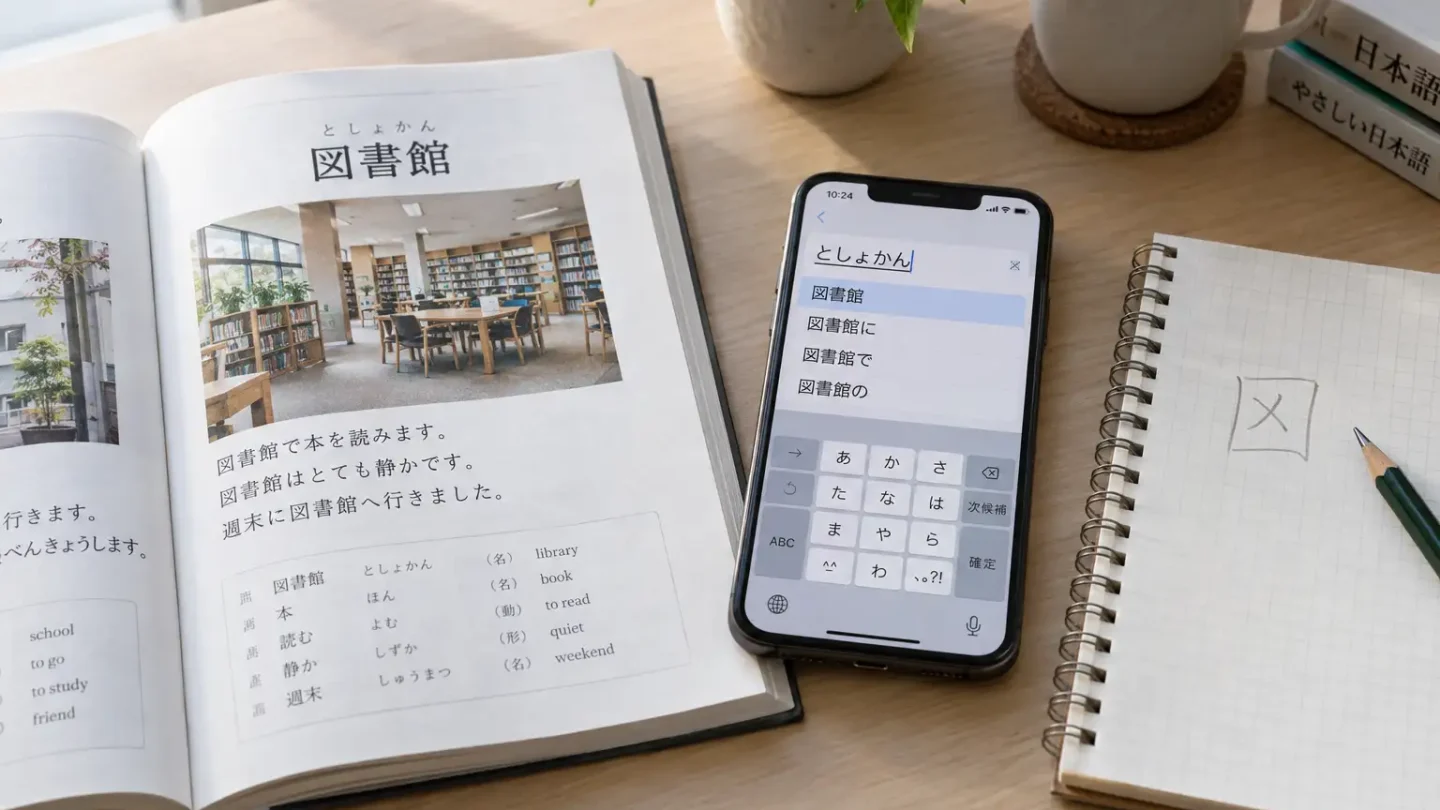
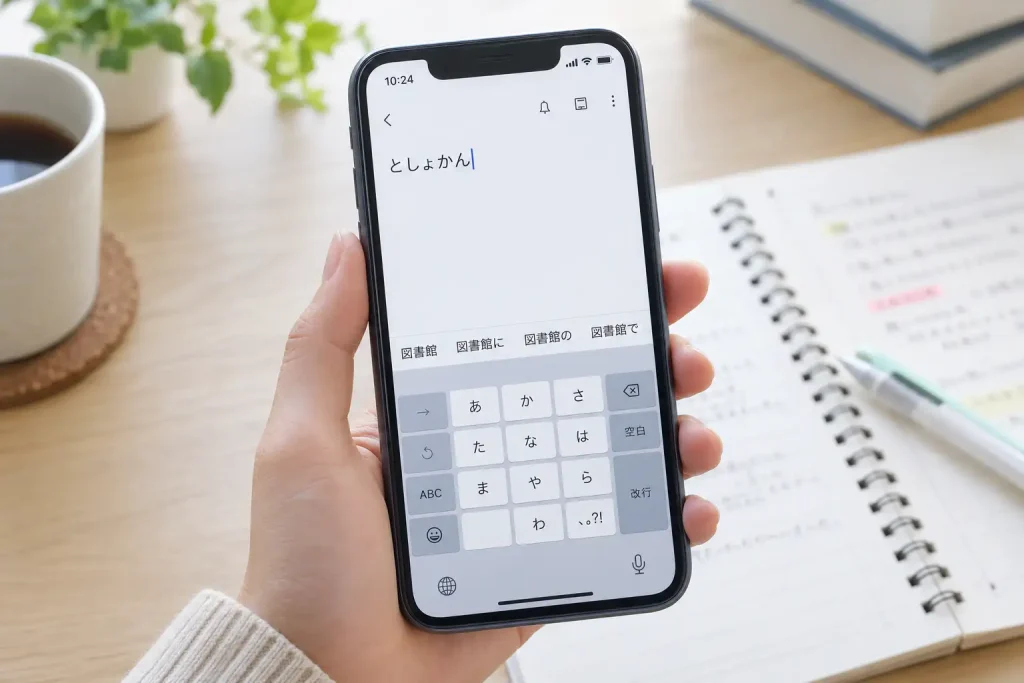
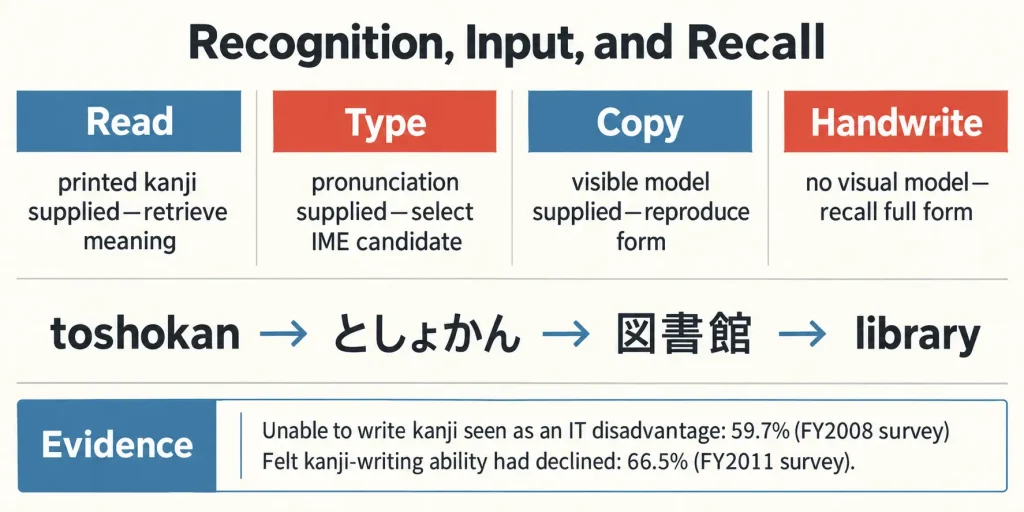
Suppose you want to write 図書館, toshokan, literally “library.” On a roman-letter keyboard, you type toshokan. The input system first builds としょかん and then offers 図書館 as a conversion candidate. You select it because you recognize the word and know that the characters match your intended meaning.
Nothing in that sequence requires you to recall that 図 contains a surrounding enclosure, that 書 has its particular internal arrangement, or that 館 ends with the food radical on the left. You have retrieved the pronunciation and recognized the correct result, but you have not reconstructed the characters.
This is not a shortcut used only by beginners. Kana-to-kanji conversion is an ordinary mechanism for producing digital Japanese. The system shifts the user’s task from recall the complete visual form to recognize the correct candidate.
Reading retrieves meaning from a visible form
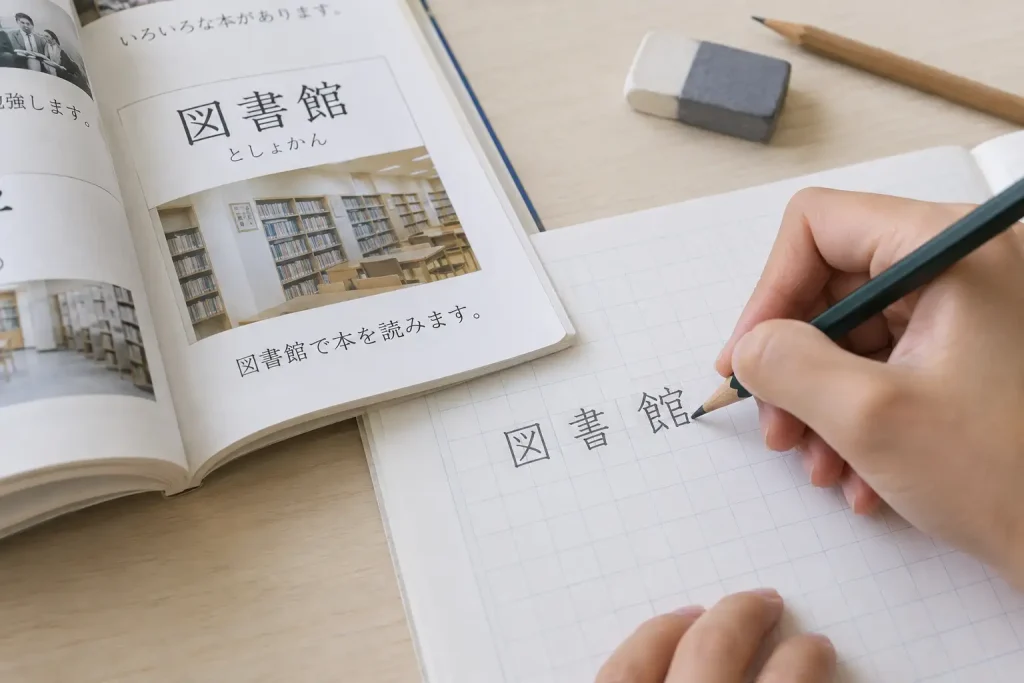
Reading begins with something already on the page or screen. You see 図書館, match its shape to a known word, retrieve the pronunciation toshokan, and understand “library.”
That process can succeed even when your mental picture of each character is incomplete. You may distinguish 書 from similar forms by its overall structure without being able to place every stroke correctly on blank paper.
This is kanji recognition, and it depends heavily on context. In a sentence about returning a book, 図書館 becomes easier to identify because the surrounding words narrow the possibilities. The page supplies the character shape; the sentence helps supply the meaning.
Handwriting begins in the opposite direction. You have the word toshokan and must generate three detailed shapes without seeing them. Recognition provides the answer as part of the question, while recall does not.
| Skill | What you start with | What you must retrieve | Typical task |
|---|---|---|---|
| Reading | A visible character in context | Meaning and pronunciation | Understanding a sign or sentence |
| Typing | A pronunciation | The correct candidate from a list | Writing a message or document |
| Copying | A visible model | Stroke placement while looking | Completing a form from a reference |
| Handwriting from memory | A word or meaning | Full character shapes and order | Writing an answer without assistance |
For the larger system around this process, Hiragana, Katakana, Kanji: How Japanese Writing Works explains why the scripts share a sentence and how their jobs differ. This article starts after that distinction and asks which output skill deserves your time.
Handwriting reconstructs a character without showing you the answer
To write a kanji from memory, you must recall its components, their positions, approximate proportions, and stroke sequence. Recognizing a shape as correct after seeing it is not enough.
Take 議, gi, used in words connected with discussion and deliberation. A learner may read 会議, kaigi, “meeting,” immediately because the compound appears often. Writing 議 on blank paper is harder because the character must be rebuilt from several tightly arranged components.
This difference explains a familiar experience: you start writing, produce the first side of the character, and then stop. When you check your phone, the correct form looks obvious. It was stored strongly enough for recognition but not strongly enough for unaided production.
Stroke order supports that production process. It gives your hand a repeatable route through a character and helps preserve a readable balance. However, stroke-order drills are a means of building a handwriting skill, not a prerequisite for understanding every printed word that contains the character.
“I know it when I see it” is not an excuse. It is an accurate description of recognition memory.
The mistake is treating that sentence as proof that nothing has been learned. If you can distinguish the intended character from incorrect IME candidates and understand it in a sentence, you possess a useful reading skill even if handwritten recall remains weaker.
IME conversion asks you to choose, not draw
An IME—input method editor—handles the transition from pronunciation to Japanese script. Depending on the device, you may enter sounds through roman letters, a kana keyboard, flick input, speech, or handwriting recognition.
The common roman-letter path looks like this:
- Type the pronunciation.
- Let the system convert the letters into kana.
- Request kanji conversion.
- Read the proposed candidates.
- Select the word that matches the intended meaning.
- Confirm the sentence and correct any wrong conversion.
The outsider’s mistake is assuming that conversion removes the need to know kanji. It removes the need to draw kanji, but not the need to read the result.
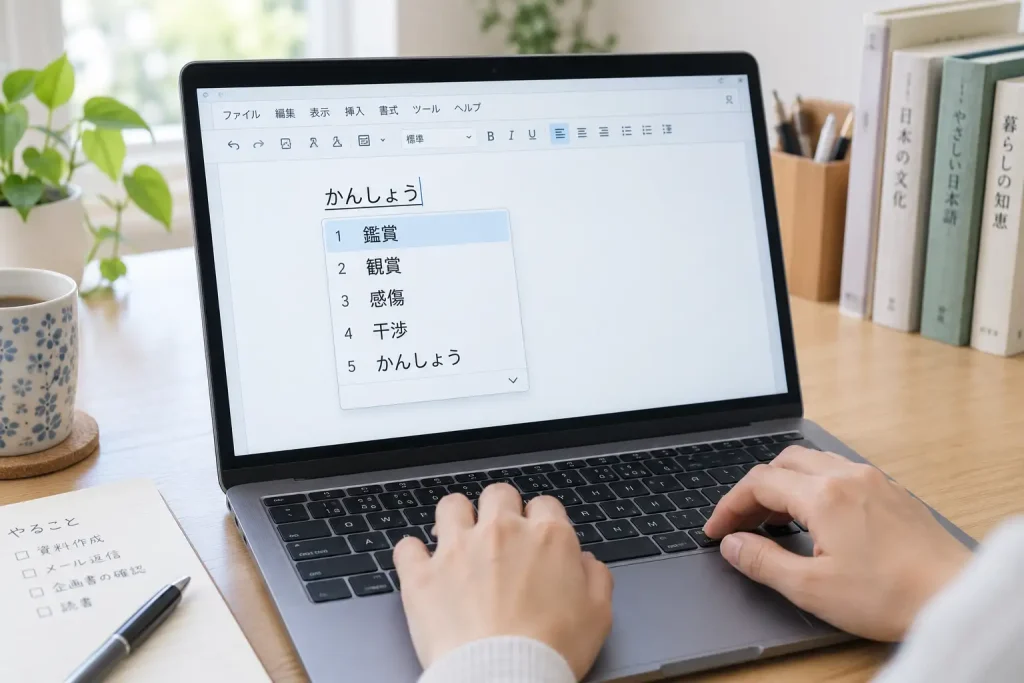
Japanese contains many homophones, so the same pronunciation can lead to several candidates. A user who selects solely by position or appearance can produce the wrong word while preserving the intended sound.
| Input | Possible output | Meaning |
|---|---|---|
| かう, kau | 買う | to buy |
| かう, kau | 飼う | to keep or raise an animal |
| かえる, kaeru | 帰る | to return |
| かえる, kaeru | 変える | to change something |
| かえる, kaeru | 替える | to replace or exchange |
The computer has not decided what you mean. It has presented possibilities, and reading ability is what lets you choose among them.
Romanization is useful for input, but it should not replace kana on the learning side. Romaji Explained: Three Systems and Which One to Use covers why typing with Latin letters is a legitimate tool while reading Japanese through romaji indefinitely is not.
Components reduce the recognition load
Kanji are not random pictures. Recurring components create visual families, suggest broad meaning categories, and sometimes provide clues to pronunciation.
部首, bushu, literally “section headers,” are the traditional radicals used to classify characters. Learners often use “radical” more loosely for any recurring component, although not every visible part is the dictionary radical of that character.
The detail outsiders get wrong is expecting a component to function like a complete definition. The water component does not guarantee that every character containing it simply means water. It gives you a structural clue, not a translation.
Components still earn their place early because they make characters easier to compare. You can notice what changed, where it changed, and which part stayed constant. This supports reading before your hand can reproduce either character smoothly.
If you meet an unknown form, How to Find a Character You Cannot Read explains component-based lookup and modern alternatives. Lookup is a separate survival skill: you do not need to know the pronunciation before searching for the character.
Readings attach to words, not to isolated flashcards
A kanji can have more than one reading. The traditional categories are 音読み, on’yomi, literally “sound reading,” and 訓読み, kun’yomi, literally “meaning reading.”
Memorizing a large bundle of pronunciations beside an isolated character creates the wrong task. When reading actual Japanese, you encounter characters inside words, and the word usually determines the reading.
The character 生 illustrates the problem particularly well because it appears in many common words and grammatical forms. A list of its possible readings is difficult to retain and still does not tell you which one a sentence requires.
A more efficient unit is the word:
- 学生, gakusei — student
- 先生, sensei — teacher
- 生まれる, umareru — to be born
- 生きる, ikiru — to live
- 生, nama — raw or fresh
This is why learning kanji for reading works better when characters arrive with vocabulary and sentences. You learn what a written word looks like, how it sounds, and where it appears.
Why the Same Kanji Sounds Different handles the history and practical logic of those readings. Here the useful consequence is narrower: knowing every theoretical reading is not required before you begin reading the words that matter.
Four consequences that change the study order
The first consequence is that recognition can grow faster than production. You can build a useful reading vocabulary without waiting until every character is available for perfect handwritten recall.
The second is that writing a character repeatedly is not automatically reading practice. If your attention is on copying the outline while your mind drifts away from the word, you may improve pen movement without improving recognition in sentences.
The third is that typing depends on literacy rather than replacing it. IME candidates must be checked, homophones must be separated, and incorrect conversions must be noticed. Stronger reading makes digital writing safer.
The fourth is that forgetting a handwritten form does not erase the word. A native speaker may pause over a character, type its pronunciation into a phone, recognize the result, and continue. 漢字健忘, kanji kenbō, exists precisely because knowledge can survive in one channel while weakening in another.
An Agency for Cultural Affairs survey released in 2009 found that 59.7 percent of respondents considered becoming unable to write kanji a disadvantage associated with information technology. A later national survey reported that 66.5 percent felt their ability to write kanji had declined. The figures measure perceptions rather than a handwriting examination, but they show that the reading-writing gap is not merely a learner’s complaint.
The uncomfortable part is that handwriting drills can consume the hours you needed for vocabulary, grammar, and actual reading.
That does not make handwriting useless. It means you should decide which skill you are buying with each study session.
When handwriting moves back to the front
Handwriting deserves higher priority when your real-world task requires it. School examinations, classroom assignments, calligraphy, handwritten forms, board work, personal notes, and professional settings can all make production important.
It also has value as a memory aid. Writing slowly enough to notice components can make a character more distinctive and easier to recognize later. The benefit comes from active attention, not from filling a page with unattended repetitions.
Use handwriting early when you need to:
- distinguish characters you repeatedly confuse;
- understand how components occupy left, right, upper, lower, and enclosing positions;
- complete a test that requires written answers;
- produce addresses, names, or formal information by hand;
- read handwritten notes rather than standardized type;
- develop penmanship as a goal in its own right.
For everyone else, a compact handwriting layer is enough at first. Learn the basic stroke directions, copy new characters a few careful times, and test whether you can recognize them later in words.
Then return to reading. The First Hundred Kanji and Why Those provides a practical starting sequence instead of asking you to copy characters in arbitrary dictionary order.
Where the reading-first rule stops working
The rule does not hold equally for every goal. If you are preparing for a handwriting test, “recognition first” cannot become “production never.” The assessment determines the skill you must practice.
Names are another exception. Personal and place names can use uncommon readings, unusual character combinations, or forms that an IME does not rank first. You need especially careful candidate checking because a visually plausible substitution can still be someone else’s name.
Foreign names usually present the opposite problem: they are commonly written in katakana rather than assigned arbitrary kanji. The site’s name converter with 898 checked names shows established katakana renderings without pretending that every unfamiliar name has one mechanically perfect answer.
Handwritten Japanese also differs from printed fonts. Fast notes compress strokes, join forms, and omit the geometrical neatness of textbook models. Reading only screen fonts will not automatically prepare you for a handwritten menu or message.
Finally, writing can reveal distinctions that recognition practice has hidden. If two characters remain visually interchangeable after repeated exposure, reconstructing their components by hand may be the fastest way to separate them.
Do I need to write kanji before I can read Japanese?
No. Reading, typing, copying, and writing from memory draw on overlapping knowledge, but they place different demands on recall. Requiring all four to advance at the same speed creates an unnecessary bottleneck.
A balanced beginner routine can assign different standards to each skill:
| Learning target | Useful early standard |
|---|---|
| Recognition | Identify the character inside familiar words |
| Meaning | Understand the word in a sentence |
| Reading | Recall the pronunciation of the whole word |
| Typing | Produce the word and choose the correct conversion |
| Copying | Reproduce a legible form while looking at a model |
| Handwriting | Write selected high-value words without help |
The priority is not “never write.” It is reading kanji before handwriting mastery. Copy enough to understand structure, but spend the larger share of your effort meeting characters in vocabulary and connected text.
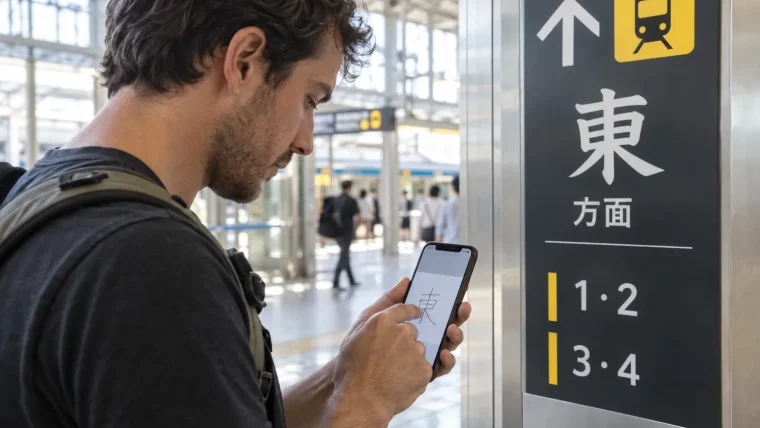
This order also changes how you measure progress. A character is useful before you can write it from memory if you can recognize it on a train sign, menu, message, form, or article.
There is no reason to delay that usefulness until your handwriting catches up.
A practical study order for kanji
Start with a real word, not a bare character. Learn its pronunciation and meaning, notice the component structure, and read it in more than one sentence.
Next, type the word and inspect the IME candidates. This forces you to recognize the intended spelling among alternatives and connects reading with the way Japanese is actually produced digitally.
Then copy the word carefully if writing helps you notice its shape. Close the model and try it once from memory. If you cannot reproduce it, decide whether that failure matters for your current goal.
A learner focused on travel, novels, websites, games, manga, or everyday messages should return to reading. A learner facing handwritten exams should schedule retrieval practice and write without looking.
The most efficient rule is one sentence: learn kanji in words until you can read them, and require handwriting only where your life or test actually requires handwriting.