Most etiquette advice about Japan is written as if every rule carried the same weight. It does not. Some of it is genuinely invisible to the people around you, and some of it will make a room go quiet.
The dividing line is not how polite the rule sounds. It is what the rule protects.
Rules of form, and rules of boundary
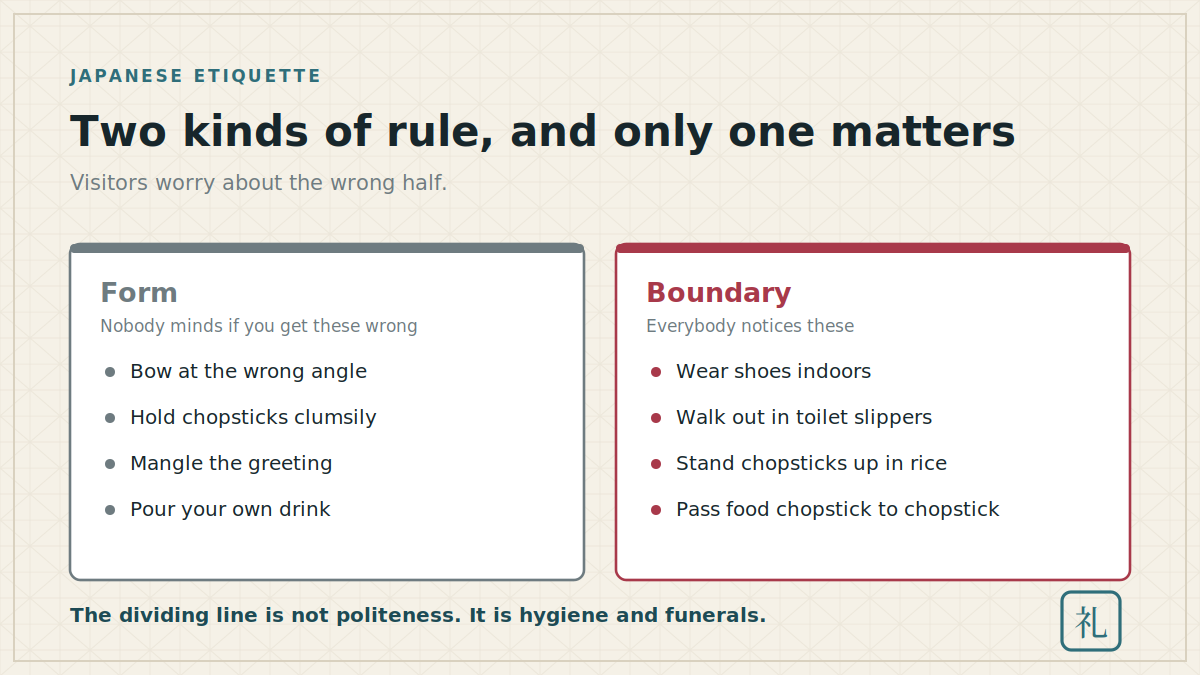
Almost everything in a Japanese etiquette guide falls into one of two groups.
Rules of form are about doing a thing gracefully — the depth of a bow, the grip on chopsticks, whether you said arigatou or arigatou gozaimasu. Getting these wrong marks you as a foreigner, which you are, and which everyone had already worked out. Nobody minds.
Rules of boundary are about keeping two things apart — outdoor dirt from indoor floors, the bath from the washing, the language of funerals from the language of dinner. Cross one and the reaction is not “how charmingly foreign”; it is the flinch an American host would produce if you walked across their bed in muddy boots.
That is the whole framework, and it holds up. Once you have it, you can work out situations you have never read about.
| The rule | What it protects | If you get it wrong |
|---|---|---|
| Shoes off at the step | The indoor floor from the street | Visible, and someone has to clean it |
| Toilet slippers stay in the toilet | The same boundary, one room further in | Noticed instantly by everyone present |
| Wash before the bath | Shared water that everyone else entered clean | You will be asked to get out |
| Chopsticks never upright in rice | Funeral imagery, kept away from a meal | The table goes quiet |
| Bow depth, chopstick grip, greeting level | Nothing — these are form | Nothing at all |
What people actually notice
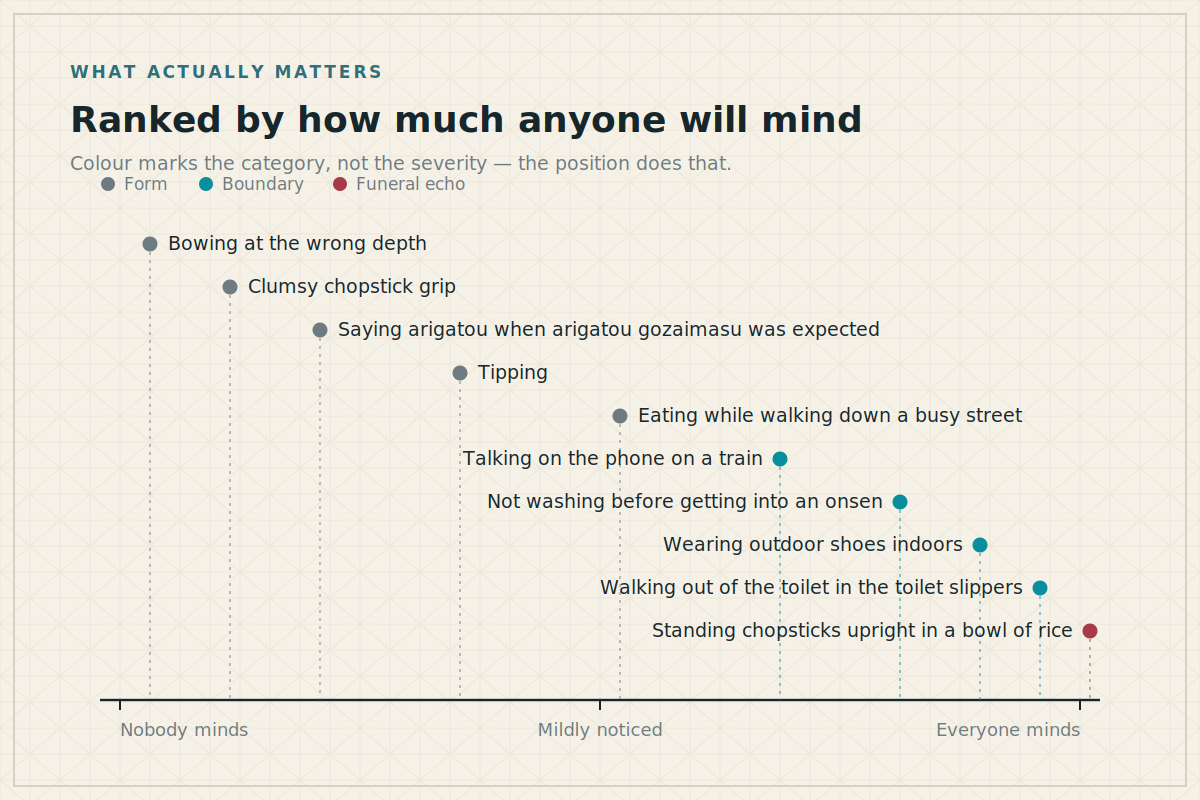
Look at the left end of that scale. Bowing badly, chopstick grip, the wrong level of politeness — the three things visitors rehearse, and the three that cost nothing. Now the right end: shoes, slippers, chopsticks upright in rice. Two hygiene boundaries and one funeral echo, none of which requires any skill at all. They require knowing they exist.
That asymmetry is the most useful thing on this page. The rules that matter are not hard; they are just unfamiliar.
Shoes: the boundary you will meet first
Shoes come off at the entrance of homes, traditional inns, many restaurants, temples, some clinics, most changing rooms and a surprising number of schools and offices.
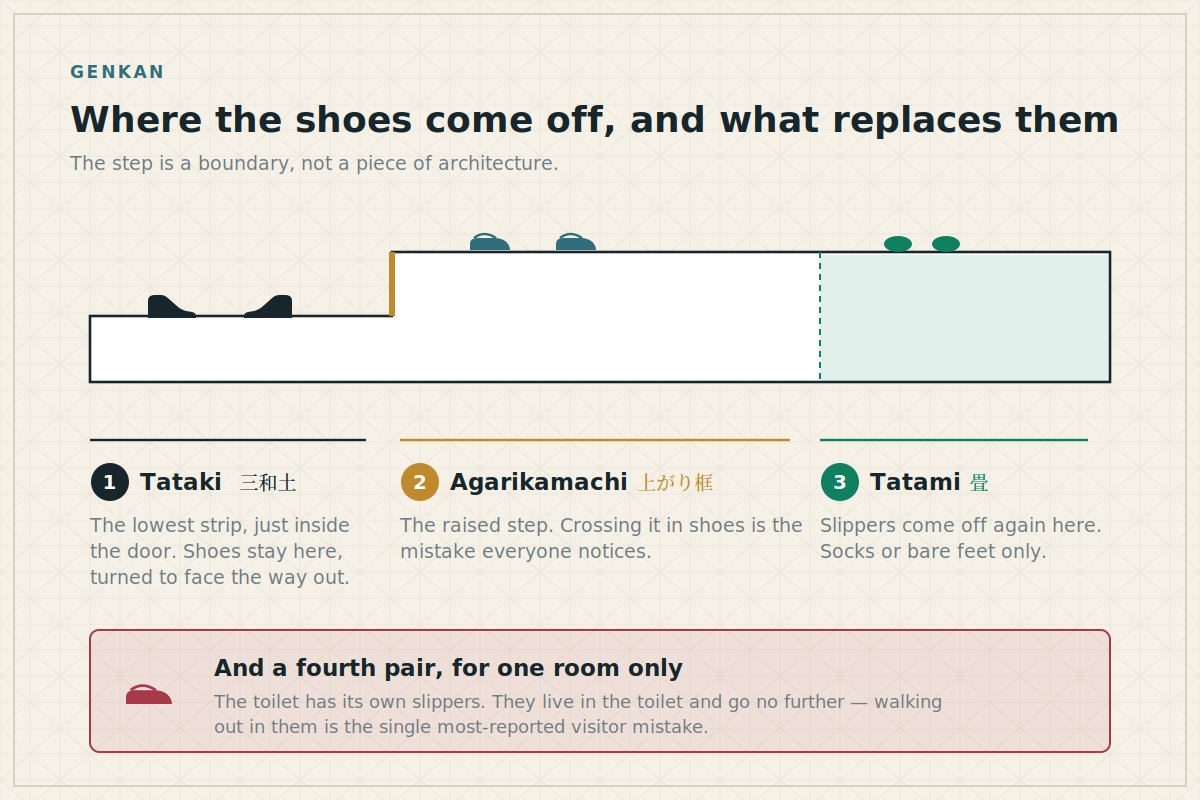
The entrance area is the genkan, built to make the boundary physical: the floor by the door is lower, and there is a step up into the house proper. The step is the line.
- Turn your shoes to face the door after taking them off. If you forget, someone will quietly do it for you — a small kindness you would rather not need.
- Slippers are for corridors and hard floors only. They come off again at the edge of a tatami room.
- The toilet has its own slippers, and they never leave the toilet. Walking back into the living room in them is the most-reported visitor mistake in Japan.
Wear socks without holes. You will be in them more than you expect.
Chopsticks: two real taboos and a lot of noise
Almost everything written about chopstick etiquette is form. Two things are not.
Do not stand chopsticks upright in a bowl of rice. That arrangement — tatebashi — is how rice is offered to the dead at a funeral. It is not “a bit rude”; it is a funeral image on the dinner table.
Do not pass food directly from chopsticks to chopsticks. At a Japanese cremation, family members pass bones between chopsticks. Set the food on a plate instead.
Everything else — the chopstick rest, not pointing with them, not rubbing disposable ones together — is form.
Money, tipping and the little tray
There is no tipping in Japan, at all. Not in restaurants, not in taxis, not for housekeeping. Money left on a table will usually be chased down the street and returned to you.
At a till you will often see a small ridged tray. Payment goes on the tray rather than into the cashier’s hand, and change comes back the same way. Japan is far more card-friendly than it was, but cash is still worth carrying.
Trains, streets and public quiet
Trains are quiet. Not silent — people talk — but phone calls are not made, and phones stay on silent, which Japanese calls manner mode.
- Queue where the marks on the platform tell you to. The doors will stop exactly there.
- Stand on the left of an escalator in Tokyo, on the right in Osaka. Official campaigns now ask everyone to stand on both sides and not walk at all, so the habit is genuinely in flux.
- Public bins are scarce. Carry your rubbish until you find one, which is what everyone else is doing.
- Eating while walking is mildly frowned on in busy areas, and completely normal in front of the stall that sold you the food.
Nobody expects a visitor to be graceful. They expect a visitor not to bring the outside in — dirt, noise, or the imagery of a funeral.The rule behind the rules
Onsen and public baths
The most intimidating item on most lists, and the one with the clearest logic. The bath is for soaking, not washing, and everybody in it has already washed.
- Undress completely in the changing room. Swimsuits are not worn.
- Wash at the seated showers first, thoroughly, and rinse all the soap off.
- Get into the bath clean. The small towel stays out of the water; people fold it on their head.
- Tie long hair up so it stays out of the water too.
Tattoos are still refused at a good number of establishments, though the rule has been loosening and many places now allow them, ask that they be covered, or offer private baths. Check before travelling a long way for a specific bath.
Greetings, cards and the table
Bowing is form, which is why it belongs in the harmless column. A small nod, roughly fifteen degrees, covers essentially everything a visitor does; the full three-angle system is set out in our article on bowing, but nobody is measuring you.
Business cards are where the form tightens. A meishi is handed over and received with both hands, read rather than pocketed, and left on the table during a meeting. Treat the card as standing in for the person and you will get it right by instinct.
At a table, two habits are worth borrowing: say itadakimasu before eating and gochisousama deshita after, and pour for others rather than yourself — you fill your neighbour’s glass, they fill yours, and leaving your glass full is the quiet signal that you have had enough. The rest of the vocabulary is in our guide to ordering food in Japanese.
Visiting someone’s home
Rarer than you might expect — Japanese social life leans heavily on restaurants and bars — so an invitation home is a real one.
Bring something: cake, good fruit, or something from where you come from. This is temiyage, and its conventions are in our article on gift giving. Hand it over once you are inside and seated, with both hands. And do not wander — being shown where to sit is not a formality.
Three small things nobody warns you about
Blowing your nose in public reads as unpleasant; sniffing does not. The reverse of the American instinct.
Saying no directly is rare. “It’s a little difficult” — chotto muzukashii — is a refusal, and hearing it as a maybe leads to real confusion. The politeness levels behind this are covered in our article on keigo.
Masks are ordinary and never political. People wear them when they have a cold, out of consideration rather than fear.
What happens if you get it wrong
Almost nothing. Japan is unusually forgiving of visitors, and the standard response to a foreigner making a mistake is to fix it quietly and move on.
Which is exactly why the boundary rules deserve the attention. They are the ones where an apology does not fully repair the moment, because the discomfort is physical rather than social — a floor that now has street dirt on it, a bath everyone else got into clean.
Learn the four boundaries and let the rest go. Shoes off at the step. Toilet slippers stay in the toilet. Wash before the bath. Chopsticks never upright in rice, never passing food to other chopsticks. Everything else on this page is a refinement of that list.
If you are planning a trip around it, the festivals worth building an itinerary on are in our season-by-season guide, and the numbers that quietly shape gift sets, hotel floors and wedding envelopes are in lucky and unlucky numbers in Japan. And before you hand over a business card, it is worth having your own name settled in Japanese rather than improvised — the reasoning is in writing your name in Japanese.