Japan runs on a seasonal calendar to a degree that surprises visitors from countries where the seasons are mostly weather. Menus change, shop windows change, which flowers people photograph changes. And the festivals — matsuri — sit at the centre of it.
This is the year laid out, with the ones worth planning a trip around marked.
Spring: March to May
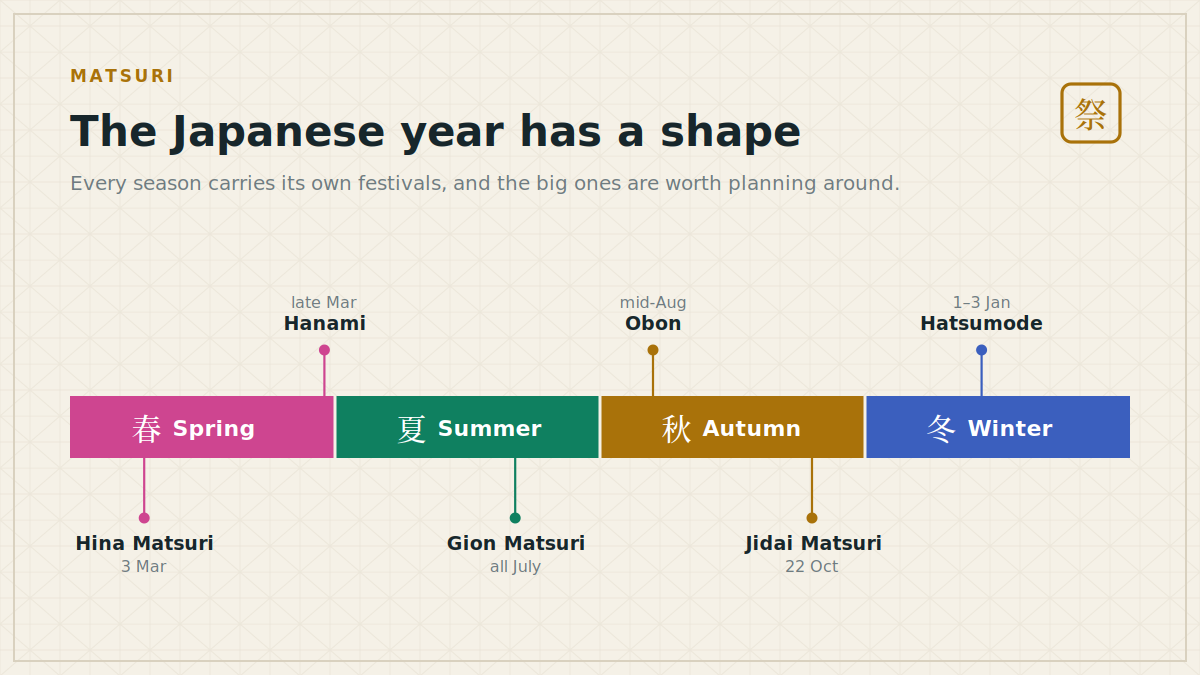
Hanami, cherry blossom viewing, is a national preoccupation with its own forecast, broadcast nightly for weeks. The blossom front moves north from Kyushu in mid-March to Hokkaido in early May, and the window in any one place is about a week. Parks fill with blue tarpaulins, junior colleagues are sent early to hold ground, and the whole thing is far more sociable than the photographs suggest.
Also in spring:
- Hina Matsuri, 3 March. The doll festival, for girls — tiered displays of emperor, empress and court, put out weeks ahead and, by superstition, packed away promptly afterwards.
- Kodomo no Hi, 5 May. Children’s day, and the origin of the carp streamers flying over rivers through late April.
- Golden Week, 29 April to 5 May. Four public holidays close together: everything is open, everything is full, everything costs more. Avoid travelling within Japan during it.
- Kanda Matsuri, Tokyo, mid-May in odd-numbered years — one of the three great festivals, alternating with Sannō Matsuri in even years.
Summer: June to August
June is the rainy season, tsuyu, and the quietest month in the festival year — hydrangeas are the compensation. Then July and August arrive and Japan holds more festivals than any traveller can attend.
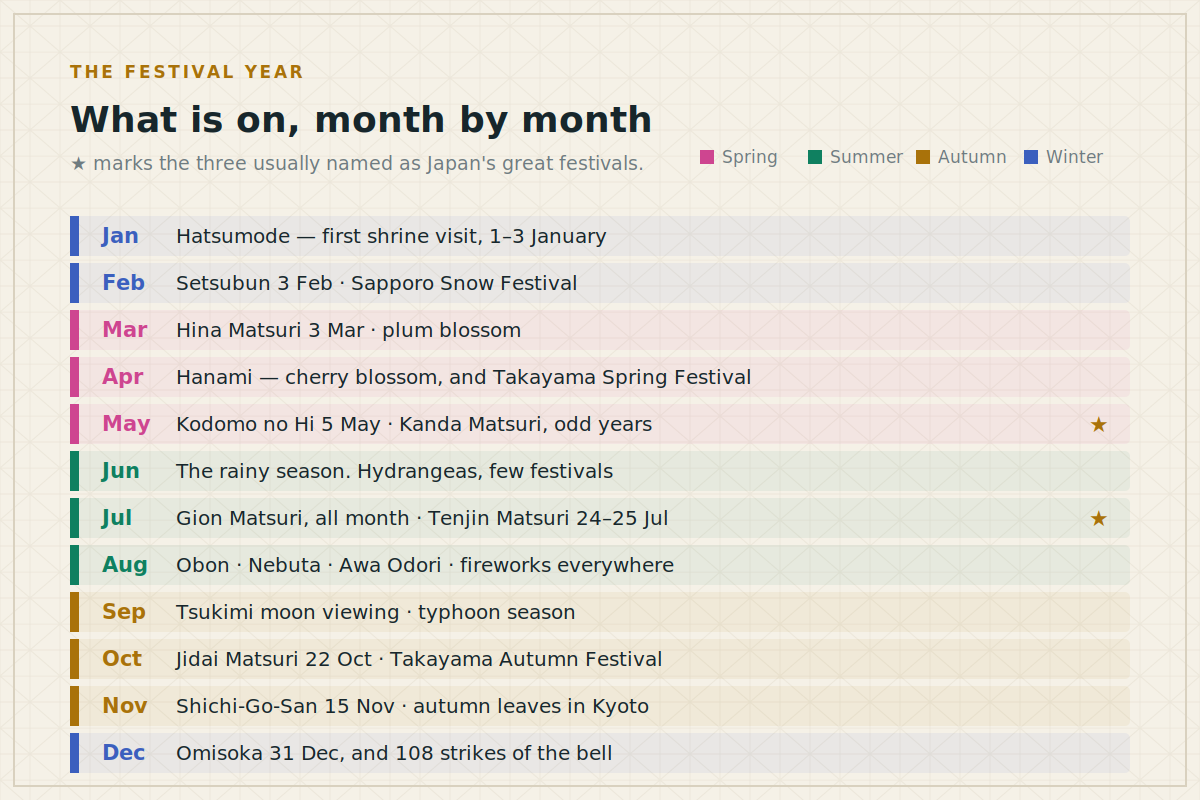
Gion Matsuri in Kyoto runs for the whole of July and is the largest festival in Japan. The centrepieces are the two Yamaboko Junkō processions, on 17 and 24 July, when enormous wheeled floats — several storeys tall, weighing many tonnes — are hauled through the streets by teams of men on ropes. On the three evenings before each procession the floats stand lit in the streets and old merchant houses open their front rooms to show off heirlooms.
Tenjin Matsuri in Osaka, 24 and 25 July, is the water one: a procession of boats down the river, with fireworks. The third of the great three.
Obon, mid-August across most of the country, is the festival of the returning dead. Families travel to their home towns, graves are cleaned, and lanterns are floated to guide ancestors back and away again. In Kyoto the send-off is the Gozan no Okuribi on 16 August, when giant characters are set alight on five mountainsides around the city.
Obon is also, with New Year, one of the two weeks when the entire country is travelling at once. Book far ahead or plan around it.
Two regional summer festivals justify the detour on their own: Nebuta Matsuri in Aomori, 2 to 7 August, with vast illuminated paper floats of warriors and demons pushed through the streets at night; and Awa Odori in Tokushima, 12 to 15 August, a dance festival where the visiting public is genuinely invited to join in.
Running through all of it: hanabi taikai, fireworks displays. Japan treats fireworks as a craft with named makers and competitive standards, and a major display runs well over an hour with a structure to it.
Autumn: September to November
The mirror of spring, and in the opinion of many people who live in Japan, the better half of the year. The weather settles and the leaves start turning.
Kōyō, autumn leaves, works like the blossom front in reverse — Hokkaido in September, Kyushu in December. Kyoto in the second half of November is the peak, and as crowded as the blossom.
| Festival | Where | When | What it is |
|---|---|---|---|
| Tsukimi | Everywhere | Mid-September | Moon viewing, with dumplings and pampas grass |
| Takayama Autumn Festival | Gifu | 9–10 October | Ornate floats with mechanical puppets |
| Kurama Fire Festival | Kyoto | 22 October | Pine torches carried through a mountain village |
| Jidai Matsuri | Kyoto | 22 October | A costume procession through twelve centuries |
| Shichi-Go-San | Everywhere | 15 November | Children of three, five and seven at a shrine |
Shichi-Go-San is worth a look if you are at a shrine in November: children formally dressed, often in hired kimono, at ages counted the old way rather than by birthday. That count has its own logic, explained in our article on kazoedoshi.
Winter: December to February
Winter is where the Japanese year turns over, and the turning is the biggest event on the calendar.
Ōmisoka, 31 December, is spent at home. Long buckwheat noodles are eaten for long life, and at midnight temple bells are struck 108 times — joya no kane — once for each earthly desire in Buddhist thought.
Hatsumōde, the first shrine visit of the year, happens on 1 to 3 January and draws the largest crowds of any Japanese custom; Meiji Shrine in Tokyo takes several million people over three days. Fortunes are drawn, last year’s charms returned to be burnt, new ones bought. New Year is also a full shutdown — many small businesses close for several days, and it is the one time of year when Japan is genuinely not open.
The rest of winter:
- Setsubun, 3 February. Roasted soybeans thrown out of the door with the cry oni wa soto, fuku wa uchi — demons out, fortune in.
- Sapporo Snow Festival, early February. Enormous snow and ice sculptures in Hokkaido, over about a week.
- Namahage, Oga peninsula, 31 December. Men in demon masks visit houses to frighten lazy children — genuinely startling, and much older than the tourist version.
Japan has two weeks a year when everybody is travelling at once — Obon in August and New Year in January. Knowing that is worth more than any single festival date.The practical planning rule
What actually happens at a matsuri
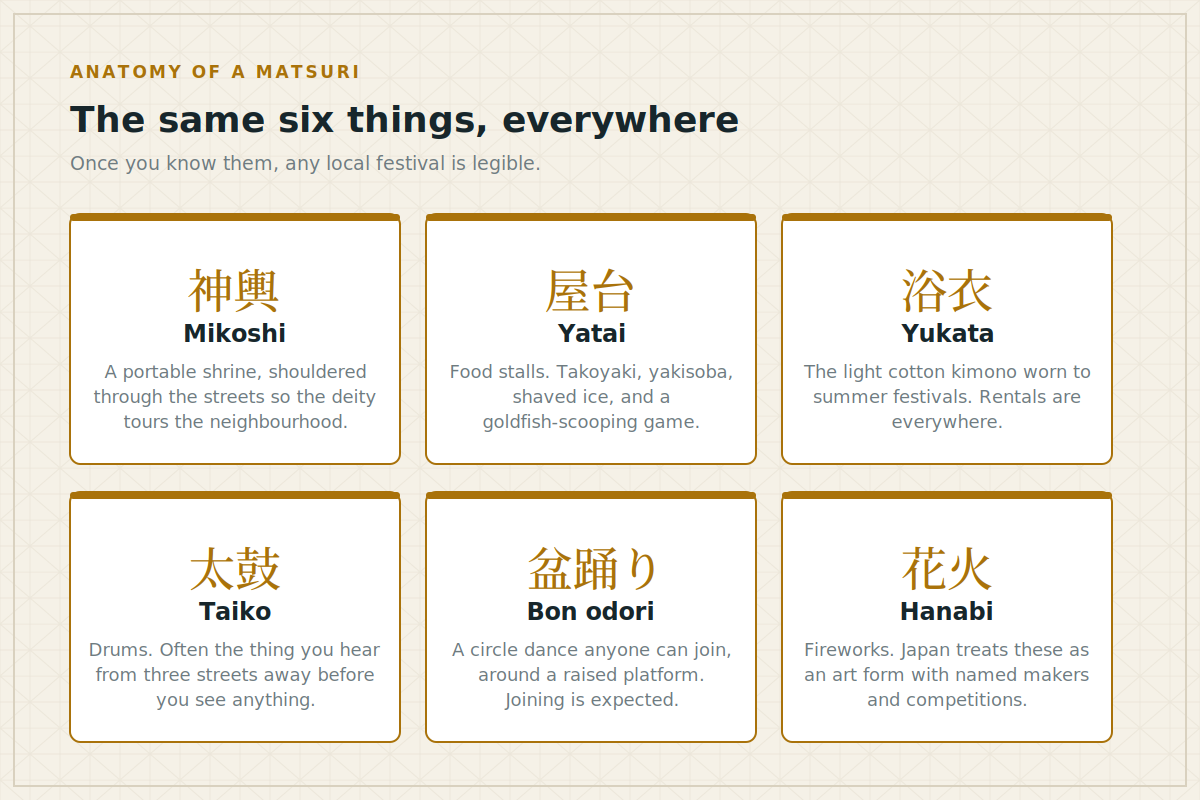
Most matsuri are built from the same components at any scale. The one at the end of your street has the same anatomy as Gion, at a fiftieth of the size.
The mikoshi is the reason the festival exists: a portable shrine, carried through the streets so the local deity tours the neighbourhood it protects. The shouting and the deliberate rocking are part of it — an energetic ride is understood as a good one.
And bon odori, the circle dance around a raised platform, is the one where joining in is not merely tolerated but expected. The steps repeat, they are simple, and someone will show you.
Going to one: practical notes
Go in the evening. Most matsuri run into the night and the lit version is the one worth seeing.
- Crowds are serious at the big ones. Gion and the largest fireworks displays involve hundreds of thousands of people and controlled one-way pedestrian flows. Give yourself hours, not minutes.
- Yukata are welcome. Rental shops near festival sites will dress you for a few thousand yen, and nobody regards a foreigner in yukata as costume.
- Bring cash. Food stalls take almost nothing else.
- Trains after fireworks are the hardest part of the evening. Leave twenty minutes early or plan to wait an hour.
- Small is often better. A neighbourhood shrine festival with two hundred people has more warmth and no queuing at all.
Why the seasons carry this much weight
Partly agriculture — most of these festivals began as prayers about rice. Partly religion: the calendar is Shintō and Buddhist at once, and the two sit alongside each other without friction, a shrine visit at New Year and a Buddhist observance at Obon in the same year by the same family.
And partly because seasonal awareness is built into the language itself. Letters traditionally open with a remark about the season, poetry requires a seasonal word, and menus advertise what is at its peak this fortnight. The festivals are the loudest expression of a habit that runs through everything.
It also explains a calendar oddity. Many of these festivals were originally fixed to a lunisolar calendar and were shifted when Japan adopted the Gregorian one in 1873 — which is why Tanabata is 7 July in most of the country and 6 to 8 August in Sendai. The same festival, one following the new date and one the old. That calendar change is described in our guide to the Japanese era system.
Planning around it
The short version, if you are choosing when to travel: late March and early April for blossom, at a price. Late July and August for the great festivals, in heat that is genuinely difficult. Late October and November for the best weather of the year. Early January for New Year, if you want the country at its most itself and do not mind things being shut.
Whichever you pick, you will want the phrases that come up at a festival — those are in our list of essential phrases, and the etiquette that applies once you are inside a shrine is in the etiquette guide.