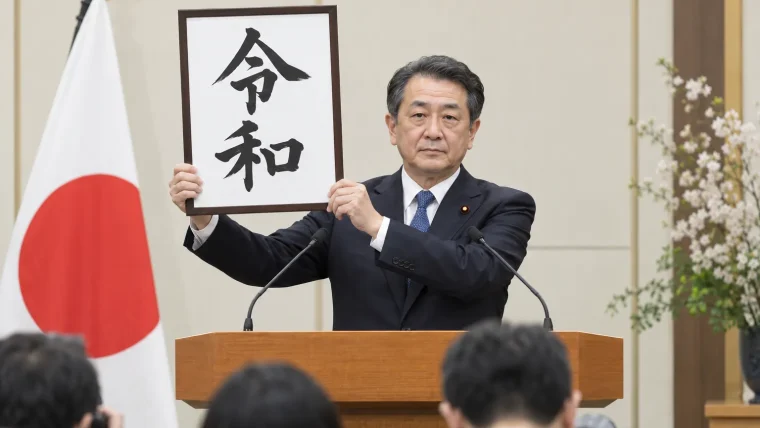
A Japanese date field looks like a wall of characters until you know it has exactly seven slots, always in the same order. Once you can see the slots, every form in the country becomes readable — driver’s licence, residence card, bank application, hospital paperwork.
This is the anatomy, plus the conventions that surround it.
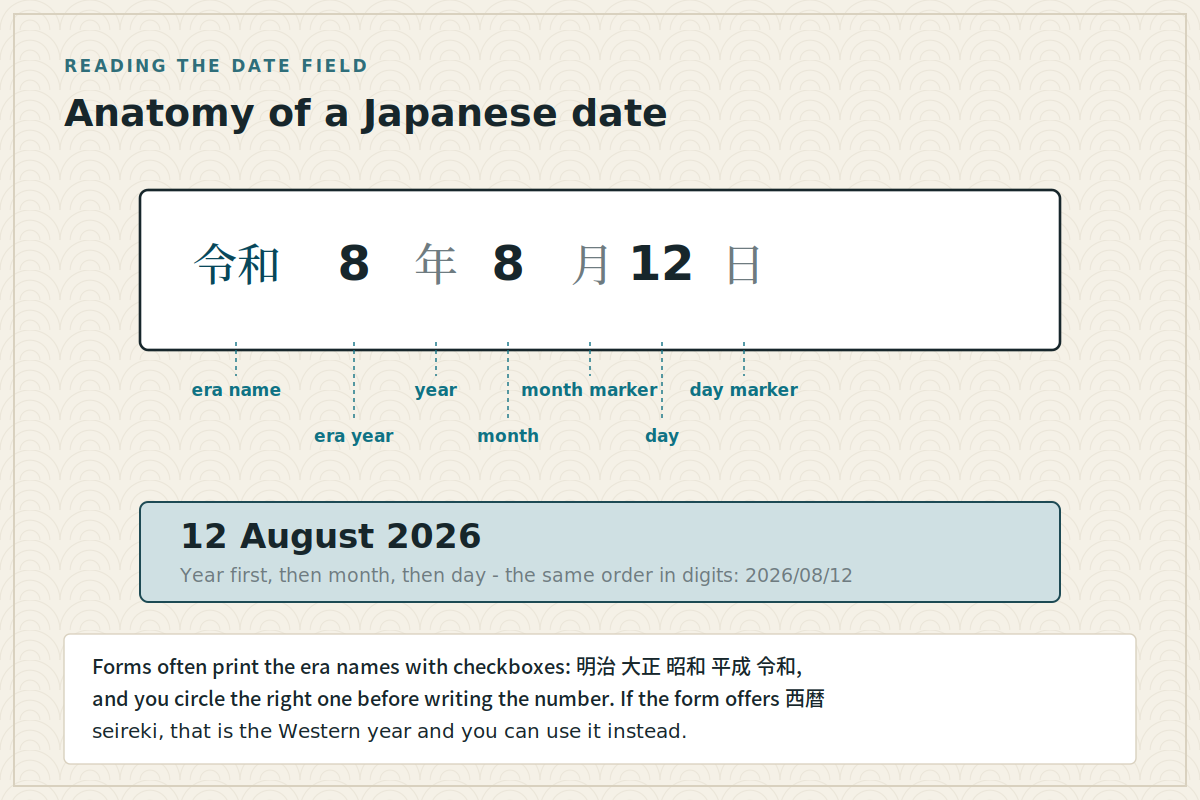
The order is always year, month, day
Japanese dates run from the largest unit to the smallest, without exception. 2026年8月12日 is 12 August 2026, and the digit form 2026/08/12 follows the same order.
This is worth internalising because it removes the American–European ambiguity entirely. There is no reading of a Japanese date on which 08/12 could mean December. The three markers make it explicit:
- 年 nen — year
- 月 gatsu — month
- 日 nichi — day
The months themselves are wonderfully regular: 1月 through 12月, “month one” through “month twelve,” with none of the irregular names English and most European languages carry.
The era prefix
Where a form uses the era calendar, the year slot has two parts: the era name in kanji, then the number. So 令和8年 is “Reiwa year 8,” which is 2026.
Recognising five character pairs on sight is the whole skill:
| Kanji | Era | Covers | Subtract |
|---|---|---|---|
| 令和 | Reiwa | 2019 – | 2018 |
| 平成 | Heisei | 1989 – 2019 | 1988 |
| 昭和 | Shōwa | 1926 – 1989 | 1925 |
| 大正 | Taishō | 1912 – 1926 | 1911 |
| 明治 | Meiji | 1868 – 1912 | 1867 |
Many forms print all five with a circle to draw round the right one, sometimes abbreviated to the initials M, T, S, H and R. That abbreviation is also why a new era name can never begin with those letters, as explained in the article on how era names are chosen.
If the form offers 西暦 seireki, that is the Western year and you may simply write it. Since 2019 more and more forms include the option, and using it is not a lesser choice.
Where you will meet it
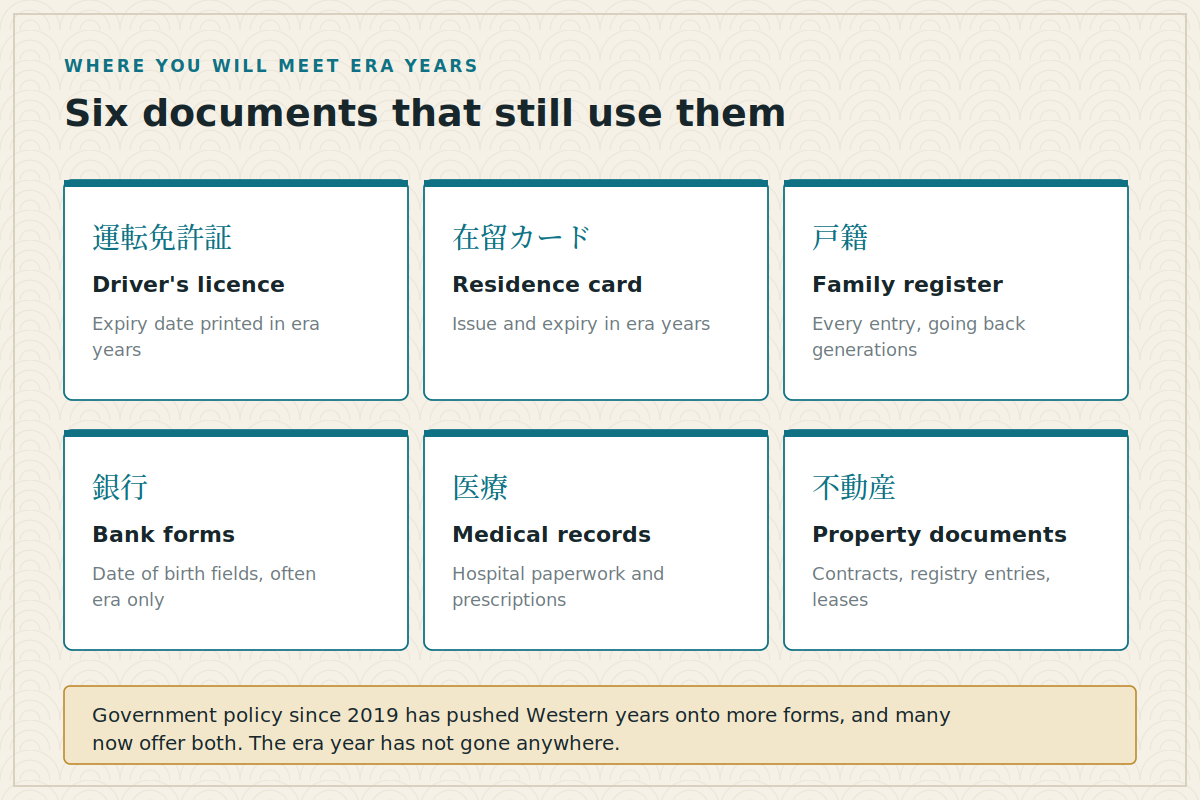
- 運転免許証, driver’s licence — issue and expiry dates in era years.
- 在留カード, residence card — the same, and the one you will be asked for most.
- 戸籍, the family register — every entry, going back generations, and the foundational identity document in Japan.
- Bank, insurance and pension forms, especially date-of-birth fields.
- Medical records, prescriptions and hospital admission paperwork.
- Property contracts, leases and registry entries.
Six other conventions on the same forms
Name order is family name first. The fields are usually labelled 姓 sei for surname and 名 mei for given name, in that order — the opposite of an American form. Foreign names are written in katakana, and getting the spelling right matters here more than anywhere; the reasoning is in our guide to writing your name in Japanese.
Furigana lines. Many forms have a second name field marked ふりがな or フリガナ, asking for the reading in kana. For a foreign name written in katakana, you generally repeat it.
Age is the ordinary age. A form asking 年齢 wants your Western age, not the traditional count. That one is ceremonial only — see the article on kazoedoshi.
Stamps, not signatures. Older forms expect a hanko personal seal in a small circle marked 印. Foreign residents are usually allowed a signature, and many procedures have dropped the seal entirely, but the box still gets printed.
Write in black. Black ink, block characters, no correction fluid. A mistake is usually corrected by striking through and stamping or initialling beside it.
Postal codes have their own symbol. 〒 marks a postal code, and Japanese addresses run largest-to-smallest like the dates — prefecture, city, ward, block, building.
Year, month, day, largest to smallest. Address the same way. Name family-first. Once you notice the pattern, half the form explains itself.The organising principle
Two traps
The transition years. A birth date in January 1989 is Shōwa 64, not Heisei 1, and a date between January and April 2019 is Heisei 31, not Reiwa 1. Converting from the year alone gets these wrong, and the result looks perfectly plausible. The exact boundaries are in the transition years article.
The first year is 元年. Never the numeral. 令和元年, not 令和1年.
Digital forms and the same problem
Online forms have not removed the era question, only moved it. A Japanese web form typically offers a dropdown with the five era names and a year field beside it, or a 西暦 toggle switching the whole thing to Western years.
Two things to watch. Some dropdowns list only the eras a plausible applicant could have been born in, which means an older applicant occasionally finds their era missing and has to phone. And a fair number of systems convert internally by year alone, producing the transition-year error invisibly — you enter a correct date and the record stores a wrong era.
Where a form offers both, the Western year is the safer entry, for the same reason it is safer in software: it has no boundary conditions.
Filling one in yourself
Reading is the harder half; writing one is mostly a matter of order and care.
- Find out which calendar the form wants. If both 元号 and 西暦 appear, either is acceptable and the Western year is simpler. If only the era boxes appear, use the era.
- Circle or tick the era, then write the number. Do not write the era name by hand if the form has printed it for you.
- Write the year, then the month, then the day, in the boxes provided, in that order. Arabic numerals are standard on modern forms.
- Use black ink and block characters. A number written casually is a number that will be queried.
- Do not use correction fluid. Strike through the error with a single line and stamp or initial beside it — that is the accepted repair.
One habit worth borrowing from Japanese practice: fill the date in last. It is the field most often written from memory and most often wrong, and doing it deliberately at the end catches the era mistake before it becomes someone else’s problem.
A short reading exercise
Try these three, then check:
- 平成7年3月20日
- 昭和39年10月10日
- 令和元年5月1日
They are 20 March 1995; 10 October 1964, the opening day of the Tokyo Olympics; and 1 May 2019, the first day of the Reiwa era. If you got all three, you can read any date field in Japan.
Our era converter does the arithmetic in both directions and handles the boundary cases, and the full explanation of the system is in the era converter guide.