Bowing is the piece of Japanese etiquette foreigners worry about most and need least. There is a system, it has three levels, and a visitor will spend almost their entire trip inside the shallowest one.
Here is the system, and then the part that actually matters — when the shallow nod is not enough.
The three bows
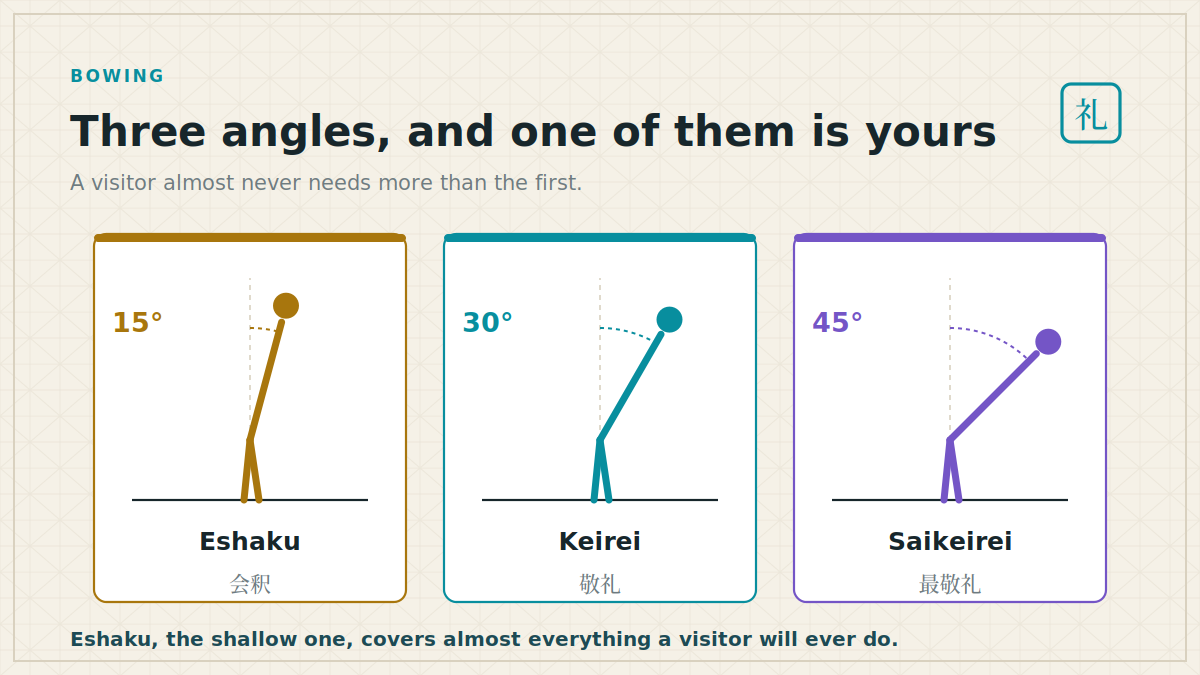
Japanese bows are described by how far the torso tilts from vertical. Three depths are named.
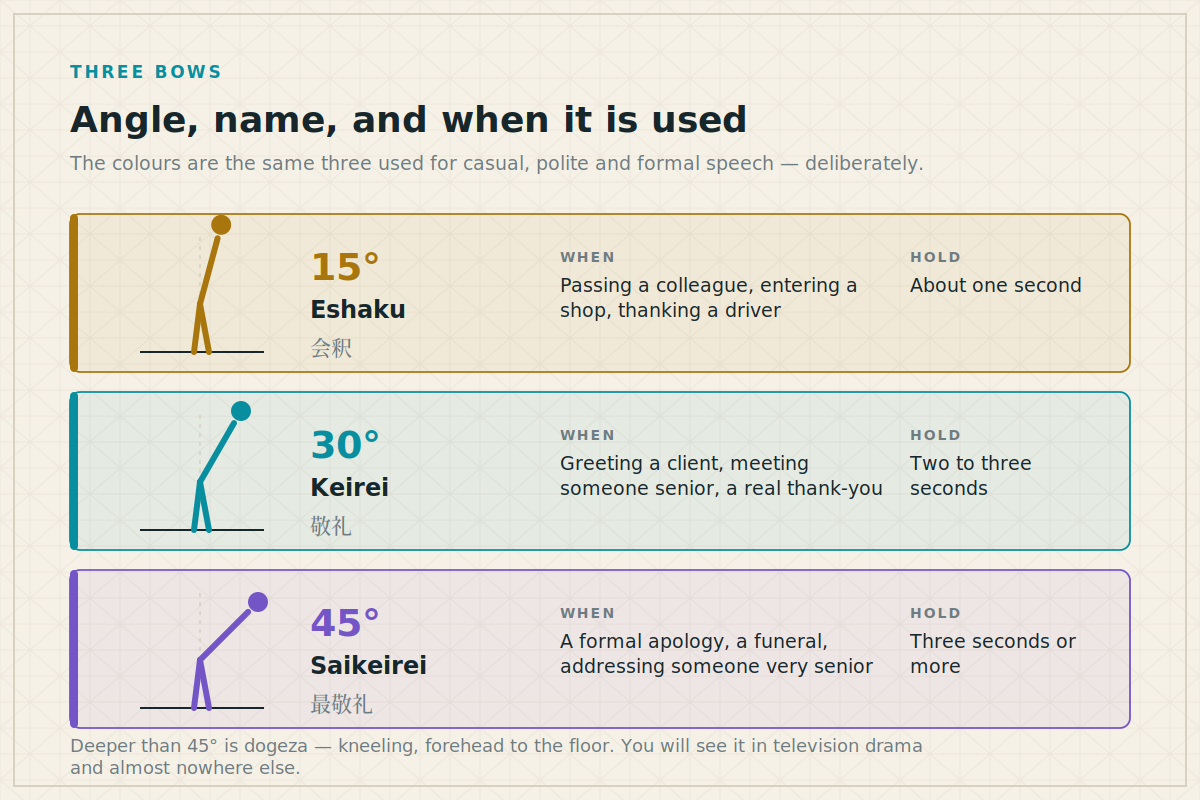
会釈 eshaku, about fifteen degrees. The everyday one. Passing a colleague in a corridor, entering a shop, thanking a driver who let you cross, acknowledging someone across a room. Held for about a second — really more of a dip than a bow.
敬礼 keirei, about thirty degrees. The business standard. Greeting a client, being introduced to someone senior, saying a thank-you that carries weight. Held two or three seconds.
最敬礼 saikeirei, about forty-five degrees. Deep respect or real apology. A funeral, a formal apology for something that cost someone real trouble, meeting someone considerably above you. Held longer, and slowly.
Below all three there is a plain nod of the head, which is what most casual interactions between friends actually consist of. Above them there is dogeza — kneeling with the forehead to the floor — which is extraordinary, essentially theatrical, and something you will see in television drama and almost nowhere in life.
The mechanics
The angle matters less than the shape. Four things make a bow read as sincere rather than perfunctory:
- Bend from the waist, with the back straight. A bow that curves the spine and drops the head reads as a slouch.
- Stop moving. Bowing while walking, or bowing while continuing to talk, both look like you are getting it out of the way.
- Eyes down. Looking up at the person while bowing is a small oddity — the gaze follows the head.
- Pause at the bottom. This is the one that separates a real bow from a nod, and it costs nothing. Down, hold a beat, up more slowly than you went down.
Hands: men traditionally at the sides, women clasped in front. This is taught as a rule and observed loosely; nobody will look at your hands.
Which bow, in practice
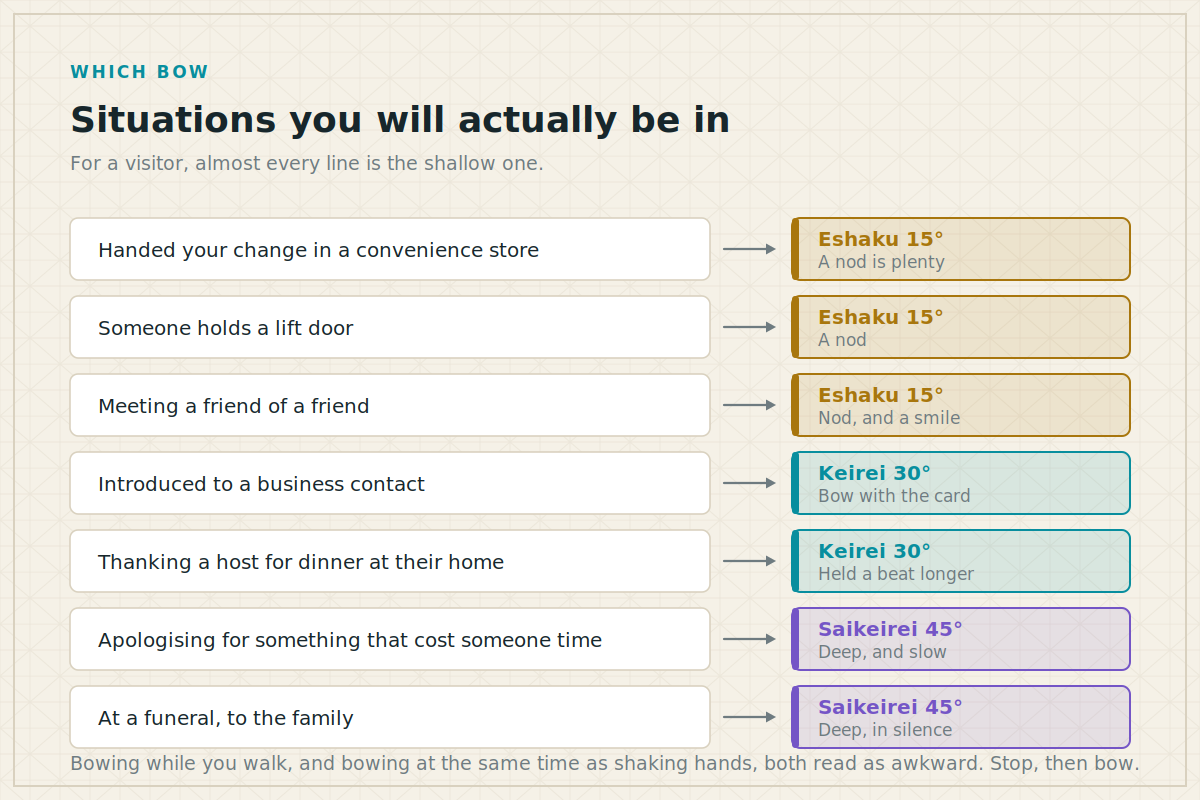
Look at how the list falls. Convenience stores, lifts, introductions to friends — a nod. The two situations that need a deep bow are an apology with real cost behind it, and a funeral.
This is the whole practical answer for a visitor. Nod at everything, and save the deep one for an apology you actually mean.
The bow-off
One thing that catches Westerners out: bowing is often not a single exchange.
Between people of unequal position, the junior bows lower and comes up later. This produces a small negotiation, because both parties are trying to be the more deferential one, and it can go two or three rounds before it settles.
As a visitor you are outside the hierarchy, so nobody is competing with you. If someone bows and you bow back, that is the whole transaction. If they bow again, one more short one closes it politely, and then stop.
Where bowing shows up unexpectedly
On the telephone. Universal, unselfconscious, and slightly wonderful to watch. People bow to a person who cannot see them because the bow is part of how the sentence is said.
In traffic. A driver who lets you out will get a small head dip from the other driver, and pedestrians dip their heads at cars that stop for them. It is the most common bow in Japan by sheer volume.
By staff, at scale. Shop assistants bow to customers constantly, department stores bow to the first customers of the day, and shinkansen cleaning crews line up and bow to the train as it arrives and departs. You are not expected to match this; a nod back is right.
By a train conductor leaving a carriage. They turn at the door and bow to the carriage. It happens on every journey and most passengers do not look up.
A visitor’s bow is not being graded. What it signals is that you noticed the person, which is all a bow was ever for.What the gesture is actually doing
Bowing and shaking hands
An awkward corner, because both parties are usually trying to accommodate the other.
Japanese people meeting foreigners frequently offer a hand. Foreigners meeting Japanese people frequently bow. The result is a hybrid — a handshake with a small bow attached — which is now so common in international business settings that it has effectively become the standard.
The thing to avoid is doing both simultaneously and vigorously: bowing deeply while shaking hands means one person’s head is heading for the other person’s arm. If a hand is offered, take it and add a small nod. If a bow comes first, bow back and let the hand follow if it is offered.
Bowing and apology
This is where depth genuinely carries meaning, and where a visitor might reasonably want to get it right.
A Japanese apology is expected to look like an apology. Saying the words at the wrong depth undercuts them — the same way a mumbled “sorry” while walking away does in English, only more so, because the physical form is doing more of the work.
For something small — bumping someone, taking a moment too long at a ticket machine — sumimasen with a shallow bow is complete. For something that cost someone real time or money, the words go up a register and the bow goes to forty-five degrees and stays there. The words themselves, and how they change with the size of the fault, are set out in our article on apologising in Japanese.
What you should not do is over-apologise for trivia at maximum depth. A deep bow for a minor thing does not read as extra-polite; it reads as strange, or as sarcasm.
Bowing at shrines and temples
Ritual bowing follows a fixed sequence rather than the social scale.
At a Shintō shrine, the standard offering sequence is: bow once on passing through the gate; at the offering box, put in a coin, bow twice, clap twice, make your wish, then bow once more. The bows here are deep, and the sequence is fixed enough that you can simply follow the person in front of you.
At a Buddhist temple the same visit has no clapping. Coin, a single bow, hands together in silence, a bow to finish.
Nobody minds a visitor getting the count wrong. Copying the person ahead of you is not only acceptable, it is how most Japanese teenagers learn it.
Why the angle system exists at all
The three named depths come out of the same impulse as the three levels of politeness in the language: Japanese encodes the relationship between two people into the form of the interaction, rather than leaving it to tone.
English does this too, but mostly with vocabulary and hedging — “could you possibly” against “give me”. Japanese does it with verb forms, and with the body. That is why the three bow depths line up so neatly with casual, polite and formal speech, and why the two systems are usually taught together. The linguistic half is covered in our article on politeness levels.
The two scales line up closely enough to put side by side:
| Bow | Angle | Matching speech register | Typical setting |
|---|---|---|---|
| Nod | A few degrees | Plain form — arigatou | Friends, family |
| Eshaku 会釈 | 15° | Polite — arigatou gozaimasu | Shops, colleagues, strangers |
| Keirei 敬礼 | 30° | Humble — osewa ni narimasu | Clients, seniors, formal introductions |
| Saikeirei 最敬礼 | 45° | Deepest humble — moushiwake gozaimasen | Apology, funeral, high deference |
Seen that way, the bow is not decoration. It is a grammatical element that happens to be performed with the spine.
The short version
Nod at people. Stop walking first. Hold it for a beat. That is ninety-five per cent of it, and it will carry you through weeks in Japan without a single awkward moment.
The remaining five per cent is knowing that a real apology needs a real bow, and that a funeral needs the deepest one you have. Both are situations where you will know they apply.
The wider question of which etiquette rules carry weight — and which ones cost nothing at all — is set out in our guide to Japanese etiquette for visitors. And if you are bowing while handing over a business card, it is worth having your name in katakana already settled rather than improvised on the spot; our name converter guide covers that.