Japan has more named categories of gift than most languages have words for gift. There is a word for the souvenir you bring colleagues from a trip, a different word for what you carry to someone’s house, a summer obligation gift, a winter one, and a specific envelope of cash for weddings that is not the same envelope as the one for funerals.
None of it is difficult. But it is a system, and a visitor who understands the shape of it will do the right thing without memorising anything.
The occasions, and what each one is called
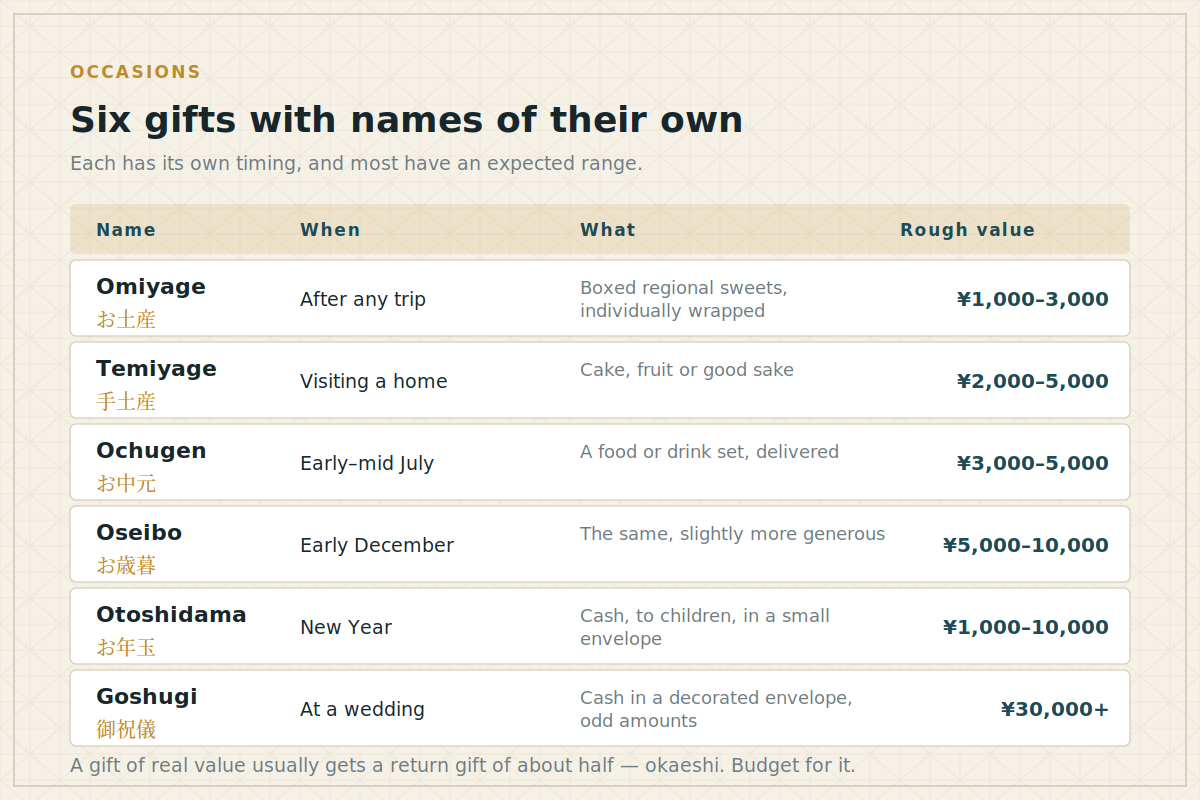
お土産 omiyage is the one you will meet first. Come back from a trip and you bring something for the people who covered your absence — colleagues, classmates, the team. It is almost always food, almost always regional, and almost always individually wrapped so it can be handed round an office. Every station in Japan has a shop selling exactly this, because the demand is constant and structural.
手土産 temiyage is what you carry when you visit someone’s home. Cake, good fruit, decent sake. Bought near where you live rather than near where they live, which sounds like a nicety and is genuinely observed — a gift from your own neighbourhood says you thought about it before setting out.
お中元 ochūgen and お歳暮 oseibo are the twin seasonal obligations: midsummer and year-end. These go to people you owe some ongoing debt of gratitude — a doctor, a teacher, a business contact, a landlord — and they are usually ordered from a department store and delivered rather than handed over. Department stores build entire floors around this twice a year.
お年玉 otoshidama is New Year money for children, in a small decorated envelope, from relatives. It is the highlight of the Japanese childhood financial year.
Money as a gift, and the envelope it comes in
Cash is a normal and respectable gift in Japan for weddings and funerals, which is the reverse of the American instinct. But it is never handed over bare, and the envelope carries specific information.
御祝儀 goshūgi is wedding money. It goes in a decorative envelope, and three rules apply:
- Odd amounts. ¥30,000 and ¥50,000 are the standard figures for a guest. Even numbers can be divided in two, which is a bad image at a wedding. Ten is treated as an exception and is fine.
- Never four or nine. The reasons are in our article on lucky and unlucky numbers, and they are strong enough that nobody tests them.
- New notes. Crisp, unfolded bills, obtained from a bank. The message is that you prepared.
香典 kōden is condolence money, and it inverts almost every one of those signals. The envelope is black and white or silver rather than red and white. And the notes should be old — because new notes would suggest you had them ready, which is to say that you were expecting the death.
That single detail tells you more about how the system thinks than any list of rules could. The gift is not only a transfer of value; it is a statement about your relationship to the event, and every element is read.
The wrapping is the message
Two components on a formal Japanese gift do work that the contents cannot.
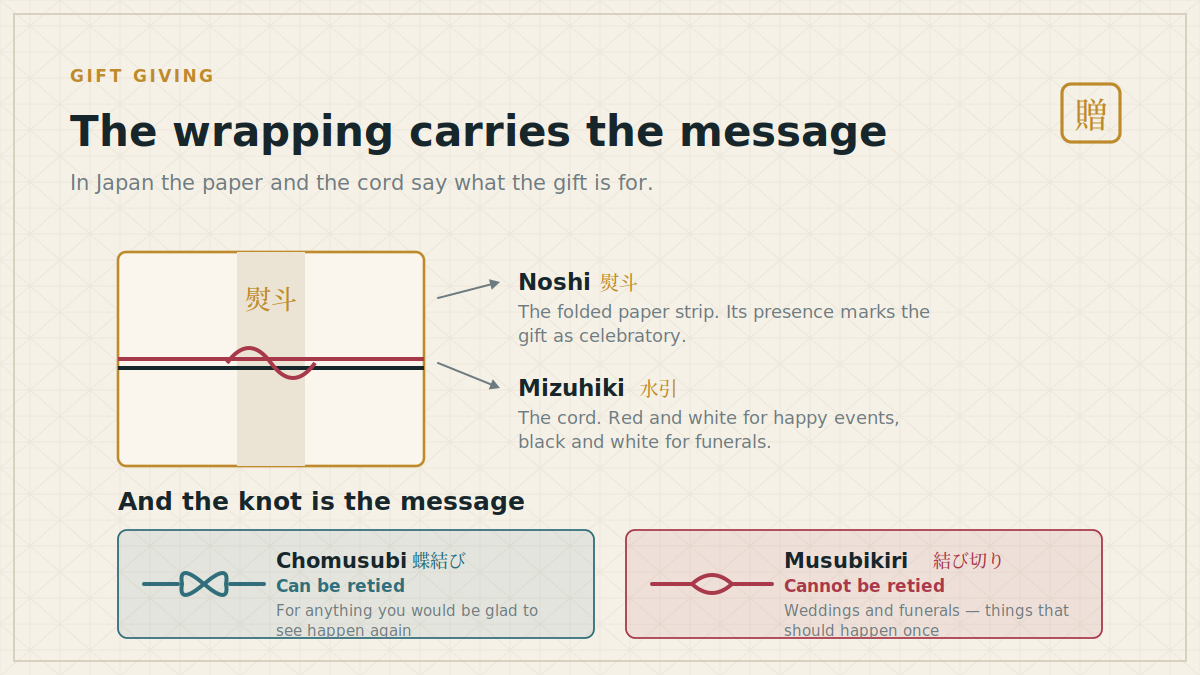
熨斗 noshi is the folded paper ornament in the top right corner. Its presence marks the gift as celebratory. It is absent on anything to do with a funeral or illness — which means the wrapping alone declares the register before anything is opened.
水引 mizuhiki is the decorative cord. Colour signals the occasion — red and white for happy, black and white or silver for mourning — and the knot signals something subtler.
| Knot | Japanese | Property | Used for |
|---|---|---|---|
| Bow knot | 蝶結び chōmusubi | Can be untied and retied | Births, general congratulations, seasonal gifts — anything you would be glad to repeat |
| Tight knot | 結び切り musubikiri | Cannot be retied | Weddings, funerals, recovery from illness — things that should happen once |
A bow knot at a wedding is a small disaster, because it wishes the marriage repeatable. This is the sort of detail Japanese stationery shops handle for you: tell the assistant the occasion and they will hand you the correct envelope.
Handing it over
Four things, and only the first two matter much.
- Both hands. Always, for anything.
- Not on the doorstep. Come in, sit down, and offer the gift once you are settled. Handing it over at the door reads as a delivery.
- Take it out of the shop bag first and offer the wrapped gift itself.
- Say something modest about it. The traditional tsumaranai mono desu ga — “it’s a trifling thing, but” — is now dated; younger people say something warm and specific instead.
Receiving works in reverse. Both hands, a word of thanks, and traditionally not opening it in front of the giver — though this has softened, and many people now open a gift immediately if invited to.
What not to give
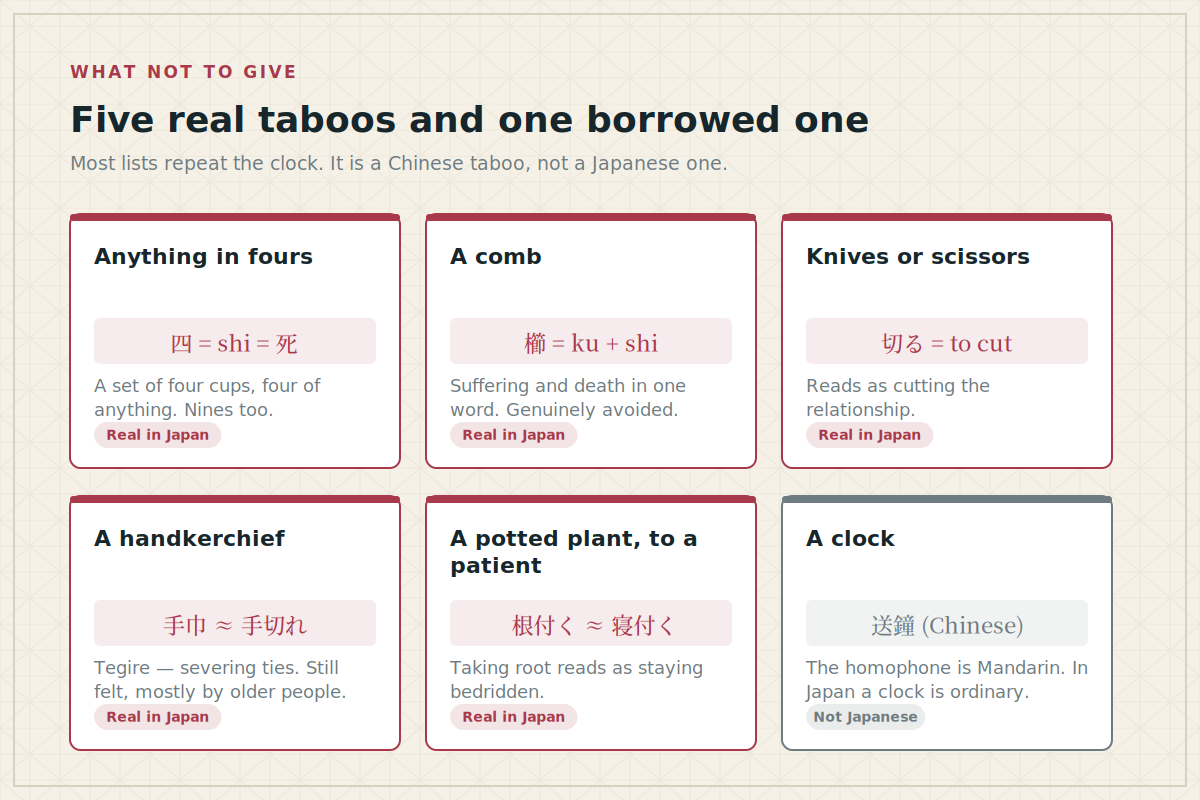
Most of the real prohibitions are sound-based, which is a recurring feature of Japanese superstition.
Anything in fours or nines. A set of four cups, four of anything. The digits carry the sounds of death and suffering.
A comb, 櫛 kushi, which contains ku and shi — suffering and death in a single two-syllable word. About as unambiguous as these things get.
A handkerchief. One reading of the older word is tegire, a homophone for 手切れ, “severing ties.” Still felt, chiefly by older people.
Knives and scissors, for the obvious symbolic reason. Though a good Japanese kitchen knife is a famous souvenir and works perfectly well as a gift to yourself.
A potted plant to someone in hospital. Taking root, 根付く nezuku, sits very close to 寝付く netsuku, to be laid up in bed. Cut flowers are fine — though not white ones, and not camellias, whose flowers drop whole and are said to resemble a head falling.
The clock, and why we left it off
Almost every English-language list of Japanese gift taboos includes clocks. It should not.
The taboo is Chinese and specifically Mandarin: 送鐘 sòng zhōng, to give a clock, is a near-homophone for 送終, to attend a funeral. The pun does not exist in Japanese, where the words are unrelated, and a clock or watch in Japan is an ordinary and rather nice gift.
The item travels through gift-etiquette articles because Japan and China get bundled together, and because nobody checks. It is the same failure we keep running into on this site: a rule that is right somewhere gets applied where it does not hold, and the result looks plausible enough that it is repeated rather than tested.
Giving back: okaeshi
The part visitors do not see coming. A significant gift in Japan usually generates a return gift, お返し okaeshi, at roughly half the value — the practice is literally called 半返し, “half-return.”
This applies after weddings, funerals, births, and recovery from an illness people sent gifts about. Wedding guests receive a boxed gift on the day; families who received condolence money send something back after the mourning period.
Two consequences. Budget for it if you are on the receiving end of Japanese generosity. And be aware that a large unsolicited gift creates an obligation rather than simply delighting the recipient — which is why the seasonal gifts have such well-established price ranges. The range is doing work.
New notes for a wedding, because you prepared. Old notes for a funeral, because you did not.The whole logic in two lines
If you are the visitor
You are outside the obligation system, which makes this easy. Nobody expects a foreign visitor to run ochūgen. What is genuinely appreciated:
- Something from where you are from, clearly identified as such. Regional food, local sweets, a specialty of your city — this maps exactly onto how omiyage works and is understood instantly.
- Food over objects, shareable over singular — a box of twelve small things beats one large thing.
- Wrapped, even roughly. Presentation carries more weight here than price.
- Handed over with both hands, sitting down, with a sentence about what it is.
And if you are visiting a home, bring something. It is not optional in the way it might be elsewhere, and the etiquette around home visits is covered in our guide to Japanese etiquette.
The pattern underneath
Every element of this system — the noshi, the knot, the age of the banknotes, the half-value return — does the same job: making the relationship legible without anyone having to say anything about it. The same instinct shows up in the language, where the grammar encodes who is senior to whom, and in the bow, where the body does it; both are covered in our article on bowing.
Seen that way, the rules stop being a list to memorise and become a small readable code. And you only need to read it, not write it.