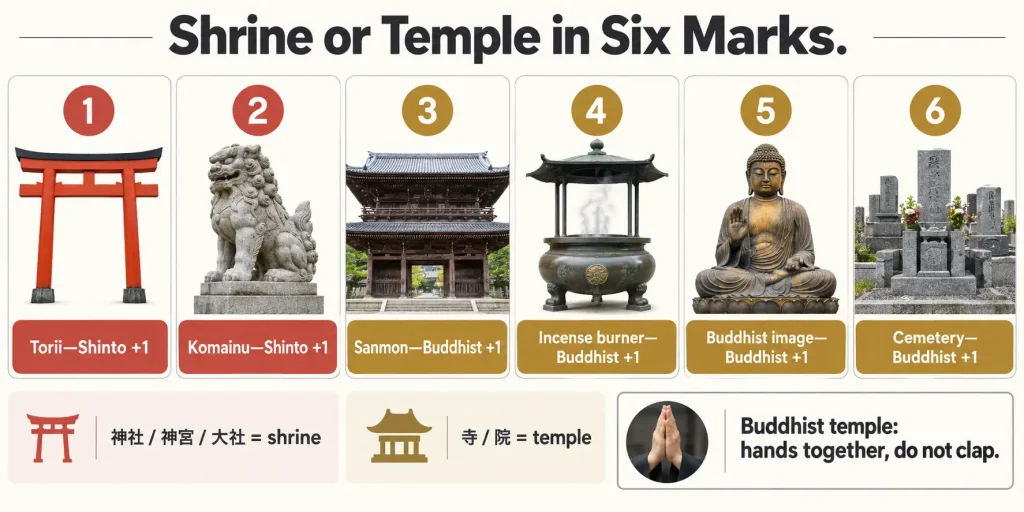
Six visible markers are enough to identify most religious sites you enter in Japan. The shrine vs temple Japan question becomes manageable when you stop judging the roof and count the evidence instead: torii and komainu point toward Shinto, while a sanmon gate, incense burner, Buddhist image, and cemetery point toward a Buddhist temple.
The count is an editorial identification tool, not an official religious classification. Give each clearly visible marker one point, compare the two sides, and then confirm the result by reading the site’s Japanese name.
The roof is usually the least useful clue. The gate and the objects beyond it tell you far more.
Where the six-marker test comes from
Japanese uses different words for the two institutions. 神社, jinja, literally “kami place,” is a Shinto shrine, while お寺, otera, literally “honorable temple,” is the everyday term for a Buddhist temple.
A shrine is associated with 神, kami: sacred presences connected with places, communities, natural forces, ancestors, or historical figures. A temple belongs to a Buddhist school and centers worship on buddhas, bodhisattvas, and Buddhist teachings.
The problem is that the buildings can look similar to an unfamiliar eye. Both may have tiled or wooden roofs, stone lanterns, offertory boxes, bells, gardens, purification practices, charms, seal counters, and people praying.
That leaves six more dependable things to count:
| Visible marker | Shinto side | Buddhist side | Evidence value |
|---|---|---|---|
| 鳥居, torii, shrine gateway | +1 | 0 | Strong Shinto marker |
| 狛犬, komainu, guardian figures | +1 | 0 | Supporting Shinto marker |
| 山門, sanmon, formal temple gate | 0 | +1 | Strong Buddhist marker |
| 香炉, kōro, incense burner | 0 | +1 | Supporting Buddhist marker |
| Buddhist image or statue | 0 | +1 | Strong Buddhist marker |
| Cemetery or lines of family graves | 0 | +1 | Supporting Buddhist marker |
| Total possible score | 2 | 4 | Six markers counted |
The unequal totals do not imply that temples are easier, more important, or more religious. They reflect the six features chosen for this practical test. A torii alone can identify a shrine more decisively than several ambiguous decorative objects.
For the larger explanation of why Japanese families may use both traditions without treating them as exclusive memberships, read How Shinto and Buddhism Actually Show Up. That pillar covers everyday rites and religious identity; this guide stays with what you can see at the entrance.
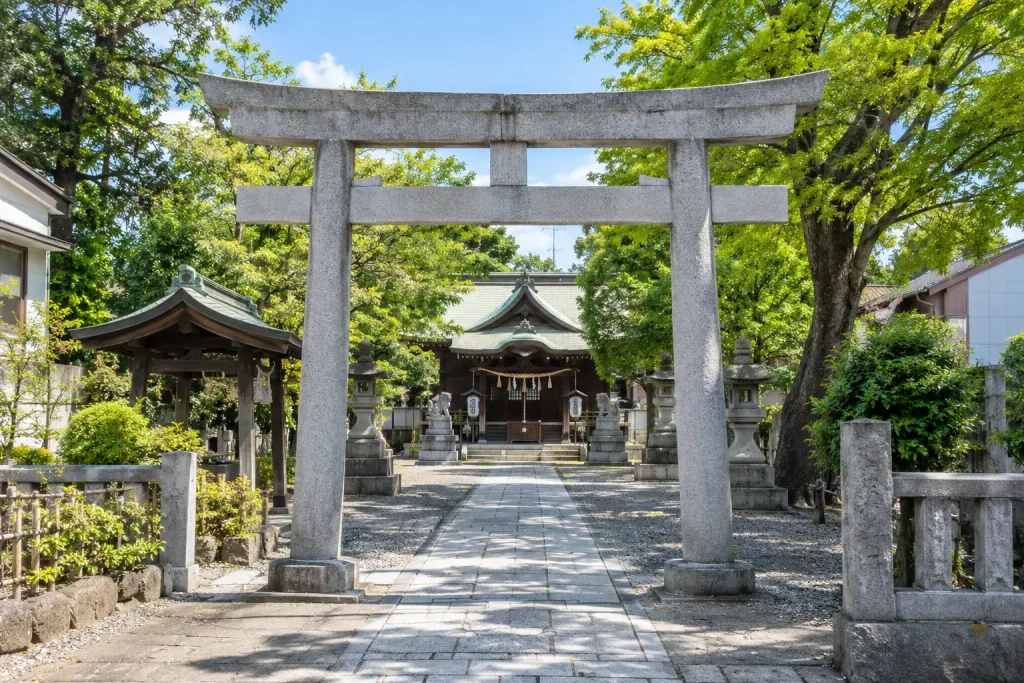
Marker one: the torii settles the Shinto side quickly
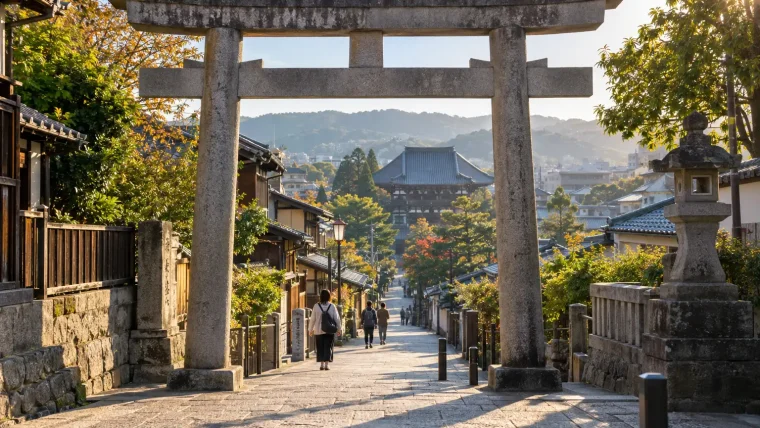
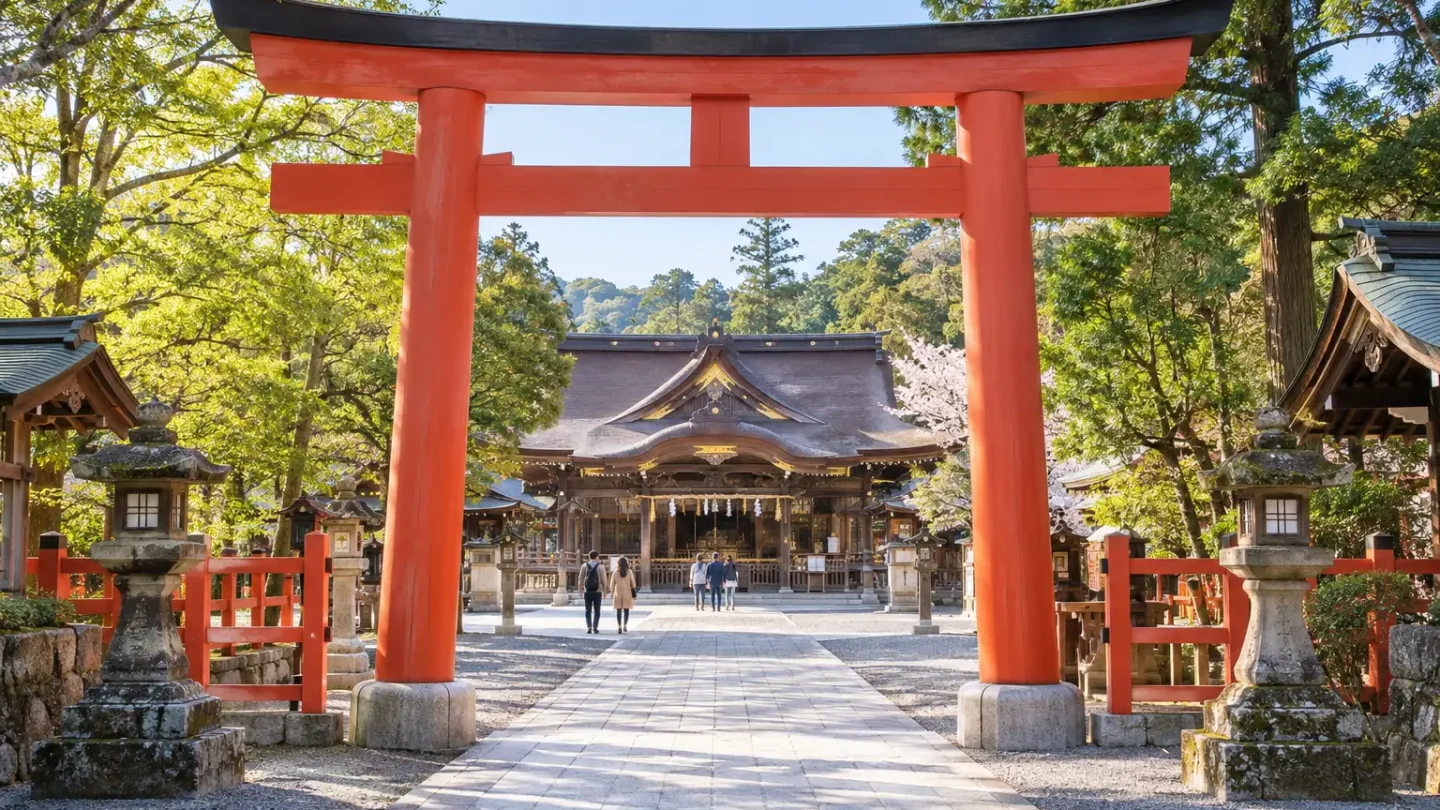
鳥居, torii, is the gateway marking entry into a Shinto sacred area. It usually consists of two upright supports crossed by horizontal beams, although its materials, proportions, color, and construction style vary.
A vermilion torii is easy to recognize, but not every torii is red. You will also see gates made from unpainted wood, stone, concrete, or metal. Color is decoration; shape and placement are the evidence.
If a torii stands across the approach, score one point for the Shinto side. In many ordinary cases, that single marker is enough to identify a shrine before you reach the main buildings.
Do not assume that everything beyond the gate must belong only to Shinto. Japan has a long history of 神仏習合, shinbutsu shūgō, literally “combination of kami and buddhas.” Shrines and temples were institutionally separated under modern government policy, but older sites, shared grounds, and neighboring complexes can still preserve evidence of both traditions.
A torii can also stand some distance from the worship hall. It marks a boundary or approach, not necessarily the exact point where the principal building begins.
Marker two: komainu guard more than the doorway
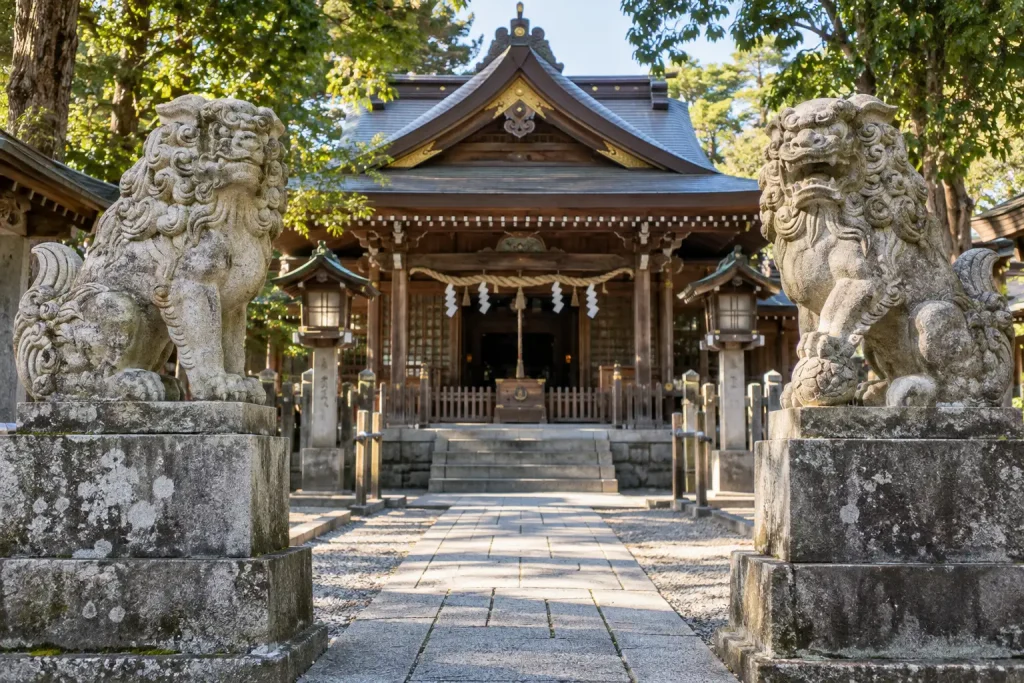
狛犬, komainu, literally “Korean dogs,” are paired guardian figures commonly positioned near a Shinto shrine’s approach or worship area. Despite the name, they often look more like stylized lions than domestic dogs.
They usually appear as a pair facing outward or toward the path. One may have an open mouth while the other has a closed mouth, creating a deliberate contrast.
For the test, a recognizable komainu pair adds one Shinto point. It is supporting evidence rather than an absolute verdict because guardian figures also appear in complicated historical settings, and other animals can replace them at particular shrines.
Foxes are strongly associated with Inari shrines. Cattle, wolves, monkeys, rabbits, deer, and other messengers can appear elsewhere. The animal does not tell you that Japanese people generally worship that species; it usually relates to the shrine’s kami, tradition, or origin story.
Shinto shrine symbols work as a set. A torii followed by guardian figures and a worship hall is much stronger evidence than an isolated stone animal in a garden.
A guardian statue is useful only after you ask what it is guarding.
Marker three: the sanmon belongs to the temple approach
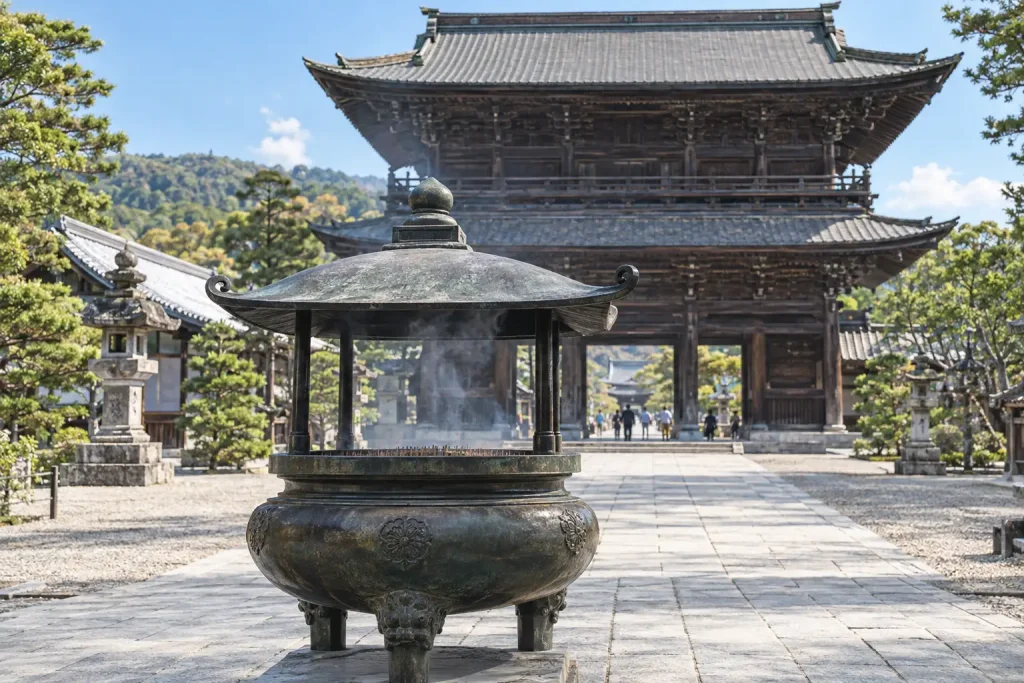
山門, sanmon, literally “mountain gate,” is a formal gateway associated with a Buddhist temple. The name remains in use even when the temple is located in a city rather than on a mountain.
Unlike the open outline of a torii, a sanmon is usually a substantial roofed structure. It may contain doors, upper rooms, side bays, guardian images, or heavy structural pillars.
Score one Buddhist point when the main approach passes through a clearly recognizable temple gate. The gate may also carry a plaque displaying the temple’s name.
Do not rely on size. A major sanmon can resemble a building, but a neighborhood temple may have a compact roofed gate. The useful contrast is structural: the torii frames open space with beams, while the temple gate has a roof and an architectural body beneath it.
The site name gives confirmation. Temple names commonly end with 寺, read ji or tera, or 院, in, meaning an institution or sub-temple. Shrine names often contain 神社, jinja, 神宮, jingū, or 大社, taisha.
| What appears in the name | Reading | Usually identifies |
|---|---|---|
| 神社 | jinja | Shinto shrine |
| 神宮 | jingū | Shinto shrine with a particular status or association |
| 大社 | taisha | Major Shinto shrine designation |
| 寺 | ji or tera | Buddhist temple |
| 院 | in | Buddhist temple or sub-temple |
| 宮 | gū or miya | Often a shrine, but context matters |
Marker four: incense points toward Buddhism
香炉, kōro, literally “incense furnace,” is the large burner you may see in front of a Buddhist temple hall. Visitors place incense in it and may draw smoke toward themselves before approaching the hall.
For the six-marker test, a public incense burner adds one Buddhist point. A conspicuous burner filled with upright incense sticks is among the fastest ways to identify a temple once you are inside the grounds.
The outsider’s mistake is treating any smoke as a temple marker. Shrines can use fire, smoke, or incense in particular ceremonies, and food stalls can fill festival grounds with smoke for an entirely non-ritual reason.
Look at the object and its position. A purpose-built burner on the main approach, used by visitors before entering a religious hall, is useful evidence. Smoke by itself is not.
The uncomfortable practical point is that copying other visitors without understanding the site can make you perform the wrong sequence. Check the posted instructions before washing, burning incense, ringing a bell, or praying.
Marker five: the image tells you who the hall is for
A visible Buddhist image strongly favors the temple side. You may see a statue or image of a Buddha, a bodhisattva, a temple guardian, or 地蔵, Jizō, a bodhisattva commonly represented in small stone figures.
The principal image may be inside the hall and difficult to see. It may also be displayed only on designated occasions, so its absence proves nothing.
Some figures are easy for visitors to misidentify. A large seated statue suggests Buddhism, but small guardian figures, local sacred stones, and historical monuments require context. Do not turn every old statue into a religious identification clue.
When the image is explicitly labeled with Buddhist terms or stands before an altar with incense, add one Buddhist point. If the label is unclear, leave it out of the arithmetic rather than forcing a result.
This is also where dates on plaques may switch into Japanese era notation. The site’s era converter covering every year from 1868 through 2050 is useful when an inscription gives a restoration or dedication year in era form.
Marker six: a cemetery is strong supporting evidence
A cemetery beside or behind the main buildings usually points toward a Buddhist temple. Many Japanese families maintain graves through relationships with temples, and Buddhist institutions have a central role in funerals and memorial services.
Look for rows of upright stone grave markers, family names, flower holders, incense stands, and narrow paths between plots. Add one Buddhist point when the burial ground is clearly part of the religious complex.
A cemetery is supporting evidence rather than a universal rule. Municipal, public, Christian, secular, and privately operated cemeteries also exist. Not every temple has a visible graveyard, particularly in dense tourist districts.
Do not enter a cemetery as if it were an outdoor museum. Keep your voice low, stay on paths, and avoid photographing identifiable family graves or people carrying out memorial observances without permission.
The life-stage division helps explain the pattern. Shinto is highly visible around beginnings and protection, while Buddhist institutions are prominent around death and family remembrance. The Ages Japan Marks With a Ceremony covers civic and family milestones without pretending that every ceremony belongs to one religion.
Work the count before trusting your first impression
The arithmetic is intentionally simple. Count only markers you can identify with confidence, give each one a point on its respective side, and compare the totals.
Imagine that you enter through a roofed gate, pass an incense burner, and notice family graves behind the hall. You have three Buddhist points and no Shinto points:
- Sanmon gate: temple +1
- Incense burner: temple +1
- Cemetery: temple +1
- Torii: shrine 0
- Komainu: shrine 0
- Clearly identified Buddhist image: temple 0 because none is visible
- Result: shrine 0, temple 3
Now imagine an approach with a torii and a komainu pair but no incense burner, cemetery, sanmon, or Buddhist image. The result is shrine 2, temple 0.
The test does not require all available markers. One unmistakable gate often answers the question, while several supporting objects make the result more secure.
| Example site | Shinto points | Buddhist points | Working identification |
|---|---|---|---|
| Torii + komainu | 2 | 0 | Shinto shrine |
| Sanmon + incense burner | 0 | 2 | Buddhist temple |
| Incense burner + Buddhist image + cemetery | 0 | 3 | Buddhist temple |
| Torii + nearby cemetery | 1 | 1 | Mixed or neighboring sites; read the names |
| No clear marker | 0 | 0 | Do not guess; check the sign |
This is how to tell a shrine from a temple without turning architectural style into a false certainty. The total tells you when the evidence is clear and, just as importantly, when it is not.
What moves the result or breaks the test
The largest variable is historical overlap. Before the government-directed separation of Shinto and Buddhism in the early Meiji period, kami and Buddhist institutions had been connected for centuries. Some complexes still stand next to each other or preserve features whose origins cross the modern boundary.
A shrine may occupy one part of a hill while a temple occupies another. The road, stairway, parking area, or garden can be shared, making the whole place look like a single institution.
The second variable is specialization. Inari shrines use fox guardians, so looking only for komainu would miss a valid Shinto marker. Buddhist temples also differ by school and do not all have the same statues, halls, graveyards, or incense arrangements.
The third variable is reconstruction. Fire, war, earthquakes, development, and restoration have changed entrances and layouts. A new concrete building can still be a temple, while an old wooden hall is not automatically Buddhist.
The name on the sign wins when the visual count produces a tie. Read 神社 or 神宮 as shrine evidence and 寺 or 院 as temple evidence. If adjacent signs identify two institutions, accept that you have found two sites rather than trying to force the grounds into one category.
The gesture that matters: do not clap at a Buddhist temple
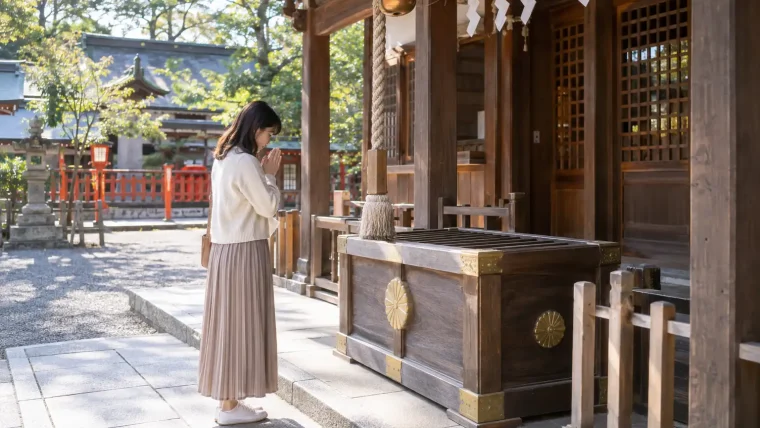
At many Shinto shrines, the widely taught sequence is 二礼二拍手一礼, nirei nihakushu ichirei, literally “two bows, two claps, one bow.” Individual shrines can use different procedures, so their posted instructions take priority.
At a Buddhist temple, bring your hands together and pray quietly. Do not clap at a Buddhist temple. This is the practical difference worth remembering even if you forget every architectural term in the article.
| Action | Shinto shrine | Buddhist temple |
|---|---|---|
| Small offering | Common | Common |
| Bell or rope | May be present | May be present |
| Bow | Yes | Yes |
| Hands together | Yes | Yes |
| Clap during the standard prayer sequence | Common at many shrines | No |
| Incense before prayer | Not a general visitor rule | Common at many temples |
You do not need to perform a perfect ritual to visit respectfully. Pause, watch without blocking the approach, and follow instructions posted by the institution.
General behavior—photography, boundaries, shoes, noise, and active worship—is covered in Japanese Etiquette for Visitors: What Actually Matters. That article separates meaningful boundaries from details visitors worry about unnecessarily.
Festivals add another layer because a shrine precinct can temporarily look like a street market. Japanese Festivals by Season: A Year-Round Guide explains what happens across the calendar rather than repeating festival planning here.
The comparison Americans usually expect
An American visitor may expect the denomination to be announced by a sign and the building to follow a recognizable church plan. Japanese sites require a different reading because the institution may reveal itself through the approach, gate, ritual objects, and name suffix.
You are also less likely to be asked what religion you belong to before entering. A shrine or temple can function simultaneously as a place of worship, historic site, neighborhood institution, cemetery, festival organizer, garden, or tourist destination.
That does not make the religious identity interchangeable. A temple is not simply a shrine with incense, and a shrine is not merely a temple with a torii. The six markers are clues to two different institutional traditions.
Shared visitors and overlapping history do not erase the line between jinja and otera.
The useful comparison is therefore procedural. In the United States, you might identify a religious building by denomination before deciding how to behave. In Japan, you often identify the site by its visible markers so that you know which behavior fits.
Shrine or Temple in Six Marks
Frequently asked questions
Is every building behind a torii a shrine?
A torii strongly identifies a Shinto sacred approach, but a larger complex may also contain or border a Buddhist temple. Read the signs when multiple institutions share the area.
Are all shrine gates red?
No. Torii may be vermilion, natural wood, stone, concrete, or metal. The shape and its position across the approach matter more than the color.
Are komainu always dogs?
Their name includes “dog,” but the figures often resemble stylized lions. Some shrines use other guardian or messenger animals, especially foxes at Inari shrines.
Does every Buddhist temple have incense?
No. Incense is common but not universally visible or available to visitors. Restrictions, ceremonies, local practice, and the temple’s layout can change what you see.
Can a temple have an offering box and bell?
Yes. Those objects are not exclusive to Shinto, which is why they are absent from the six-marker score. The gate, incense, images, cemetery, and written name are more useful.
Should I clap once instead of twice at a temple?
No. Do not clap during Buddhist temple prayer. Place your hands together quietly and follow the temple’s posted instructions.
Can I photograph graves?
Do not photograph identifiable family graves or people observing memorial rites without permission. A cemetery is not simply another sightseeing display.
What is the fastest reliable test?
Look for one decisive gate: a torii points to a shrine, while a substantial roofed sanmon points to a temple. Then confirm with the Japanese name.
The figure to remember is six visible markers. Recheck official visitor instructions and access rules before the scheduled annual review in November 2027.