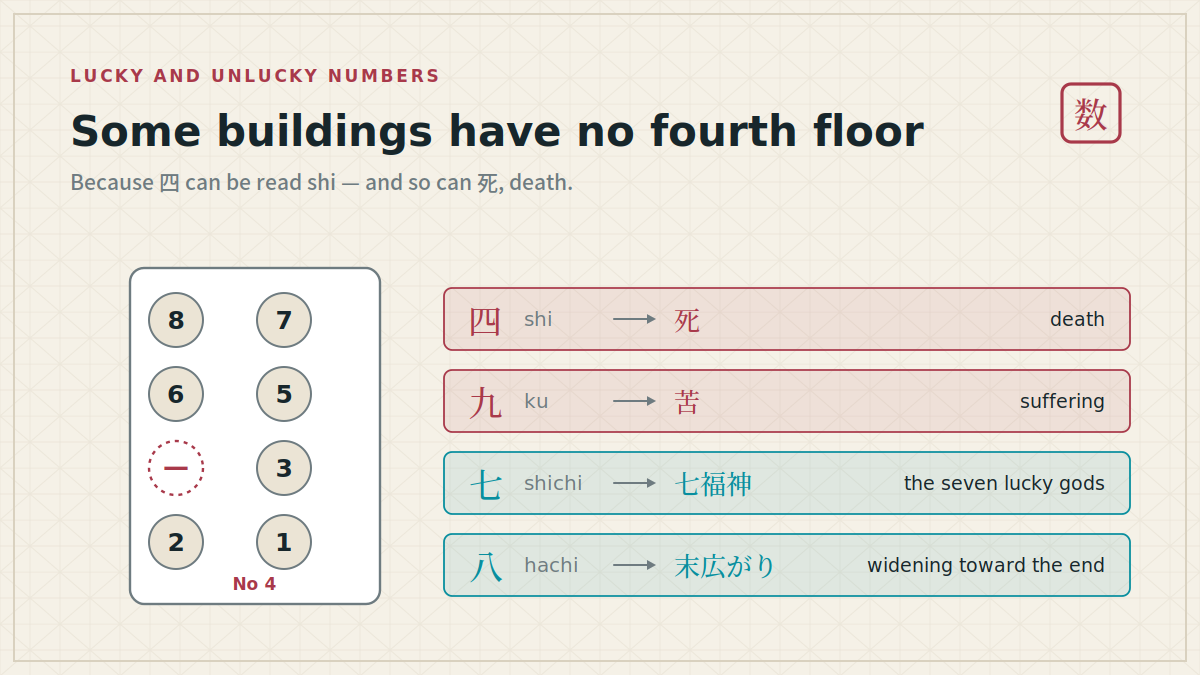
Some Japanese hospitals have no room 4. Some hotels have no fourth floor. Gift sets come in threes and fives and almost never in fours. Wedding money is given in odd amounts.
None of this is arbitrary. It comes from a single feature of the language: several Japanese numbers have two readings, and one of the readings collides with a word nobody wants to say.
Four and nine
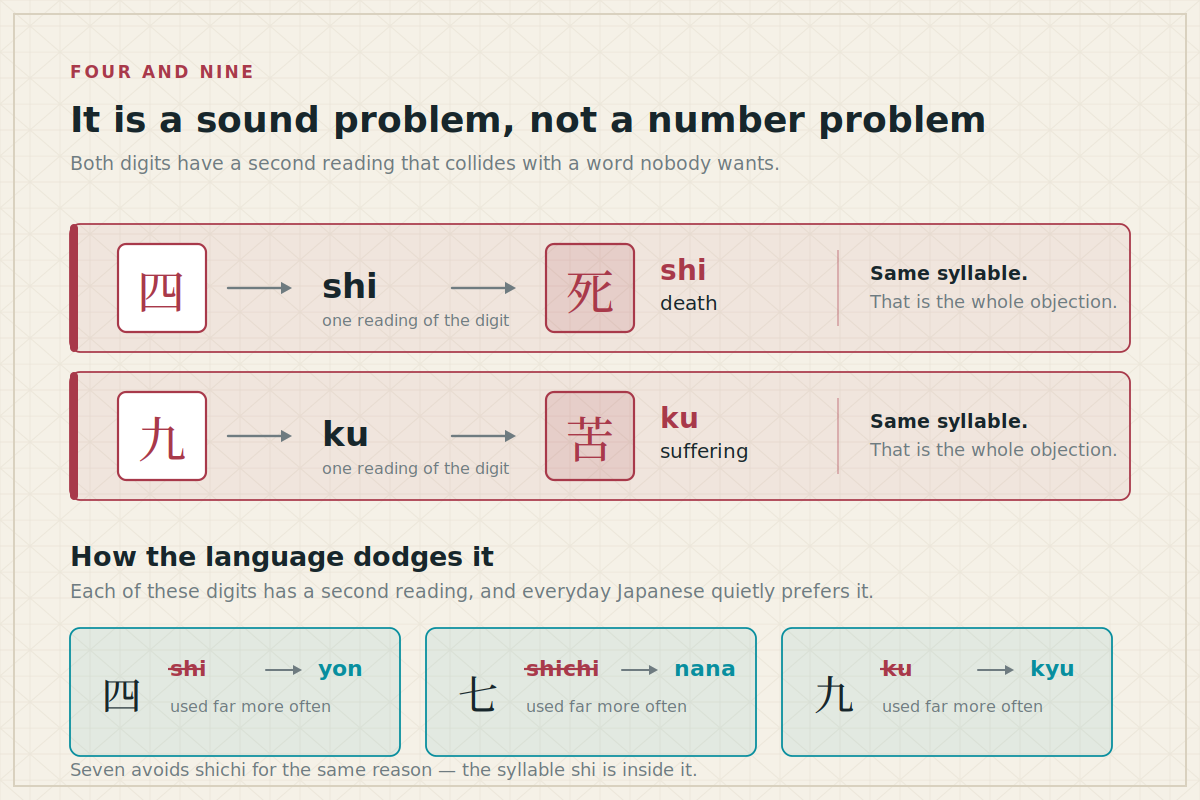
四, four, can be read shi. So can 死, death. Identical syllable, entirely unrelated words, and that is enough.
九, nine, can be read ku. So can 苦 — suffering, hardship, agony.
Both come from the Chinese-derived layer of Japanese vocabulary, which is why the same superstition exists across East Asia. In China and Korea the aversion to four is stronger and more systematic than in Japan; buildings there routinely label the fourth floor “F” or skip it entirely. Japan is less rigorous about it, but the discomfort is real.
Combined, they get worse. Forty-nine — shijūku — hovers near 死苦, “death-agony,” and it is also the length of the Buddhist mourning period, forty-nine days. Forty-two reads as shini, which is very close to “to death,” and it is a common Japanese explanation for why a car number or a room number gets skipped.
How the language quietly avoids it
This is the part that makes the superstition genuinely useful to know, because it changes how you count.
Japanese has two number systems, and the native-Japanese readings give alternatives for exactly the awkward digits:
| Digit | Sino-Japanese | Native reading | Which one is used |
|---|---|---|---|
| 四 | shi | yon | yon, overwhelmingly |
| 七 | shichi | nana | nana, usually |
| 九 | ku | kyū | kyū, usually |
Seven is on that list for a slightly different reason: shichi is not itself unlucky, but it contains shi, and it is also easy to mishear as ichi, one. Both problems disappear with nana.
The practical result is that when a Japanese speaker reads out a phone number or a room number, they will almost always say yon, nana and kyū. If you learned shi–go–roku–shichi–hachi–ku from a textbook, this is why it never quite sounds like what you hear. The two systems and where each is used are set out in our article on Japanese numbers and counters.
Where the avoidance actually shows up
Hospitals are the most consistent. Room numbers skipping 4, 9, 42 and 49 is common enough to be a documented practice rather than a rumour, and it is easy to see why a hospital in particular would care.
Hotels and apartment buildings sometimes skip the fourth floor, and more often skip room 404 and similar. Not universal — plenty of Japanese buildings have a perfectly ordinary fourth floor.
Gift sets come in threes, fives and tens. A set of four teacups is not sold as a set of four. This is the one that catches shoppers out.
Wedding envelopes, where ¥40,000 or ¥90,000 would be a genuine misstep. The conventions around cash gifts are covered in our article on Japanese gift giving.
Vehicle registration plates carry a documented version of the same instinct: the hiragana character し is excluded from Japanese plates because it stands for 死. So is へ, for a much less solemn reason — it reads as 屁, “fart.” Both are official exclusions rather than folklore, which makes them a rare hard data point in a field full of soft ones.
The lucky side
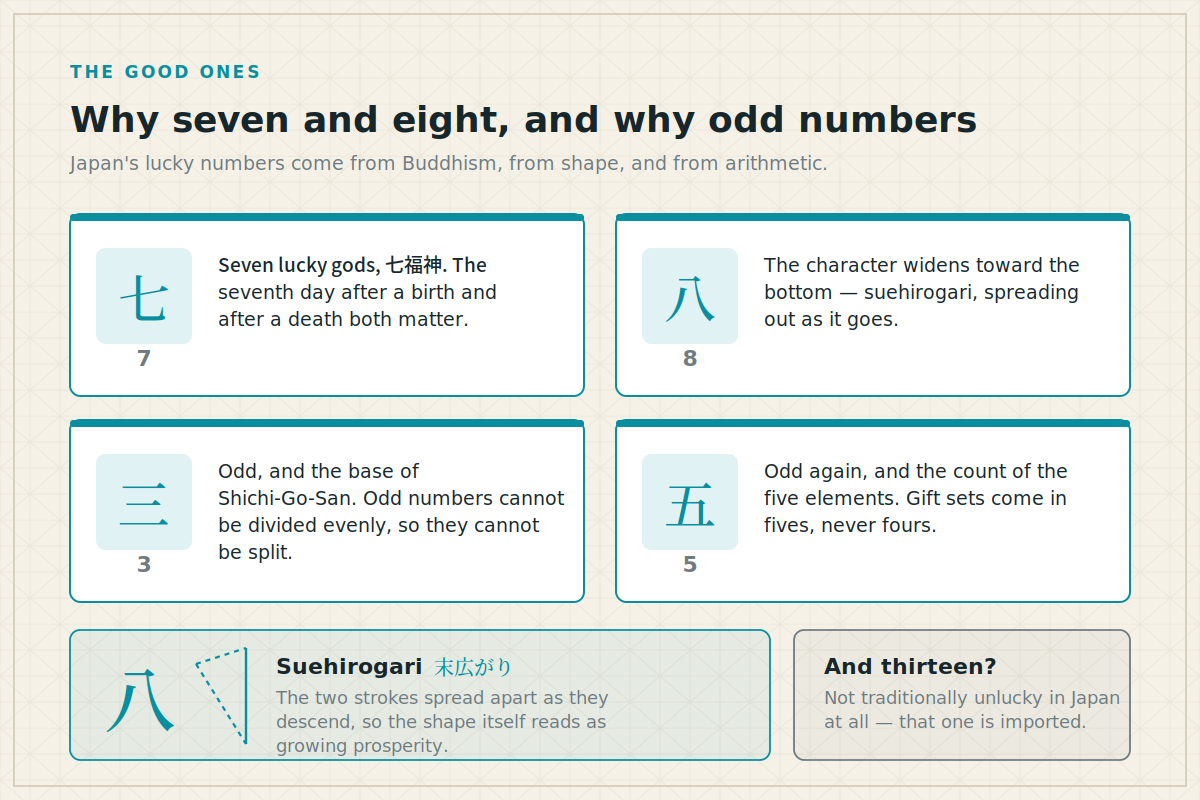
Seven is lucky through Buddhism rather than through sound. The 七福神 — Seven Lucky Gods — are a fixture of New Year imagery. The seventh day after a birth is when a child is traditionally named, and the seventh day after a death is the first memorial service. The Western association with seven arrived later and layered on top of a existing one.
Eight is lucky through its shape, which is a genuinely different kind of reason. The character 八 widens as it descends, and that spreading form is called 末広がり suehirogari — “broadening toward the end.” Growing prosperity, an expanding future. Eight also carries a sense of “many” in older Japanese: 八百万の神, the eight million gods, means an uncountable number rather than a census.
Three and five are lucky by being odd. Odd numbers cannot be divided into two equal parts, which makes them the right choice for anything you do not want split — hence wedding money in odd amounts, and hence Shichi-Go-San, the seven-five-three festival at which children are taken to a shrine.
Four is unlucky because of how it sounds. Eight is lucky because of how it looks. The two superstitions do not even use the same mechanism.Why there is no single rule
Thirteen, and the rule that does not transfer
Thirteen carries no traditional Japanese weight at all. There is no thirteenth-floor problem, no Friday the thirteenth, no cultural memory attached to it.
What has happened is partial import: Western hotels in Japan, and Japanese hotels catering to Western guests, sometimes handle thirteen the way an American hotel would. So you may occasionally encounter it, and it will always be for the benefit of foreign visitors rather than local ones.
This cuts both ways, and it is worth saying plainly. Visitors assume Japanese superstitions are exotic and therefore stronger than their own. They are neither. A great many Japanese people regard the four-and-nine business as mild silliness, and go on avoiding it anyway — much as people who do not believe in bad luck still do not walk under ladders.
Numbers that mean something else entirely
A related habit worth knowing, because it explains phone numbers and shop names that look like nonsense.
Japanese numbers can be read as syllables and used to spell words, a practice called 語呂合わせ goroawase. Because each digit has several possible readings, almost anything can be encoded.
- 4649 reads as yo-ro-shi-ku — “nice to meet you,” “please treat me well.”
- 39 reads as san-kyū — “thank you.”
- 893 reads as ya-ku-za, which is where that word’s association with a losing hand in a card game comes from.
- 11 22 reads as ii fūfu, “a good married couple,” which is why 22 November is unofficially couples’ day.
Companies choose phone numbers this way deliberately, and dates get commemorated on the same principle — there is a food day for almost every number that can be read as a food.
It is the cheerful cousin of the four-and-nine problem. Both come from the same fact: Japanese numbers carry multiple readings, so numbers can always be heard as words.
Age, and the years that are unlucky by count
Separate from the digits themselves, Japan has a set of unlucky ages: 厄年 yakudoshi. For men, 25, 42 and 61. For women, 19, 33 and 37.
The heaviest are 42 for men and 33 for women — 大厄 taiyaku, the great calamity years — and the reasons are the same kind of wordplay. Forty-two reads as shi-ni, “to death,” and thirty-three as san-zan, “disastrous.”
People visit a shrine for a purification rite in these years, and a great many otherwise unsuperstitious people go anyway. One catch: these ages are counted the traditional way, not by birthday, which puts them a year or two off the age you would give in English. That count is explained in our article on kazoedoshi.
What to actually do about any of this
As a visitor, three things:
- Say yon, nana and kyū. This is the one with daily practical value — it is how numbers are read aloud, and using shi for four will make you slightly harder to understand.
- Do not give sets of four. Buy three, five or a full set.
- If you are giving cash, avoid four and nine in the amount entirely.
And do not overcorrect. Nobody is offended by the number four appearing in ordinary life, room 4 exists in most buildings, and mentioning it is not a taboo. The superstition operates at the level of deliberate choices — what you name a room, what you put in a gift set, what you write on an envelope — not at the level of arithmetic.
The wider question of which Japanese customs carry real weight and which are decorative is the subject of our etiquette guide, and the numbers themselves — both counting systems, and the counter words that go with them — are in Japanese numbers and counters.