Are Japanese people religious? Usually not in the American sense of declaring one faith, joining one congregation, and treating that identity as exclusive. Religion in Japan explained properly begins with a distinction: many people report no personal faith while continuing to visit shrines, maintain family graves, attend Buddhist funerals, and mark the New Year with a religious rite.
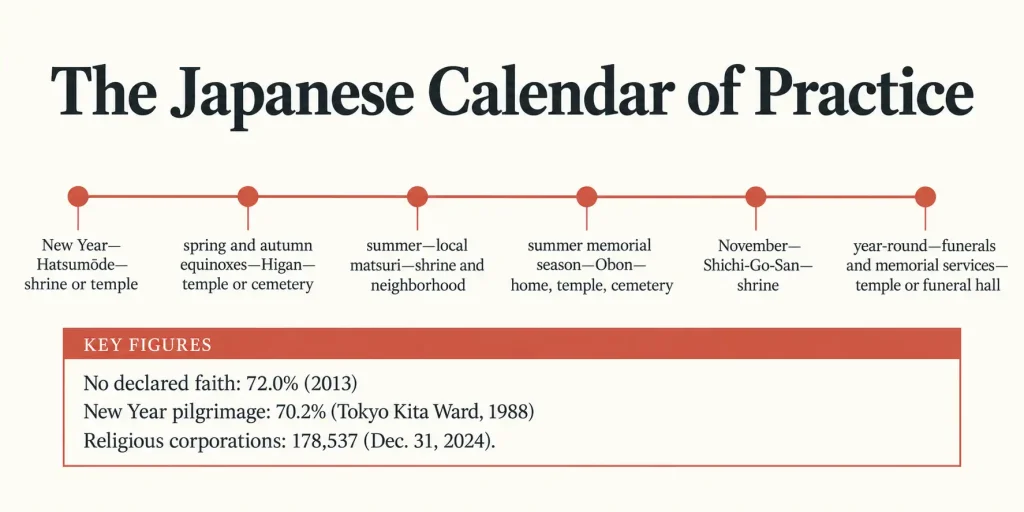
The best-known figure needs a warning label. A national survey conducted in 2013 found that 72.0 percent of respondents said they had no faith, did not believe, or were not interested. The often-repeated claim that about 70 percent of Japanese people make a New Year visit comes from older or narrower surveys, including a 1988 Tokyo ward survey in which 70.2 percent reported New Year pilgrimages and a 2015 survey in which more than 70 percent of shrine and temple users named New Year as a reason for visiting.
The apparent contradiction disappears once you stop treating ritual as a membership card.
Is Japan a Shinto country or a Buddhist country?
It is both, but that answer does not mean everyone consciously combines two theological systems. Shinto and Buddhism occupy overlapping parts of Japanese life, and many families use institutions belonging to each without feeling that they have changed religions.
神道, Shintō, literally “the way of the kami,” centers on 神, kami: presences or powers associated with places, communities, natural features, ancestors, and historical figures. Buddhism arrived from the Asian continent and developed into numerous Japanese schools with different teachings and practices.
For a quick practical distinction, think of Shinto as especially visible around purification, local protection, beginnings, and seasonal rites. Buddhism is more visible around memorial services, graves, funerals, and teachings about death. This is a pattern, not a rule that works in every family.
Japan’s official statistics underline how thoroughly both traditions remain institutionalized. As of the end of 2024, the Agency for Cultural Affairs counted 83,928 Shinto religious corporations and 76,172 Buddhist ones among 178,537 religious corporations in total.
Religion in Japan explained: How can someone follow both?
The question assumes that religious affiliation must be exclusive. That assumption makes sense in parts of the United States, where a person may be asked to identify as Catholic, Protestant, Jewish, Muslim, Buddhist, atheist, or another single category. It is less useful for reading everyday Japanese behavior.
A family may take a baby to a shrine, hold a Christian-style wedding because the ceremony appeals to them, and arrange a Buddhist funeral. None of those decisions necessarily predicts what family members believe about deities, salvation, or life after death.
This produces a form of Japanese religious practice that is situational. The institution selected depends on the occasion, the family’s history, the local community, and sometimes simple convenience.
The boundary is therefore not always “Which religion are you?” More useful questions are:
- What occasion is being marked?
- Which institution traditionally handles it?
- Does the family have an existing relationship with a temple or shrine?
- Is the event devotional, social, memorial, or seasonal?
- Is the participant expressing belief or simply performing a familiar rite?
This is why adding Shinto and Buddhist adherent counts can produce totals larger than Japan’s population. Religious organizations count relationships according to their own methods, while surveys asking about personal belief measure something different.
Why do people say they have no religion?
The Japanese expression 無宗教, mushūkyō, literally “no religion,” often means that a person does not belong to a religious organization or hold a defined personal creed. It does not automatically mean rejection of every ritual, sacred place, prayer, memorial, or idea of spiritual significance.
The wording of the survey question matters. The 2013 Japanese National Character Survey asked whether respondents had any faith or religious belief. Its negative response combined people who did not have faith, did not believe, or were not interested, so the 72.0 percent result should not be translated into “72 percent are atheists.”
“Do you have any religious faith or belief?”
That question measures declared conviction. It does not ask whether you visit a family grave, buy a traffic-safety charm, attend a neighborhood festival, or make a first shrine visit in January.
In Japan, “I have no religion” and “I went to a shrine this morning” can be two accurate statements from the same person.
For the visitor, this distinction matters more than labels. Do not challenge someone who says they are non-religious by listing the rites they perform. They are describing identity; you are observing practice.
What is hatsumode, and why is it so common?
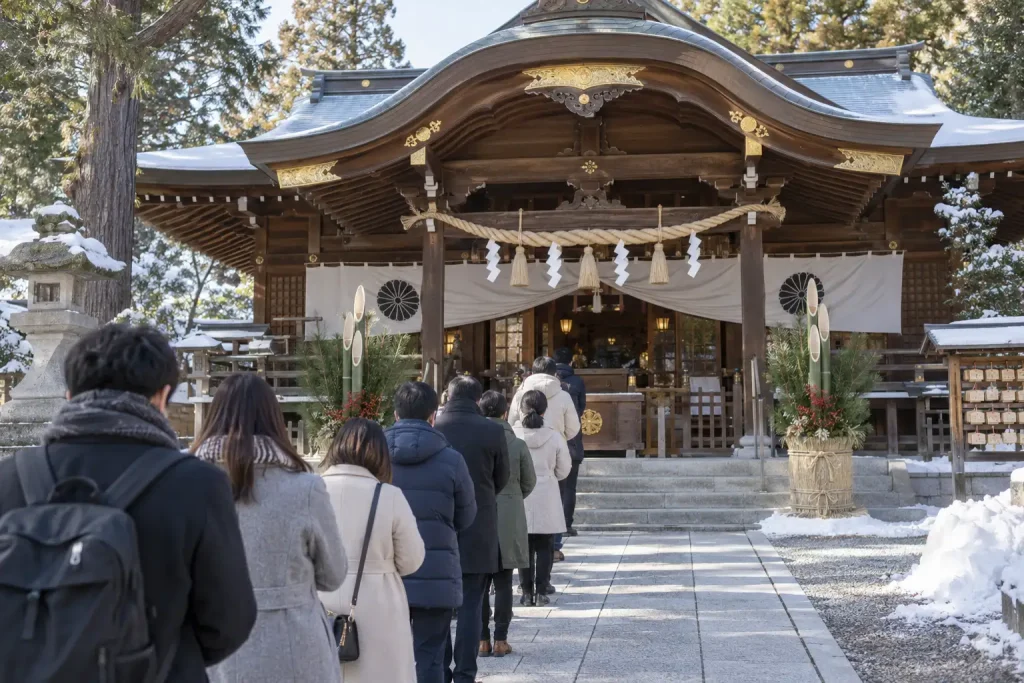
初詣, hatsumōde, literally “first visit,” is the first shrine or temple visit of the year. People go to express thanks, make wishes, return old charms, obtain new ones, or simply begin January in the expected way.
The key word is first, not “conversion.” Hatsumode in Japan belongs to the turning of the calendar, much as exchanging New Year greetings does. The rite is religious in setting and form, but participation does not necessarily announce a settled belief.
This also explains why a person may choose either a shrine or a Buddhist temple. Famous sites attract heavy crowds, while many people walk to a neighborhood institution connected to their family or area.
A typical visit may include:
- Entering the grounds without blocking the gate or approach.
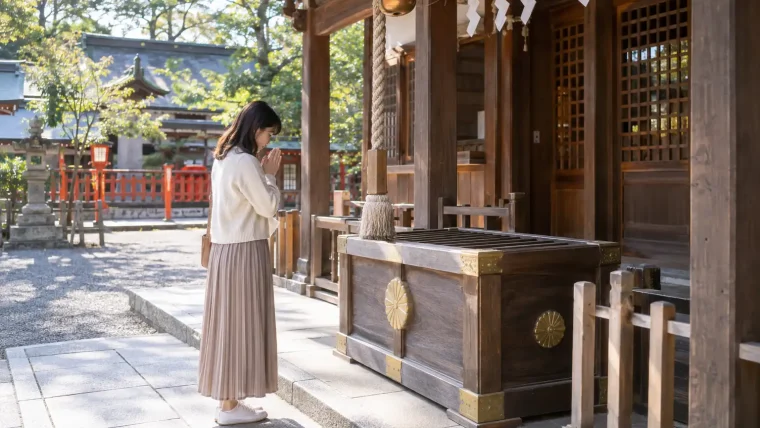
- Purifying the hands at a 手水舎, temizuya, literally “hand-water pavilion,” when it is open.
- Making a small offering.
- Praying according to the practice of that site.
- Returning an old charm and obtaining another if desired.
- Drawing an おみくじ, omikuji, literally a “sacred lot,” to receive a written fortune for the year.
The site’s broader Japanese festivals by season guide covers the annual calendar, from New Year through summer festivals and autumn observances, rather than repeating that calendar here.
How can I tell a shrine from a temple?
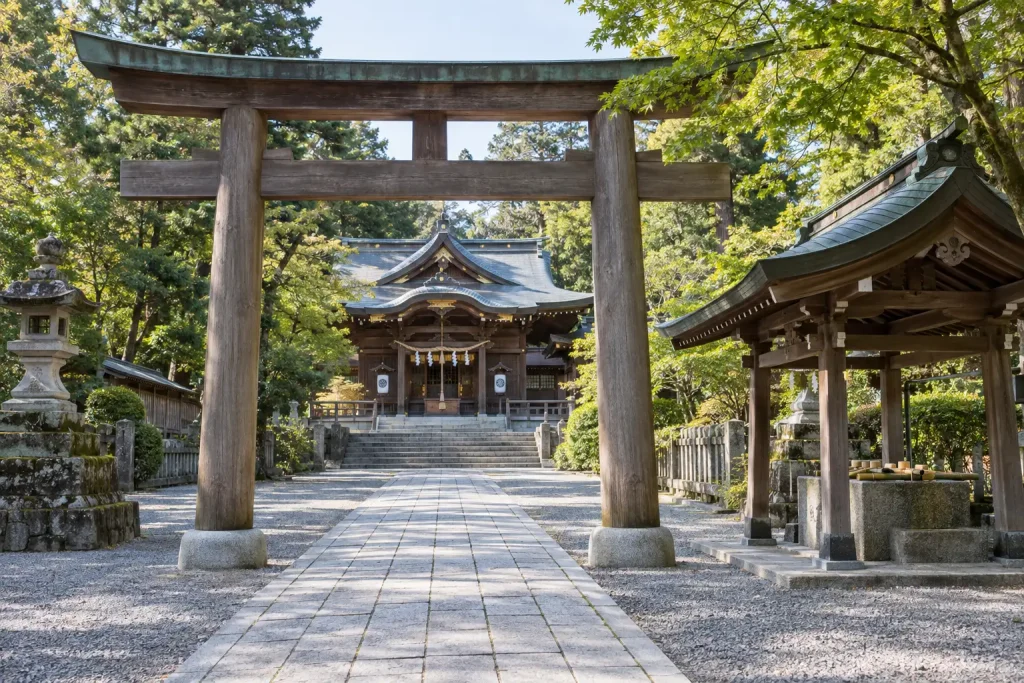
A shrine is a Shinto institution; a temple is Buddhist. In Japanese, shrine names often contain 神社, jinja, literally “kami place,” or 神宮, jingū, an imperial shrine designation. Buddhist temples commonly use 寺, tera or ji, meaning “temple,” in their names.
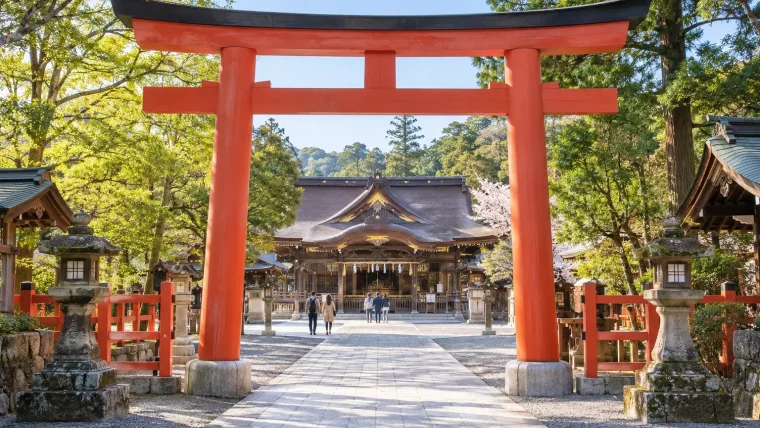
The entrance usually gives you the quickest clue. A Shinto shrine commonly has a 鳥居, torii, a gateway marking entry into sacred space. A Buddhist temple may have a substantial roofed gate, statues, incense, a pagoda, or a bell.
| What you notice | Shinto shrine | Buddhist temple |
|---|---|---|
| Common Japanese name | 神社, jinja; 神宮, jingū | 寺, tera or ji; 院, in |
| Typical entrance | Torii gate | Roofed temple gate |
| Main sacred focus | Kami | Buddhas and bodhisattvas |
| Common ritual feature | Purification water | Incense burner |
| Often associated with | Protection, beginnings, local festivals | Funerals, memorials, graves |
| Prayer gesture | Commonly bows and claps | Commonly quiet prayer without clapping |
Architecture alone is not infallible. Centuries of interaction between Shinto and Buddhism left mixed layouts, shared symbols, and sites that changed institutional identity over time. Read the name on the sign when the building does not give you a clear answer.
What should I do when I visit a shrine?
You do not need to pretend to believe anything. Behave as you would in an active church: enter respectfully, lower your voice, do not obstruct worshippers, and follow posted instructions.
At many shrines, the familiar prayer sequence is two bows, two claps, a silent prayer, and one final bow. However, local practices can differ, so instructions displayed by the shrine take priority over a universal travel-guide formula.
| Stage | What you do | What it communicates |
|---|---|---|
| Approach | Keep to the side when space allows | Leaves the central route unobstructed |
| Purification | Rinse your hands if the basin is operating | Physical and ritual preparation |
| Offering | Place money in the offering box | Voluntary offering, not an admission fee |
| Greeting | Follow the shrine’s posted sequence | Respect for local practice |
| Exit | Step away before checking your phone or purchases | Keeps the worship area clear |
There is no nationally required offering amount. Shrine worship itself generally does not become “more effective” because you insert a larger coin, and you should be skeptical of travel advice that assigns guaranteed meanings to particular denominations.
The wider question of what visitors genuinely need to get right is covered in Japanese etiquette for visitors. That guide separates rules protecting real boundaries from harmless errors of form.
What should I do differently at a Buddhist temple?
Do not clap unless the temple explicitly instructs you to do so. At the main hall, an offering may be followed by quiet prayer with your hands together.
Some temples have incense burners. If incense is available for visitors, buy or receive it in the manner indicated, place it where directed, and avoid lighting a bundle simply because other people are doing so. At crowded or historically sensitive sites, access and procedures may be restricted.
Admission and worship are separate issues. Many neighborhood temples can be entered without a sightseeing ticket, while famous temples, gardens, treasure halls, and museums may charge admission. There is no national temple price, so check the official page of the specific site before traveling.
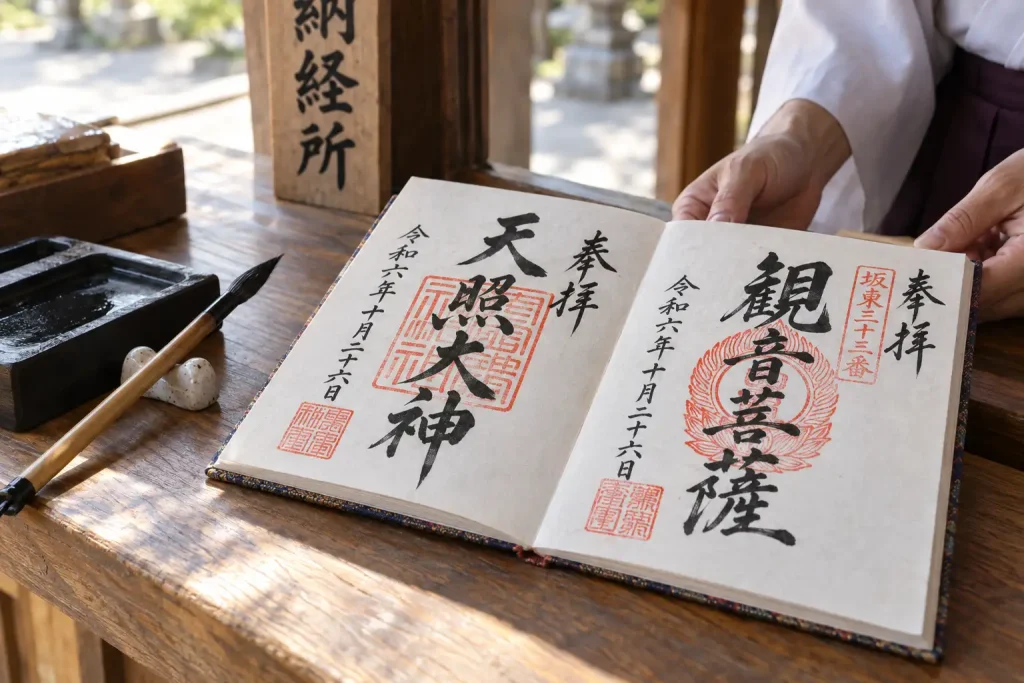
御朱印, goshuin, literally a “vermilion seal,” is a calligraphed record issued by participating shrines and temples. It is not merely a collectible stamp: present a dedicated 御朱印帳, goshuinchō, or seal book, pay the amount posted by the institution, and receive it respectfully.
Is a Japanese festival a religious event or a street party?
Often it is both. A 祭り, matsuri, or festival, may include a rite for the local kami, a portable shrine, neighborhood organizations, food stalls, music, and an evening crowd that has come mainly to socialize.
The religious center can be easy to miss because the public celebration is louder. A 神輿, mikoshi, literally a “divine palanquin,” carries the kami through the community. The stalls, performances, and traffic controls are built around that movement.
You do not need to take part in worship to attend. You do need to remember that the grounds remain an active religious space even when they resemble a fairground. Follow barriers, do not touch ritual objects, and ask before photographing a ceremony at close range.
For itinerary planning rather than religious interpretation, Where the Leaves Turn, and Exactly When explains autumn viewing periods and regional movement. Seasonal scenery frequently overlaps with temple and shrine visits, but the foliage itself is not evidence of religious participation.
Why are Shinto rites common at beginnings and Buddhist rites at death?
This is the question beginners usually do not know to ask.
Shinto places strong emphasis on purification and has traditionally treated death as a source of ritual pollution. Japanese Buddhist institutions, meanwhile, developed extensive systems for funerals, posthumous names, memorial services, household altars, and grave care.
That division helps explain the familiar life-cycle pattern:
- A newborn may be taken to a shrine.
- Children may visit a shrine for 七五三, Shichi-Go-San, literally “seven-five-three.”
- Adults may attend a civil, Shinto, Christian-style, or secular wedding.
- A funeral and later memorial services are often Buddhist.
- Family members may visit graves during Buddhist seasonal observances.
This pattern is widespread but not compulsory. Christians, members of new religious movements, secular families, and people with mixed backgrounds make different choices. Even within Buddhist funerals, practice varies by school, region, temple, and family relationship.
Coming-of-age practices have their own civic and ceremonial logic. The Ages Japan Marks With a Ceremony explains those milestones without treating every formal event as a religious service.
Do charms, fortunes, and prayers show what someone believes?
Not reliably. An お守り, omamori, literally “protection,” may be obtained for safe travel, examinations, health, childbirth, relationships, or traffic safety. A person can carry one because a parent gave it to them, because the custom feels reassuring, or because they hold a specific belief in its protection.
The same applies to omikuji. Drawing a paper fortune can be serious, playful, or somewhere between the two. If the result is unfavorable, many sites provide a place to tie the paper, but local directions should decide what you do.
Shinto and Buddhism in Japan are easier to understand when you allow a ritual to have several meanings at once. It can be family continuity, seasonal routine, personal hope, local identity, and religious practice without each participant ranking those meanings in the same order.
Formal services are different from casual worship. Shrines and temples may publish set fees for blessings, memorials, charms, seal books, or special access, but the amount and service vary by institution. Always use the official website or an on-site board; there is no honest nationwide price table.
Does Japan’s religious calendar affect an ordinary trip?
Yes, even when you never enter a place of worship. New Year can change opening hours, transportation demand, and access around major sites. Summer festivals can reroute streets, and Buddhist memorial periods can increase domestic travel.
Dates printed in Japanese era notation may also appear on notices, commemorative boards, and institutional documents. Instead of memorizing parallel tables, use the Japanese era converter, which covers every year from 1868 through 2050 across the site’s five-era range.
The practical rule is simple: check the official page of the specific shrine, temple, or event shortly before visiting. Religious institutions are not standardized attractions, and worship schedules take priority over your sightseeing plan.
The Japanese Calendar of Practice
Frequently asked questions
Can foreigners pray at Japanese shrines and temples?
Yes. You do not need to be Japanese or formally affiliated with a religion, but you should follow the institution’s instructions and avoid treating worship as a performance for photographs.
Should I clap at a Buddhist temple?
Normally, no. Clapping is associated with common Shinto shrine practice, while Buddhist prayer is generally quiet with the hands together. Follow posted guidance if a particular institution uses a different procedure.
Must I bow at every torii gate?
A brief bow is respectful, but visitors are not expected to perform every detail perfectly. Avoid blocking the entrance and remember that the central approach may be treated as a route for the kami.
Are shrines and temples free?
Ordinary worship often has no admission charge, and offerings are voluntary. Major temples, gardens, museums, and special precincts may charge, while charms, goshuin, blessings, and formal services have separately posted amounts.
Can I photograph a prayer or ceremony?
Do not assume that you can. General exterior photography may be allowed while main halls, sacred objects, weddings, prayers, and formal rituals are restricted. Look for signs and ask staff when the situation is unclear.
Is Shinto the same everywhere?
No. Widely recognized patterns exist, but individual shrines preserve local rites and procedures. Site-specific instructions beat any general checklist.
What should I learn next?
Start with Japanese Festivals by Season: A Year-Round Guide to see how religious institutions fit into the calendar. Then read Japanese Etiquette for Visitors: What Actually Matters before entering an active shrine, temple, home, bath, or ceremonial space.