Refusing to let the hotel copy your passport is the mistake most likely to stop check-in completely. A Japanese hotel check in form is not merely a customer survey: it feeds the hotel’s legally required guest register, while current national guidance tells operators to obtain and retain a passport copy from foreign guests who do not have an address in Japan. If you are visiting from the United States and enter your Tokyo hotel as your “address,” you also create an inaccurate record because the field is asking where you live, not where you are sleeping that night. The correct entry is normally your full overseas home address. Residents of Japan fall into a different category, so foreign appearance or citizenship alone does not trigger the non-resident passport rule.
Refusing the passport copy at reception
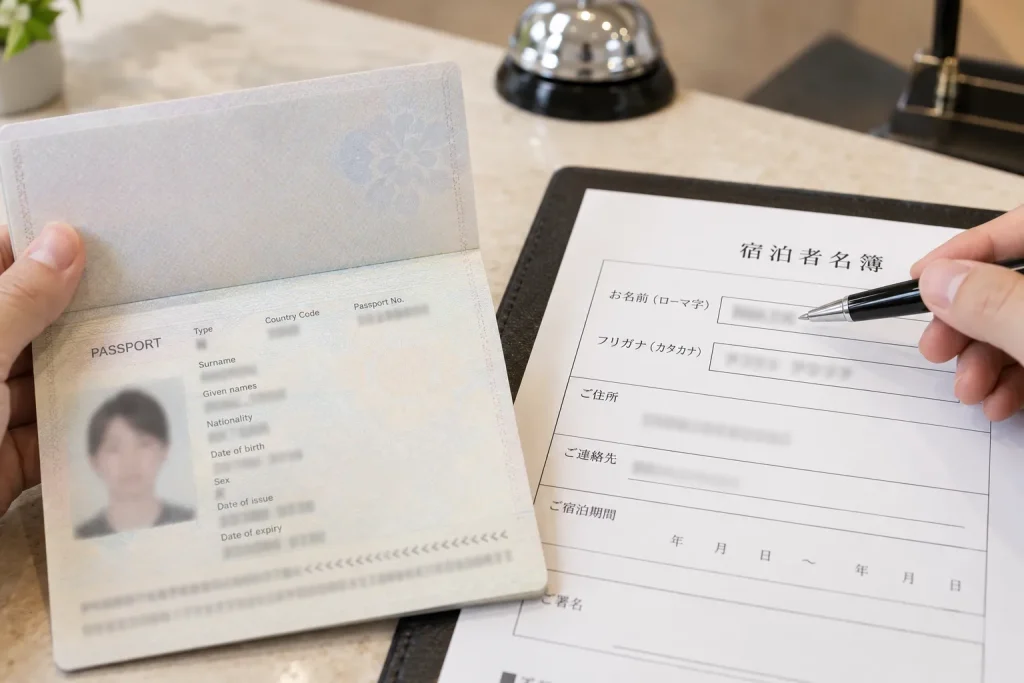
Travelers sometimes refuse the copy because they have read that Japanese law does not require domestic guests to surrender identification at every hotel. That research is partly correct but applied to the wrong category. The Hotel Business Act requires lodging operators to maintain a 宿泊者名簿, shukuhakusha meibo, literally “lodger register,” and the enforcement rules add nationality and passport number for foreign nationals without a Japanese address. Ministry of Health, Labour and Welfare guidance also directs operators to request the passport and retain a copy with the register. If an eligible guest continues to refuse after the hotel explains the government instruction, national operational guidance tells the hotel to take an appropriate response, which may include contacting the nearest police station.
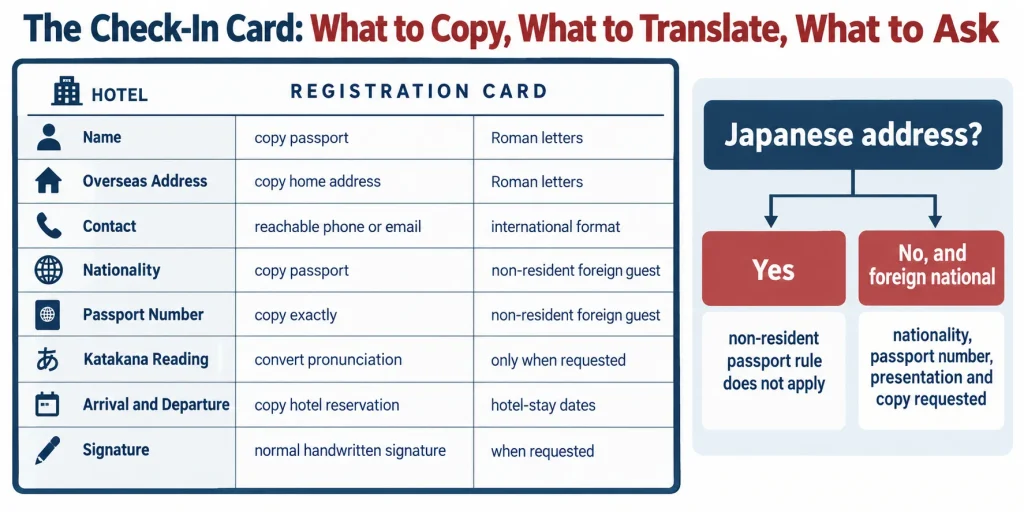
The important distinction is not “Japanese guest versus foreign guest.” It is whether a foreign guest possesses an address in Japan. A foreign resident who can provide a Japanese address does not belong to the specific non-resident category merely because the passport shows foreign nationality. A short-term visitor using a US home address generally does.
The passport-copy protocol follows your residence status for the stay, not how foreign you look or sound.
What to do instead: If you do not have an address in Japan, present the passport used for your trip and allow the hotel to copy its identity page.
Writing the hotel’s address as your own
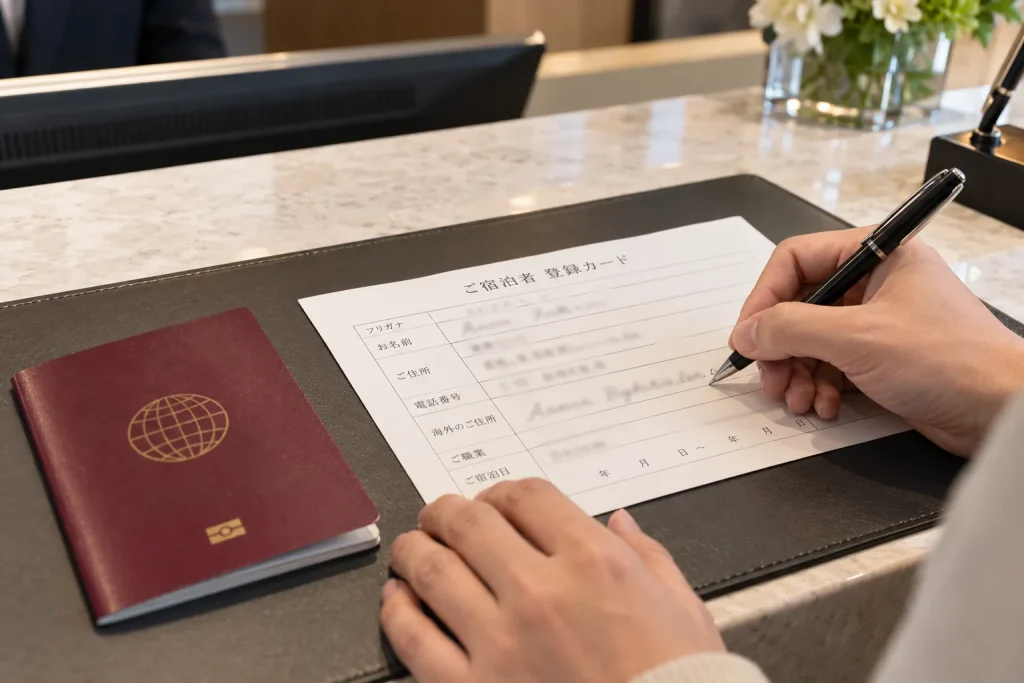
The overseas address on a Japanese hotel form causes more errors than the Japanese-language fields. A traveler sees 住所, jūsho, literally “address,” and writes the hotel’s street address because that is their current location in Japan. It feels logical, especially after immigration and transportation forms have asked where the traveler will stay. On the hotel register, however, the field identifies the guest’s residence. Repeating the hotel’s address defeats that purpose and may prompt the front desk to ask you to complete the card again.
Write your ordinary residential address abroad, including the street, city, state or province, postal code, and country. An American entry can remain in Roman letters. There is no need to convert “United States” into Japanese or force a US address into Japanese prefecture and municipality boxes unless the particular digital form requires a country selection first.
For example, Megan Elizabeth Carter, who lives in Seattle and is visiting Kyoto, would enter:
| Form field | Worked entry |
|---|---|
| 氏名 — Name | MEGAN ELIZABETH CARTER |
| 住所 — Address | 1840 EXAMPLE AVE, SEATTLE, WA 98101, USA |
| 連絡先 — Contact | Her reachable email address or mobile number |
| 国籍 — Nationality | USA or UNITED STATES |
| 旅券番号 — Passport number | Exactly as printed in the passport |
| 到着日 — Arrival date | The date she checks into this hotel |
| 出発日 — Departure date | The date she checks out of this hotel |
The street number above is a fictional formatting example, not a real person’s address. Its purpose is to show the order of the components. Your actual entry must match where you genuinely live.
For a broader guide to names, addresses, phonetic boxes, dates, and seals, Every Japanese Form That Asks for Your Name explains the recurring paperwork system rather than this hotel-specific protocol.
What to do instead: Put your full overseas residential address in the address field, not the address of the hotel you are checking into.
Shortening your name to the version used socially
A guest named Elizabeth may write “Liz,” while someone with two surnames may omit one to save space. That seems harmless because the reservation may already use the shorter name. It can cause a mismatch among the booking, passport, payment card, and legally maintained guest record. The safest version for an overseas visitor is the full name shown on the passport identity page. Preserve every middle name and surname that appears there unless hotel staff explicitly instruct you otherwise.
Name order is another source of avoidable corrections. Japanese forms often separate 姓, sei, literally “family name,” and 名, mei, literally “given name.” Other cards provide one undivided 氏名 field. When labels are unclear, Surname First or Last: What to Write Where covers the layouts rather than relying on visual position alone.
Use this quick reading guide:
- 姓, sei: family name or surname.
- 名, mei: given name.
- 氏名, shimei: full name.
- フリガナ, furigana: phonetic reading requested in the indicated script.
- 署名, shomei: signature.
What to do instead: Copy the passport name in full and place each component according to the printed field label.
Converting the legal name into katakana everywhere
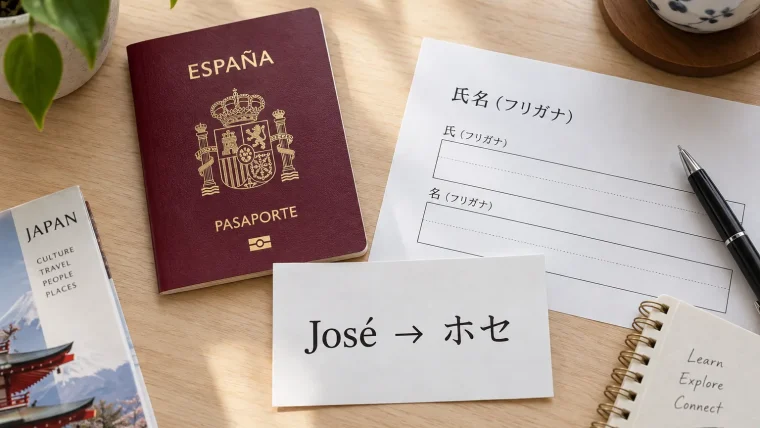
Travelers who have studied Japanese sometimes believe that every Japanese form requires a foreign name in katakana. This is a half-informed mistake. A box marked 氏名 asks for the name, but a separate フリガナ or カタカナ box asks for its phonetic rendering. Replacing the passport spelling with katakana in the main identity field can make comparison slower rather than more Japanese. Your Roman-letter passport spelling remains the authoritative reference for a non-resident guest.
If the form genuinely asks for katakana, use the pronunciation of the name rather than converting letters mechanically. Katakana Name Rules, and the Names That Break Them explains why familiar spellings do not always follow a simple transliteration formula. The site’s name converter with 898 checked names is useful when your name is included, but it should not replace the Roman-letter entry where the hotel wants the passport name.
| Label on the card | Script to use | Example for Megan |
|---|---|---|
| 氏名 or Name | Roman letters matching passport | MEGAN ROTHWELL |
| 姓 | Passport surname | ROTHWELL |
| 名 | Passport given name | MEGAN |
| フリガナ | Follow the hotel’s script instruction | メーガン・ロスウェル |
| カタカナ | Katakana | メーガン・ロスウェル |
| Signature | Your normal signature | Usual handwritten signature |
What to do instead: Use Roman letters for the passport-name field and katakana only when the form separately requests a phonetic reading.
Guessing what “contact” means
The law now identifies contact information as a core guest-register item, but individual hotels design the visible field differently. A card may show 連絡先, renrakusaki, literally “contact destination,” without specifying phone or email. Some travelers repeat their home address, while others enter a US phone number that will not work during the trip. The hotel needs a practical way to reach you if there is a question about the stay, an emergency, or property left behind.
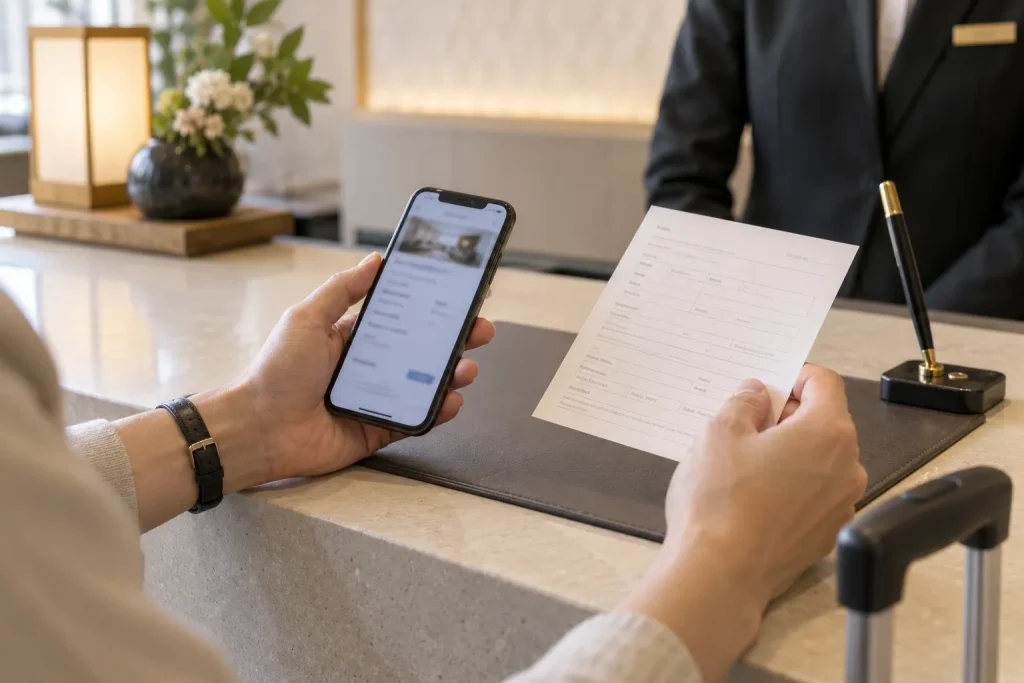
Use a mobile number that remains active in Japan, including the international country code when appropriate. If the form accepts email, provide an address you actually monitor. Do not invent a Japanese phone number simply because the box format looks domestic. Ask the front desk how to enter an international number if the digital form rejects the plus sign or contains too few spaces.
The correct contact detail is the one through which the hotel can reach you during or shortly after the stay.
What to do instead: Enter a reachable mobile number or email and ask staff how to handle a form that accepts only Japanese-format numbers.
Copying the booking dates without checking the card labels
A traveler may paste the entire trip range into the hotel card even when the stay at that property covers only part of the journey. Another common error is treating “departure” as the flight home rather than departure from the hotel. Both choices seem reasonable because travel forms use similar language for different reference points. The lodging register, however, concerns this accommodation. Arrival and departure therefore refer to your check-in and check-out at this property.
Japanese cards may use 到着日, tōchakubi, literally “arrival day,” and 出発日, shuppatsubi, literally “departure day.” Some hotels also request the previous place of stay or next destination under local rules or their own operational procedures. Those fields do not necessarily ask for a complete itinerary. If the card asks for 前泊地, zenpakuchi, literally “previous lodging place,” enter the city or accommodation immediately before this hotel; if it asks for 行先, ikisaki, literally “destination,” give the next relevant destination.
What to do instead: Enter the dates and travel points connected to this hotel stay, not the dates of your entire Japan trip.
Assuming the passport copy replaces the entire card
A well-prepared traveler may know that official guidance allows a passport copy to substitute for certain identity entries. The mistake is assuming that the scan supplies every item the guest register needs. A passport shows your legal name, nationality, passport number, and identity photograph, but it does not establish your current overseas residential address or the best contact method for this trip. It also does not automatically provide hotel-specific arrival and departure information. The front desk may therefore require both the copy and several completed fields.
Current MHLW operational guidance says that retaining the passport copy may substitute for entering the non-resident guest’s name, nationality, and passport number in the corresponding register fields. That is narrower than “the passport replaces the form.” Local ordinances and the hotel’s lawful operational needs may add fields beyond the national minimum. This is why registration cards differ among Tokyo business hotels, Kyoto ryokan, airport properties, and licensed vacation rentals.
What to do instead: Treat the passport copy as identity documentation and complete every remaining field the hotel marks as required.
Reaching for a residence card when the passport rule does not fit
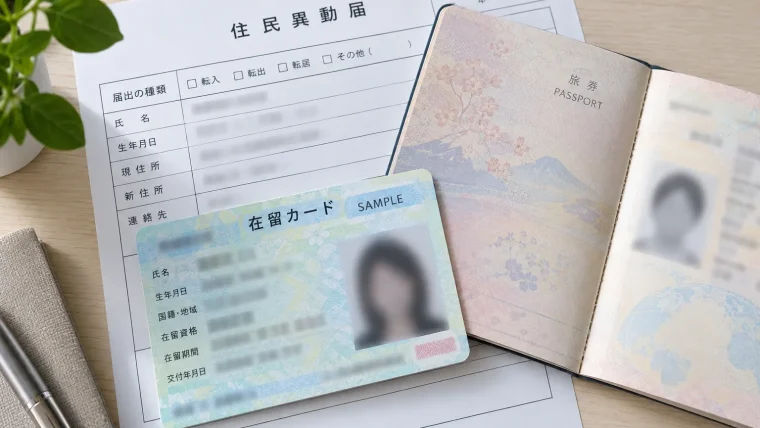
Some foreign residents of Japan have researched the non-resident exception and carry a residence card showing a domestic address. Problems begin when either the guest or the hotel treats nationality alone as the trigger. The MHLW wording applies specifically to foreign nationals who do not possess an address in Japan. A foreign resident with a Japanese address is therefore not in the same category as a tourist using an overseas address.
A hotel may still need to verify the accuracy of its guest register, but that does not convert the non-resident passport-copy protocol into a blanket rule for every non-Japanese guest. If staff request a passport despite your Japanese residence, calmly explain that you have an address in Japan and show appropriate evidence if you choose to cooperate. Do not turn the lobby into an improvised legal argument when a manager can clarify the hotel’s procedure.
The distinction can be summarized as follows:
- A visitor without a Japanese address supplies the ordinary register details plus nationality and passport number.
- Government guidance directs the operator to view and retain a copy of that visitor’s passport.
- A foreign resident supplies their Japanese residential address and does not automatically fall under the non-resident passport rule.
- The hotel may request additional information permitted by applicable local rules or reasonably needed for the stay.
This sequence reflects the national statute, enforcement rules, and MHLW management guidance checked on September 11, 2026.
What to do instead: Answer the threshold question first—do you have an address in Japan?—before deciding which identification protocol applies.
Signing, stamping, or correcting the wrong way
Travelers sometimes hunt for a seal box because they have heard that Japanese paperwork requires a 判子, hanko, literally “seal.” Ordinary foreign guests do not need to manufacture a personal seal merely to complete a standard hotel registration card. If the card asks for a signature, use your normal handwritten signature. If it specifically displays 印, in, literally “seal mark,” ask the front desk whether a signature is acceptable rather than stamping an improvised symbol. How a Foreign Name Becomes a Carved Seal explains the separate subject of foreign-name seals without suggesting that every visitor needs one.
Corrections should also be visible and honest. Do not erase a passport number until the paper thins or overwrite a digit until it becomes unreadable. Ask for a fresh card or follow the staff member’s correction method. On a tablet or kiosk, return to the relevant field before submitting instead of assuming reception can silently repair the record later.
The habit that prevents nearly every error is simple: keep your passport and overseas home address in front of you and copy rather than translate. Complete the Roman-letter identity fields first, add katakana only where requested, and ask about any label that remains unclear. Precision is faster than trying to make your information look more Japanese.
What to do instead: Sign normally, ask before using a seal, and correct uncertain entries with hotel staff rather than guessing.
FAQ about Japanese hotel registration cards
Does every foreign tourist have to provide a passport copy?
MHLW instructions cover foreign guests who do not have an address in Japan. The hotel records nationality and passport number for this group and is directed to request and retain a passport copy. A foreign resident with a Japanese address does not fall into the rule solely because of nationality. A hotel may ask questions to establish which category applies.
Which address should an American tourist enter?
Enter your residential address in the United States. Include the street address, city, state, ZIP code, and country in Roman letters. Do not write the Japanese hotel’s address unless a differently labeled field specifically asks for your accommodation address. The form is recording who you are and where you reside.
Must my name be written in Japanese?
Usually, the main name field should match your passport in Roman letters. Add katakana only when the card provides a separate phonetic field or staff request it. How to Write Your Name in Japanese: The Complete Guide covers the writing system in detail, so there is no need to reproduce those conversion rules on the hotel card. Your passport spelling remains the safer identity reference.
Can a hotel keep my passport overnight?
The government protocol calls for presentation and copying, not routine surrender of the original for the entire stay. A front desk may briefly handle the passport to scan or photocopy the identity page. Ask when it will be returned if staff do not give it back immediately. Keep possession of the original after the copying process is complete.
Why does one hotel ask for more information than another?
The national rules establish core register information, while enforcement provisions and local requirements can add to the form. Hotels also use different registration systems and may request operational details relevant to the stay. That is why one card may ask only for basic contact information while another includes a previous location or next destination. An unfamiliar field should be clarified rather than filled with invented information.